Malaysia Passwordless Authentication Market Size & Growth Rate (2026-2032)
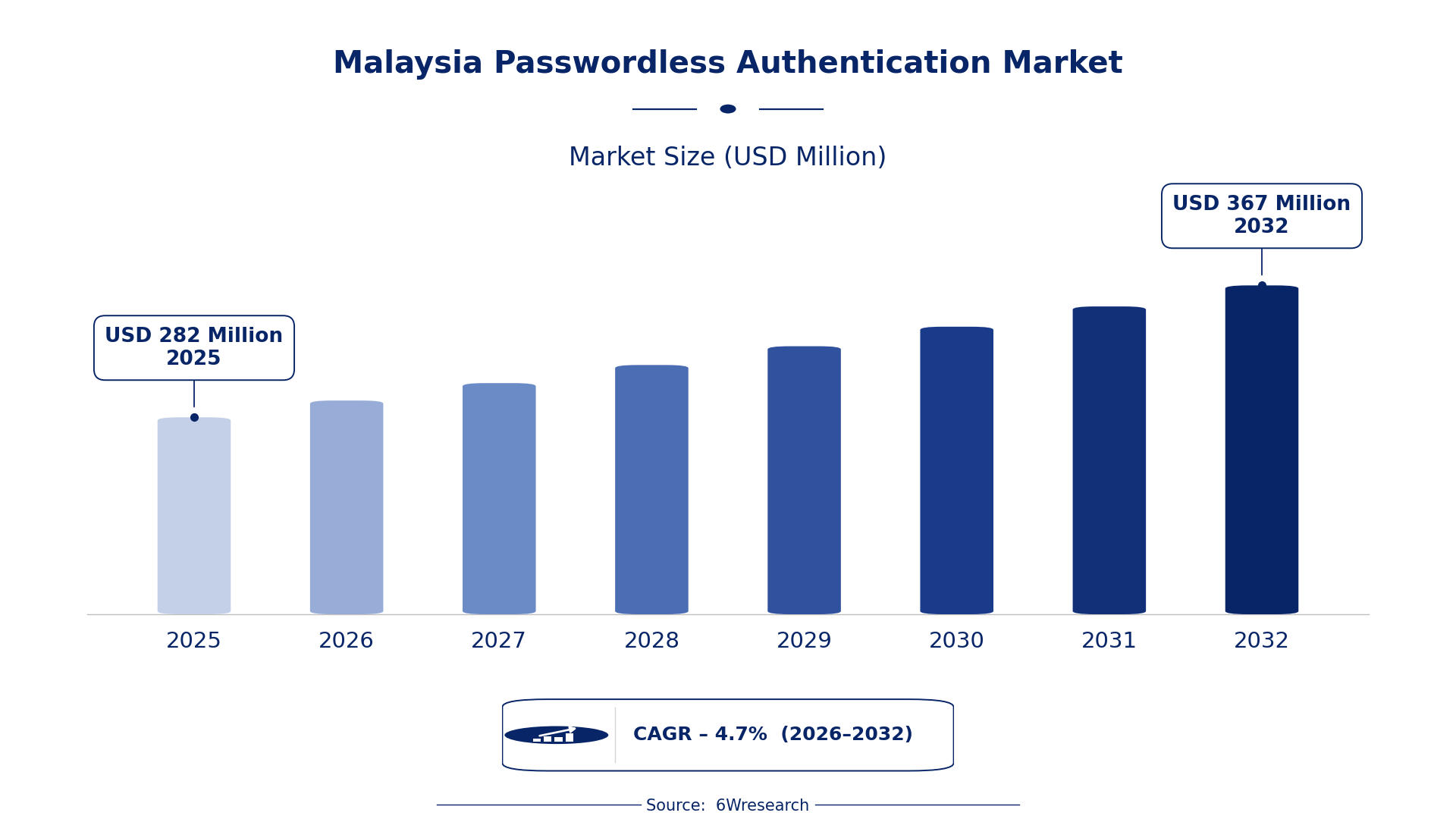
The Malaysia Passwordless Authentication Market was estimated at USD 282 Million in 2025 and is projected to reach USD 367 Million by 2032, growing at a CAGR of 4.7% from 2026 to 2032.
Malaysia Passwordless Authentication Market Synopsis
The Malaysian market for passwordless authentication is increasingly becoming a focal point for businesses seeking enhanced security without sacrificing user experience. The shift towards passwordless solutions, including biometrics and smart cards, reflects a growing awareness of the vulnerabilities associated with traditional password systems.
As cyber threats become more sophisticated, organizations in Malaysia are prioritizing security protocols that protect sensitive information. This demand drives innovation and investment in passwordless technologies, making them a vital component of future cybersecurity strategies.
Malaysia Passwordless Authentication Market Year-wise Growth Rate and Key Drivers
This graph illustrates the annual growth rates of the Malaysia Passwordless Authentication Market from 2021 to 2032, highlighting a steady upward trajectory and projected expansion over the forecast period.
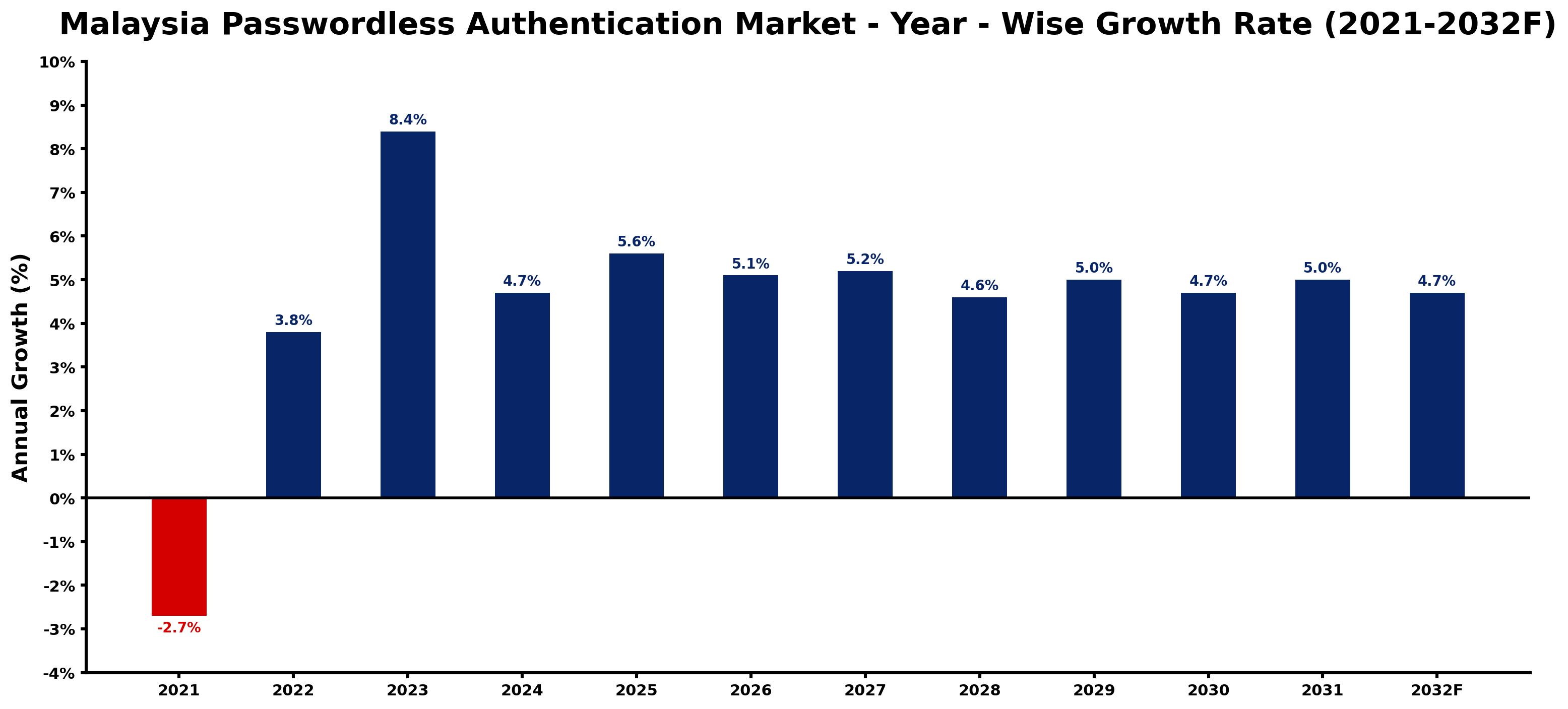
The table below presents the year‑wise growth rates along with the key drivers influencing the market
| Year | Growth Rate | Major Drivers |
| 2021 | -2.7% | Government data privacy regulations hinder technology implementation. |
| 2022 | 3.8% | Cybersecurity Policy 2021 boosts passwordless tech adoption. |
| 2023 | 8.4% | Increased mobile payments drive demand for secure access. |
| 2024 | 4.7% | Government's focus on digital identity enhances user trust. |
| 2025 | 5.6% | Rise in biometric solutions aligns with local security needs. |
| 2026 | 5.1% | Regulatory initiatives push for enhanced fraud prevention methods. |
| 2027 | 5.2% | Growing awareness of data privacy bolsters passwordless solutions. |
| 2028 | 4.6% | Adoption of smart devices increases demand for seamless access. |
| 2029 | 5.0% | Local enterprises prioritize security in digital transformation plans. |
| 2030 | 4.7% | Youth demographic favors user-friendly authentication methods. |
| 2031 | 5.0% | Increased remote work fuels demand for secure authentication. |
| 2032 | 4.7% | Partnerships with fintech firms drive passwordless innovation. |
Note: Market size estimations and growth projections presented in this report are based on 6Wresearch's proprietary forecasting methodology, utilizing the latest available industry data, government publications, and primary research inputs.
Malaysia Passwordless Authentication Market Key Takeaways
Below are some of the specific key takeaways from the market, including:
- Passwordless authentication is increasingly viewed as a necessity rather than an option for security in Malaysia.
- The growing prevalence of cyber threats is pushing organizations to adopt advanced authentication measures.
- User acceptance and education are critical to the successful implementation of passwordless systems.
- Biometric solutions are leading the charge in adoption, fueled by their convenience and security.
- Government initiatives are supporting the transition to passwordless authentication, enhancing infrastructure and regulation.
Evaluation of Restraints in Malaysia Passwordless Authentication Market
Despite the enthusiasm surrounding passwordless authentication, several challenges persist that hinder its full-scale adoption. Privacy concerns around biometric data remain a significant barrier, leading to hesitance among organizations to implement these solutions widely. Furthermore, the integration of new technologies with existing systems poses technical hurdles that require careful consideration. User education is paramount; without a solid understanding of the benefits, the market risks stagnation. These restraints indicate that while the potential for growth is substantial, a strategic approach is necessary for widespread acceptance.
Malaysia Passwordless Authentication Market Trends
Several trends are shaping the future of the Malaysia Passwordless Authentication Market. Firstly, the rise of remote work has accelerated the demand for convenient and secure authentication methods. Organizations are increasingly adopting biometric technologies to streamline user access while enhancing security. Secondly, user-centric approaches are gaining traction, as businesses focus on creating frictionless experiences without compromising data integrity. Lastly, partnerships between technology providers and businesses are emerging to create customized solutions, driving innovation and responsiveness in the marketplace.
Malaysia Passwordless Authentication Market Opportunities
The potential for growth in the Malaysia Passwordless Authentication Market is substantial, particularly in sectors that handle sensitive data, such as finance and healthcare. Investment in government-sponsored digital initiatives will bolster infrastructure and create new opportunities for solution providers. Additionally, the shift towards mobile applications opens up avenues for mobile-based biometric authentication methods, catering to a tech-savvy population. Organizations willing to embrace change and invest in user education will find themselves at the forefront of this market evolution.
Government Initiatives in the Malaysia Passwordless Authentication Market
Government initiatives are significantly influencing the Malaysia Passwordless Authentication Market. Recognizing the necessity of secure digital frameworks, public policy is increasingly focused on enhancing cybersecurity measures. This includes regulatory frameworks aimed at mandating the adoption of advanced authentication technologies across various sectors.
- A recently completed initiative in 2025 mandated cybersecurity standards for public sector organizations, emphasizing the need for passwordless solutions.
- Currently, the government is implementing a national digital security program designed to promote the adoption of biometric technologies across private enterprises.
- Looking ahead, a planned initiative aims to develop a comprehensive regulatory framework to further integrate passwordless authentication into financial services by 2028.
- Ongoing discussions are in progress to establish public-private partnerships that support the development of advanced authentication systems throughout the telecommunications sector.
Future Insights of the Malaysia Passwordless Authentication Market
As we move toward 2032, the Malaysia Passwordless Authentication Market is expected to thrive, propelled by technological advancements and an increasing emphasis on security. Organizations will likely prioritize user experience, leading to innovative solutions that cater to diverse business needs. The integration of AI and machine learning will also enhance the security capabilities of passwordless systems, providing organizations with real-time threat detection. This trajectory suggests a market that not only grows in size but also in sophistication, adapting to new challenges and demands.
Malaysia Passwordless Authentication Market Latest Developments
In the past year, the Malaysia Passwordless Authentication Market has witnessed a flurry of activity. Industry players are increasingly recognizing the benefits of adopting advanced security measures, with numerous initiatives aimed at improving user accessibility and data protection.
- A major technology vendor launched a biometric authentication platform in early 2025, aimed at enhancing security for enterprise applications.
- Ongoing trials for a smart card-based authentication system began in mid-2025, expected to roll out across various sectors by 2026.
- In Q4 2025, a leading regional operator partnered with cybersecurity firms to develop a comprehensive passwordless solution for financial institutions.
- Upcoming plans for a digital literacy campaign targeting businesses to educate them on passwordless technologies are set to kick off in early 2026.
Malaysia Passwordless Authentication Market - Key Attractiveness of the Report
- 10 Years of Market Numbers
- Historical Data Starting from 2022 to 2025
- Base Year: 2025
- Forecast Data until 2032
- Key Performance Indicators Impacting the Market
- Major Upcoming Developments and Projects
Key Highlights of the Report:
- Malaysia Passwordless Authentication Market Outlook
- Market Size of Malaysia Passwordless Authentication Market, 2025
- Forecast of Malaysia Passwordless Authentication Market, 2032
- Historical Data and Forecast of Malaysia Passwordless Authentication Revenues & Volume for the Period 2022-2032F
- Malaysia Passwordless Authentication Market Trend Evolution
- Malaysia Passwordless Authentication Market Drivers and Challenges
- Malaysia Passwordless Authentication Price Trends
- Malaysia Passwordless Authentication Porter's Five Forces
- Malaysia Passwordless Authentication Industry Life Cycle
- Historical Data and Forecast of Malaysia Passwordless Authentication Market Revenues & Volume By Offering for the Period 2022-2032F
- Historical Data and Forecast of Malaysia Passwordless Authentication Market Revenues & Volume By Hardware for the Period 2022-2032F
- Historical Data and Forecast of Malaysia Passwordless Authentication Market Revenues & Volume By Software for the Period 2022-2032F
- Historical Data and Forecast of Malaysia Passwordless Authentication Market Revenues & Volume By Services for the Period 2022-2032F
- Historical Data and Forecast of Malaysia Passwordless Authentication Market Revenues & Volume By Motility for the Period 2022-2032F
- Historical Data and Forecast of Malaysia Passwordless Authentication Market Revenues & Volume By Fixed/Rack Mounted for the Period 2022-2032F
- Historical Data and Forecast of Malaysia Passwordless Authentication Market Revenues & Volume By Mobile/Portable for the Period 2022-2032F
- Historical Data and Forecast of Malaysia Passwordless Authentication Market Revenues & Volume By Authentication Type for the Period 2022-2032F
- Historical Data and Forecast of Malaysia Passwordless Authentication Market Revenues & Volume By Single-factor for the Period 2022-2032F
- Historical Data and Forecast of Malaysia Passwordless Authentication Market Revenues & Volume By Multi-factor for the Period 2022-2032F
- Historical Data and Forecast of Malaysia Passwordless Authentication Market Revenues & Volume By End User for the Period 2022-2032F
- Historical Data and Forecast of Malaysia Passwordless Authentication Market Revenues & Volume By BFSI for the Period 2022-2032F
- Historical Data and Forecast of Malaysia Passwordless Authentication Market Revenues & Volume By IT and ITeS for the Period 2022-2032F
- Historical Data and Forecast of Malaysia Passwordless Authentication Market Revenues & Volume By Government and Law Enforcement for the Period 2022-2032F
- Historical Data and Forecast of Malaysia Passwordless Authentication Market Revenues & Volume By Healthcare for the Period 2022-2032F
- Historical Data and Forecast of Malaysia Passwordless Authentication Market Revenues & Volume By Manufacturing for the Period 2022-2032F
- Historical Data and Forecast of Malaysia Passwordless Authentication Market Revenues & Volume By Retail and Consumer Electronics for the Period 2022-2032F
- Historical Data and Forecast of Malaysia Passwordless Authentication Market Revenues & Volume By Travel and Hospitality for the Period 2022-2032F
- Historical Data and Forecast of Malaysia Passwordless Authentication Market Revenues & Volume By Other Verticals (Education; Energy and Utilities; Aerospace and Defense; Media and Entertainment; Online Gaming; and Transportation and Logistics) for the Period 2022-2032F
- Malaysia Passwordless Authentication Import Export Trade Statistics
- Market Opportunity Assessment By Offering
- Market Opportunity Assessment By Motility
- Market Opportunity Assessment By Authentication Type
- Market Opportunity Assessment By End User
- Malaysia Passwordless Authentication Top Companies Market Share
- Malaysia Passwordless Authentication Competitive Benchmarking By Technical and Operational Parameters
- Malaysia Passwordless Authentication Company Profiles
- Malaysia Passwordless Authentication Key Strategic Recommendations






































