Malaysia Paving Blocks Market Summary
The malaysia paving blocks market was estimated at USD 333 Million in 2025 and is projected to reach USD 434 Million by 2032, growing at a CAGR of 5.3% from 2026 to 2032.
Malaysia Paving Blocks Market Year-wise Growth Rate and Key Drivers
This graph highlights how the Malaysia Paving Blocks Market has steadily grown over the past five years, supported by major growth factors.
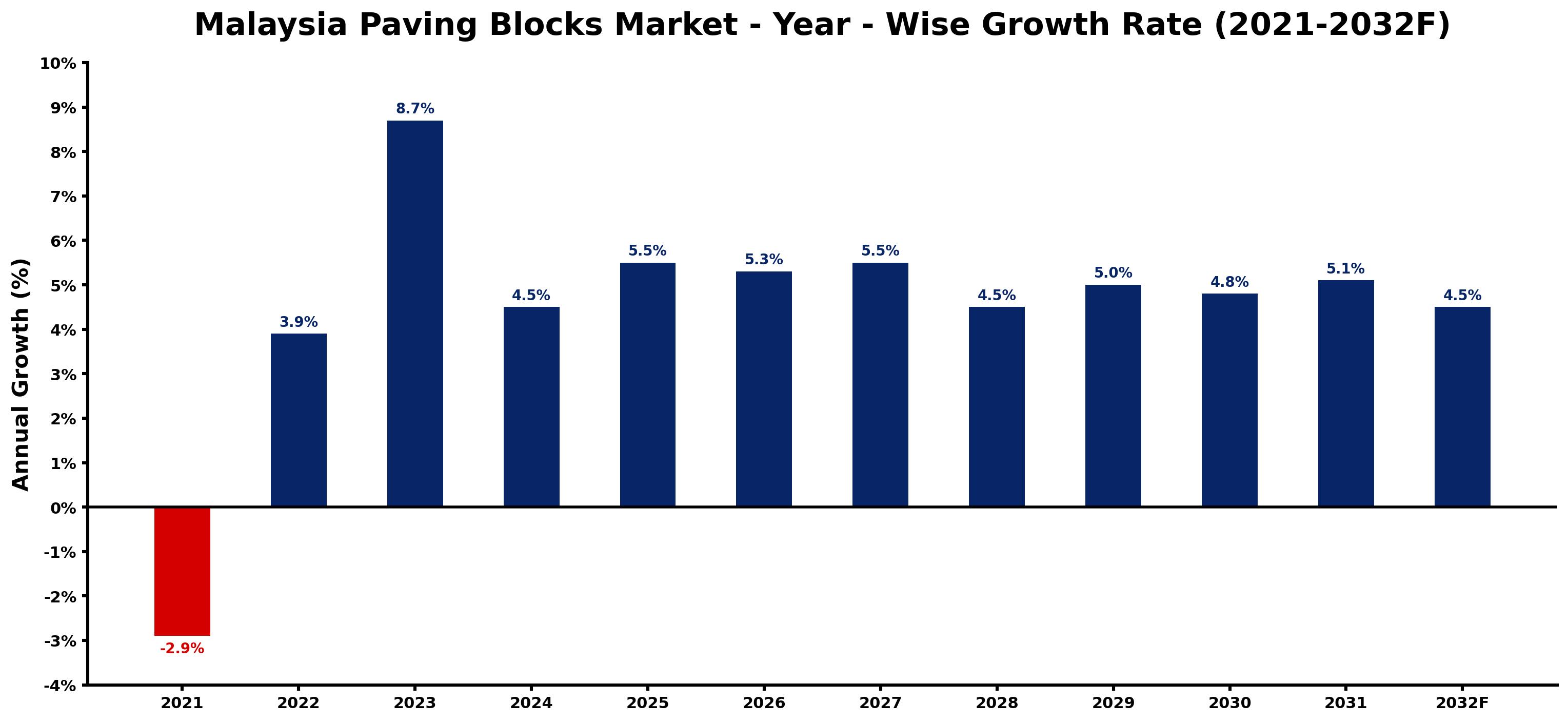
The table below presents the year wise growth rates along with the key drivers influencing the market
| Year | Growth Rate | Major Drivers |
| 2021 | -2.9% | A significant slowdown in construction activities diminished the demand for paving blocks in Malaysia. |
| 2022 | 3.9% | Urbanization efforts prompted higher investments in infrastructure and roadway enhancements. |
| 2023 | 8.7% | Sustainability trends encouraged the use of eco-friendly paving block solutions. |
| 2024 | 4.5% | Increased residential developments spurred demand for aesthetically pleasing outdoor spaces. |
| 2025 | 5.5% | Local manufacturers began offering customized paving designs to attract diverse clientele. |
| 2026 | 5.3% | Technological advancements in production improved paving block durability and cost-efficiency. |
| 2027 | 5.5% | Growing tourism in Malaysia led to enhancements in public spaces and pavements. |
| 2028 | 4.5% | Infrastructure projects in neighboring countries created regional demand for quality paving blocks. |
| 2029 | 5.0% | Changing consumer preferences shifted towards low-maintenance and long-lasting paving solutions. |
| 2030 | 4.8% | Collaboration among construction firms focused on integrating smart materials for urban landscapes. |
| 2031 | 5.1% | Emerging trends in outdoor aesthetics influenced the design and style of paving products. |
| 2032 | 4.5% | Economic recovery post-pandemic led to renewed urban development and expansion projects. |
Note - Market size estimations and growth projections presented in this report are based on 6Wresearch's advanced forecasting approach, validated with industry datasets as of June 2026.
Malaysia Paving Blocks Market Synopsis
The Malaysia Paving Blocks Market is projected to reach 5.3% and witness significant growth during the forecast period (2026-2032). The ongoing urbanization and industrialization trends across Malaysia are propelling the demand for construction activities, thereby significantly contributing to the expansion of the paving blocks market. Increased government initiatives aimed at enhancing infrastructure, alongside growing foreign investments, are also anticipated to create favorable conditions for paving block manufacturers in the Malaysian market.
Malaysia Paving Blocks Market Growth Drivers
Several key factors are driving the growth of the Malaysia paving blocks market. The rapid urban development, particularly in major cities, has led to a surge in the construction of roads, sidewalks, and public spaces where paving blocks are essential. Additionally, the shift toward sustainable construction practices is increasing the popularity of eco-friendly paving materials, including permeable pavement blocks. The government's focus on infrastructure upgrades, including smart city initiatives, is further inflating the demand for high-quality paving solutions.
- The demand for paving blocks in urban areas is being propelled by ongoing residential and commercial construction projects.
- Increased awareness and preference for environmentally friendly building materials are driving innovations in the paving blocks segment.
- Government infrastructure projects are creating substantial demand for durable and aesthetically pleasing paving blocks, thereby facilitating market growth.
- The introduction of advanced manufacturing technologies by local firms is enhancing productivity and quality within the paving blocks market.
- Rising urban population density is leading to a greater need for road and transportation infrastructure, boosting paving block consumption.
Malaysia Paving Blocks Market Trends and Opportunities
The Malaysia paving blocks market is poised for transformation, with several trends indicating a shift toward innovation and sustainability. Notably, the increasing adoption of interlocking concrete pavements is notable, as these materials provide advantages in functionality and environmental compatibility. The trend towards 'green' materials is likely to persist, as consumers and developers prioritize sustainability in construction.
- The inclination towards smart city developments is creating opportunities for paving block manufacturers to supply specialized products that meet urban planning requirements.
- Investments in research and development are expected to yield new product lines that cater to specific market needs, enhancing competitiveness.
- Collaboration between private and public sectors for infrastructure development presents lucrative avenues for paving block suppliers.
- The rise of e-commerce in construction materials is opening up new distribution channels and strengthening market reach for paving block manufacturers.
- Technological advancements in product design are improving product life cycles, making paving blocks more appealing in various applications.
Malaysia Paving Blocks Market Government Investment and Initiatives
Government initiatives play a crucial role in the growth of the Malaysia paving blocks market. Malaysia's government has been actively investing in infrastructure improvements, which includes roads and public facilities where paving blocks are extensively used. Various public spending programs are aimed at enhancing urban infrastructure, thus creating demand for high-quality paving products. Moreover, incentives for using sustainable materials in public works projects align with the growing trend towards eco-friendly construction practices.
- The government's commitment to expanding the nation's road networks is increasing the demand for paving solutions.
- Public-private partnerships are being encouraged to enhance infrastructure development and improve the quality of paving blocks used in national construction projects.
- Regulatory frameworks that promote the use of green materials in construction are fostering a more sustainable paving blocks market.
- Funding for community development projects often allocates budgets for quality paving materials, boosting local manufacturers.
- Strategic urban planning initiatives support the integration of innovative paving solutions, indicating a strong commitment to modern construction standards.
Malaysia Paving Blocks Market Latest Developments (May 2025 - June 2026)
Recent developments in the Malaysia paving blocks market highlight a forward-thinking approach to construction materials and technology. A growing number of manufacturers are exploring sustainable options to meet increasing consumer demand. Innovations in design and function are becoming prominent, driven by developments in concrete technology. The trend towards smart urban environments is encouraging manufacturers to develop paving blocks equipped with smart technologies, enhancing urban living quality. Additionally, collaborative projects between the public sector and private firms are paving the way for new market opportunities.
- Emergence of new product innovations that emphasize sustainability and durability is reshaping the market landscape.
- Increased networking between industry stakeholders at international trade shows is facilitating knowledge transfer and new collaborations.
- Notable research outputs focused on advanced paving solutions highlight the importance of sustainability in ongoing market strategies.
- Government-backed infrastructure projects have seen a renewed focus on using high-performance paving blocks, signaling a trend towards quality.
- The impact of urbanization on growth has intensified, leading to a stronger emphasis on quality paving in construction projects across Malaysia.
Malaysia Paving Blocks Market - Key Attractiveness of the Report
- 10 Years of Market Numbers
- Historical Data Starting from 2022 to 2025
- Base Year: 2025
- Forecast Data until 2032
- Key Performance Indicators Impacting the Market
- Major Upcoming Developments and Projects
Key Highlights of the Report:
- Malaysia Paving Blocks Market Outlook
- Market Size of Malaysia Paving Blocks Market, 2025
- Forecast of Malaysia Paving Blocks Market, 2032F
- Historical Data and Forecast of Malaysia Paving Blocks Revenues & Volume for the Period 2022-2032F
- Malaysia Paving Blocks Market Trend Evolution
- Malaysia Paving Blocks Market Drivers and Challenges
- Malaysia Paving Blocks Price Trends
- Malaysia Paving Blocks Porter's Five Forces
- Malaysia Paving Blocks Industry Life Cycle
- Historical Data and Forecast of Malaysia Paving Blocks Market Revenues & Volume By Product for the Period 2022-2032F
- Historical Data and Forecast of Malaysia Paving Blocks Market Revenues & Volume By Pavers for the Period 2022-2032F
- Historical Data and Forecast of Malaysia Paving Blocks Market Revenues & Volume By Glazed Clay Bricks for the Period 2022-2032F
- Historical Data and Forecast of Malaysia Paving Blocks Market Revenues & Volume By Wall Block for the Period 2022-2032F
- Historical Data and Forecast of Malaysia Paving Blocks Market Revenues & Volume By Material for the Period 2022-2032F
- Historical Data and Forecast of Malaysia Paving Blocks Market Revenues & Volume By Clay for the Period 2022-2032F
- Historical Data and Forecast of Malaysia Paving Blocks Market Revenues & Volume By Building Bricks for the Period 2022-2032F
- Historical Data and Forecast of Malaysia Paving Blocks Market Revenues & Volume By Concrete for the Period 2022-2032F
- Historical Data and Forecast of Malaysia Paving Blocks Market Revenues & Volume By End-users for the Period 2022-2032F
- Historical Data and Forecast of Malaysia Paving Blocks Market Revenues & Volume By General for the Period 2022-2032F
- Historical Data and Forecast of Malaysia Paving Blocks Market Revenues & Volume By Structural for the Period 2022-2032F
- Historical Data and Forecast of Malaysia Paving Blocks Market Revenues & Volume By Hardscaping for the Period 2022-2032F
- Historical Data and Forecast of Malaysia Paving Blocks Market Revenues & Volume By Siding for the Period 2022-2032F
- Historical Data and Forecast of Malaysia Paving Blocks Market Revenues & Volume By Fireplace for the Period 2022-2032F
- Historical Data and Forecast of Malaysia Paving Blocks Market Revenues & Volume By Other for the Period 2022-2032F
- Malaysia Paving Blocks Import Export Trade Statistics
- Market Opportunity Assessment By Product
- Market Opportunity Assessment By Material
- Market Opportunity Assessment By End-users
- Malaysia Paving Blocks Top Companies Market Share
- Malaysia Paving Blocks Competitive Benchmarking By Technical and Operational Parameters
- Malaysia Paving Blocks Company Profiles
- Malaysia Paving Blocks Key Strategic Recommendations






































