Malaysia Peat Market Size, Share & Growth Rate
The Malaysia Peat Market was estimated at USD 453 Million in 2025 and is projected to reach USD 587 Million by 2032, growing at a CAGR of 3.8% from 2026 to 2032. This growth trajectory is primarily fueled by the rising demand for green energy solutions, as peat presents a viable alternative with its high combustible value and lower emissions compared to traditional fossil fuels. Additionally, the government's supportive policies and incentives are likely to bolster industry advancements, leading to enhanced production capabilities.
Malaysia Peat Market Year-wise Growth Rate and Key Drivers
This graph highlights how the Malaysia Peat Market has steadily grown over the years, supported by major growth factors.
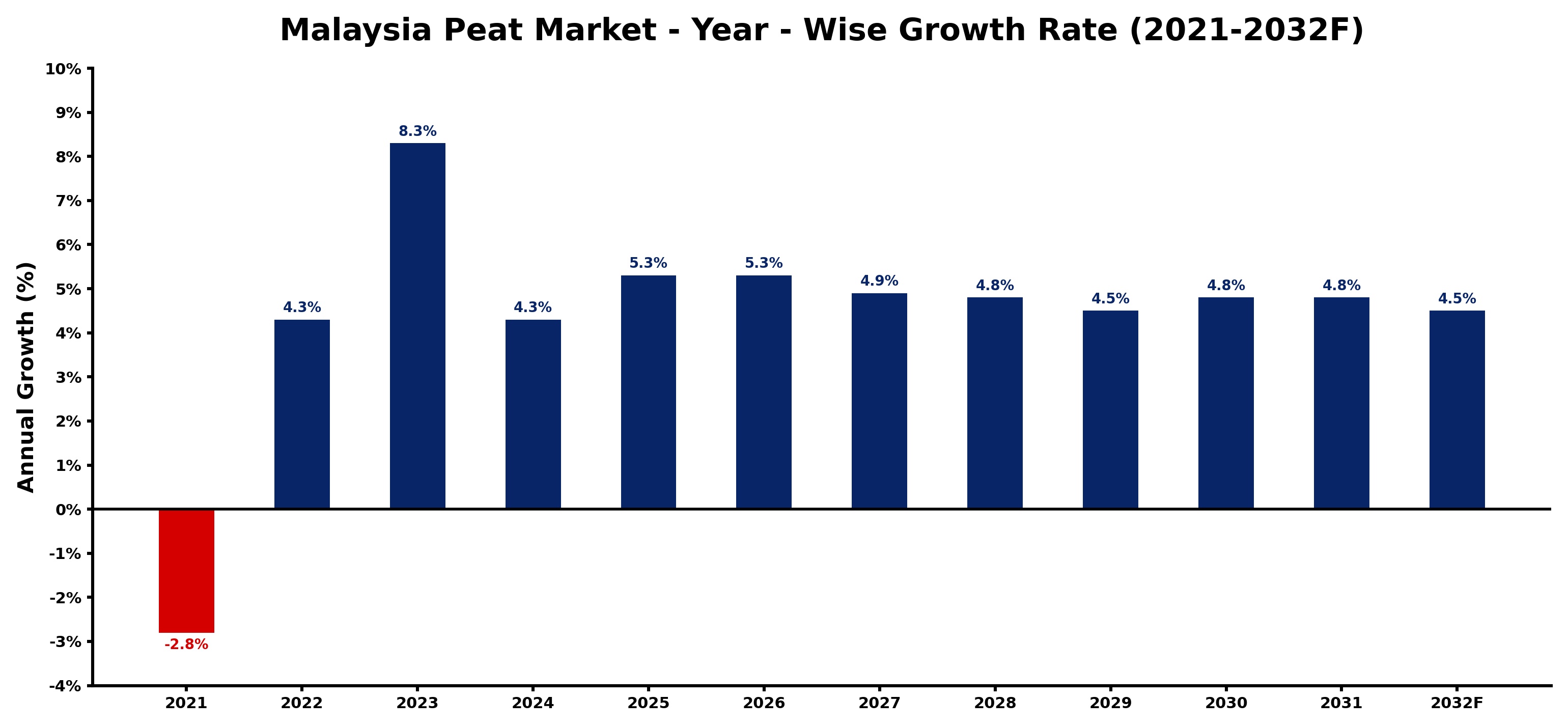
The table below presents the year‑wise growth rates along with the key drivers influencing the market
| Year | Growth Rate | Major Drivers |
| 2021 | -2.8% | Reduced export demand led to lower peat production levels |
| 2022 | 4.3% | Precision engineering advancements boost demand for peat based composites |
| 2023 | 8.3% | Domestic peat extraction projects boost manufacturing sector investment opportunities |
| 2024 | 4.3% | Logistics infrastructure investments boost peat export efficiency and capacity |
| 2025 | 5.3% | Manufacturing investments boost peat harvesting equipment production capabilities |
| 2026 | 5.3% | Technological upgrades in peat processing boost export market competitiveness |
| 2027 | 4.9% | Smart manufacturing systems boost efficiency in peat extraction processes |
| 2028 | 4.8% | Improved peat extraction technologies boosted export driven agricultural investments |
| 2029 | 4.5% | Export driven peat processing facilities boost demand for advanced machinery |
| 2030 | 4.8% | Increased peat utilization in industrial sectors boosted export competitiveness |
| 2031 | 4.8% | New peat extraction technologies enhance efficiency in export manufacturing |
| 2032 | 4.5% | Export oriented manufacturing growth drives peat based substrate utilization in agriculture |
Note - Market size estimations and growth projections presented in this report are based on 6Wresearch’s advanced forecasting approach, validated with industry datasets as of June 2026.
Malaysia Peat Market Synopsis
The increasing application of peat in agriculture is a key driver for the market, as it significantly enhances soil quality and fertility. With a shift towards organic farming practices, peat serves as a natural fertilizer, thus attracting interest from various stakeholders in the agricultural sector.
Moreover, the demand for peat as a renewable energy source aligns with Malaysia's commitment to sustainable practices. As industries continue to seek eco-friendly alternatives, the peat market is positioned to benefit from the growing emphasis on organic and green products, highlighting its essential role in meeting modern energy needs.
Malaysia Peat Market Key Takeaways
- Projected market growth reflects increasing demand for sustainable energy solutions.
- Versatile applications in agriculture and horticulture are driving higher consumption rates.
- Government incentives and regulatory frameworks are promoting industry expansion.
- The market is navigating through environmental challenges with a focus on sustainable practices.
- COVID-19 has reshaped consumer preferences, leading to renewed interest in peat-based products.
Evaluation of Restraints in Malaysia Peat Market
Despite a positive outlook, the Malaysia Peat market grapples with significant restraints. Environmental concerns surrounding peat extraction remain a major issue, as the process can release substantial greenhouse gases, compromising carbon sequestration efforts. The delicate balance between meeting demand and ensuring ecological sustainability is crucial for the long-term viability of peat production. Therefore, the industry must adopt and promote sustainable peatland management practices, prioritizing conservation to mitigate these environmental impacts.
Malaysia Peat Market Trends
Current trends show a marked shift towards sustainable and organic products in the agriculture sector, fostering demand for peat. Innovations in extraction and processing technologies are also emerging, aimed at minimizing environmental impacts while maximizing product efficiency. Moreover, the pandemic has accelerated a consumer preference for home gardening and self-sufficiency, further enhancing the appeal of peat-based soil amendments and fertilizers.
Malaysia Peat Market Opportunities
The market offers genuine growth opportunities in developing sustainable peat products, especially as the agricultural sector increasingly seeks organic solutions. Investment in research and development to enhance peat processing methods can lead to improved product offerings. Additionally, partnerships with ecological organizations may foster initiatives that promote sustainable land use, ensuring long-term market stability and growth.
Government Initiatives in the Malaysia Peat Market
The Malaysian government has introduced several policies and initiatives aimed at supporting the peat market. These include providing incentives for sustainable farming practices and encouraging research into environmentally friendly extraction methods. Programs that promote sustainable land use and restore peatland ecosystems are also crucial, highlighting the government's commitment to balancing economic growth with environmental preservation.
Future Insights of the Malaysia Peat Market
Looking ahead to 2026-2032, the Malaysia Peat market is poised for sustained growth as global and domestic demands for sustainable energy and organic farming practices escalate. The continued evolution of government policies in favor of sustainability will likely influence market dynamics positively. As the industry embraces eco-innovation and stakeholder collaboration, it is set to play an essential role in Malaysia's transition towards a greener economy.
Malaysia Peat Market Latest Developments (May 2025 - June 2026)
Recent developments in the Malaysia Peat market highlight a concerted effort towards enhancing sustainable extraction practices. Industry stakeholders have started implementing advanced technologies that aim to reduce environmental impacts associated with peat harvesting. Furthermore, a surge in initiatives promoting organic farming has led to increased investments in peat-based products, signaling a shift towards more eco-conscious consumer behavior.
Malaysia Peat Market - Key Attractiveness of the Report
- 10 Years of Market Numbers
- Historical Data Starting from 2022 to 2025
- Base Year: 2025
- Forecast Data until 2032
- Key Performance Indicators Impacting the Market
- Major Upcoming Developments and Projects
Key Highlights of the Report:
- Malaysia Peat Market Outlook
- Market Size of Malaysia Peat Market, 2025
- Forecast of Malaysia Peat Market, 2032
- Historical Data and Forecast of Malaysia Peat Revenues & Volume for the Period 2022-2032F
- Malaysia Peat Market Trend Evolution
- Malaysia Peat Market Drivers and Challenges
- Malaysia Peat Price Trends
- Malaysia Peat Porter's Five Forces
- Malaysia Peat Industry Life Cycle
- Historical Data and Forecast of Malaysia Peat Market Revenues & Volume By Type for the Period 2022-2032F
- Historical Data and Forecast of Malaysia Peat Market Revenues & Volume By Coco Peat for the Period 2022-2032F
- Historical Data and Forecast of Malaysia Peat Market Revenues & Volume By Sod Peat for the Period 2022-2032F
- Historical Data and Forecast of Malaysia Peat Market Revenues & Volume By Other for the Period 2022-2032F
- Historical Data and Forecast of Malaysia Peat Market Revenues & Volume By Material Type for the Period 2022-2032F
- Historical Data and Forecast of Malaysia Peat Market Revenues & Volume By Fibric for the Period 2022-2032F
- Historical Data and Forecast of Malaysia Peat Market Revenues & Volume By Hemic for the Period 2022-2032F
- Historical Data and Forecast of Malaysia Peat Market Revenues & Volume By Sapric for the Period 2022-2032F
- Historical Data and Forecast of Malaysia Peat Market Revenues & Volume By Others for the Period 2022-2032F
- Historical Data and Forecast of Malaysia Peat Market Revenues & Volume By Application for the Period 2022-2032F
- Historical Data and Forecast of Malaysia Peat Market Revenues & Volume By Agriculture for the Period 2022-2032F
- Historical Data and Forecast of Malaysia Peat Market Revenues & Volume By Fuel & Energy for the Period 2022-2032F
- Historical Data and Forecast of Malaysia Peat Market Revenues & Volume By Others for the Period 2022-2032F
- Malaysia Peat Import Export Trade Statistics
- Market Opportunity Assessment By Type
- Market Opportunity Assessment By Material Type
- Market Opportunity Assessment By Application
- Malaysia Peat Top Companies Market Share
- Malaysia Peat Competitive Benchmarking By Technical and Operational Parameters
- Malaysia Peat Company Profiles
- Malaysia Peat Key Strategic Recommendations






































