Malaysia Petroleum Refining Products Market Summary
The malaysia petroleum refining products market was estimated at USD 218 Million in 2025 and is projected to reach USD 284 Million by 2032, growing at a CAGR of 5.7% from 2026 to 2032.
Malaysia Petroleum Refining Products Market Year-wise Growth Rate and Key Drivers
This graph highlights how the Malaysia Petroleum Refining Products Market has steadily grown over the past five years, supported by major growth factors.
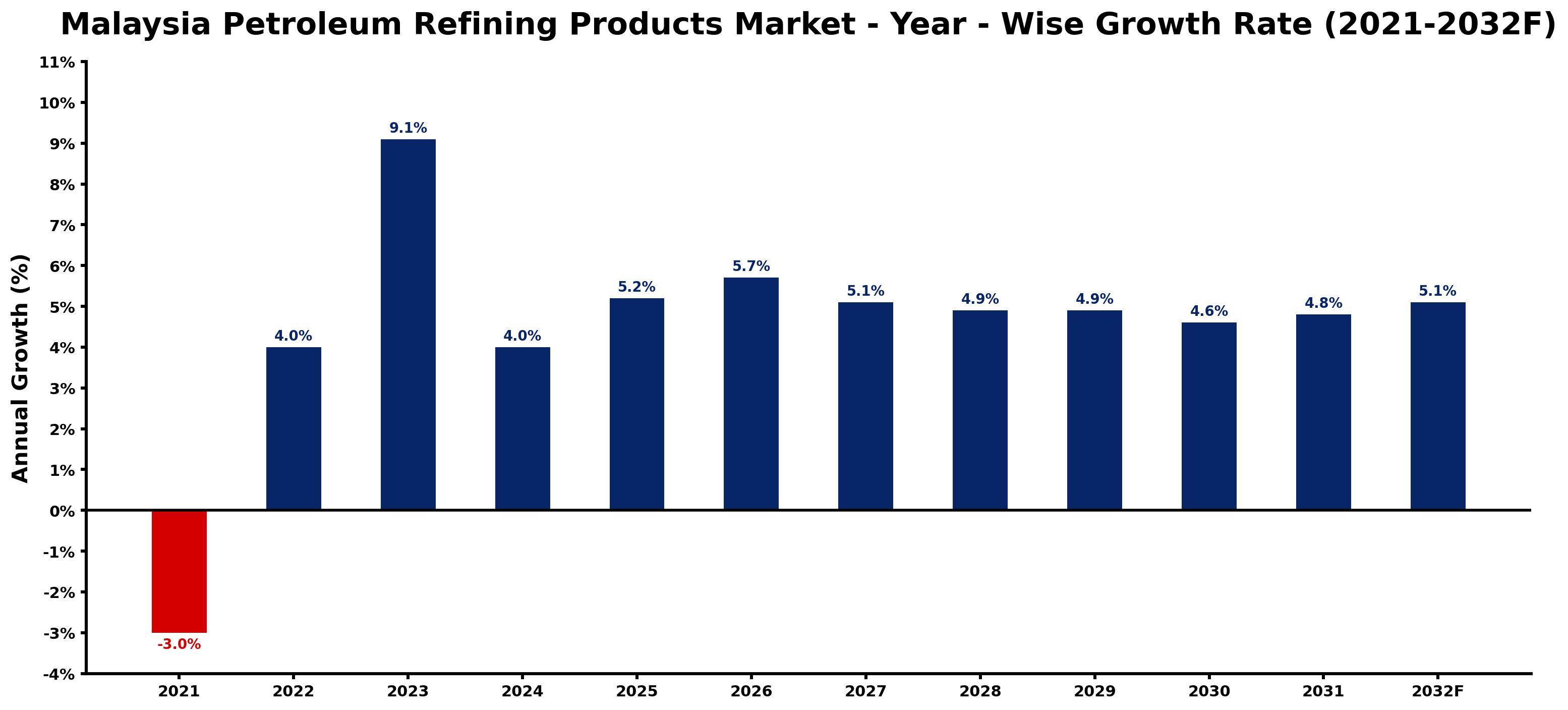
The table below presents the year wise growth rates along with the key drivers influencing the market
| Year | Growth Rate | Major Drivers |
| 2021 | -3.0% | Decreased global oil demand amid pandemicdriven economic contraction significantly lowered refinery output levels in Malaysia. |
| 2022 | 4.0% | New refining technology began attracting investment, improving product yield and efficiency. |
| 2023 | 9.1% | Demand for cleaner fuels prompted upgrades in existing refinery infrastructures nationwide. |
| 2024 | 4.0% | Regional cooperation with ASEAN countries enhanced cross-border petroleum product distribution networks. |
| 2025 | 5.2% | Local automotive industry expansion increased gasoline and diesel requirements substantially. |
| 2026 | 5.7% | International oil prices stabilization contributed to consumer confidence and spending patterns. |
| 2027 | 5.1% | Emerging transportation trends, including electric vehicles, spurred alternative fuel research initiatives. |
| 2028 | 4.9% | Refinery consolidation efforts improved economies of scale, driving down operational costs. |
| 2029 | 4.9% | Environmental awareness led to higher investments in sustainable refining practices and technologies. |
| 2030 | 4.6% | Shifts in consumer preferences towards biofuels encouraged diversification within refining portfolios. |
| 2031 | 4.8% | Increased foreign direct investment sought to capitalize on Malaysia's strategic location and resources. |
| 2032 | 5.1% | Technological partnerships with global firms fostered innovation in refining processes and outputs. |
Note - Market size estimations and growth projections presented in this report are based on 6Wresearch's advanced forecasting approach, validated with industry datasets as of June 2026.
Malaysia Petroleum Refining Products Market Synopsis
The Malaysia Petroleum Refining Products Market is projected to reach 5.7% and witness significant growth during the forecast period (2026-2032). The market is anticipated to expand at a compound annual growth rate (CAGR) of 4.8%, driven by a multitude of factors including a rising population, increasing GDP, and an expanding industrial sector. Malaysia's refining infrastructure, comprising approximately 15 operational refineries with a total capacity of 881,000 barrels per day as of 2019, is positioned to support this growth. Investments in advanced refining technologies, particularly the shift towards hydrocracking, are set to enhance operational efficiency and product output, thereby propelling the market forward.
Malaysia Petroleum Refining Products Market Growth Drivers
The growth of the Malaysia Petroleum Refining Products Market is underpinned by several dynamic drivers. Firstly, the demographic trend indicates an increase in population, which leads to a heightened demand for transportation fuels and other petroleum products. Secondly, the robust economic performance characterized by rising GDP fosters industrial activities that necessitate increased fuel consumption. Thirdly, ongoing investments in upgrading refinery capacities and technologies are improving efficiency and expanding product ranges. Additionally, the growing demand for cleaner fuels aligns with global sustainability goals, driving refiners to adapt and innovate their processes to meet stringent regulatory standards. Finally, the strategic geographic positioning of Malaysia as a trading hub in Southeast Asia enhances the market's appeal and accessibility.
Malaysia Petroleum Refining Products Market Challenges and Restraints
Despite its promising growth trajectory, the Malaysia Petroleum Refining Products Market faces several challenges. The volatility of crude oil prices can significantly impact profitability margins for refiners, making financial planning increasingly complex. Furthermore, the environmental impact of refining processes raises regulatory scrutiny and compliance costs, compelling companies to invest in cleaner technologies. Additionally, competition from other regional refining centres may pose a threat to market share, as neighboring countries enhance their refining capabilities. The transition towards renewable energy sources also presents a long-term challenge, as demand shifts may reduce reliance on petroleum products. Lastly, geopolitical factors and trade tensions can influence supply chains and operational efficiencies within the market.
Malaysia Petroleum Refining Products Market Government Investment and Initiatives
The Malaysian government plays a pivotal role in shaping the petroleum refining landscape through various investments and initiatives aimed at bolstering the sector. Policies encouraging capital allowances for refining activities provide financial incentives for companies to invest in improvements and expansions. The government's focus on sustainable development has led to initiatives aimed at modernizing refineries to adhere to environmental regulations and improve product quality. Furthermore, public spending on infrastructure development enhances logistical capabilities, facilitating smoother operations for refineries. Collaborative engagements between government bodies and industry stakeholders also foster innovation, driving advancements in technology and operational practices. These initiatives are crucial in attracting both domestic and foreign investments into the refining sector, setting the foundation for future growth.
Malaysia Petroleum Refining Products Market Latest Developments (May 2025 - June 2026)
In the period from May 2025 to June 2026, the Malaysia Petroleum Refining Products Market experienced significant developments that indicate a proactive approach to industry challenges. Refiners began implementing advanced technologies to enhance productivity and reduce environmental footprints, aligning with global sustainability trends. Furthermore, the government introduced additional incentives for investments in renewable energy initiatives within the refining sector, reflecting a shift towards a more sustainable operational model. Notable activities included feasibility studies for new refinery projects and upgrades to existing facilities, aimed at improving overall capacity and efficiency. Additionally, dialogues among industry stakeholders focused on collaborative strategies to navigate the complexities posed by fluctuating crude oil prices while maintaining competitive pricing in the market.
Malaysia Petroleum Refining Products Market - Key Attractiveness of the Report
- 10 Years of Market Numbers
- Historical Data Starting from 2022 to 2025
- Base Year: 2025
- Forecast Data until 2032
- Key Performance Indicators Impacting the Market
- Major Upcoming Developments and Projects
- What is the expected growth rate of the Malaysia Petroleum Refining Products Market during the forecast period?
- How many operational refineries are currently in Malaysia, and what is their total capacity?
- What kind of government initiatives are in place to support the refining sector in Malaysia?
- What are the main challenges facing the Malaysia Petroleum Refining Products Market?
Key Highlights of the Report:
- Malaysia Petroleum Refining Products Market Outlook
- Market Size of Malaysia Petroleum Refining Products Market, 2025
- Forecast of Malaysia Petroleum Refining Products Market, 2032F
- Historical Data and Forecast of Malaysia Petroleum Refining Products Revenues & Volume for the Period 2022-2032F
- Malaysia Petroleum Refining Products Market Trend Evolution
- Malaysia Petroleum Refining Products Market Drivers and Challenges
- Malaysia Petroleum Refining Products Price Trends
- Malaysia Petroleum Refining Products Porter's Five Forces
- Malaysia Petroleum Refining Products Industry Life Cycle
- Historical Data and Forecast of Malaysia Petroleum Refining Products Market Revenues & Volume By Type for the Period 2022-2032F
- Historical Data and Forecast of Malaysia Petroleum Refining Products Market Revenues & Volume By Ethane & LPG for the Period 2022-2032F
- Historical Data and Forecast of Malaysia Petroleum Refining Products Market Revenues & Volume By Gasoline for the Period 2022-2032F
- Historical Data and Forecast of Malaysia Petroleum Refining Products Market Revenues & Volume By Diesel/Gasoil for the Period 2022-2032F
- Historical Data and Forecast of Malaysia Petroleum Refining Products Market Revenues & Volume By Jet/Kerosene for the Period 2022-2032F
- Historical Data and Forecast of Malaysia Petroleum Refining Products Market Revenues & Volume By Naphtha for the Period 2022-2032F
- Historical Data and Forecast of Malaysia Petroleum Refining Products Market Revenues & Volume By Fuel Oil for the Period 2022-2032F
- Historical Data and Forecast of Malaysia Petroleum Refining Products Market Revenues & Volume By Others for the Period 2022-2032F
- Historical Data and Forecast of Malaysia Petroleum Refining Products Market Revenues & Volume By End-users for the Period 2022-2032F
- Historical Data and Forecast of Malaysia Petroleum Refining Products Market Revenues & Volume By Transportation for the Period 2022-2032F
- Historical Data and Forecast of Malaysia Petroleum Refining Products Market Revenues & Volume By Others for the Period 2022-2032F
- Malaysia Petroleum Refining Products Import Export Trade Statistics
- Market Opportunity Assessment By Type
- Market Opportunity Assessment By End-users
- Malaysia Petroleum Refining Products Top Companies Market Share
- Malaysia Petroleum Refining Products Competitive Benchmarking By Technical and Operational Parameters
- Malaysia Petroleum Refining Products Company Profiles
- Malaysia Petroleum Refining Products Key Strategic Recommendations






































