Malaysia Pharmaceutical Packaging Market Summary
The malaysia pharmaceutical packaging market was estimated at USD 272 Million in 2025 and is projected to reach USD 352 Million by 2032, growing at a CAGR of 5.2% from 2026 to 2032.
Malaysia Pharmaceutical Packaging Market Year-wise Growth Rate and Key Drivers
This graph highlights how the Malaysia Pharmaceutical Packaging Market has steadily grown over the past five years, supported by major growth factors.
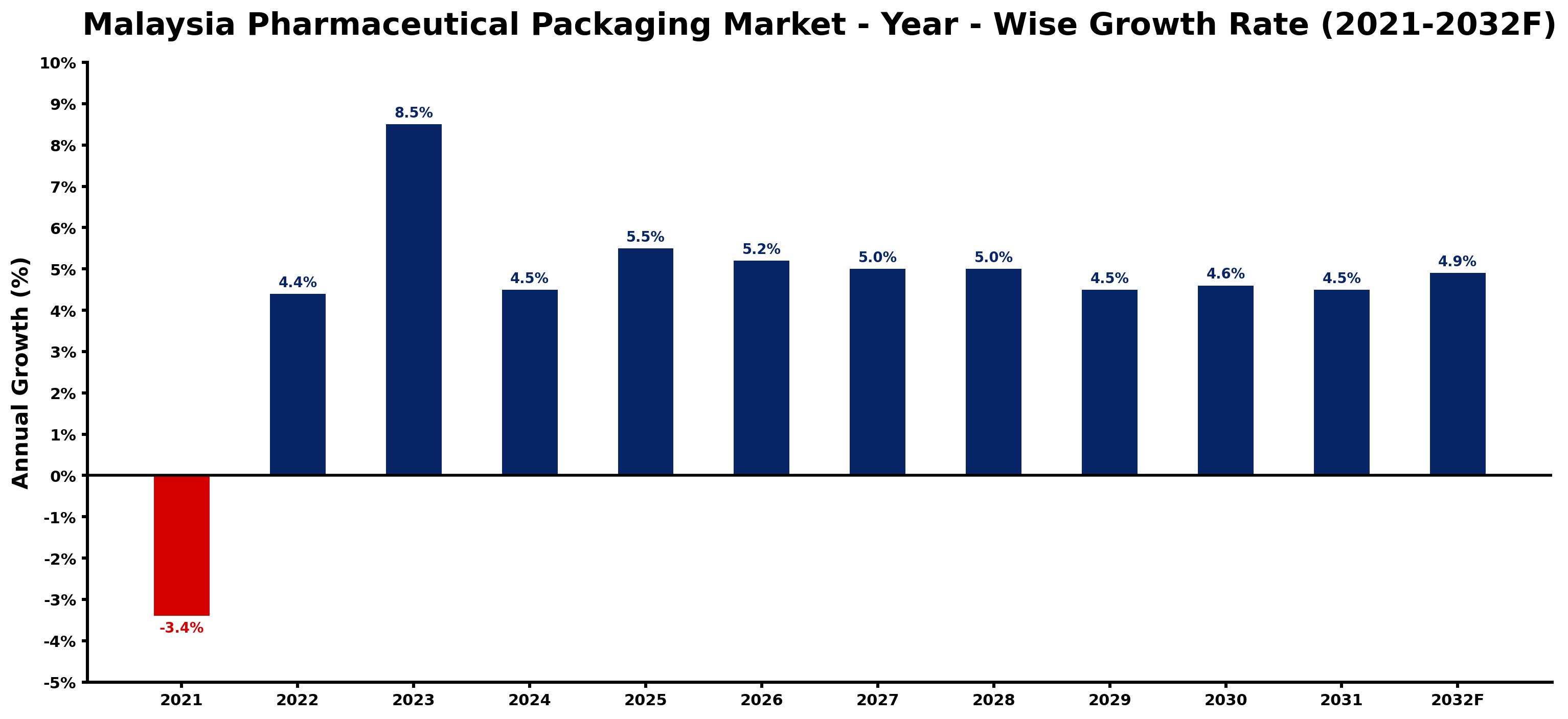
The table below presents the year wise growth rates along with the key drivers influencing the market
| Year | Growth Rate | Major Drivers |
| 2021 | -3.4% | Disruptions in global supply chains hindered timely delivery of packaging materials, impacting production capabilities. |
| 2022 | 4.4% | Technological innovations in packaging materials enhanced product shelf life and safety. |
| 2023 | 8.5% | Increased local production capacity positioned Malaysia as a regional packaging hub. |
| 2024 | 4.5% | Emergence of e-pharmacies necessitated robust and efficient packaging solutions. |
| 2025 | 5.5% | Consumer awareness around medication safety prompted demand for tamper-evident packaging. |
| 2026 | 5.2% | Healthcare sector expansion fueled investments in advanced packaging technologies. |
| 2027 | 5.0% | Partnerships between manufacturers and tech firms fostered innovation in packaging design. |
| 2028 | 5.0% | Regional trade agreements opened new markets for Malaysian pharmaceutical packaging exporters. |
| 2029 | 4.5% | Digital transformation in the supply chain reduced operational costs significantly. |
| 2030 | 4.6% | Customization of packaging solutions increased to cater to diverse consumer preferences. |
| 2031 | 4.5% | Research initiatives highlighted the importance of child-resistant packaging in safety. |
| 2032 | 4.9% | Sustainability certifications became crucial for companies aiming for competitive advantage. |
Note - Market size estimations and growth projections presented in this report are based on 6Wresearch's advanced forecasting approach, validated with industry datasets as of June 2026.
Malaysia Pharmaceutical Packaging Market Synopsis
The Malaysia Pharmaceutical Packaging Market is projected to reach 5.2% and witness significant growth during the forecast period (2026-2032). This upward trend is attributed to a variety of factors including the increasing demand for sophisticated drug delivery systems, a rise in healthcare expenditure, and the growing prevalence of chronic diseases such as diabetes and cardiovascular disorders. In addition to these health concerns, the growing adoption of plastic packaging materials over traditional liquid containers is expected to propel market growth. Furthermore, governmental initiatives aimed at improving healthcare infrastructure, along with escalated investments from international firms, serve as additional catalysts for market expansion.
Malaysia Pharmaceutical Packaging Market Growth Drivers
The driving forces behind the Malaysia Pharmaceutical Packaging Market are diverse, yet interconnected. Primarily, the surge in healthcare spending is fostering advancements in pharmaceutical packaging solutions tailored for modern healthcare requirements.
- The rising incidence of chronic diseases necessitates innovative drug delivery mechanisms, thus emphasizing the importance of efficient packaging solutions that ensure the safety and efficacy of medications.
- The shift towards plastic packaging is driven by its lightweight characteristics and its advantages in maintaining product integrity, hinting at a move away from heavier traditional materials.
- Technological advancements in packaging, particularly in the production of unit-dose blister packages embedded with desiccants, are revolutionizing moisture control strategies, offering improved product preservation.
- Government initiatives aimed at enhancing the pharmaceutical sector's infrastructure have created an appealing environment for investment, significantly impacting packaging demands.
- The increasing market entry of international players is further stimulating innovation and competition, leading to a broader array of pharmaceutical packaging solutions available to consumers.
Malaysia Pharmaceutical Packaging Market Challenges and Restraints
While the Malaysia Pharmaceutical Packaging Market is poised for growth, certain challenges may hinder its progress. Regulatory compliance remains a critical concern as the industry must navigate stringent laws pertaining to safety and environmental impacts.
- The increasing cost of raw materials poses a significant obstacle, particularly in the context of sustainable packaging solutions, which may deter smaller players from entering the market.
- Heightened competition among packaging providers can lead to price wars, resulting in reduced profit margins for manufacturers focused on quality.
- The rapid evolution of technology creates a constant need for investment in research and development, which can be a financial burden, especially for smaller enterprises.
- Consumer preferences for eco-friendly packaging options are rising, pressuring manufacturers to adapt swiftly, which may be challenging in terms of both cost and logistics.
- The lack of skilled labor and technical expertise in innovative packaging technologies can also hinder the effective implementation of advanced solutions in the market.
Malaysia Pharmaceutical Packaging Market Government Investment and Initiatives
The Malaysian government has made substantial investments to strengthen the healthcare framework, directly impacting the pharmaceutical packaging sector. Initiatives aimed at enhancing pharmaceutical infrastructure are being prioritized to boost production efficiency and the overall quality of medical products.
- Investment in healthcare projects focuses on modernizing facilities and optimizing supply chain processes, thus necessitating advanced packaging solutions.
- Public funding initiatives are being introduced to support research and development in innovative packaging technologies that align with sustainable practices.
- The government's commitment to improving regulatory frameworks ensures that packaging solutions meet international safety and quality standards, fostering growth.
- Programs aimed at enhancing workforce training and skill development in advanced packaging technologies also form part of government policy, addressing the manpower needs of the industry.
- Collaboration with industry stakeholders is encouraged to ensure that packaging advancements correspond to real-world healthcare challenges, leading to more effective solutions.
Malaysia Pharmaceutical Packaging Market Latest Developments (May 2025 - June 2026)
Recent developments in the Malaysia Pharmaceutical Packaging Market reflect a growing emphasis on sustainability and technological innovation. Companies within the sector are increasingly prioritizing eco-friendly materials to meet the evolving expectations of both regulators and consumers.
- New partnerships and collaborations have emerged, focusing on sharing expertise and resources to enhance product offerings while maintaining compliance with environmental standards.
- Innovations in smart packaging technologies have been introduced, allowing for real-time monitoring of medication integrity, which is anticipated to improve patient safety.
- Market players are actively investing in automation and advanced manufacturing technologies to streamline production processes and reduce operational costs.
- Healthcare institutions are adopting more sophisticated packaging solutions for the distribution of medicines, indicating a shift towards a more integrated approach to pharmaceutical logistics.
- There has been a noticeable increase in academic and industry partnerships aimed at research initiatives to develop next-generation packaging solutions that cater to patient needs.
Malaysia Pharmaceutical Packaging Market - Key Attractiveness of the Report
- 10 Years of Market Numbers
- Historical Data Starting from 2022 to 2025
- Base Year: 2025
- Forecast Data until 2032
- Key Performance Indicators Impacting the Market
- Major Upcoming Developments and Projects
Key Highlights of the Report:
- Malaysia Pharmaceutical Packaging Market Outlook
- Market Size of Malaysia Pharmaceutical Packaging Market, 2025
- Forecast of Malaysia Pharmaceutical Packaging Market, 2032F
- Historical Data and Forecast of Malaysia Pharmaceutical Packaging Revenues & Volume for the Period 2022-2032F
- Malaysia Pharmaceutical Packaging Market Trend Evolution
- Malaysia Pharmaceutical Packaging Market Drivers and Challenges
- Malaysia Pharmaceutical Packaging Price Trends
- Malaysia Pharmaceutical Packaging Porter's Five Forces
- Malaysia Pharmaceutical Packaging Industry Life Cycle
- Historical Data and Forecast of Malaysia Pharmaceutical Packaging Market Revenues & Volume By Material Types for the Period 2022-2032F
- Historical Data and Forecast of Malaysia Pharmaceutical Packaging Market Revenues & Volume By Plastics & Polymers for the Period 2022-2032F
- Historical Data and Forecast of Malaysia Pharmaceutical Packaging Market Revenues & Volume By Paper & Paperboard for the Period 2022-2032F
- Historical Data and Forecast of Malaysia Pharmaceutical Packaging Market Revenues & Volume By Glass for the Period 2022-2032F
- Historical Data and Forecast of Malaysia Pharmaceutical Packaging Market Revenues & Volume By Aluminum Foil for the Period 2022-2032F
- Historical Data and Forecast of Malaysia Pharmaceutical Packaging Market Revenues & Volume By Others for the Period 2022-2032F
- Historical Data and Forecast of Malaysia Pharmaceutical Packaging Market Revenues & Volume By Product Types for the Period 2022-2032F
- Historical Data and Forecast of Malaysia Pharmaceutical Packaging Market Revenues & Volume By Primary Pharmaceutical Packaging for the Period 2022-2032F
- Historical Data and Forecast of Malaysia Pharmaceutical Packaging Market Revenues & Volume By Secondary Pharmaceutical Packaging for the Period 2022-2032F
- Historical Data and Forecast of Malaysia Pharmaceutical Packaging Market Revenues & Volume By Tertiary Pharmaceutical Packaging for the Period 2022-2032F
- Historical Data and Forecast of Malaysia Pharmaceutical Packaging Market Revenues & Volume By End-users for the Period 2022-2032F
- Historical Data and Forecast of Malaysia Pharmaceutical Packaging Market Revenues & Volume By Pharmaceutical Manufacturing for the Period 2022-2032F
- Historical Data and Forecast of Malaysia Pharmaceutical Packaging Market Revenues & Volume By Retail Pharmacy for the Period 2022-2032F
- Historical Data and Forecast of Malaysia Pharmaceutical Packaging Market Revenues & Volume By Contract Packaging for the Period 2022-2032F
- Historical Data and Forecast of Malaysia Pharmaceutical Packaging Market Revenues & Volume By Institutional Pharmacy for the Period 2022-2032F
- Historical Data and Forecast of Malaysia Pharmaceutical Packaging Market Revenues & Volume By Others for the Period 2022-2032F
- Malaysia Pharmaceutical Packaging Import Export Trade Statistics
- Market Opportunity Assessment By Material Types
- Market Opportunity Assessment By Product Types
- Market Opportunity Assessment By End-users
- Malaysia Pharmaceutical Packaging Top Companies Market Share
- Malaysia Pharmaceutical Packaging Competitive Benchmarking By Technical and Operational Parameters
- Malaysia Pharmaceutical Packaging Company Profiles
- Malaysia Pharmaceutical Packaging Key Strategic Recommendations






































