Malaysia Photographic Film Processing Chemicals Market Size, Share & Growth Rate
The Malaysia Photographic Film Processing Chemicals Market was estimated at USD 263 Million in 2025 and is projected to reach USD 341 Million by 2032, growing at a CAGR of 3.8% from 2026 to 2032. This growth is largely attributed to the steadfast commitment of film photography enthusiasts and professionals who seek high-quality chemicals for preservation and restoration. In addition, the burgeoning interest in film photography among younger demographics, combined with a resurgence in analog practices, is expected to further stimulate demand within this specialized market.
Malaysia Photographic Film Processing Chemicals Market Year-wise Growth Rate and Key Drivers
This graph highlights how the Malaysia Photographic Film Processing Chemicals Market has steadily grown over the years, supported by major growth factors.
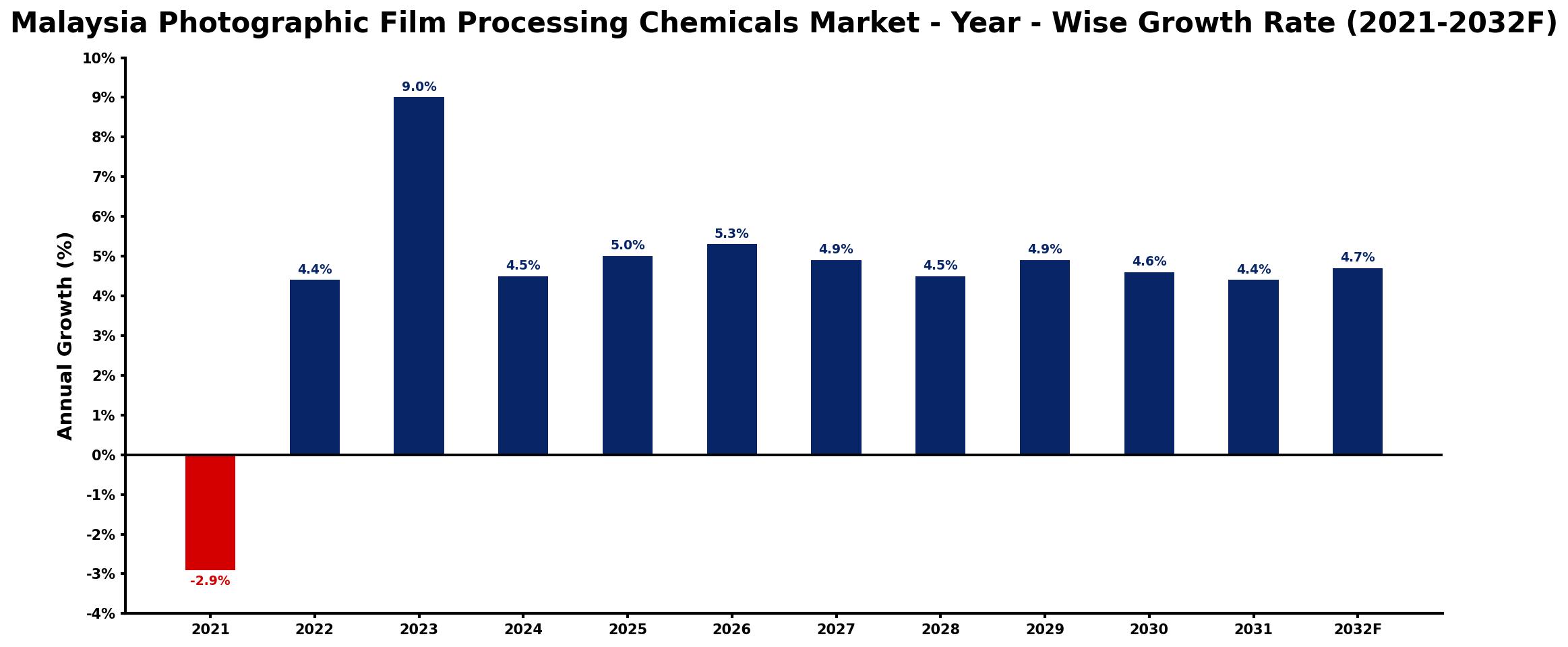
The table below presents the year‑wise growth rates along with the key drivers influencing the market
| Year | Growth Rate | Major Drivers |
| 2021 | -2.9% | decreased consumer interest in photography |
| 2022 | 4.4% | rise in digital content creation |
| 2023 | 9.0% | increased demand for vintage aesthetics |
| 2024 | 4.5% | growing popularity of analog photography |
| 2025 | 5.0% | expansion of niche photography markets |
| 2026 | 5.3% | surge in creative photography workshops |
| 2027 | 4.9% | increased investment in art supplies |
| 2028 | 4.5% | growth of social media influencers |
| 2029 | 4.9% | development of new artistic trends |
| 2030 | 4.6% | boost in local photography events |
| 2031 | 4.4% | expanding industrial usage applications |
| 2032 | 4.7% | increased collaboration among creators |
Note: Market size estimations and growth projections presented in this report are based on 6Wresearch's proprietary forecasting methodology, utilizing the latest available industry data, government publications, and primary research inputs.
Malaysia Photographic Film Processing Chemicals Market Synopsis
In recent years, the Malaysian market for photographic film processing chemicals has exhibited an intriguing, albeit modest, momentum, driven primarily by niche segments dedicated to film photography. Despite the overarching trend of digital photography overshadowing traditional practices, a loyal customer base persists, valuing the unique aesthetic qualities of analog film.
While the market faces challenges due to the declining prevalence of film photography, it remains resilient. Manufacturers are responding to this niche demand by developing specialized products, positioning themselves for potential growth in a space that continues to evolve with passionate enthusiasts and professionals committed to preserving film's artistic legacy.
Malaysia Photographic Film Processing Chemicals Market Key Takeaways
- The niche market for photographic film processing chemicals persists despite the digital photography trend.
- There is a growing interest in film photography among younger generations, fueling demand for processing chemicals.
- High-quality processing chemicals are critical for film preservation and restoration projects.
- Environmental regulations surrounding chemical disposal present ongoing complexities for manufacturers.
- The impact of COVID-19 has emphasized the importance of adaptability within the film processing chemicals sector.
Evaluation of Restraints in Malaysia Photographic Film Processing Chemicals Market
The Malaysia Photographic Film Processing Chemicals Market is encountering several key restraints that hinder its growth trajectory. The predominant challenge remains the dwindling customer base for film processing chemicals, as many consumers increasingly favor digital alternatives. This transition has led to a decline in demand for traditional film, which, in turn, affects the consumption of necessary chemicals. Furthermore, stringent environmental regulations regarding the disposal of chemical waste necessitate compliance and investment in sustainable practices, complicating operations for manufacturers in this sector.
Malaysia Photographic Film Processing Chemicals Market Trends
Current trends indicate a steady revival of interest in analog photography, particularly among creative communities that appreciate the tactile and nostalgic elements of film. This resurgence is encouraging manufacturers to innovate in developing eco-friendly processing chemicals that align with sustainable practices. Additionally, social media platforms play a significant role in promoting film photography, inspiring a new wave of enthusiasts to explore and invest in traditional methods. As the market adapts to these trends, the production of specialized kits and chemicals tailored for amateur and professional photographers is on the rise.
Malaysia Photographic Film Processing Chemicals Market Opportunities
Opportunities abound for growth in the Malaysia Photographic Film Processing Chemicals Market, especially through targeted marketing strategies aimed at film photography enthusiasts. The increasing focus on sustainability offers avenues for the development of biodegradable or low-impact processing chemicals, appealing to environmentally conscious consumers. Additionally, collaborations with educational institutions and photography workshops can foster a deeper appreciation for film techniques, thereby enlarging the consumer base. Furthermore, the market can explore partnerships with art galleries and archival services to promote the preservation of historical photographs.
Government Initiatives in the Malaysia Photographic Film Processing Chemicals Market
Government initiatives supporting the arts and creative industries indirectly benefit the photographic film processing chemicals market. Various funding programs and grants aimed at cultural preservation encourage the documentation of historical practices, including traditional photography. Additionally, environmental policies are increasingly prioritizing sustainable manufacturing processes, promoting the use of eco-friendly chemicals, which aligns with global sustainability trends.
Future Insights of the Malaysia Photographic Film Processing Chemicals Market
Looking ahead to the period from 2026 to 2032, the Malaysia Photographic Film Processing Chemicals Market is poised for a moderate yet promising evolution. As film photography continues to attract a dedicated following, particularly among younger generations, a stable demand for processing chemicals is anticipated. Moreover, the industry's ability to adapt to environmental concerns and innovate in product offerings will be pivotal in capturing market share. Ultimately, the resilience of analog photography as a cultural and artistic medium bodes well for the long-term prospects of this niche market.
Malaysia Photographic Film Processing Chemicals Market Latest Developments (2025 - 2026)
The Malaysian market for photographic film processing chemicals has experienced notable developments in recent months. Innovations in chemical formulations aimed at enhancing photo quality and ease of use have emerged, along with initiatives that highlight the unique attributes of film photography. Industry stakeholders are actively participating in local photography festivals and workshops, fostering community engagement and education around traditional techniques. Such activities are vital in sustaining interest and encouraging new entrants into the film photography scene.
Malaysia Photographic Film Processing Chemicals Market - Key Attractiveness of the Report
- 10 Years of Market Numbers
- Historical Data Starting from 2022 to 2025
- Base Year: 2025
- Forecast Data until 2032
- Key Performance Indicators Impacting the Market
- Major Upcoming Developments and Projects
Key Highlights of the Report:
- Malaysia Photographic Film Processing Chemicals Market Outlook
- Market Size of Malaysia Photographic Film Processing Chemicals Market, 2025
- Forecast of Malaysia Photographic Film Processing Chemicals Market, 2032
- Historical Data and Forecast of Malaysia Photographic Film Processing Chemicals Revenues & Volume for the Period 2022-2032F
- Malaysia Photographic Film Processing Chemicals Market Trend Evolution
- Malaysia Photographic Film Processing Chemicals Market Drivers and Challenges
- Malaysia Photographic Film Processing Chemicals Price Trends
- Malaysia Photographic Film Processing Chemicals Porter's Five Forces
- Malaysia Photographic Film Processing Chemicals Industry Life Cycle
- Historical Data and Forecast of Malaysia Photographic Film Processing Chemicals Market Revenues & Volume By Function for the Period 2022-2032F
- Historical Data and Forecast of Malaysia Photographic Film Processing Chemicals Market Revenues & Volume By Development Agent for the Period 2022-2032F
- Historical Data and Forecast of Malaysia Photographic Film Processing Chemicals Market Revenues & Volume By Activator for the Period 2022-2032F
- Historical Data and Forecast of Malaysia Photographic Film Processing Chemicals Market Revenues & Volume By Preservative for the Period 2022-2032F
- Historical Data and Forecast of Malaysia Photographic Film Processing Chemicals Market Revenues & Volume By Restrainer for the Period 2022-2032F
- Historical Data and Forecast of Malaysia Photographic Film Processing Chemicals Market Revenues & Volume By Solvents for the Period 2022-2032F
- Historical Data and Forecast of Malaysia Photographic Film Processing Chemicals Market Revenues & Volume By Neutralizer for the Period 2022-2032F
- Historical Data and Forecast of Malaysia Photographic Film Processing Chemicals Market Revenues & Volume By Hardener for the Period 2022-2032F
- Historical Data and Forecast of Malaysia Development Agent Photographic Film Processing Chemicals Market Revenues & Volume By Buffer for the Period 2022-2032F
- Historical Data and Forecast of Malaysia Photographic Film Processing Chemicals Market Revenues & Volume By Type for the Period 2022-2032F
- Historical Data and Forecast of Malaysia Photographic Film Processing Chemicals Market Revenues & Volume By Sodium Thiosulfate for the Period 2022-2032F
- Historical Data and Forecast of Malaysia Photographic Film Processing Chemicals Market Revenues & Volume By Sodium Hydroxide for the Period 2022-2032F
- Historical Data and Forecast of Malaysia Photographic Film Processing Chemicals Market Revenues & Volume By Water for the Period 2022-2032F
- Historical Data and Forecast of Malaysia Photographic Film Processing Chemicals Market Revenues & Volume By Acetic Acid for the Period 2022-2032F
- Historical Data and Forecast of Malaysia Photographic Film Processing Chemicals Market Revenues & Volume By Potassium Alum for the Period 2022-2032F
- Historical Data and Forecast of Malaysia Photographic Film Processing Chemicals Market Revenues & Volume By Potassium Bromide for the Period 2022-2032F
- Historical Data and Forecast of Malaysia Photographic Film Processing Chemicals Market Revenues & Volume By Sodium Sulfite for the Period 2022-2032F
- Historical Data and Forecast of Malaysia Photographic Film Processing Chemicals Market Revenues & Volume By Other Chemicals for the Period 2022-2032F
- Malaysia Photographic Film Processing Chemicals Import Export Trade Statistics
- Market Opportunity Assessment By Function
- Market Opportunity Assessment By Type
- Malaysia Photographic Film Processing Chemicals Top Companies Market Share
- Malaysia Photographic Film Processing Chemicals Competitive Benchmarking By Technical and Operational Parameters
- Malaysia Photographic Film Processing Chemicals Company Profiles
- Malaysia Photographic Film Processing Chemicals Key Strategic Recommendations






































