Malaysia Photosensitive Semiconductor Device Market Size, Share & Growth Rate
The Malaysia Photosensitive Semiconductor Device Market was estimated at USD 899 Million in 2025 and is projected to reach USD 1338 Million by 2032, growing at a CAGR of 5.8% from 2026 to 2032. This growth trajectory is largely driven by the rapid adoption of automation in key sectors such as automotive and telecommunications, where light-sensing technologies play a critical role. Furthermore, the demand for enhanced optical communication systems is catalyzing innovations that improve device sensitivity and response times, ensuring compatibility with emerging technologies like 5G and IoT.
Malaysia Photosensitive Semiconductor Device Market Year-wise Growth Rate and Key Drivers
This graph highlights how the Malaysia Photosensitive Semiconductor Device Market has steadily grown over the years, supported by major growth factors.
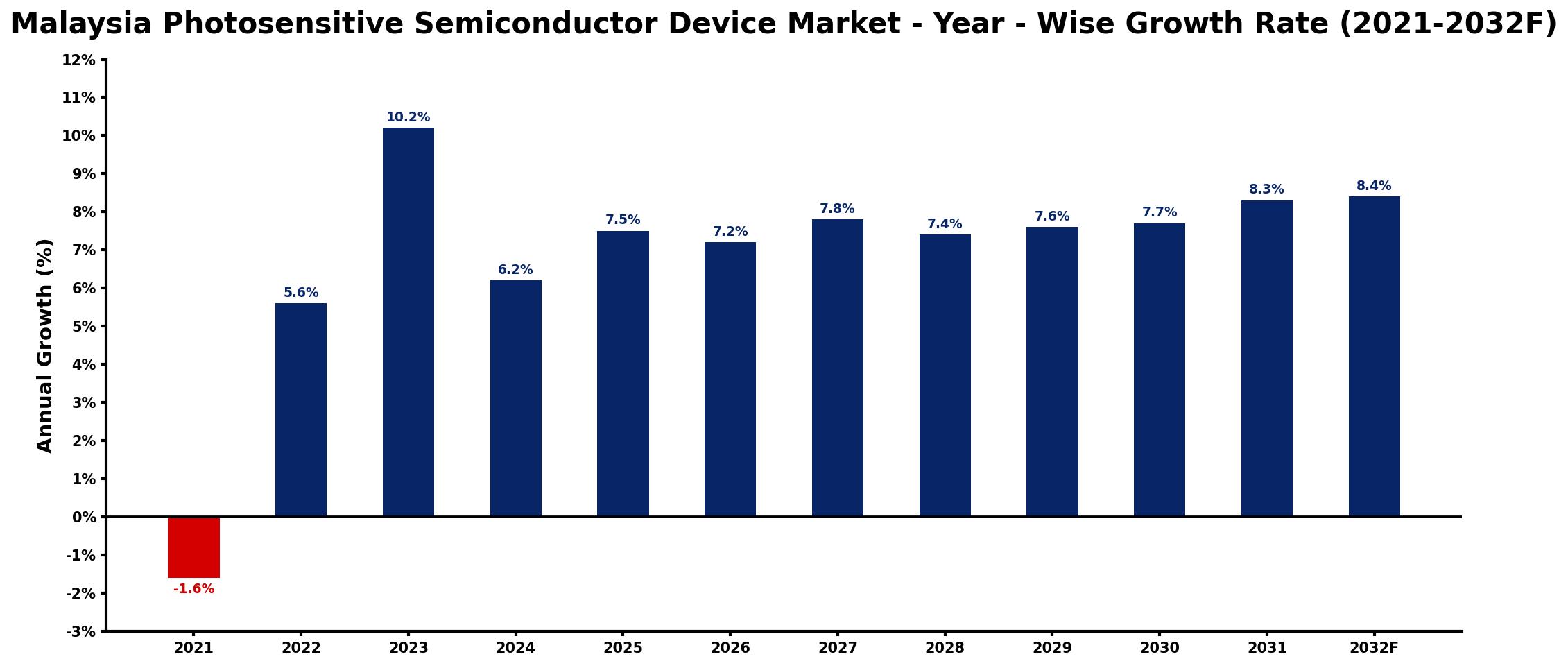
The table below presents the year‑wise growth rates along with the key drivers influencing the market
| Year | Growth Rate | Major Drivers |
| 2021 | -1.6% | Reduced investments in technology sectors |
| 2022 | 5.6% | Rising demand for renewable energy |
| 2023 | 10.2% | Expansion of smart city initiatives |
| 2024 | 6.2% | Growth in automotive electronics market |
| 2025 | 7.5% | Increased adoption of IoT solutions |
| 2026 | 7.2% | Surge in consumer electronics production |
| 2027 | 7.8% | Development of advanced manufacturing processes |
| 2028 | 7.4% | increased overall sector activity |
| 2029 | 7.6% | growing automotive sector requirements |
| 2030 | 7.7% | Rising focus on energy efficiency |
| 2031 | 8.3% | Increased funding for research projects |
| 2032 | 8.4% | growing regional consumption patterns |
Note: Market size estimations and growth projections presented in this report are based on 6Wresearch's proprietary forecasting methodology, utilizing the latest available industry data, government publications, and primary research inputs.
Malaysia Photosensitive Semiconductor Device Market Synopsis
The most significant force shaping the Malaysia Photosensitive Semiconductor Device Market is the burgeoning demand for sensor technologies across diverse applications. Industries ranging from automotive to industrial automation are increasingly integrating photosensitive devices to enhance performance and efficiency in light sensing and data transmission.
Moreover, the automotive sector is a primary driver, fueled by the growing need for safety features and autonomous driving capabilities. The proliferation of the IoT ecosystem further supports this market, as smart home systems and wearable devices increasingly rely on sophisticated sensor technologies.
Malaysia Photosensitive Semiconductor Device Market Key Takeaways
- The market is poised for substantial growth due to rising sensor demands across multiple sectors.
- Enhanced optical networks and communication systems are critical to the market's expansion.
- Technological advancements in device sensitivity are paving the way for next-generation applications.
- Automotive safety and automation are strong contributors to market dynamics.
- The IoT trend is boosting demand for innovative photosensitive devices, particularly in consumer electronics.
Evaluation of Restraints in Malaysia Photosensitive Semiconductor Device Market
Despite the strong growth potential, the Malaysia Photosensitive Semiconductor Device Market faces some constraints that could hinder its progress. Market saturation and commoditization pose significant challenges for manufacturers, necessitating differentiation through innovation and new applications. Additionally, the threat of imitation and counterfeiting underscores the need for robust intellectual property protections, which can be a resource-intensive endeavor for companies operating in this space.
Malaysia Photosensitive Semiconductor Device Market Trends
Emerging trends within the Malaysia Photosensitive Semiconductor Device Market include a shift towards high-speed data transmission systems and increased interest in integrating these devices into smart infrastructures. The ongoing transition to 5G networks is a pivotal trend, as it demands higher performance standards from photosensitive devices. Additionally, developments in energy-efficient technologies are influencing product design, leading to devices that not only perform better but also consume less power.
Malaysia Photosensitive Semiconductor Device Market Opportunities
Significant growth opportunities lie in tapping into the expanding automotive sector and the burgeoning IoT ecosystem. As Malaysia advances its technological infrastructure, the integration of photosensitive devices into smart cities presents lucrative avenues for investment. Furthermore, the healthcare sector's increasing reliance on automation and smart devices also represents a promising area for product development and market penetration.
Government Initiatives in the Malaysia Photosensitive Semiconductor Device Market
The Malaysian government has been actively promoting initiatives aimed at enhancing the nations technological infrastructure. Policies focused on digital transformation and public spending on smart city projects are particularly relevant. Additionally, incentives for research and development in high-tech industries are likely to foster innovation within the photosensitive semiconductor sector, creating a more conducive environment for growth.
Future Insights of the Malaysia Photosensitive Semiconductor Device Market
Looking ahead to 2026-2032, the Malaysia Photosensitive Semiconductor Device Market is set to experience robust growth, driven by continuous advancements in technology. The ongoing expansion of the automotive industry and the acceleration of IoT applications will be significant contributors. As manufacturers innovate to meet rising demands for efficiency and performance, the market will likely adapt and thrive in response to evolving consumer needs.
Malaysia Photosensitive Semiconductor Device Market Latest Developments (2025 - 2026)
Recent developments within the Malaysia Photosensitive Semiconductor Device Market reflect a strong alignment with global technological trends. Innovations aimed at enhancing device capabilities for automation and sensor integration are on the rise. Additionally, as companies pivot towards sustainable manufacturing practices, the focus on energy-efficient designs has gained momentum, signaling a commitment to meet both consumer and regulatory expectations in an increasingly eco-conscious market.
Malaysia Photosensitive Semiconductor Device Market - Key Attractiveness of the Report
- 10 Years of Market Numbers
- Historical Data Starting from 2022 to 2025
- Base Year: 2025
- Forecast Data until 2032
- Key Performance Indicators Impacting the Market
- Major Upcoming Developments and Projects
Key Highlights of the Report:
- Malaysia Photosensitive Semiconductor Device Market Outlook
- Market Size of Malaysia Photosensitive Semiconductor Device Market, 2025
- Forecast of Malaysia Photosensitive Semiconductor Device Market, 2032
- Historical Data and Forecast of Malaysia Photosensitive Semiconductor Device Revenues & Volume for the Period 2022-2032F
- Malaysia Photosensitive Semiconductor Device Market Trend Evolution
- Malaysia Photosensitive Semiconductor Device Market Drivers and Challenges
- Malaysia Photosensitive Semiconductor Device Price Trends
- Malaysia Photosensitive Semiconductor Device Porter's Five Forces
- Malaysia Photosensitive Semiconductor Device Industry Life Cycle
- Historical Data and Forecast of Malaysia Photosensitive Semiconductor Device Market Revenues & Volume By Device for the Period 2022-2032F
- Historical Data and Forecast of Malaysia Photosensitive Semiconductor Device Market Revenues & Volume By Photocell for the Period 2022-2032F
- Historical Data and Forecast of Malaysia Photosensitive Semiconductor Device Market Revenues & Volume By Photodiode for the Period 2022-2032F
- Historical Data and Forecast of Malaysia Photosensitive Semiconductor Device Market Revenues & Volume By Phototransistor for the Period 2022-2032F
- Historical Data and Forecast of Malaysia Photosensitive Semiconductor Device Market Revenues & Volume By Photoresistor for the Period 2022-2032F
- Historical Data and Forecast of Malaysia Photosensitive Semiconductor Device Market Revenues & Volume By Photo IC for the Period 2022-2032F
- Historical Data and Forecast of Malaysia Photosensitive Semiconductor Device Market Revenues & Volume By End User for the Period 2022-2032F
- Historical Data and Forecast of Malaysia Photosensitive Semiconductor Device Market Revenues & Volume By Automotive and Transportation for the Period 2022-2032F
- Historical Data and Forecast of Malaysia Photosensitive Semiconductor Device Market Revenues & Volume By Consumer Electronics for the Period 2022-2032F
- Historical Data and Forecast of Malaysia Photosensitive Semiconductor Device Market Revenues & Volume By Aerospace and Defence for the Period 2022-2032F
- Historical Data and Forecast of Malaysia Photosensitive Semiconductor Device Market Revenues & Volume By Healthcare for the Period 2022-2032F
- Historical Data and Forecast of Malaysia Photosensitive Semiconductor Device Market Revenues & Volume By Industrial for the Period 2022-2032F
- Historical Data and Forecast of Malaysia Photosensitive Semiconductor Device Market Revenues & Volume By Security and Survelliance for the Period 2022-2032F
- Malaysia Photosensitive Semiconductor Device Import Export Trade Statistics
- Market Opportunity Assessment By Device
- Market Opportunity Assessment By End User
- Malaysia Photosensitive Semiconductor Device Top Companies Market Share
- Malaysia Photosensitive Semiconductor Device Competitive Benchmarking By Technical and Operational Parameters
- Malaysia Photosensitive Semiconductor Device Company Profiles
- Malaysia Photosensitive Semiconductor Device Key Strategic Recommendations






































