Malaysia Piano Market Size Growth Rate
The Malaysia Piano Market is poised for steady growth rate improvements from 2025 to 2029. Commencing at 0.09% in 2025, growth builds up to 0.15% by 2029.

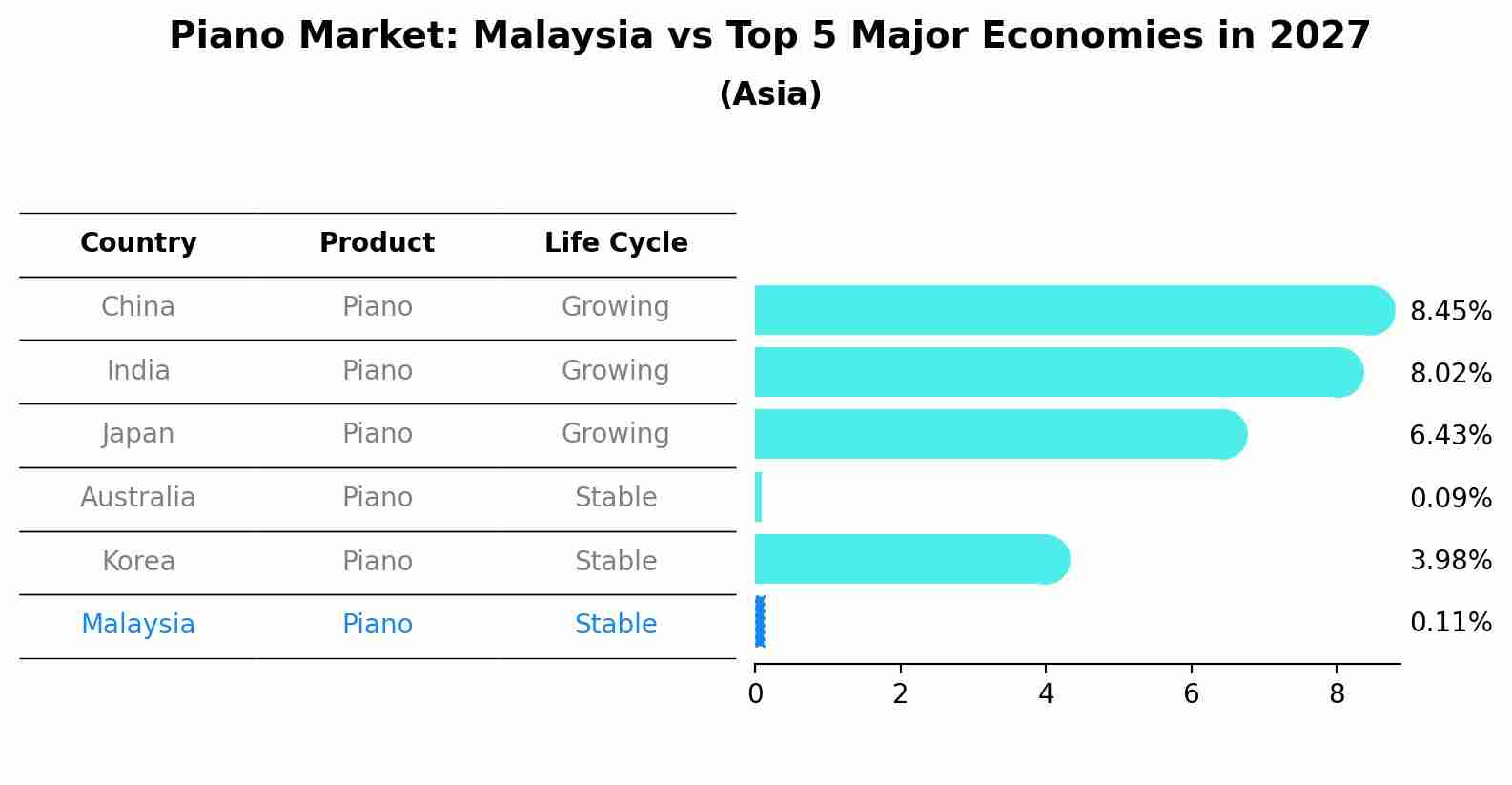
Piano Market: Malaysia vs Top 5 Major Economies in 2027 (Asia)
Malaysia's Piano market is anticipated to experience a stable growth rate of 0.11% by 2027, reflecting trends observed in the largest economy China, followed by India, Japan, Australia and South Korea.
Malaysia Piano Market Synopsis
The Malaysia piano market remains strong, driven by a combination of music education programs, a burgeoning interest in music, and the aspirational appeal of owning a piano. Pianos are increasingly seen as a symbol of status and cultural refinement. The market is witnessing innovation with digital pianos offering versatile features and connectivity. Continued support for music education and the adoption of pianos in homes and music schools are expected to sustain the market`s growth.
Drivers of the Market
The piano market in Malaysia is experiencing steady growth due to various factors. One of the key drivers is the rising interest in music education, both among children and adults. As more Malaysia recognize the benefits of learning to play the piano, the demand for acoustic and digital pianos is on the rise. Furthermore, the versatility of pianos in various musical genres, from classical to contemporary, contributes to their sustained popularity. The digital piano segment is particularly thriving, thanks to advancements in technology, making it a more affordable and accessible option for aspiring musicians.
Challenges of the Market
Challenges in the Malaysia piano market include limited consumer space for large pianos in urban settings. Competition from digital keyboards and electric pianos can affect traditional piano sales. Ensuring consistent piano tuning and quality control in different environmental conditions is crucial. Additionally, the market must address the cost of importing high-quality piano components.
COVID 19 Impact on the Market
The Malaysia Piano market, like the percussion instruments market, saw fluctuations in demand during the pandemic. Sales of acoustic pianos, typically used in concert halls and educational institutions, were affected by the closure of performance venues and schools. However, digital pianos and keyboards experienced increased sales as people turned to at-home music practice and online learning. The long-term outlook for the piano market is positive, with a resurgence in demand expected as cultural activities and music education resume.
Key Players in the Market
In the Malaysia piano market, some key players to watch out for include Yamaha Music Malaysia, Kawai Musical Instruments Manufacturing Co., Ltd., Roland Corporation, and Steinway Gallery Malaysia. These companies are renowned for producing high-quality pianos and have a significant presence in the Malaysia music industry.
Key Highlights of the Report:
- Malaysia Piano Market Outlook
- Market Size of Malaysia Piano Market, 2024
- Forecast of Malaysia Piano Market, 2031
- Historical Data and Forecast of Malaysia Piano Revenues & Volume for the Period 2021-2031
- Malaysia Piano Market Trend Evolution
- Malaysia Piano Market Drivers and Challenges
- Malaysia Piano Price Trends
- Malaysia Piano Porter's Five Forces
- Malaysia Piano Industry Life Cycle
- Historical Data and Forecast of Malaysia Piano Market Revenues & Volume By Type for the Period 2021-2031
- Historical Data and Forecast of Malaysia Piano Market Revenues & Volume By Grand Piano for the Period 2021-2031
- Historical Data and Forecast of Malaysia Piano Market Revenues & Volume By Upright Piano for the Period 2021-2031
- Historical Data and Forecast of Malaysia Piano Market Revenues & Volume By Application for the Period 2021-2031
- Historical Data and Forecast of Malaysia Piano Market Revenues & Volume By Learning and Teaching for the Period 2021-2031
- Historical Data and Forecast of Malaysia Piano Market Revenues & Volume By Entertainment for the Period 2021-2031
- Historical Data and Forecast of Malaysia Piano Market Revenues & Volume By Other for the Period 2021-2031
- Malaysia Piano Import Export Trade Statistics
- Market Opportunity Assessment By Type
- Market Opportunity Assessment By Application
- Malaysia Piano Top Companies Market Share
- Malaysia Piano Competitive Benchmarking By Technical and Operational Parameters
- Malaysia Piano Company Profiles
- Malaysia Piano Key Strategic Recommendations






































