Malaysia Piezoelectric Devices Market Size, Share & Growth Rate
The Malaysia Piezoelectric Devices Market was estimated at USD 438 Million in 2025 and is projected to reach USD 646 Million by 2032, growing at a CAGR of 5.7% from 2026 to 2032. This promising growth trajectory is largely propelled by the increasing integration of piezoelectric technology across diverse applications such as aerospace, medical devices, and consumer electronics. Moreover, the rising demand for precise sensors and actuators in various industrial sectors is expected to further bolster market expansion.
Malaysia Piezoelectric Devices Market Year-wise Growth Rate and Key Drivers
This graph highlights how the Malaysia Piezoelectric Devices Market has steadily grown over the years, supported by major growth factors.
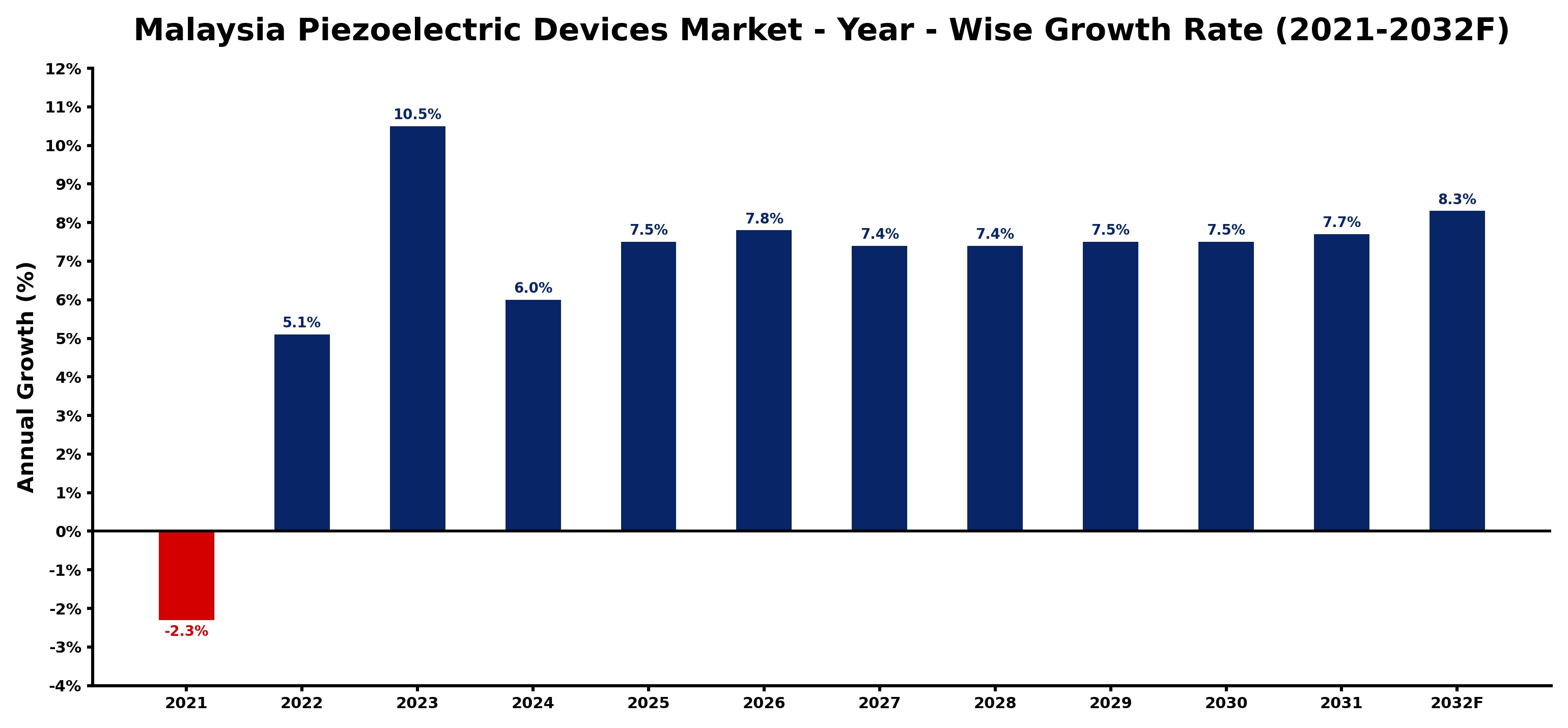
The table below presents the year‑wise growth rates along with the key drivers influencing the market
| Year | Growth Rate | Major Drivers |
| 2021 | -2.3% | Weak automotive production cut demand for piezoelectric device components |
| 2022 | 5.1% | Domestic precision engineering investments boost piezoelectric device production capacity |
| 2023 | 10.5% | Accelerated production schedules boosted piezoelectric component export volumes |
| 2024 | 6.0% | Precision engineering investments bolstered piezoelectric component export capabilities |
| 2025 | 7.5% | Precision engineering advancements boosted piezoelectric device manufacturing output |
| 2026 | 7.8% | Precision engineering advancements boosted piezoelectric component manufacturing output |
| 2027 | 7.4% | Manufacturing investments in precision engineering boost piezoelectric device production |
| 2028 | 7.4% | Domestic manufacturers adopt smart sensors for precision process control |
| 2029 | 7.5% | Improved automotive production lines boosted demand for piezoelectric sensors |
| 2030 | 7.5% | Precision engineering investments boosted piezoelectric device manufacturing capabilities |
| 2031 | 7.7% | Precision engineering upgrades boosted piezoelectric device export capabilities |
| 2032 | 8.3% | Precision engineering investments boosted piezoelectric component manufacturing capacity |
Note - Market size estimations and growth projections presented in this report are based on 6Wresearch’s advanced forecasting approach, validated with industry datasets as of June 2026.
Malaysia Piezoelectric Devices Market Synopsis
Currently, the most significant force shaping the Malaysia Piezoelectric Devices Market is the increasing emphasis on smart technology applications across multiple sectors. These devices are becoming critical components in modern sensor technologies, enhancing operational efficiency and precision.
In addition, the automotive industry's shift towards advanced driver assistance systems (ADAS) and the growth of the healthcare sector are contributing factors to the rising adoption of piezoelectric devices. The synergy of these trends is creating an environment ripe for innovation and investment.
Malaysia Piezoelectric Devices Market Key Takeaways
- Projected market growth with an estimated value reaching USD 646 Million by 2032.
- Increased application of piezoelectric technology in aerospace, automotive, and healthcare sectors.
- Local and international suppliers contribute to a diverse market landscape.
- Technological advancements are driving demand for high-precision sensors and actuators.
- Challenges in integration highlight the need for comprehensive technical support from market players.
Evaluation of Restraints in Malaysia Piezoelectric Devices Market
Despite the promising prospects, the Malaysia Piezoelectric Devices Market faces certain constraints. One significant hurdle is the integration of advanced piezoelectric systems into existing infrastructure, which often demands specialized knowledge and technical expertise. This requirement can deter some potential users, especially in traditional industries. Additionally, the high initial cost associated with adopting new technologies can slow down the pace of implementation, making it imperative for manufacturers to offer tailored solutions and robust support systems to alleviate these barriers.
Malaysia Piezoelectric Devices Market Trends
Currently, there is a noticeable trend towards miniaturization of piezoelectric devices, driven by the need for compact solutions in consumer electronics and medical applications. This shift is complemented by advancements in material science, leading to the development of more efficient and durable piezoelectric materials. Additionally, the increasing focus on sustainable energy solutions is propelling the use of piezoelectric energy harvesting technologies, further broadening the market's appeal.
Malaysia Piezoelectric Devices Market Opportunities
Opportunities for growth within the Malaysia Piezoelectric Devices Market are abundant. With the rising demand for renewable energy solutions, piezoelectric devices designed for energy harvesting are likely to see increased adoption. Moreover, as smart technology becomes more prevalent in everyday life, manufacturers can explore new applications within the Internet of Things (IoT) framework, positioning themselves at the forefront of innovation in this burgeoning sector.
Government Initiatives in the Malaysia Piezoelectric Devices Market
The Malaysian government has shown commitment to enhancing technological advancements through various initiatives and funding programs aimed at fostering innovation. By promoting R&D within key sectors such as healthcare and automotive, these government actions not only support local manufacturers but also create a conducive environment for the growth of piezoelectric technology. Public investments in infrastructure and smart city developments further enhance the potential landscape for piezoelectric devices.
Future Insights of the Malaysia Piezoelectric Devices Market
Looking ahead to the period from 2026 to 2032, the Malaysia Piezoelectric Devices Market is set to experience robust growth fueled by technological advancements and increased consumer awareness. With ongoing developments in smart technology and automation, the market will likely expand into new areas, especially within the healthcare and automotive sectors. The need for accurate measurement and control systems will keep demand strong, ensuring that industry players remain focused on innovation to capture emerging opportunities.
Malaysia Piezoelectric Devices Market Latest Developments (May 2025 - June 2026)
The piezoelectric devices sector in Malaysia is witnessing a series of developments, with companies focusing on enhancing product capabilities and diversifying their offerings. Collaborations between technology firms and research institutions are becoming increasingly common, paving the way for novel applications and improved efficiencies. Additionally, there has been a noticeable rise in investments directed toward sustainable energy solutions that integrate piezoelectric technology, reflecting the market's adaptive response to global energy demands.
Malaysia Piezoelectric Devices Market - Key Attractiveness of the Report
- 10 Years of Market Numbers
- Historical Data Starting from 2022 to 2025
- Base Year: 2025
- Forecast Data until 2032
- Key Performance Indicators Impacting the Market
- Major Upcoming Developments and Projects
Key Highlights of the Report:
- Malaysia Piezoelectric Devices Market Outlook
- Market Size of Malaysia Piezoelectric Devices Market, 2025
- Forecast of Malaysia Piezoelectric Devices Market, 2032
- Historical Data and Forecast of Malaysia Piezoelectric Devices Revenues & Volume for the Period 2022-2032F
- Malaysia Piezoelectric Devices Market Trend Evolution
- Malaysia Piezoelectric Devices Market Drivers and Challenges
- Malaysia Piezoelectric Devices Price Trends
- Malaysia Piezoelectric Devices Porter's Five Forces
- Malaysia Piezoelectric Devices Industry Life Cycle
- Historical Data and Forecast of Malaysia Piezoelectric Devices Market Revenues & Volume By Product for the Period 2022-2032F
- Historical Data and Forecast of Malaysia Piezoelectric Devices Market Revenues & Volume By Piezoelectric Sensors for the Period 2022-2032F
- Historical Data and Forecast of Malaysia Piezoelectric Devices Market Revenues & Volume By Piezoelectric Actuators for the Period 2022-2032F
- Historical Data and Forecast of Malaysia Piezoelectric Devices Market Revenues & Volume By Piezoelectric Motors for the Period 2022-2032F
- Historical Data and Forecast of Malaysia Piezoelectric Devices Market Revenues & Volume By Piezoelectric Transducers for the Period 2022-2032F
- Historical Data and Forecast of Malaysia Piezoelectric Devices Market Revenues & Volume By Piezoelectric Generators for the Period 2022-2032F
- Historical Data and Forecast of Malaysia Piezoelectric Devices Market Revenues & Volume By Others for the Period 2022-2032F
- Historical Data and Forecast of Malaysia Piezoelectric Devices Market Revenues & Volume By Material for the Period 2022-2032F
- Historical Data and Forecast of Malaysia Piezoelectric Devices Market Revenues & Volume By Piezoelectric Crystals for the Period 2022-2032F
- Historical Data and Forecast of Malaysia Piezoelectric Devices Market Revenues & Volume By Piezoelectric Ceramics for the Period 2022-2032F
- Historical Data and Forecast of Malaysia Piezoelectric Devices Market Revenues & Volume By Piezoelectric Polymers for the Period 2022-2032F
- Historical Data and Forecast of Malaysia Piezoelectric Devices Market Revenues & Volume By Piezoelectric Composites for the Period 2022-2032F
- Historical Data and Forecast of Malaysia Piezoelectric Devices Market Revenues & Volume By Application for the Period 2022-2032F
- Historical Data and Forecast of Malaysia Piezoelectric Devices Market Revenues & Volume By Aerospace & Defense for the Period 2022-2032F
- Historical Data and Forecast of Malaysia Piezoelectric Devices Market Revenues & Volume By Industrial & Manufacturing for the Period 2022-2032F
- Historical Data and Forecast of Malaysia Piezoelectric Devices Market Revenues & Volume By Automotive for the Period 2022-2032F
- Historical Data and Forecast of Malaysia Piezoelectric Devices Market Revenues & Volume By Healthcare for the Period 2022-2032F
- Historical Data and Forecast of Malaysia Piezoelectric Devices Market Revenues & Volume By Information & Communication for the Period 2022-2032F
- Historical Data and Forecast of Malaysia Piezoelectric Devices Market Revenues & Volume By Consumer Electronics for the Period 2022-2032F
- Historical Data and Forecast of Malaysia Piezoelectric Devices Market Revenues & Volume By Others for the Period 2022-2032F
- Malaysia Piezoelectric Devices Import Export Trade Statistics
- Market Opportunity Assessment By Product
- Market Opportunity Assessment By Material
- Market Opportunity Assessment By Application
- Malaysia Piezoelectric Devices Top Companies Market Share
- Malaysia Piezoelectric Devices Competitive Benchmarking By Technical and Operational Parameters
- Malaysia Piezoelectric Devices Company Profiles
- Malaysia Piezoelectric Devices Key Strategic Recommendations






































