Malaysia Piperonal Market Size, Share & Growth Rate
The Malaysia Piperonal Market was estimated at USD 216 Million in 2025 and is projected to reach USD 283 Million by 2032, growing at a CAGR of 3.9% from 2026 to 2032. This upward trend reflects an increasing consumer demand for fragrances and flavored products, particularly in the booming cosmetics and personal care sectors. As Malaysian lifestyles shift towards a greater emphasis on personal grooming and wellness, the piperonal market is positioned to capitalize on these evolving consumer preferences.
Malaysia Piperonal Market Year-wise Growth Rate and Key Drivers
This graph highlights how the Malaysia Piperonal Market has steadily grown over the years, supported by major growth factors.
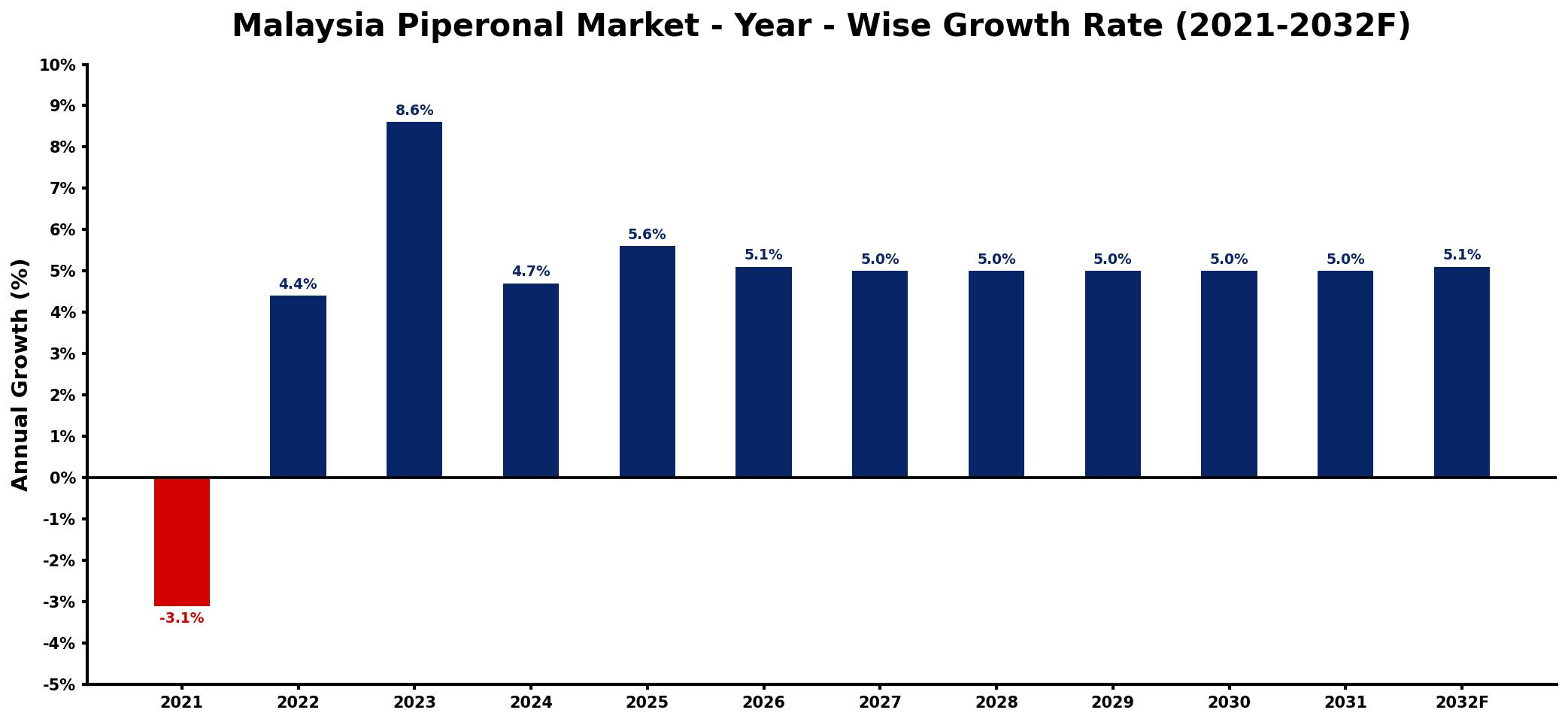
The table below presents the year‑wise growth rates along with the key drivers influencing the market
| Year | Growth Rate | Major Drivers |
| 2021 | -3.1% | decrease in fragrance manufacturing demand |
| 2022 | 4.4% | growing interest in natural ingredients |
| 2023 | 8.6% | expansion of personal care market |
| 2024 | 4.7% | increased investment in R&D |
| 2025 | 5.6% | rising popularity of aromatherapy products |
| 2026 | 5.1% | enhanced production capacities established |
| 2027 | 5.0% | growing export opportunities identified |
| 2028 | 5.0% | increased capital investment inflows |
| 2029 | 5.0% | increased consumer awareness trends |
| 2030 | 5.0% | growth in eco-friendly packaging |
| 2031 | 5.0% | rising demand for scented candles |
| 2032 | 5.1% | emerging markets driving new applications |
Note: Market size estimations and growth projections presented in this report are based on 6Wresearch's proprietary forecasting methodology, utilizing the latest available industry data, government publications, and primary research inputs.
Malaysia Piperonal Market Synopsis
The growing interest in natural and organic ingredients in the beauty and food industries is significantly boosting the piperonal market in Malaysia. This aromatic compound, primarily derived from the essential oils of various plants, is highly favored for its pleasant scent and flavor-enhancing properties.
With the pharmaceutical sector's increasing reliance on piperonal for the synthesis of active compounds, the demand trajectory is further solidified. The combination of a rising middle class and heightened disposable incomes in Malaysia is also propelling the overall growth of the market.
Malaysia Piperonal Market Key Takeaways
- Significant growth anticipated in the fragrance and flavor sectors, driven by increasing consumer preference.
- The pharmaceutical industrys dependence on piperonal for compound synthesis adds another layer of market resilience.
- Local manufacturers are playing a crucial role in meeting the rising domestic demand.
- Increased focus on natural and organic products supports the market's favorable outlook.
- Regulatory challenges may pose limitations, but the overall market shows robust potential for expansion.
Evaluation of Restraints in Malaysia Piperonal Market
Despite the promising growth prospects for the piperonal market in Malaysia, certain restraints could impede its expansion. Regulatory restrictions concerning the use of aromatic compounds in consumer products may limit market access and operational flexibility for manufacturers. Additionally, fluctuations in raw material prices could impact production costs, leading to price volatility in the market. These factors necessitate careful navigation by stakeholders as they strategize for future growth.
Malaysia Piperonal Market Trends
Emerging trends within the Malaysia Piperonal Market highlight a shift towards clean-label products and natural fragrances, aligning with global consumer preferences. Additionally, advancements in extraction technologies are enabling manufacturers to improve the purity and efficiency of piperonal production. The rise of e-commerce platforms has also transformed how consumers access scented products, thereby increasing market visibility and demand.
Malaysia Piperonal Market Opportunities
Significant investment opportunities lie in product innovation and the development of value-added piperonal derivatives. As the market increasingly focuses on sustainability, companies that can offer eco-friendly formulations stand to gain a competitive advantage. The exploration of untapped regional markets presents further avenues for growth, particularly in areas where personal care and cosmetic consumption is on the rise.
Government Initiatives in the Malaysia Piperonal Market
The Malaysian government has been implementing various initiatives to enhance the fragrance and flavor industries, including support for local manufacturers and incentives for research and development in natural product sourcing. Public spending on health and wellness, along with regulatory frameworks designed to promote sustainable practices, provides a conducive environment for the growth of the piperonal market.
Future Insights of the Malaysia Piperonal Market
Looking ahead to 2026-2032, the Malaysia Piperonal Market is expected to benefit from increased consumer sophistication and a growing preference for premium products. As the economy continues to recover from the pandemic, increased disposable incomes will likely amplify spending in the fragrance and cosmetic sectors. Furthermore, the continuous innovation in piperonal applications across various industries promises to keep this market dynamic and resilient.
Malaysia Piperonal Market Latest Developments (2025 - 2026)
Recent developments in the Malaysia piperonal market indicate an uptick in collaborations between local producers and international fragrance houses aimed at enhancing product offerings. Furthermore, new regulatory standards are being established to ensure quality and safety in the use of aromatic compounds. These changes reflect the industrys adaptation to evolving consumer needs and highlight a strong commitment to sustainability.
Malaysia Piperonal Market - Key Attractiveness of the Report
- 10 Years of Market Numbers
- Historical Data Starting from 2022 to 2025
- Base Year: 2025
- Forecast Data until 2032
- Key Performance Indicators Impacting the Market
- Major Upcoming Developments and Projects
Key Highlights of the Report:
- Malaysia Piperonal Market Outlook
- Market Size of Malaysia Piperonal Market, 2025
- Forecast of Malaysia Piperonal Market, 2032
- Historical Data and Forecast of Malaysia Piperonal Revenues & Volume for the Period 2022-2032F
- Malaysia Piperonal Market Trend Evolution
- Malaysia Piperonal Market Drivers and Challenges
- Malaysia Piperonal Price Trends
- Malaysia Piperonal Porter's Five Forces
- Malaysia Piperonal Industry Life Cycle
- Historical Data and Forecast of Malaysia Piperonal Market Revenues & Volume By Type for the Period 2022-2032F
- Historical Data and Forecast of Malaysia Piperonal Market Revenues & Volume By Natural Piperonal for the Period 2022-2032F
- Historical Data and Forecast of Malaysia Piperonal Market Revenues & Volume By Synthetic Piperonal for the Period 2022-2032F
- Historical Data and Forecast of Malaysia Piperonal Market Revenues & Volume By Application for the Period 2022-2032F
- Historical Data and Forecast of Malaysia Piperonal Market Revenues & Volume By Flavors and Fragrances for the Period 2022-2032F
- Historical Data and Forecast of Malaysia Piperonal Market Revenues & Volume By Food Industry for the Period 2022-2032F
- Historical Data and Forecast of Malaysia Piperonal Market Revenues & Volume By Others for the Period 2022-2032F
- Malaysia Piperonal Import Export Trade Statistics
- Market Opportunity Assessment By Type
- Market Opportunity Assessment By Application
- Malaysia Piperonal Top Companies Market Share
- Malaysia Piperonal Competitive Benchmarking By Technical and Operational Parameters
- Malaysia Piperonal Company Profiles
- Malaysia Piperonal Key Strategic Recommendations






































