Malaysia Plastic Processing Equipment Market Size, Share & Growth Rate
The Malaysia Plastic Processing Equipment Market was estimated at USD 172 Million in 2025 and is projected to reach USD 223 Million by 2032, growing at a CAGR of 3.8% from 2026 to 2032. This robust growth trajectory is driven by the escalating demand for sophisticated plastic processing technologies across key sectors such as automotive and packaging. As companies increasingly prioritize energy efficiency and operational automation, investment in advanced processing solutions is expected to surge.
Malaysia Plastic Processing Equipment Market Year-wise Growth Rate and Key Drivers
This graph highlights how the Malaysia Plastic Processing Equipment Market has steadily grown over the years, supported by major growth factors.
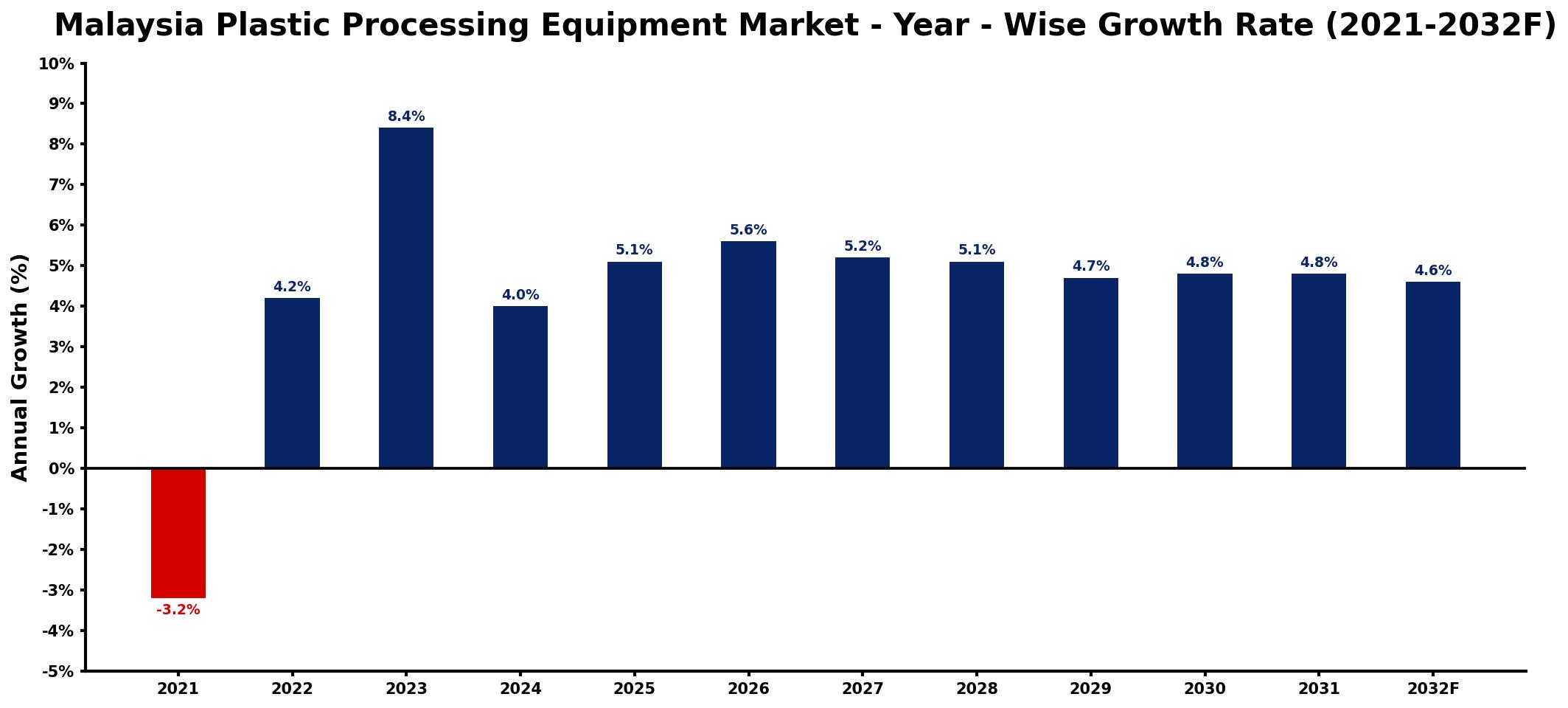
The table below presents the year‑wise growth rates along with the key drivers influencing the market
| Year | Growth Rate | Major Drivers |
| 2021 | -3.2% | decrease in industrial investments |
| 2022 | 4.2% | growing demand in packaging sector |
| 2023 | 8.4% | increased exports to ASEAN markets |
| 2024 | 4.0% | rising consumer electronics production |
| 2025 | 5.1% | expansion in automotive manufacturing |
| 2026 | 5.6% | growing environmental sustainability initiatives |
| 2027 | 5.2% | increased adoption of automation |
| 2028 | 5.1% | rising demand for biodegradable alternatives |
| 2029 | 4.7% | strengthening international trade flows |
| 2030 | 4.8% | expansion of e-commerce platforms |
| 2031 | 4.8% | increased focus on recycling technologies |
| 2032 | 4.6% | growing investment in R&D initiatives |
Note: Market size estimations and growth projections presented in this report are based on 6Wresearch's proprietary forecasting methodology, utilizing the latest available industry data, government publications, and primary research inputs.
Malaysia Plastic Processing Equipment Market Synopsis
At the forefront of the Malaysia Plastic Processing Equipment Market is the push for technological innovation, which is reshaping production methodologies across various industries. Companies are leveraging automation to enhance output quality and efficiency, leading to heightened demand for cutting-edge equipment.
This sector is not only benefiting from internal demands but is also aligning with global trends toward sustainability and efficiency. As regulatory frameworks become stricter regarding environmental impacts, manufacturers are prompted to upgrade equipment to comply, further driving the market's growth.
Malaysia Plastic Processing Equipment Market Key Takeaways
- The market is anticipated to grow from USD 172 Million in 2025 to USD 223 Million by 2032.
- Technological advancements and automation are pivotal in driving market demand.
- The automotive, electronics, and packaging sectors are significant contributors to growth.
- Energy efficiency and compliance with environmental regulations are crucial motivators for investment in new equipment.
- Post-pandemic recovery is fostering renewed interest in digitalization and automation technologies.
Evaluation of Restraints in Malaysia Plastic Processing Equipment Market
Despite the optimistic growth outlook, the Malaysia Plastic Processing Equipment Market faces notable restraints. A primary concern is the urgent need for technology upgrades to comply with increasingly stringent environmental regulations. High energy costs associated with operating advanced machinery can deter investment, especially for smaller players in the market. Additionally, the availability of skilled labor poses a challenge, as a knowledgeable workforce is crucial for operating and maintaining sophisticated equipment.
Malaysia Plastic Processing Equipment Market Trends
Significant trends in the Malaysia Plastic Processing Equipment Market include a marked shift towards smart manufacturing and Industry 4.0 practices. As companies adopt IoT and AI technologies, the demand for equipment that can seamlessly integrate into digital ecosystems is on the rise. Moreover, sustainability trends are prompting manufacturers to invest in equipment that minimizes waste and energy consumption, thereby aligning with global environmental goals.
Malaysia Plastic Processing Equipment Market Opportunities
The market is rife with opportunities for growth and investment, particularly in automation technologies and sustainable processing solutions. As Malaysian industries continue to modernize, there is a pronounced need for equipment that can enhance productivity while adhering to environmental standards. Companies that focus on developing energy-efficient machinery stand to gain significant market share as manufacturers prioritize sustainability alongside performance.
Government Initiatives in the Malaysia Plastic Processing Equipment Market
The Malaysian government is actively promoting the growth of the plastic processing equipment sector through various initiatives aimed at boosting manufacturing capabilities. Public investments in infrastructure, support for R&D, and incentives for adopting sustainable practices are just some measures that enhance the competitive landscape. Programs designed to facilitate foreign investment further signal a commitment to expanding the manufacturing base, which benefits the plastic processing equipment market.
Future Insights of the Malaysia Plastic Processing Equipment Market
Looking ahead, the Malaysia Plastic Processing Equipment Market is poised for a transformative period from 2026 to 2032. As industries increasingly embrace digitalization and automation, equipment that integrates seamlessly with advanced technologies will become essential. The push towards sustainability will also define the market's trajectory, prompting continuous investments in energy-efficient and environmentally friendly processing solutions.
Malaysia Plastic Processing Equipment Market Latest Developments (2025 - 2026)
Recent developments in the Malaysian plastic processing equipment sector indicate a strong shift towards automation and the adoption of smart technologies. Companies are increasingly investing in digital solutions that enhance operational efficiency and productivity. Additionally, there is a growing focus on meeting international environmental standards, leading to the launch of innovative equipment tailored to reduce carbon footprints while maintaining output quality.
Malaysia Plastic Processing Equipment Market - Key Attractiveness of the Report
- 10 Years of Market Numbers
- Historical Data Starting from 2022 to 2025
- Base Year: 2025
- Forecast Data until 2032
- Key Performance Indicators Impacting the Market
- Major Upcoming Developments and Projects
Key Highlights of the Report:
- Malaysia Plastic Processing Equipment Market Outlook
- Market Size of Malaysia Plastic Processing Equipment Market, 2025
- Forecast of Malaysia Plastic Processing Equipment Market, 2032
- Historical Data and Forecast of Malaysia Plastic Processing Equipment Revenues & Volume for the Period 2022-2032F
- Malaysia Plastic Processing Equipment Market Trend Evolution
- Malaysia Plastic Processing Equipment Market Drivers and Challenges
- Malaysia Plastic Processing Equipment Price Trends
- Malaysia Plastic Processing Equipment Porter's Five Forces
- Malaysia Plastic Processing Equipment Industry Life Cycle
- Historical Data and Forecast of Malaysia Plastic Processing Equipment Market Revenues & Volume By Product for the Period 2022-2032F
- Historical Data and Forecast of Malaysia Plastic Processing Equipment Market Revenues & Volume By Screw for the Period 2022-2032F
- Historical Data and Forecast of Malaysia Plastic Processing Equipment Market Revenues & Volume By Twin Screw for the Period 2022-2032F
- Historical Data and Forecast of Malaysia Plastic Processing Equipment Market Revenues & Volume By Barrel for the Period 2022-2032F
- Historical Data and Forecast of Malaysia Plastic Processing Equipment Market Revenues & Volume By Nozzle System for the Period 2022-2032F
- Historical Data and Forecast of Malaysia Plastic Processing Equipment Market Revenues & Volume By End Caps for the Period 2022-2032F
- Historical Data and Forecast of Malaysia Plastic Processing Equipment Market Revenues & Volume By Others for the Period 2022-2032F
- Historical Data and Forecast of Malaysia Plastic Processing Equipment Market Revenues & Volume By Material for the Period 2022-2032F
- Historical Data and Forecast of Malaysia Plastic Processing Equipment Market Revenues & Volume By Bimetallic for the Period 2022-2032F
- Historical Data and Forecast of Malaysia Plastic Processing Equipment Market Revenues & Volume By Nitride for the Period 2022-2032F
- Historical Data and Forecast of Malaysia Plastic Processing Equipment Market Revenues & Volume By Carbide for the Period 2022-2032F
- Historical Data and Forecast of Malaysia Plastic Processing Equipment Market Revenues & Volume By Steel for the Period 2022-2032F
- Historical Data and Forecast of Malaysia Plastic Processing Equipment Market Revenues & Volume By Chrome for the Period 2022-2032F
- Historical Data and Forecast of Malaysia Plastic Processing Equipment Market Revenues & Volume By Others for the Period 2022-2032F
- Historical Data and Forecast of Malaysia Plastic Processing Equipment Market Revenues & Volume By Industry for the Period 2022-2032F
- Historical Data and Forecast of Malaysia Plastic Processing Equipment Market Revenues & Volume By Automotive for the Period 2022-2032F
- Historical Data and Forecast of Malaysia Plastic Processing Equipment Market Revenues & Volume By Packaging for the Period 2022-2032F
- Historical Data and Forecast of Malaysia Plastic Processing Equipment Market Revenues & Volume By Electronics for the Period 2022-2032F
- Historical Data and Forecast of Malaysia Plastic Processing Equipment Market Revenues & Volume By Healthcare for the Period 2022-2032F
- Historical Data and Forecast of Malaysia Plastic Processing Equipment Market Revenues & Volume By Consumer Goods for the Period 2022-2032F
- Historical Data and Forecast of Malaysia Plastic Processing Equipment Market Revenues & Volume By Others for the Period 2022-2032F
- Historical Data and Forecast of Malaysia Plastic Processing Equipment Market Revenues & Volume By Application for the Period 2022-2032F
- Historical Data and Forecast of Malaysia Plastic Processing Equipment Market Revenues & Volume By Extrusion for the Period 2022-2032F
- Historical Data and Forecast of Malaysia Plastic Processing Equipment Market Revenues & Volume By Injection Molding for the Period 2022-2032F
- Historical Data and Forecast of Malaysia Plastic Processing Equipment Market Revenues & Volume By Sales Channel for the Period 2022-2032F
- Historical Data and Forecast of Malaysia Plastic Processing Equipment Market Revenues & Volume By OEM for the Period 2022-2032F
- Historical Data and Forecast of Malaysia Plastic Processing Equipment Market Revenues & Volume By After Market for the Period 2022-2032F
- Malaysia Plastic Processing Equipment Import Export Trade Statistics
- Market Opportunity Assessment By Product
- Market Opportunity Assessment By Material
- Market Opportunity Assessment By Industry
- Market Opportunity Assessment By Application
- Market Opportunity Assessment By Sales Channel
- Malaysia Plastic Processing Equipment Top Companies Market Share
- Malaysia Plastic Processing Equipment Competitive Benchmarking By Technical and Operational Parameters
- Malaysia Plastic Processing Equipment Company Profiles
- Malaysia Plastic Processing Equipment Key Strategic Recommendations






































