Malaysia Plastics Products Market Summary
The malaysia plastics products market was estimated at USD 198 Million in 2025 and is projected to reach USD 258 Million by 2032, growing at a CAGR of 5.5% from 2026 to 2032.
Malaysia Plastics Products Market Year-wise Growth Rate and Key Drivers
This graph highlights how the Malaysia Plastics Products Market has steadily grown over the past five years, supported by major growth factors.
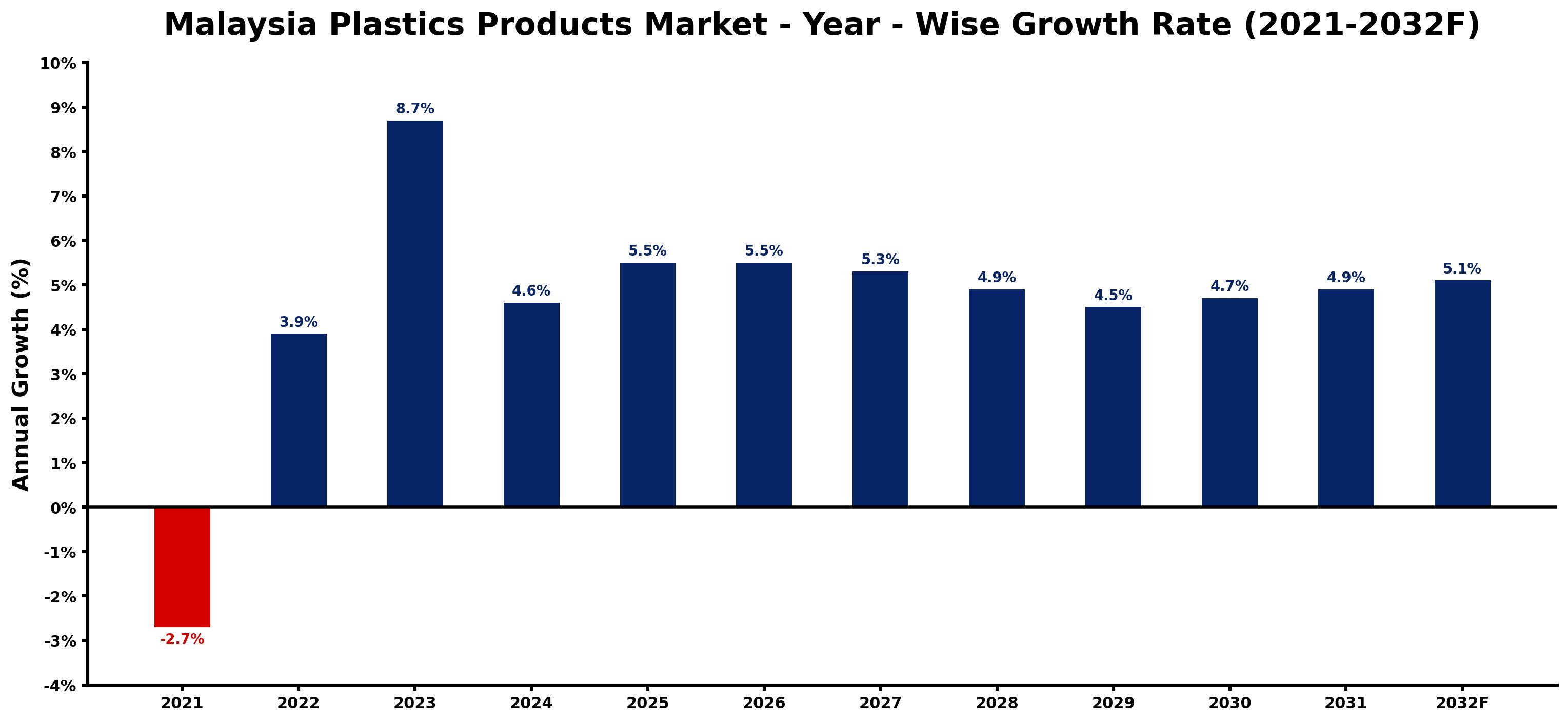
The table below presents the year wise growth rates along with the key drivers influencing the market
| Year | Growth Rate | Major Drivers |
| 2021 | -2.7% | Increased environmental awareness led to a decline in plastic product consumption among ecoconscious consumers. |
| 2022 | 3.9% | Consumer preferences shifted towards sustainable materials, influencing product development strategies. |
| 2023 | 8.7% | Increased urbanization prompted growth in construction materials, including plastic products and components. |
| 2024 | 4.6% | Technological innovations led to enhanced recycling processes, reducing waste and costs significantly. |
| 2025 | 5.5% | Local manufacturers began embracing automation, boosting output efficiency and product quality. |
| 2026 | 5.5% | Emerging industries, such as e-commerce, seized the opportunity for innovative packaging solutions. |
| 2027 | 5.3% | Corporate sustainability commitments encouraged investments in biodegradable and eco-friendly plastic alternatives. |
| 2028 | 4.9% | Regional trade agreements fostered collaborations, expanding the market's reach in Southeast Asia. |
| 2029 | 4.5% | Environmental awareness campaigns stimulated consumer demand for responsibly sourced plastic products. |
| 2030 | 4.7% | Increased investments in R&D led to the introduction of advanced composite materials in production. |
| 2031 | 4.9% | Collaborations between startups and established firms revitalized the market with disruptive innovations. |
| 2032 | 5.1% | The rise of smart manufacturing techniques improved efficiency, positioning Malaysia as a competitive hub. |
Note - Market size estimations and growth projections presented in this report are based on 6Wresearch's advanced forecasting approach, validated with industry datasets as of June 2026.
Malaysia Plastics Products Market Synopsis
The Malaysia Plastics Products Market is projected to reach 5.5% and witness significant growth during the forecast period (2026-2032). The market is anticipated to expand at a compound annual growth rate (CAGR) of 6.6%, driven by the increasing demand across multiple sectors including construction, automotive, packaging, and consumer durables. As industrialization progresses and the population grows, there is a corresponding rise in the consumption of plastic products. Factors such as rising disposable income and shifts in consumer lifestyle are also contributing to the robust growth of the plastics industry in Malaysia.
Malaysia Plastics Products Market Growth Drivers
Several factors are propelling the growth of the Malaysia Plastics Products Market. Firstly, the rapid growth in the construction sector has greatly increased the demand for various plastic materials utilized in building and infrastructure projects. Secondly, the automotive industry is also witnessing a significant uptick in the use of plastics for components, driven by a need for lightweight and fuel-efficient vehicles. Thirdly, the packaging sector is evolving, with more companies opting for flexible and sustainable plastic solutions to cater to consumer preferences.
- Investment in infrastructure development has led to an increase in the need for durable and versatile plastic products.
- Consumer preferences are shifting towards convenience and sustainability, enhancing the demand for innovative packaging solutions.
- The automotive sector's emphasis on lightweight materials for fuel efficiency is significantly boosting the plastics market.
- Collaborations between businesses and research institutions are fostering innovation in biodegradable and eco-friendly plastic alternatives.
- Public and private sector initiatives are focusing on improving recycling technologies to reduce environmental impact, further driving market growth.
Malaysia Plastics Products Market Challenges and Restraints
The Malaysia Plastics Products Market faces several challenges that could impede its growth trajectory. Stringent environmental regulations and health concerns regarding plastic pollution pose significant risks to the industry's expansion. Bans on specific plastic products have been implemented in response to environmental issues, which may affect the overall market dynamics. Additionally, the volatility in raw material prices can lead to unpredictability in production costs, thereby impacting profitability.
- Compliance with environmental regulations can increase operational costs and limit production capabilities.
- The imposition of bans on certain single-use plastics can restrict market opportunities and challenge profitability.
- Fluctuating raw material prices make it difficult for manufacturers to maintain competitive pricing.
- Consumer pushback against plastic products could lead to a decline in market sentiment and reduced sales.
- Increased scrutiny from governmental bodies may lead to heightened operational regulations, further complicating production processes.
Malaysia Plastics Products Market Government Investment and Initiatives
The Malaysian government has implemented various initiatives aimed at promoting the growth of the plastics sector while ensuring environmental sustainability. Investments in research and development of eco-friendly plastics are gaining traction, supported by public funding aimed at fostering innovation. Furthermore, the government has launched campaigns to encourage recycling and the adoption of alternative materials, which support long-term industry growth. Collaborative efforts with industry stakeholders are also focused on establishing comprehensive recycling infrastructure to manage plastic waste effectively.
Malaysia Plastics Products Market Latest Developments (May 2025 - June 2026)
Recent developments in the Malaysia Plastics Products Market reflect the industry's adaptability to changing consumer preferences and regulatory environments. Over this period, there has been a notable increase in the introduction of biodegradable plastics as manufacturers respond to environmental concerns. New partnerships between businesses and technology firms have emerged, aimed at developing advanced recycling processes and products. Additionally, the packaging industry has seen significant innovations geared towards sustainability, aligning product offerings with consumer demand for eco-friendly alternatives.
Malaysia Plastics Products Market - Key Attractiveness of the Report
- 10 Years of Market Numbers
- Historical Data Starting from 2022 to 2025
- Base Year: 2025
- Forecast Data until 2032
- Key Performance Indicators Impacting the Market
- Major Upcoming Developments and Projects
Key Highlights of the Report:
- Malaysia Plastics Products Market Outlook
- Market Size of Malaysia Plastics Products Market, 2025
- Forecast of Malaysia Plastics Products Market, 2032F
- Historical Data and Forecast of Malaysia Plastics Products Revenues & Volume for the Period 2022-2032F
- Malaysia Plastics Products Market Trend Evolution
- Malaysia Plastics Products Market Drivers and Challenges
- Malaysia Plastics Products Price Trends
- Malaysia Plastics Products Porter's Five Forces
- Malaysia Plastics Products Industry Life Cycle
- Historical Data and Forecast of Malaysia Plastics Products Market Revenues & Volume By Types for the Period 2022-2032F
- Historical Data and Forecast of Malaysia Plastics Products Market Revenues & Volume By Plastics Packaging Materials And Unlaminated Film And Sheet for the Period 2022-2032F
- Historical Data and Forecast of Malaysia Plastics Products Market Revenues & Volume By Plastic Pipes And Shapes for the Period 2022-2032F
- Historical Data and Forecast of Malaysia Plastics Products Market Revenues & Volume By Laminated Plastics Plate, Sheet, And Shape for the Period 2022-2032F
- Historical Data and Forecast of Malaysia Plastics Products Market Revenues & Volume By Plastics Bottle for the Period 2022-2032F
- Historical Data and Forecast of Malaysia Plastics Products Market Revenues & Volume By Urethane And Other Foam Product for the Period 2022-2032F
- Historical Data and Forecast of Malaysia Plastics Products Market Revenues & Volume By Polystyrene Foam Product for the Period 2022-2032F
- Historical Data and Forecast of Malaysia Plastics Products Market Revenues & Volume By Other Plastics Product ? ? for the Period 2022-2032F
- Historical Data and Forecast of Malaysia Plastics Products Market Revenues & Volume By End-users for the Period 2022-2032F
- Historical Data and Forecast of Malaysia Plastics Products Market Revenues & Volume By Automotive & Transportation for the Period 2022-2032F
- Historical Data and Forecast of Malaysia Plastics Products Market Revenues & Volume By Electrical & Electronics for the Period 2022-2032F
- Historical Data and Forecast of Malaysia Plastics Products Market Revenues & Volume By Medical for the Period 2022-2032F
- Historical Data and Forecast of Malaysia Plastics Products Market Revenues & Volume By Construction for the Period 2022-2032F
- Historical Data and Forecast of Malaysia Plastics Products Market Revenues & Volume By Others for the Period 2022-2032F
- Malaysia Plastics Products Import Export Trade Statistics
- Market Opportunity Assessment By Types
- Market Opportunity Assessment By End-users
- Malaysia Plastics Products Top Companies Market Share
- Malaysia Plastics Products Competitive Benchmarking By Technical and Operational Parameters
- Malaysia Plastics Products Company Profiles
- Malaysia Plastics Products Key Strategic Recommendations






































