Malaysia Plumbing Components Market Size, Share & Growth Rate
The Malaysia Plumbing Components Market was estimated at USD 162 Million in 2025 and is projected to reach USD 211 Million by 2032, growing at a CAGR of 3.8% from 2026 to 2032. This growth is largely propelled by the ongoing urbanization and robust construction activities across the nation. Additionally, increasing awareness about water conservation is driving demand for more efficient plumbing solutions, encouraging manufacturers to innovate and adapt.
Malaysia Plumbing Components Market Year-wise Growth Rate and Key Drivers
This graph highlights how the Malaysia Plumbing Components Market has steadily grown over the years, supported by major growth factors.
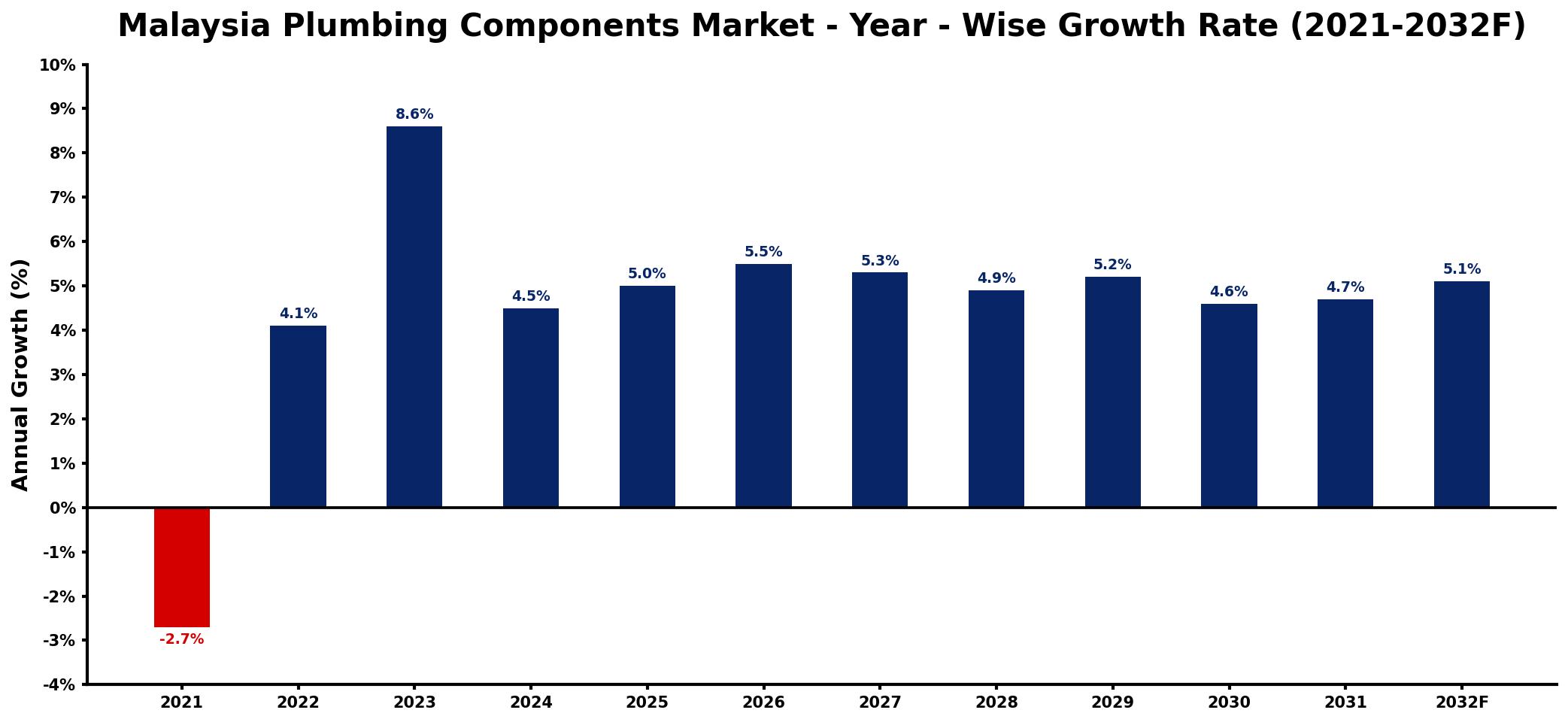
The table below presents the year‑wise growth rates along with the key drivers influencing the market
| Year | Growth Rate | Major Drivers |
| 2021 | -2.7% | Economic slowdown affecting investments |
| 2022 | 4.1% | Construction sector rebounds strongly |
| 2023 | 8.6% | Rising urbanization driving demand |
| 2024 | 4.5% | Increased residential renovation projects |
| 2025 | 5.0% | Government infrastructure spending rises |
| 2026 | 5.5% | Sustainability initiatives gaining traction |
| 2027 | 5.3% | Technological advancements in installations |
| 2028 | 4.9% | Growing awareness of water conservation |
| 2029 | 5.2% | Expansion of smart home technologies |
| 2030 | 4.6% | Rising disposable income boosts spending |
| 2031 | 4.7% | Increased focus on energy efficiency |
| 2032 | 5.1% | Growing demand for eco-friendly solutions |
Note: Market size estimations and growth projections presented in this report are based on 6Wresearch's proprietary forecasting methodology, utilizing the latest available industry data, government publications, and primary research inputs.
Malaysia Plumbing Components Market Synopsis
Recently, the plumbing components market in Malaysia has shown considerable momentum, spurred by a booming construction sector. However, as projects evolve in complexity and scope, the market is poised for an even brighter future, driven by both infrastructure development and modernization efforts.
This vibrant market is characterized by a strong demand for pipes, fittings, and fixtures across residential, commercial, and industrial applications. The rising focus on sustainability is further shaping market dynamics, as consumers and businesses alike seek eco-friendly plumbing options.
Malaysia Plumbing Components Market Key Takeaways
- Strong growth trajectory fueled by urbanization and construction activities.
- Increasing demand for advanced plumbing systems focusing on water efficiency.
- Adoption of eco-friendly products and technologies shaping market offerings.
- Manufacturers are adapting to evolving regulations and quality standards.
- The market is recovering post-pandemic, with renewed investments in infrastructure.
Evaluation of Restraints in Malaysia Plumbing Components Market
The Malaysia plumbing components market faces several restraints that limit its growth potential. A significant factor is the evolving regulatory landscape, which mandates compliance with stringent building codes and water efficiency standards. Adhering to these regulations can impose additional costs on manufacturers and disrupt production cycles. Furthermore, fluctuations in construction demand can create uncertainty for suppliers and manufacturers, making long-term planning a challenge. Quality control remains paramount, as any failure in plumbing components can lead to severe consequences, necessitating continuous investment in product durability and innovation.
Malaysia Plumbing Components Market Trends
Current trends in the Malaysia plumbing components market reflect a growing emphasis on sustainability and efficiency. Manufacturers are increasingly offering products designed with eco-friendly materials and technologies that minimize water usage. Additionally, smart plumbing solutions that integrate with digital technologies are gaining traction, appealing to a tech-savvy consumer base. The renovation and retrofitting of existing buildings also play a critical role, as stakeholders seek to upgrade their plumbing systems to meet modern standards.
Malaysia Plumbing Components Market Opportunities
The future holds significant opportunities for growth within the Malaysia plumbing components market. Companies that focus on innovation, particularly in the development of smart and sustainable plumbing solutions, are likely to thrive. There is also a distinct opportunity for businesses to capitalize on the renovation market, where older properties require updated plumbing systems. Furthermore, as urban areas continue to expand, investments in public infrastructure will drive demand for plumbing components, creating a favorable environment for market players.
Government Initiatives in the Malaysia Plumbing Components Market
The Malaysian government has been actively supporting the construction sector through various initiatives and policies aimed at enhancing infrastructure development. Incentives for sustainable building practices, including the promotion of eco-friendly plumbing solutions, are also part of the governments agenda. Public spending on infrastructure projects is expected to increase, providing a favorable backdrop for investments in the plumbing components market.
Future Insights of the Malaysia Plumbing Components Market
Looking ahead to 2026-2032, the Malaysia plumbing components market is set to expand further, driven by continued urbanization and infrastructure investments. The integration of smart technologies into plumbing systems will redefine efficiency and performance standards. As environmental concerns grow, the adoption of sustainable practices is anticipated to become a non-negotiable aspect of the market, fostering innovation and competitiveness among manufacturers.
Malaysia Plumbing Components Market Latest Developments (2025 - 2026)
Recent developments in the Malaysia plumbing components market indicate a shift towards innovative technologies and sustainable practices. Companies are exploring new materials and production methods to enhance product efficiency and reduce environmental impact. Additionally, collaborations among manufacturers and stakeholders in the construction industry are on the rise, aimed at addressing the growing demand for eco-friendly and durable plumbing solutions.
Malaysia Plumbing Components Market - Key Attractiveness of the Report
- 10 Years of Market Numbers
- Historical Data Starting from 2022 to 2025
- Base Year: 2025
- Forecast Data until 2032
- Key Performance Indicators Impacting the Market
- Major Upcoming Developments and Projects
Key Highlights of the Report:
- Malaysia Plumbing Components Market Outlook
- Market Size of Malaysia Plumbing Components Market, 2025
- Forecast of Malaysia Plumbing Components Market, 2032
- Historical Data and Forecast of Malaysia Plumbing Components Revenues & Volume for the Period 2022-2032F
- Malaysia Plumbing Components Market Trend Evolution
- Malaysia Plumbing Components Market Drivers and Challenges
- Malaysia Plumbing Components Price Trends
- Malaysia Plumbing Components Porter's Five Forces
- Malaysia Plumbing Components Industry Life Cycle
- Historical Data and Forecast of Malaysia Plumbing Components Market Revenues & Volume By Product for the Period 2022-2032F
- Historical Data and Forecast of Malaysia Plumbing Components Market Revenues & Volume By Fittings for the Period 2022-2032F
- Historical Data and Forecast of Malaysia Plumbing Components Market Revenues & Volume By Manifolds for the Period 2022-2032F
- Historical Data and Forecast of Malaysia Plumbing Components Market Revenues & Volume By Pipes for the Period 2022-2032F
- Historical Data and Forecast of Malaysia Plumbing Components Market Revenues & Volume By Valves for the Period 2022-2032F
- Historical Data and Forecast of Malaysia Plumbing Components Market Revenues & Volume By End User for the Period 2022-2032F
- Historical Data and Forecast of Malaysia Plumbing Components Market Revenues & Volume By Residential for the Period 2022-2032F
- Historical Data and Forecast of Malaysia Plumbing Components Market Revenues & Volume By Non-residential for the Period 2022-2032F
- Historical Data and Forecast of Malaysia Plumbing Components Market Revenues & Volume By Application for the Period 2022-2032F
- Historical Data and Forecast of Malaysia Plumbing Components Market Revenues & Volume By Bathtubs for the Period 2022-2032F
- Historical Data and Forecast of Malaysia Plumbing Components Market Revenues & Volume By Showerheads for the Period 2022-2032F
- Historical Data and Forecast of Malaysia Plumbing Components Market Revenues & Volume By Faucets for the Period 2022-2032F
- Historical Data and Forecast of Malaysia Plumbing Components Market Revenues & Volume By Others for the Period 2022-2032F
- Malaysia Plumbing Components Import Export Trade Statistics
- Market Opportunity Assessment By Product
- Market Opportunity Assessment By End User
- Market Opportunity Assessment By Application
- Malaysia Plumbing Components Top Companies Market Share
- Malaysia Plumbing Components Competitive Benchmarking By Technical and Operational Parameters
- Malaysia Plumbing Components Company Profiles
- Malaysia Plumbing Components Key Strategic Recommendations






































