Malaysia Point Of Sale Terminals Market Size, Share & Growth Rate
The Malaysia Point Of Sale Terminals Market was estimated at USD 471 Million in 2025 and is projected to reach USD 614 Million by 2032, growing at a CAGR of 3.9% from 2026 to 2032. This upward trajectory is largely driven by the increasing preference for digital payment solutions and the heightened demand for advanced POS systems that encompass both inventory management and customer relationship features. With the ongoing expansion of the retail and hospitality sectors, businesses are prioritizing enhanced transaction efficiency and customer engagement, which is further propelling the market forward.
Malaysia Point Of Sale Terminals Market Year-wise Growth Rate and Key Drivers
This graph highlights how the Malaysia Point Of Sale Terminals Market has steadily grown over the years, supported by major growth factors.
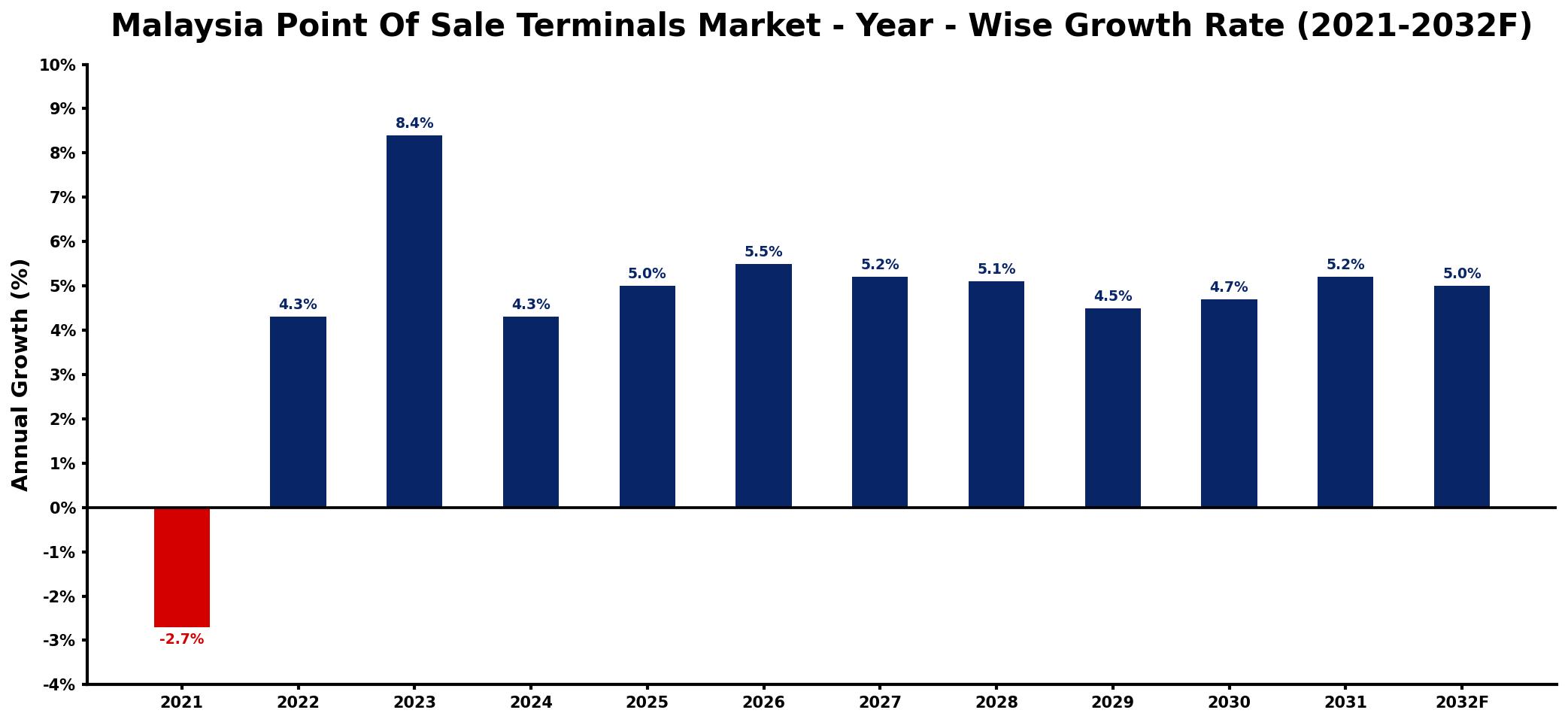
The table below presents the year‑wise growth rates along with the key drivers influencing the market
| Year | Growth Rate | Major Drivers |
| 2021 | -2.7% | decrease in consumer spending habits |
| 2022 | 4.3% | rising adoption of digital payments |
| 2023 | 8.4% | increased investment in technology |
| 2024 | 4.3% | growing e-commerce transaction volumes |
| 2025 | 5.0% | expansion of retail payment options |
| 2026 | 5.5% | enhanced focus on customer experience |
| 2027 | 5.2% | augmentation of mobile payment usage |
| 2028 | 5.1% | development of integrated payment solutions |
| 2029 | 4.5% | surge in contactless payment preferences |
| 2030 | 4.7% | broadening acceptance across sectors |
| 2031 | 5.2% | strengthening regulatory support frameworks |
| 2032 | 5.0% | emergence of innovative fintech solutions |
Note: Market size estimations and growth projections presented in this report are based on 6Wresearch's proprietary forecasting methodology, utilizing the latest available industry data, government publications, and primary research inputs.
Malaysia Point Of Sale Terminals Market Synopsis
The demand for POS terminals in Malaysia is being significantly bolstered by the rising penetration of e-commerce, which has prompted retailers to adopt robust and flexible payment processing solutions. Furthermore, the growing acceptance of contactless payment options has catalyzed the need for modern POS systems that support these functionalities, especially in light of the changes instigated by the COVID-19 pandemic.
As businesses increasingly prioritize customer experience, POS terminals integrated with advanced features like loyalty programs and real-time data analytics are becoming more sought after. The market is also witnessing innovations such as mobile POS systems, which are enhancing transaction convenience and efficiency, reflecting the broader trends in consumer behavior.
Malaysia Point Of Sale Terminals Market Key Takeaways
- The shift towards cashless transactions is a primary driver of POS terminal adoption in Malaysia.
- Integration of inventory and customer relationship management features is increasingly demanded by businesses.
- Technological advancements in mobile and cloud-based solutions are reshaping the POS landscape.
- COVID-19 has accelerated the embrace of contactless payment methods across various sectors.
- There is a competitive landscape where providers are focusing on security and user-friendly interfaces.
Evaluation of Restraints in Malaysia Point Of Sale Terminals Market
Despite the growth potential, the Malaysia point of sale terminals market is not without its challenges. Rapid technological advancements require continuous adaptation from POS providers, which can strain resources and innovation pipelines. Additionally, cybersecurity threats loom large, necessitating robust security measures to protect sensitive payment data. Compliance with ever-evolving regulatory standards, particularly concerning data protection, presents another layer of complexity that requires ongoing attention and investment. Economic fluctuations can also influence the willingness of businesses to invest in advanced POS systems, further complicating the market dynamics.
Malaysia Point Of Sale Terminals Market Trends
Current trends show a marked increase in the adoption of mobile and contactless payment technologies, driven by evolving consumer preferences and the influence of the pandemic. Additionally, the integration of artificial intelligence and machine learning into POS systems is beginning to offer businesses enhanced capabilities for data analysis and customer insights. There is also a notable shift towards cloud-based POS solutions, providing businesses with greater flexibility and scalability as they adapt to changing market conditions.
Malaysia Point Of Sale Terminals Market Opportunities
The ongoing digital transformation within the retail and hospitality sectors unveils numerous growth opportunities for POS terminal providers in Malaysia. The integration of additional features, such as advanced analytics and seamless compatibility with e-commerce platforms, can attract new clientele. Moreover, with the trend towards personalized customer experiences, companies can leverage POS systems to offer tailored promotions and loyalty programs that enhance customer engagement and retention.
Government Initiatives in the Malaysia Point Of Sale Terminals Market
The Malaysian government has been proactive in promoting digital payments as part of its broader push towards a cashless economy. Initiatives that focus on enhancing digital payment infrastructure and consumer awareness are pivotal. Furthermore, government-backed programs aimed at SMEs are facilitating access to affordable POS solutions, encouraging their adoption in various sectors.
Future Insights of the Malaysia Point Of Sale Terminals Market
Looking ahead to the period between 2026 and 2032, the Malaysia POS terminals market is expected to continue its expansion trajectory driven by the ongoing digitalization of payment systems. Businesses will likely demand more integrated solutions that offer analytics and customer engagement features. With the rise of e-commerce and mobile shopping, the necessity for robust, secure, and adaptable POS systems will only grow, positioning the market for considerable advancements in technology and user experience.
Malaysia Point Of Sale Terminals Market Latest Developments (2025 - 2026)
In the recent months, there has been a noticeable shift towards the adoption of sophisticated, cloud-based POS solutions across various industries in Malaysia. Businesses are increasingly implementing mobile POS systems to enhance transaction flexibility and customer convenience. Additionally, numerous providers are ramping up their focus on security features to better protect against growing cybersecurity threats, ensuring compliance with evolving regulatory standards.
Malaysia Point Of Sale Terminals Market - Key Attractiveness of the Report
- 10 Years of Market Numbers
- Historical Data Starting from 2022 to 2025
- Base Year: 2025
- Forecast Data until 2032
- Key Performance Indicators Impacting the Market
- Major Upcoming Developments and Projects
Key Highlights of the Report:
- Malaysia Point Of Sale Terminals Market Outlook
- Market Size of Malaysia Point Of Sale Terminals Market, 2025
- Forecast of Malaysia Point Of Sale Terminals Market, 2032
- Historical Data and Forecast of Malaysia Point Of Sale Terminals Revenues & Volume for the Period 2022-2032F
- Malaysia Point Of Sale Terminals Market Trend Evolution
- Malaysia Point Of Sale Terminals Market Drivers and Challenges
- Malaysia Point Of Sale Terminals Price Trends
- Malaysia Point Of Sale Terminals Porter's Five Forces
- Malaysia Point Of Sale Terminals Industry Life Cycle
- Historical Data and Forecast of Malaysia Point Of Sale Terminals Market Revenues & Volume By Product for the Period 2022-2032F
- Historical Data and Forecast of Malaysia Point Of Sale Terminals Market Revenues & Volume By Fixed for the Period 2022-2032F
- Historical Data and Forecast of Malaysia Point Of Sale Terminals Market Revenues & Volume By Mobile for the Period 2022-2032F
- Historical Data and Forecast of Malaysia Point Of Sale Terminals Market Revenues & Volume By Component for the Period 2022-2032F
- Historical Data and Forecast of Malaysia Point Of Sale Terminals Market Revenues & Volume By Hardware for the Period 2022-2032F
- Historical Data and Forecast of Malaysia Point Of Sale Terminals Market Revenues & Volume By Software for the Period 2022-2032F
- Historical Data and Forecast of Malaysia Point Of Sale Terminals Market Revenues & Volume By Services for the Period 2022-2032F
- Historical Data and Forecast of Malaysia Point Of Sale Terminals Market Revenues & Volume By Deployment for the Period 2022-2032F
- Historical Data and Forecast of Malaysia Point Of Sale Terminals Market Revenues & Volume By Cloud for the Period 2022-2032F
- Historical Data and Forecast of Malaysia Point Of Sale Terminals Market Revenues & Volume By On-premise for the Period 2022-2032F
- Historical Data and Forecast of Malaysia Point Of Sale Terminals Market Revenues & Volume By End Use for the Period 2022-2032F
- Historical Data and Forecast of Malaysia Point Of Sale Terminals Market Revenues & Volume By Restaurants for the Period 2022-2032F
- Historical Data and Forecast of Malaysia Point Of Sale Terminals Market Revenues & Volume By Retail for the Period 2022-2032F
- Historical Data and Forecast of Malaysia Point Of Sale Terminals Market Revenues & Volume By Hospitality for the Period 2022-2032F
- Historical Data and Forecast of Malaysia Point Of Sale Terminals Market Revenues & Volume By Healthcare for the Period 2022-2032F
- Historical Data and Forecast of Malaysia Point Of Sale Terminals Market Revenues & Volume By Warehouse for the Period 2022-2032F
- Historical Data and Forecast of Malaysia Point Of Sale Terminals Market Revenues & Volume By Entertainment for the Period 2022-2032F
- Historical Data and Forecast of Malaysia Point Of Sale Terminals Market Revenues & Volume By Others for the Period 2022-2032F
- Malaysia Point Of Sale Terminals Import Export Trade Statistics
- Market Opportunity Assessment By Product
- Market Opportunity Assessment By Component
- Market Opportunity Assessment By Deployment
- Market Opportunity Assessment By End Use
- Malaysia Point Of Sale Terminals Top Companies Market Share
- Malaysia Point Of Sale Terminals Competitive Benchmarking By Technical and Operational Parameters
- Malaysia Point Of Sale Terminals Company Profiles
- Malaysia Point Of Sale Terminals Key Strategic Recommendations






































