Malaysia Polyester Spun Yarn Market Size, Share & Growth Rate
The Malaysia Polyester Spun Yarn Market was estimated at USD 321 Million in 2025 and is projected to reach USD 420 Million by 2032, growing at a CAGR of 3.9% from 2026 to 2032. This growth trajectory is propelled by the robust expansion of the textile and apparel industry, along with the rising demand for versatile and durable fabrics. Furthermore, the increasing integration of polyester spun yarn in sectors such as automotive and construction signifies broader market acceptance and innovation.
Malaysia Polyester Spun Yarn Market Year-wise Growth Rate and Key Drivers
This graph highlights how the Malaysia Polyester Spun Yarn Market has steadily grown over the years, supported by major growth factors.
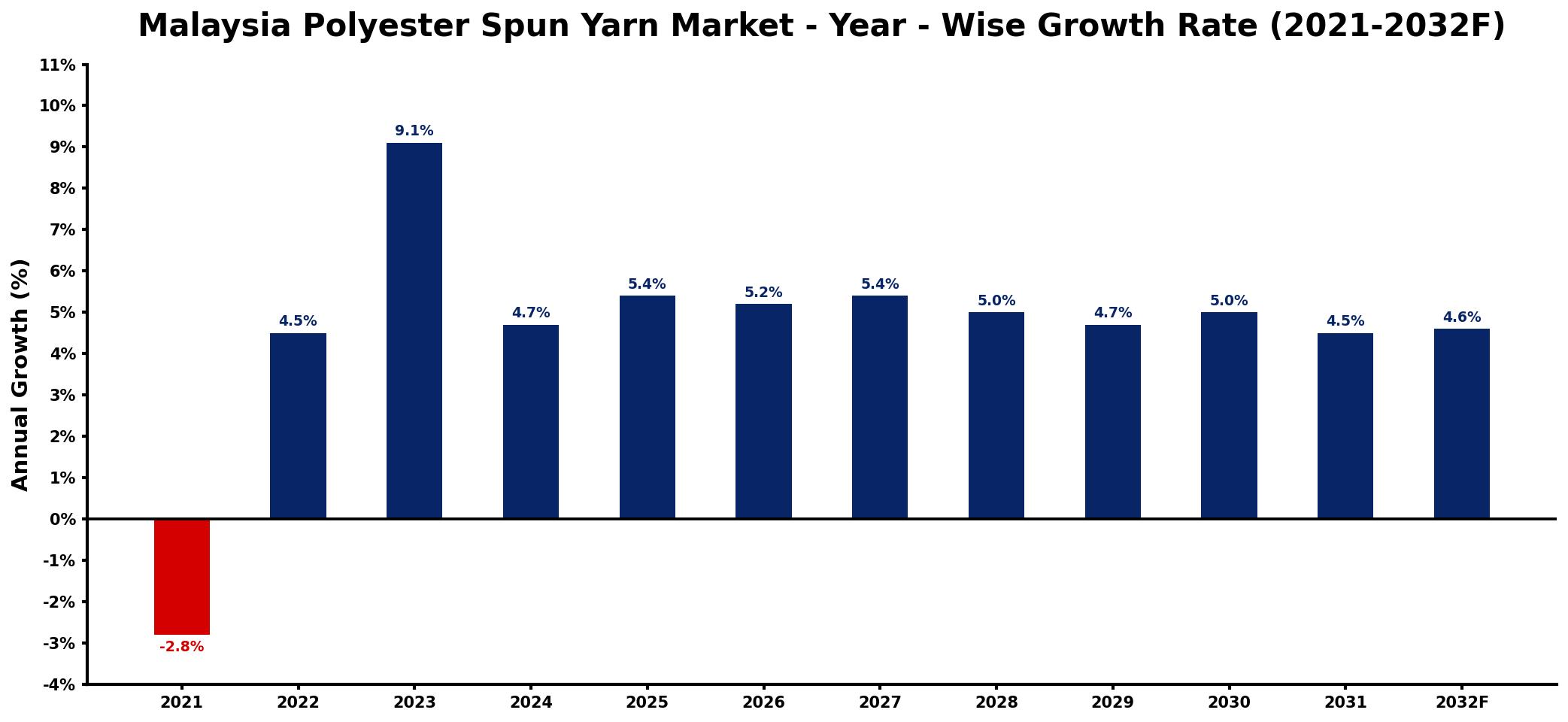
The table below presents the year‑wise growth rates along with the key drivers influencing the market
| Year | Growth Rate | Major Drivers |
| 2021 | -2.8% | decreased consumer spending on textiles |
| 2022 | 4.5% | increased fashion industry investments |
| 2023 | 9.1% | growing demand for sustainable materials |
| 2024 | 4.7% | expansion of textile manufacturing capacity |
| 2025 | 5.4% | rising popularity of athleisure apparel |
| 2026 | 5.2% | increased exports to neighboring countries |
| 2027 | 5.4% | growth in home textile applications |
| 2028 | 5.0% | emerging trends in eco-friendly fabrics |
| 2029 | 4.7% | enhanced technological advancements in production |
| 2030 | 5.0% | rising demand from sportswear sector |
| 2031 | 4.5% | increased retail presence and offerings |
| 2032 | 4.6% | growing downstream application demand |
Note: Market size estimations and growth projections presented in this report are based on 6Wresearch's proprietary forecasting methodology, utilizing the latest available industry data, government publications, and primary research inputs.
Malaysia Polyester Spun Yarn Market Synopsis
In recent years, Malaysia has established itself as a quality producer in the polyester spun yarn sector, even amidst fierce competition from countries known for low-cost manufacturing. The adaptability of the textile industry to shifting consumer preferences, along with a commitment to sustainable practices, positions the market favorably for future growth.
With a notable surge in athleisure and sportswear trends, the demand for polyester spun yarn continues to rise. This trend is complemented by investments in advanced technology and quality control measures, ensuring Malaysia maintains a competitive edge both domestically and on international platforms.
Malaysia Polyester Spun Yarn Market Key Takeaways
- The market is poised for steady growth driven by the thriving textile and apparel sectors.
- Cost-effectiveness and durability of polyester yarn are key factors fueling demand.
- The increasing use of polyester spun yarn in automotive and construction applications enhances market prospects.
- There is a growing consumer preference for sustainable textiles, prompting manufacturers to adopt eco-friendly practices.
- The impact of COVID-19 has led to a re-evaluation of production processes and supply chain management.
Evaluation of Restraints in Malaysia Polyester Spun Yarn Market
While the market holds promise, several constraints must be considered. Economic fluctuations, particularly in raw material prices, can significantly impact production costs and ultimately pricing strategies. Furthermore, the increasing global focus on sustainability presents a challenge as the industry navigates the environmental implications associated with synthetic fibers. These factors necessitate proactive strategies to ensure compliance with evolving consumer preferences and regulatory pressures.
Malaysia Polyester Spun Yarn Market Trends
Currently, the market is witnessing several trends that are shaping its future. The rise of athleisure wear has led to an uptick in demand for polyester spun yarn, which is favored for its moisture-wicking properties and comfort. Additionally, there is a growing emphasis on sustainable production methods, with manufacturers increasingly adopting environmentally-friendly practices. Technological advancements in yarn production are also paving the way for innovative applications in various sectors.
Malaysia Polyester Spun Yarn Market Opportunities
As the industry evolves, genuine growth opportunities are emerging. Expanding into the automotive and construction industries with specialized polyester spun yarn applications could provide significant market expansion. Additionally, investment in research and development for sustainable yarn production methods is likely to capture the attention of environmentally-conscious consumers, fostering brand loyalty and competitive advantage.
Government Initiatives in the Malaysia Polyester Spun Yarn Market
The Malaysian government is actively promoting the textile sector through various initiatives aimed at enhancing production capabilities and encouraging sustainable practices. Public spending in research and development, as well as incentives for companies adopting eco-friendly production methods, are expected to further stimulate growth in the polyester spun yarn market. Collaborative efforts with industry stakeholders also aim to improve infrastructure and supply chain efficiencies.
Future Insights of the Malaysia Polyester Spun Yarn Market
Looking ahead to the period from 2026 to 2032, the Malaysia Polyester Spun Yarn Market is poised for significant growth. Driven by evolving consumer preferences towards quality and sustainability, as well as technological advancements in production methods, the market landscape will likely shift. Companies that can effectively integrate innovative practices while addressing sustainability concerns will be well-positioned to capture emerging opportunities and thrive in a competitive environment.
Malaysia Polyester Spun Yarn Market Latest Developments (2025 - 2026)
In the latest industry developments, manufacturers are increasingly investing in advanced production technologies to enhance efficiency and quality. This shift not only addresses growing consumer demands for high-quality polyester spun yarn but also aligns with sustainability objectives. Furthermore, partnerships between textile manufacturers and research institutions are becoming more common, fostering innovation and the introduction of novel yarn applications.
Malaysia Polyester Spun Yarn Market - Key Attractiveness of the Report
- 10 Years of Market Numbers
- Historical Data Starting from 2022 to 2025
- Base Year: 2025
- Forecast Data until 2032
- Key Performance Indicators Impacting the Market
- Major Upcoming Developments and Projects
Key Highlights of the Report:
- Malaysia Polyester Spun Yarn Market Outlook
- Market Size of Malaysia Polyester Spun Yarn Market, 2025
- Forecast of Malaysia Polyester Spun Yarn Market, 2032
- Historical Data and Forecast of Malaysia Polyester Spun Yarn Revenues & Volume for the Period 2022-2032F
- Malaysia Polyester Spun Yarn Market Trend Evolution
- Malaysia Polyester Spun Yarn Market Drivers and Challenges
- Malaysia Polyester Spun Yarn Price Trends
- Malaysia Polyester Spun Yarn Porter's Five Forces
- Malaysia Polyester Spun Yarn Industry Life Cycle
- Historical Data and Forecast of Malaysia Polyester Spun Yarn Market Revenues & Volume By Types for the Period 2022-2032F
- Historical Data and Forecast of Malaysia Polyester Spun Yarn Market Revenues & Volume By Recycled Spun Yarn for the Period 2022-2032F
- Historical Data and Forecast of Malaysia Polyester Spun Yarn Market Revenues & Volume By Non-recycled Spun Yarn for the Period 2022-2032F
- Historical Data and Forecast of Malaysia Polyester Spun Yarn Market Revenues & Volume By Fields for the Period 2022-2032F
- Historical Data and Forecast of Malaysia Polyester Spun Yarn Market Revenues & Volume By Apparel for the Period 2022-2032F
- Historical Data and Forecast of Malaysia Polyester Spun Yarn Market Revenues & Volume By Household Textiles for the Period 2022-2032F
- Historical Data and Forecast of Malaysia Polyester Spun Yarn Market Revenues & Volume By Others for the Period 2022-2032F
- Malaysia Polyester Spun Yarn Import Export Trade Statistics
- Market Opportunity Assessment By Types
- Market Opportunity Assessment By Fields
- Malaysia Polyester Spun Yarn Top Companies Market Share
- Malaysia Polyester Spun Yarn Competitive Benchmarking By Technical and Operational Parameters
- Malaysia Polyester Spun Yarn Company Profiles
- Malaysia Polyester Spun Yarn Key Strategic Recommendations






































