Malaysia Polyesters Fibers Market Size, Share & Growth Rate
The Malaysia Polyesters Fibers Market was estimated at USD 397 Million in 2025 and is projected to reach USD 519 Million by 2032, growing at a CAGR of 3.9% from 2026 to 2032. This growth is largely attributed to the robust demand from the textile and apparel sectors, where polyester fibers serve as a cost-effective and versatile choice. Additionally, the increasing utilization of polyester fibers in packaging applications further fuels market expansion, reflecting a broader trend towards synthetic materials in various industries.
Malaysia Polyesters Fibers Market Year-wise Growth Rate and Key Drivers
This graph highlights how the Malaysia Polyesters Fibers Market has steadily grown over the years, supported by major growth factors.
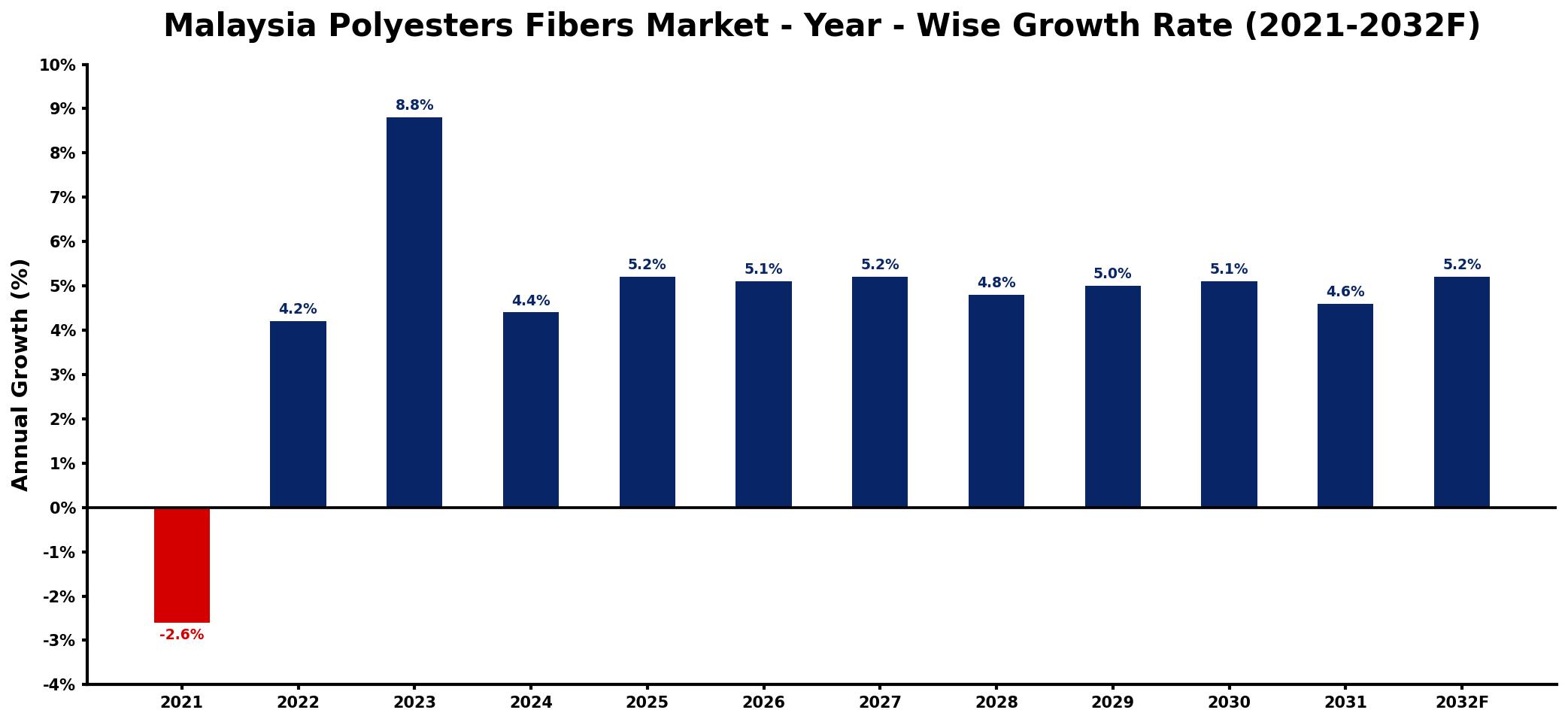
The table below presents the year‑wise growth rates along with the key drivers influencing the market
| Year | Growth Rate | Major Drivers |
| 2021 | -2.6% | decreased industrial production levels |
| 2022 | 4.2% | increased demand from automotive sector |
| 2023 | 8.8% | growing construction project investments |
| 2024 | 4.4% | expansion of textile manufacturing capacity |
| 2025 | 5.2% | rising consumer preferences for sustainability |
| 2026 | 5.1% | strengthened export market opportunities |
| 2027 | 5.2% | increased usage in home furnishings |
| 2028 | 4.8% | growing demand for sports apparel |
| 2029 | 5.0% | enhanced technological advancements adoption |
| 2030 | 5.1% | rising interest in eco-friendly materials |
| 2031 | 4.6% | expanding applications in medical textiles |
| 2032 | 5.2% | increased focus on circular economy |
Note: Market size estimations and growth projections presented in this report are based on 6Wresearch's proprietary forecasting methodology, utilizing the latest available industry data, government publications, and primary research inputs.
Malaysia Polyesters Fibers Market Synopsis
The strongest force shaping the Malaysia Polyesters Fibers Market currently is the textile and apparel industry's insatiable demand for high-performance materials. Polyester's inherent properties, such as durability, moisture resistance, and ease of care, make it an appealing option for manufacturers aiming to meet consumer expectations for quality and longevity.
Moreover, sustainability considerations are beginning to influence the market dynamics as well. As consumers become increasingly aware of environmental issues, there is a growing demand for recycled polyester and alternative sustainable fibers, prompting manufacturers to innovate and adopt more eco-friendly practices.
Malaysia Polyesters Fibers Market Key Takeaways
- The market is experiencing significant growth driven by demand from the textile and packaging industries.
- Sustainability and environmental awareness are reshaping production practices in the market.
- Technological advancements are enhancing the quality and applications of polyester fibers.
- COVID-19 shifted market dynamics, increasing demand for polyester in medical textiles.
- Competitive pressures from natural fibers pose both challenges and opportunities for polyester producers.
Evaluation of Restraints in Malaysia Polyesters Fibers Market
Despite its growth trajectory, the Malaysia Polyesters Fibers Market faces considerable restraints, particularly concerning environmental impact. The synthetic nature of polyester, derived from petroleum, raises significant environmental concerns related to plastic pollution and carbon emissions. With consumers increasingly prioritizing sustainability, there's mounting pressure on manufacturers to innovate and transition towards sustainable production methods and materials. Furthermore, the competitive landscape is intensifying as natural fibers like cotton gain traction for their perceived lower environmental footprint, compelling the polyester sector to adapt swiftly.
Malaysia Polyesters Fibers Market Trends
A noteworthy trend is the increasing incorporation of recycled polyester in textile production, driven by both consumer demand and regulatory pressures. Additionally, advancements in technology are enabling the development of high-performance polyester fibers that are lighter, stronger, and more versatile than ever before. Moreover, the rise of smart textiles, which integrate functionality into fabric, is positioning polyester as a material of choice for innovative applications.
Malaysia Polyesters Fibers Market Opportunities
The Malaysia Polyesters Fibers Market holds considerable opportunities for growth, especially in the realm of sustainable and recycled polyester products. There is also an increasing potential for manufacturers to explore partnerships with automotive and healthcare sectors, where innovative polyester applications are on the rise. Investments in research and development aimed at producing eco-friendly fibers will likely yield significant long-term returns, aligning with global sustainability goals.
Government Initiatives in the Malaysia Polyesters Fibers Market
The Malaysian government is increasingly promoting sustainable practices within the textile industry, offering incentives for companies that adopt environmentally friendly manufacturing processes. Public spending on research initiatives aimed at developing sustainable fiber alternatives is also on the rise, as well as campaigns to enhance recycling efforts within the industry. These initiatives aim to support the transition towards a more sustainable textile sector in Malaysia.
Future Insights of the Malaysia Polyesters Fibers Market
Looking ahead to the period from 2026 to 2032, the Malaysia Polyesters Fibers Market is anticipated to witness robust growth, driven by continued demand from key end-user sectors. As sustainability becomes a core focus, manufacturers are likely to enhance their product offerings with eco-friendly alternatives, contributing to a more circular economy. Furthermore, technological innovations will enable the production of more advanced polyester fibers, ensuring that the market remains competitive and relevant in an evolving landscape.
Malaysia Polyesters Fibers Market Latest Developments (2025 - 2026)
Recent developments in the Malaysia Polyesters Fibers Market indicate a significant shift towards sustainability, with several manufacturers announcing new initiatives to increase the use of recycled materials. Additionally, technological advancements have led to innovative polyester applications across various sectors, including automotive and medical textiles. These trends signal a proactive approach within the industry to align with consumer expectations and regulatory demands for more sustainable practices.
Malaysia Polyesters Fibers Market - Key Attractiveness of the Report
- 10 Years of Market Numbers
- Historical Data Starting from 2022 to 2025
- Base Year: 2025
- Forecast Data until 2032
- Key Performance Indicators Impacting the Market
- Major Upcoming Developments and Projects
Key Highlights of the Report:
- Malaysia Polyesters Fibers Market Outlook
- Market Size of Malaysia Polyesters Fibers Market, 2025
- Forecast of Malaysia Polyesters Fibers Market, 2032
- Historical Data and Forecast of Malaysia Polyesters Fibers Revenues & Volume for the Period 2022-2032F
- Malaysia Polyesters Fibers Market Trend Evolution
- Malaysia Polyesters Fibers Market Drivers and Challenges
- Malaysia Polyesters Fibers Price Trends
- Malaysia Polyesters Fibers Porter's Five Forces
- Malaysia Polyesters Fibers Industry Life Cycle
- Historical Data and Forecast of Malaysia Polyesters Fibers Market Revenues & Volume By Product Type for the Period 2022-2032F
- Historical Data and Forecast of Malaysia Polyesters Fibers Market Revenues & Volume By Polyester Staple Fibre for the Period 2022-2032F
- Historical Data and Forecast of Malaysia Polyesters Fibers Market Revenues & Volume By Polyester Filament Yarn for the Period 2022-2032F
- Historical Data and Forecast of Malaysia Polyesters Fibers Market Revenues & Volume By Application for the Period 2022-2032F
- Historical Data and Forecast of Malaysia Polyesters Fibers Market Revenues & Volume By Carpets and Rugs for the Period 2022-2032F
- Historical Data and Forecast of Malaysia Polyesters Fibers Market Revenues & Volume By Apparel for the Period 2022-2032F
- Historical Data and Forecast of Malaysia Polyesters Fibers Market Revenues & Volume By Industrial and Consumer Textiles for the Period 2022-2032F
- Historical Data and Forecast of Malaysia Polyesters Fibers Market Revenues & Volume By Household and Institutional Textiles for the Period 2022-2032F
- Malaysia Polyesters Fibers Import Export Trade Statistics
- Market Opportunity Assessment By Product Type
- Market Opportunity Assessment By Application
- Malaysia Polyesters Fibers Top Companies Market Share
- Malaysia Polyesters Fibers Competitive Benchmarking By Technical and Operational Parameters
- Malaysia Polyesters Fibers Company Profiles
- Malaysia Polyesters Fibers Key Strategic Recommendations






































