Malaysia Polyethylene (PE) Pipes and Tubes Market Summary
The malaysia polyethylene (pe) pipes and tubes market was estimated at USD 191 Million in 2025 and is projected to reach USD 247 Million by 2032, growing at a CAGR of 5.7% from 2026 to 2032.
Malaysia Polyethylene (PE) Pipes and Tubes Market Year-wise Growth Rate and Key Drivers
This graph highlights how the Malaysia Polyethylene (PE) Pipes and Tubes Market has steadily grown over the past five years, supported by major growth factors.
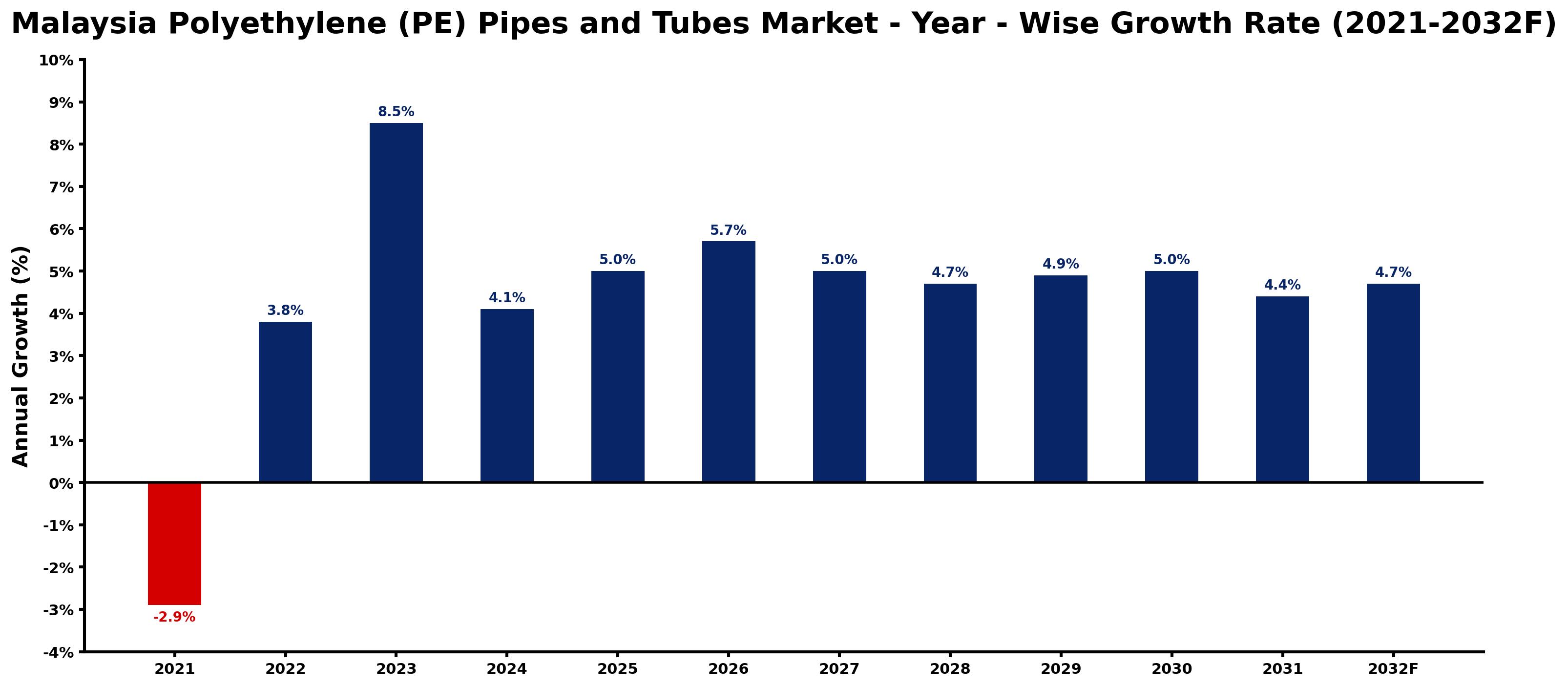
The table below presents the year wise growth rates along with the key drivers influencing the market
| Year | Growth Rate | Major Drivers |
| 2021 | -2.9% | Unprecedented supply chain disruptions hindered manufacturing capabilities, impacting the availability of polyethylene products. |
| 2022 | 3.8% | Municipal water infrastructure upgrades signal a shift toward modern piping solutions. |
| 2023 | 8.5% | Local manufacturers are amplifying production in response to regional construction demands. |
| 2024 | 4.1% | Investment in agriculture irrigation systems highlights the need for durable piping materials. |
| 2025 | 5.0% | Emerging trends in urban development create increased demand for reliable water systems. |
| 2026 | 5.7% | Cost-effective solutions drive industries to prefer polyethylene over traditional materials. |
| 2027 | 5.0% | Environmental considerations push companies to adopt recyclability in product design. |
| 2028 | 4.7% | Infrastructure projects fueled by urbanization lead to escalating pipe installation needs. |
| 2029 | 4.9% | Technological innovations enhance the performance of polyethylene in extreme climates. |
| 2030 | 5.0% | Sustainability initiatives promote the circular economy within the plastics sector. |
| 2031 | 4.4% | Competition among suppliers fosters innovation and quality improvements in PE pipes. |
| 2032 | 4.7% | Emerging markets in Southeast Asia expand demand for versatile piping solutions. |
Note - Market size estimations and growth projections presented in this report are based on 6Wresearch's advanced forecasting approach, validated with industry datasets as of June 2026.
Malaysia Polyethylene (PE) Pipes and Tubes Market Synopsis
The Malaysia Polyethylene (PE) Pipes and Tubes Market is projected to reach 5.7% and witness significant growth during the forecast period (2026-2032). This growth is underpinned by various factors, including increased investments in water infrastructure, heightened demand from the agricultural sector, and a surge in residential and commercial construction activities. These elements collectively enhance the market environment for polyethylene pipes and tubes in Malaysia, positioning it for stable expansion in the coming years.
Malaysia Polyethylene (PE) Pipes and Tubes Market Growth Drivers
Several key drivers are poised to stimulate the Malaysia Polyethylene (PE) Pipes and Tubes Market during the forecast period. These include:
- The increasing need for infrastructure upgrades, notably in water supply systems, which demands durable and efficient piping solutions.
- A growing focus on enhancing agricultural productivity through improved irrigation systems that rely heavily on polyethylene pipes for their flexibility and resilience.
- Rising urbanization and economic development, leading to a heightened requirement for extensive residential and commercial construction, further propelling the demand for PE pipes.
- Government initiatives aimed at modernizing infrastructure, which includes the adoption of advanced materials like polyethylene in various applications.
- Technological advancements that yield lighter, more flexible PE pipe products, making them more appealing to various industries, including agriculture and construction.
Malaysia Polyethylene (PE) Pipes and Tubes Market Challenges and Restraints
While the Malaysia Polyethylene (PE) Pipes and Tubes Market exhibits promising growth potential, it is not without challenges. The following factors may impede its progress:
- The high initial cost associated with polyethylene pipes and tubes, which may deter some end-users, particularly in price-sensitive sectors.
- Competition from alternative materials, such as PVC and metal, which may offer lower upfront costs, affecting the market share of polyethylene products.
- Regulatory hurdles and standards concerning the use of polyethylene pipes that could complicate market entry for new entrants and delay project timelines.
- Environmental concerns related to plastic products, prompting increased scrutiny and potential policy changes that could impact the polyethylene industry.
- The potential for market saturation in specific segments, particularly if growth in construction activities begins to level off.
Malaysia Polyethylene (PE) Pipes and Tubes Market Trends and Opportunities
Awareness of the advantages of polyethylene pipes is growing, creating significant opportunities for market expansion. Current trends include:
- Enhanced focus on sustainable practices and eco-friendly materials, positioning polyethylene as a viable solution due to its recyclable nature.
- The integration of smart technologies in irrigation systems, where polyethylene pipes play a crucial role in efficient water management.
- Growing acceptance of innovative piping solutions across different industries, driven by continuous advancements in production processes.
- Increased collaboration among stakeholders to foster research and development of improved polyethylene products, particularly for specialized applications.
- International partnerships and exports, expanding the reach of Malaysian manufacturers into emerging markets with increasing infrastructure needs.
Malaysia Polyethylene (PE) Pipes and Tubes Market Government Investment and Initiatives
Government investment plays a crucial role in the Malaysia Polyethylene (PE) Pipes and Tubes Market. Several initiatives support the growth of this sector:
- The "National Infrastructure Plan," which outlines strategic investments to enhance water distribution and management systems, directly impacting the demand for PE pipes.
- Funding schemes offered by governmental bodies to support infrastructure projects, including municipal water systems, where polyethylene pipes are increasingly favored.
- Public-private partnerships aimed at advancing infrastructure development, thereby creating opportunities for polyethylene pipe manufacturers.
- Regulatory frameworks that promote the use of environmentally friendly materials in public projects, encouraging the adoption of polyethylene pipes.
- Incentives for research and development to innovate new applications for polyethylene products, fostering a competitive marketplace.
Malaysia Polyethylene (PE) Pipes and Tubes Market Latest Developments (May 2025 - June 2026)
In the period from May 2025 to June 2026, the Malaysia Polyethylene (PE) Pipes and Tubes Market has seen several notable developments:
- Increased activity in public infrastructure projects, with many local councils initiating upgrades to existing water supply networks, thereby enhancing demand for polyethylene solutions.
- A trend towards adopting advanced manufacturing technologies, which has led to improvements in product quality and reductions in production costs for polyethylene pipes.
- Growing collaboration among industry stakeholders to address sustainability challenges, focusing on recycling initiatives and the lifecycle management of polyethylene products.
- Participations in international trade exhibitions have increased, providing Malaysian manufacturers with platforms to showcase innovations and forge new partnerships.
- An uptick in government-led training programs aimed at educating stakeholders about the benefits and applications of polyethylene pipes in various sectors.
Malaysia Polyethylene (PE) Pipes and Tubes Market - Key Attractiveness of the Report
- 10 Years of Market Numbers
- Historical Data Starting from 2022 to 2025
- Base Year: 2025
- Forecast Data until 2032
- Key Performance Indicators Impacting the Market
- Major Upcoming Developments and Projects
Key Highlights of the Report:
- Malaysia Polyethylene (PE) Pipes and Tubes Market Outlook
- Market Size of Malaysia Polyethylene (PE) Pipes and Tubes Market, 2025
- Forecast of Malaysia Polyethylene (PE) Pipes and Tubes Market, 2032
- Historical Data and Forecast of Malaysia Polyethylene (PE) Pipes and Tubes Revenues & Volume for the Period 2022-2032F
- Malaysia Polyethylene (PE) Pipes and Tubes Market Trend Evolution
- Malaysia Polyethylene (PE) Pipes and Tubes Market Drivers and Challenges
- Malaysia Polyethylene (PE) Pipes and Tubes Price Trends
- Malaysia Polyethylene (PE) Pipes and Tubes Porter's Five Forces
- Malaysia Polyethylene (PE) Pipes and Tubes Industry Life Cycle
- Historical Data and Forecast of Malaysia Polyethylene (PE) Pipes and Tubes Market Revenues & Volume By Type for the Period 2022-2032F
- Historical Data and Forecast of Malaysia Polyethylene (PE) Pipes and Tubes Market Revenues & Volume By High Density Polythene (HDPE) for the Period 2022-2032F
- Historical Data and Forecast of Malaysia Polyethylene (PE) Pipes and Tubes Market Revenues & Volume By Low Density Polythene (LDPE) for the Period 2022-2032F
- Historical Data and Forecast of Malaysia Polyethylene (PE) Pipes and Tubes Market Revenues & Volume By Linear Low Density Polythene (LLDPE) for the Period 2022-2032F
- Historical Data and Forecast of Malaysia Polyethylene (PE) Pipes and Tubes Market Revenues & Volume By Cross Link Polythene (PEX/XLPE) for the Period 2022-2032F
- Historical Data and Forecast of Malaysia Polyethylene (PE) Pipes and Tubes Market Revenues & Volume By Application for the Period 2022-2032F
- Historical Data and Forecast of Malaysia Polyethylene (PE) Pipes and Tubes Market Revenues & Volume By Industrial for the Period 2022-2032F
- Historical Data and Forecast of Malaysia Polyethylene (PE) Pipes and Tubes Market Revenues & Volume By Agriculture for the Period 2022-2032F
- Historical Data and Forecast of Malaysia Polyethylene (PE) Pipes and Tubes Market Revenues & Volume By Underwater And Municipal for the Period 2022-2032F
- Historical Data and Forecast of Malaysia Polyethylene (PE) Pipes and Tubes Market Revenues & Volume By Construction for the Period 2022-2032F
- Historical Data and Forecast of Malaysia Polyethylene (PE) Pipes and Tubes Market Revenues & Volume By Gas Extraction for the Period 2022-2032F
- Historical Data and Forecast of Malaysia Polyethylene (PE) Pipes and Tubes Market Revenues & Volume By Others for the Period 2022-2032F
- Malaysia Polyethylene (PE) Pipes and Tubes Import Export Trade Statistics
- Market Opportunity Assessment By Type
- Market Opportunity Assessment By Application
- Malaysia Polyethylene (PE) Pipes and Tubes Top Companies Market Share
- Malaysia Polyethylene (PE) Pipes and Tubes Competitive Benchmarking By Technical and Operational Parameters
- Malaysia Polyethylene (PE) Pipes and Tubes Company Profiles
- Malaysia Polyethylene (PE) Pipes and Tubes Key Strategic Recommendations






































