Malaysia Potassium chlorate Market Size, Share & Growth Rate
The Malaysia Potassium chlorate Market was estimated at USD 493 Million in 2025 and is projected to reach USD 641 Million by 2032, growing at a CAGR of 3.8% from 2026 to 2032. This growth trajectory is primarily fueled by the increasing applications of potassium chlorate in agricultural herbicides and the flourishing fireworks industry. Additionally, technological advancements in manufacturing processes and the rising demand for safe and efficient oxidizing agents are expected to further bolster market expansion.
Malaysia Potassium chlorate Market Year-wise Growth Rate and Key Drivers
This graph highlights how the Malaysia Potassium chlorate Market has steadily grown over the years, supported by major growth factors.
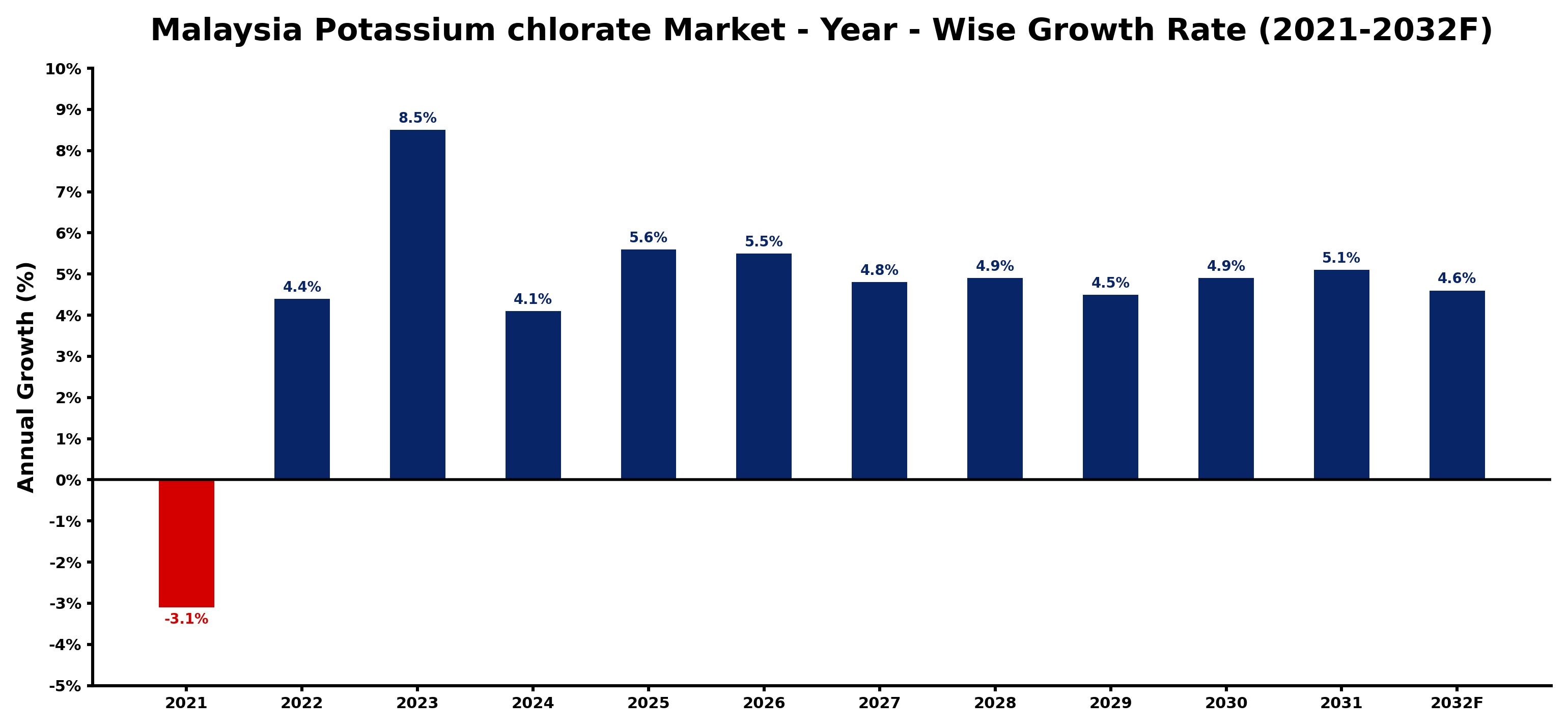
The table below presents the year‑wise growth rates along with the key drivers influencing the market
| Year | Growth Rate | Major Drivers |
| 2021 | -3.1% | Manufacturing slowdowns decreased potassium chlorate export demand significantly |
| 2022 | 4.4% | Export driven manufacturing investments boost potassium chlorate production capacity |
| 2023 | 8.5% | Precision engineering investments boost potassium chlorate production capacity |
| 2024 | 4.1% | OEM investments in automation boosted potassium chlorate production efficiency |
| 2025 | 5.6% | Precision engineering upgrades enhanced potassium chlorate production efficiencies |
| 2026 | 5.5% | Improved capacity utilization boosts potassium chlorate export manufacturing efficiency |
| 2027 | 4.8% | Technology adoption in production lines boosts potassium chlorate efficiency |
| 2028 | 4.9% | Precision engineering investments boosted potassium chlorate production capabilities |
| 2029 | 4.5% | Domestic automation advancements boost potassium chlorate production efficiency |
| 2030 | 4.9% | Precision engineering upgrades boost potassium chlorate production capacity |
| 2031 | 5.1% | Export oriented manufacturing surge drives potassium chlorate production capabilities |
| 2032 | 4.6% | Precision engineering advancements boost potassium chlorate manufacturing efficiencies |
Note - Market size estimations and growth projections presented in this report are based on 6Wresearch's advanced forecasting approach, validated with industry datasets as of June 2026.
Malaysia Potassium chlorate Market Synopsis
In recent years, the Malaysian potassium chlorate market has demonstrated resilience, driven by its diverse applications ranging from pyrotechnics to industrial processes. The compound's role as an oxidizer in fireworks and its utility in various manufacturing sectors underline its significance in the region's economic landscape.
As the agricultural sector continues to modernize, the demand for potassium chlorate as a herbicide is poised to grow, spurred by innovations in formulation and application methods. However, this growth also necessitates stringent adherence to safety protocols to mitigate risks associated with its handling and storage.
Malaysia Potassium chlorate Market Key Takeaways
- Potassium chlorate is vital for pyrotechnics and industrial applications in Malaysia.
- Growing agricultural demand for herbicides and matches drives market expansion.
- Safety regulations and sustainable practices are critical to market evolution.
- COVID-19 caused temporary disruptions but recovery is underway.
- Technological advancements are enhancing production and formulation capabilities.
Evaluation of Restraints in Malaysia Potassium chlorate Market
While the Malaysia potassium chlorate market shows promise, several restraints hinder its growth. The compound's classification as a hazardous substance poses significant regulatory challenges, impacting its production and distribution. Compliance with safety standards is non-negotiable, yet it adds layers of complexity and cost. Furthermore, public perception of potassium chlorate, often associated with its explosive potential, presents a barrier that market players must navigate carefully to foster trust and acceptance.
Malaysia Potassium chlorate Market Trends
The potassium chlorate market in Malaysia is currently witnessing several key trends. An uptick in demand for eco-friendly and sustainable formulations is gaining traction, prompting manufacturers to innovate their product offerings. Additionally, advancements in production technology are leading to more efficient manufacturing processes, thereby reducing costs and increasing supply chain resilience. The trend towards automation in production lines is also expected to enhance operational efficiency and product consistency.
Malaysia Potassium chlorate Market Opportunities
Genuine growth opportunities in the Malaysian potassium chlorate market lie primarily in the agricultural sector. As farmers seek effective herbicides to boost crop yield and manage weeds sustainably, potassium chlorate is positioned to play a pivotal role. Moreover, the evolving regulations favoring safer, environmentally friendly practices present an avenue for innovation, allowing companies to develop advanced formulations that meet both market needs and regulatory standards.
Government Initiatives in the Malaysia Potassium chlorate Market
The Malaysian government is actively promoting policies aimed at enhancing safety and sustainability within chemical manufacturing sectors, including potassium chlorate. This includes investments in research and development to foster innovations that align with environmental goals. Programs aimed at increasing awareness of safe handling practices are also integral to ensuring compliance and building confidence among stakeholders in the potassium chlorate supply chain.
Future Insights of the Malaysia Potassium chlorate Market
Looking ahead to the period between 2026 and 2032, the Malaysia potassium chlorate market is expected to evolve substantially. With an anticipated shift towards more sustainable agricultural practices, potassium chlorate could increasingly be seen as a key component in the herbicide arsenal. Furthermore, as the fireworks industry rebounds and demand surges, manufacturers will need to adapt their strategies to meet the anticipated increase in consumption, all while adhering to stringent safety protocols.
Malaysia Potassium chlorate Market Latest Developments (May 2025 - June 2026)
In the last year, the potassium chlorate market in Malaysia has seen several shifts as industry players respond to changing demands and regulations. Enhanced safety protocols have been implemented across production facilities, ensuring compliance with both local and international standards. Additionally, there is a growing emphasis on research initiatives that focus on sustainable applications of potassium chlorate, aiming to reduce its environmental footprint while expanding its industrial utility.
Malaysia Potassium chlorate Market - Key Attractiveness of the Report
- 10 Years of Market Numbers
- Historical Data Starting from 2022 to 2025
- Base Year: 2025
- Forecast Data until 2032
- Key Performance Indicators Impacting the Market
- Major Upcoming Developments and Projects
Key Highlights of the Report:
- Malaysia Potassium chlorate Market Outlook
- Market Size of Malaysia Potassium chlorate Market, 2025
- Forecast of Malaysia Potassium chlorate Market, 2032
- Historical Data and Forecast of Malaysia Potassium chlorate Revenues & Volume for the Period 2022-2032F
- Malaysia Potassium chlorate Market Trend Evolution
- Malaysia Potassium chlorate Market Drivers and Challenges
- Malaysia Potassium chlorate Price Trends
- Malaysia Potassium chlorate Porter's Five Forces
- Malaysia Potassium chlorate Industry Life Cycle
- Historical Data and Forecast of Malaysia Potassium chlorate Market Revenues & Volume By Product type for the Period 2022-2032F
- Historical Data and Forecast of Malaysia Potassium chlorate Market Revenues & Volume By Pharmaceutical Grade for the Period 2022-2032F
- Historical Data and Forecast of Malaysia Potassium chlorate Market Revenues & Volume By Chemical Grade for the Period 2022-2032F
- Historical Data and Forecast of Malaysia Potassium chlorate Market Revenues & Volume By End-use for the Period 2022-2032F
- Historical Data and Forecast of Malaysia Potassium chlorate Market Revenues & Volume By Explosives for the Period 2022-2032F
- Historical Data and Forecast of Malaysia Potassium chlorate Market Revenues & Volume By Matches for the Period 2022-2032F
- Historical Data and Forecast of Malaysia Potassium chlorate Market Revenues & Volume By Disinfectants for the Period 2022-2032F
- Historical Data and Forecast of Malaysia Potassium chlorate Market Revenues & Volume By Bleaches for the Period 2022-2032F
- Historical Data and Forecast of Malaysia Potassium chlorate Market Revenues & Volume By Medical for the Period 2022-2032F
- Malaysia Potassium chlorate Import Export Trade Statistics
- Market Opportunity Assessment By Product type
- Market Opportunity Assessment By End-use
- Malaysia Potassium chlorate Top Companies Market Share
- Malaysia Potassium chlorate Competitive Benchmarking By Technical and Operational Parameters
- Malaysia Potassium chlorate Company Profiles
- Malaysia Potassium chlorate Key Strategic Recommendations






































