Malaysia Potassium phosphate Market Size, Share & Growth Rate
The Malaysia Potassium phosphate Market was estimated at USD 353 Million in 2025 and is projected to reach USD 455 Million by 2032, growing at a CAGR of 3.7% from 2026 to 2032. This growth trajectory is significantly driven by the increasing demand for potassium phosphate as a key ingredient in fertilizers, which is further accelerated by Malaysia's agricultural advancements and urbanization trends. Moreover, the rising food processing sector is fostering additional applications, thereby contributing positively to market dynamics.
Malaysia Potassium phosphate Market Year-wise Growth Rate and Key Drivers
This graph highlights how the Malaysia Potassium phosphate Market has steadily grown over the years, supported by major growth factors.
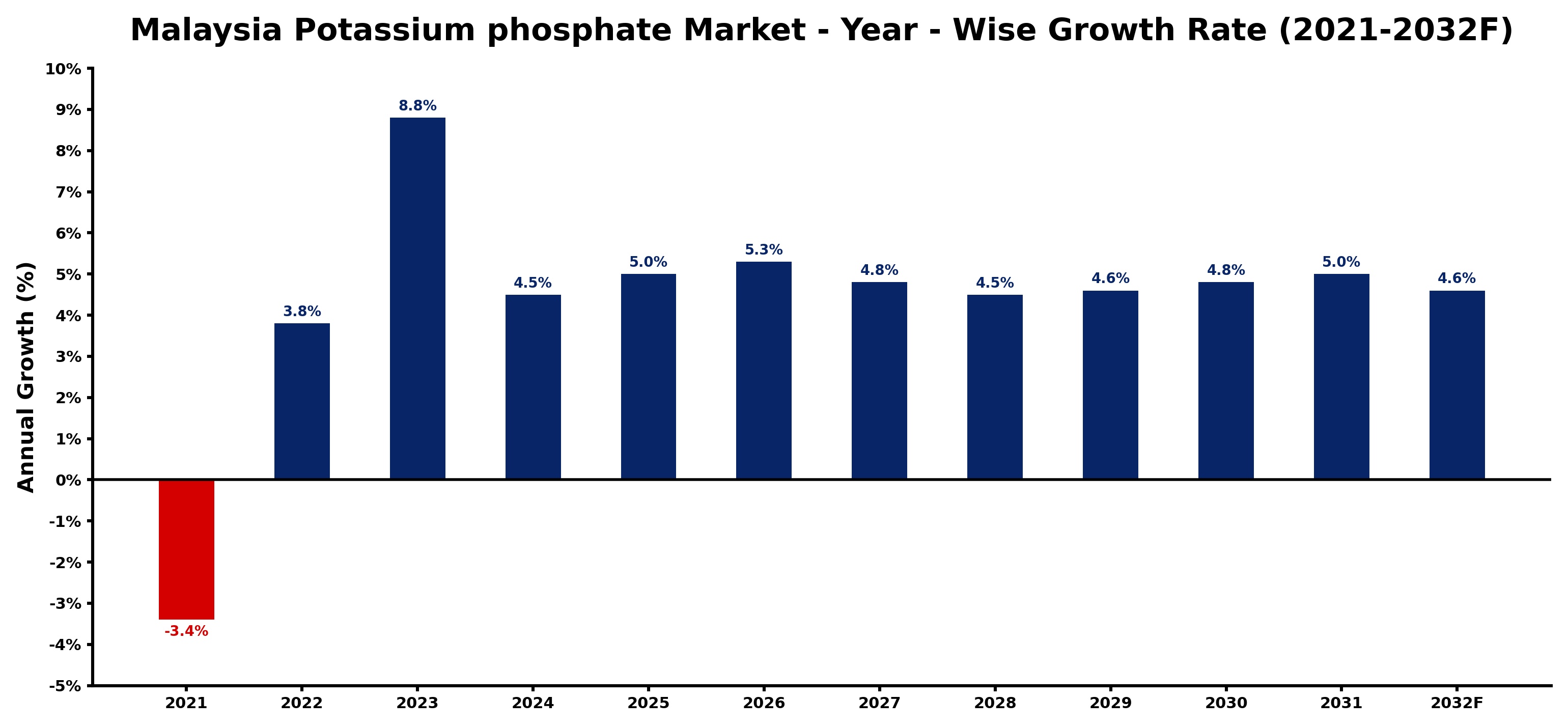
The table below presents the year‑wise growth rates along with the key drivers influencing the market
| Year | Growth Rate | Major Drivers |
| 2021 | -3.4% | Supply chain disruptions decreased potassium phosphate production efficiency |
| 2022 | 3.8% | Precision engineering investments boost local potassium phosphate production capabilities |
| 2023 | 8.8% | Precision engineering investments boost demand for potassium phosphate solutions |
| 2024 | 4.5% | Potassium phosphate supply chain enhancements optimize agricultural export manufacturing efficiency |
| 2025 | 5.0% | Manufacturers invest in advanced equipment for higher phosphate production |
| 2026 | 5.3% | Precision agriculture technology boosts potassium phosphate fertilizer demand |
| 2027 | 4.8% | Technology adoption in fertilizer production enhances export competitiveness |
| 2028 | 4.5% | Domestic investments in precision engineering boost phosphate production capacity |
| 2029 | 4.6% | Export demand for specialty fertilizers boosts potassium phosphate production efficiency |
| 2030 | 4.8% | Precision engineering advancements bolstered potassium phosphate export manufacturing efficiency |
| 2031 | 5.0% | Domestic manufacturing investments boost potassium phosphate production capacity |
| 2032 | 4.6% | Increased manufacturing investments bolster potassium phosphate export capabilities |
Note - Market size estimations and growth projections presented in this report are based on 6Wresearch’s advanced forecasting approach, validated with industry datasets as of June 2026.
Malaysia Potassium phosphate Market Synopsis
The demand for potassium phosphate in Malaysia is increasingly shaped by its essential role as a fertilizer component, catering to the needs of a growing agricultural sector. In tandem with rising urbanization, there is an observable uptick in the need for fertilizers that enhance crop yields and food production efficiency.
Furthermore, the market's expansion is closely linked to the food processing industry, where potassium phosphate serves as a crucial food additive and buffering agent. This interplay between agriculture and food processing underscores the multifaceted applications of potassium phosphate across various segments in Malaysia.
Malaysia Potassium phosphate Market Key Takeaways
- The market is set for steady growth, driven primarily by agricultural demand.
- Urbanization is creating a stronger need for efficient fertilizer solutions.
- Key applications in food processing are broadening the market scope.
- Sustainability trends are influencing product formulations and innovations.
- Market dynamics are increasingly shaped by environmental considerations and consumer preferences.
Evaluation of Restraints in Malaysia Potassium phosphate Market
Despite its growth potential, the Malaysia potassium phosphate market faces significant restraints that may temper its expansion. Foremost among these are the competitive pressures from alternative fertilizers that may offer better environmental profiles or lower costs. Additionally, concerns regarding nutrient runoff and its adverse impacts on local water bodies complicate market dynamics. Players in the industry must navigate these challenges while adapting to shifts in agricultural practices and consumer sentiments regarding sustainability. Addressing these issues will be crucial for maintaining a positive growth trajectory.
Malaysia Potassium phosphate Market Trends
In recent years, notable trends have emerged within the Malaysia potassium phosphate market that are reshaping its landscape. There is a growing emphasis on sustainable agricultural practices, prompting manufacturers to innovate towards eco-friendlier formulations. Moreover, the integration of technology in agriculture is facilitating more precise applications of fertilizers, thereby optimizing their effectiveness and minimizing waste. Additionally, the food processing industry is leaning towards natural additives, influencing product development strategies across the market.
Malaysia Potassium phosphate Market Opportunities
The opportunities within the Malaysia potassium phosphate market are substantial, particularly as demand for sustainable agriculture escalates. Investment in R&D to create advanced, eco-friendly fertilizers presents a promising avenue for growth. Additionally, tapping into the burgeoning food processing sector with customized potassium phosphate solutions can provide a significant competitive edge. Expanding distribution networks to meet the needs of emerging urban markets is another key opportunity, allowing players to capture a larger share of the growing market.
Government Initiatives in the Malaysia Potassium phosphate Market
The Malaysian government has been actively supporting initiatives aimed at bolstering the agricultural sector, which includes promoting the effective use of fertilizers like potassium phosphate. Policies focused on sustainability and environmental protection are encouraging investments in research and development for innovative agricultural products. Furthermore, public spending on agricultural enhancements and productivity improvements underscores the government's commitment to ensuring food security and sustainable practices, creating a favorable environment for market growth.
Future Insights of the Malaysia Potassium phosphate Market
Looking ahead to the period from 2026 to 2032, the Malaysia potassium phosphate market is poised for continued growth fueled by technological advancements in agriculture and a heightened focus on sustainability. The incorporation of precision farming techniques will likely enhance the efficiency of potassium phosphate application, catering to the increasing consumer demand for quality and environmentally responsible food products. As agricultural practices evolve and regulatory frameworks adapt to environmental concerns, the market stands to benefit from innovation and strategic collaborations across sectors.
Malaysia Potassium phosphate Market Latest Developments (May 2025 - June 2026)
In the recent months leading up to mid-2026, the Malaysia potassium phosphate market has observed a shift towards greater sustainability. Companies are increasingly investing in eco-friendly production methods and engaging in partnerships aimed at reducing environmental impact. Additionally, new product lines tailored to meet the demands of the food processing sector have been introduced, reflecting the dynamic nature of market trends and consumer preferences.
Malaysia Potassium phosphate Market - Key Attractiveness of the Report
- 10 Years of Market Numbers
- Historical Data Starting from 2022 to 2025
- Base Year: 2025
- Forecast Data until 2032
- Key Performance Indicators Impacting the Market
- Major Upcoming Developments and Projects
Key Highlights of the Report:
- Malaysia Potassium phosphate Market Outlook
- Market Size of Malaysia Potassium phosphate Market, 2025
- Forecast of Malaysia Potassium phosphate Market, 2032
- Historical Data and Forecast of Malaysia Potassium phosphate Revenues & Volume for the Period 2022-2032F
- Malaysia Potassium phosphate Market Trend Evolution
- Malaysia Potassium phosphate Market Drivers and Challenges
- Malaysia Potassium phosphate Price Trends
- Malaysia Potassium phosphate Porter's Five Forces
- Malaysia Potassium phosphate Industry Life Cycle
- Historical Data and Forecast of Malaysia Potassium phosphate Market Revenues & Volume By Distribution Channel for the Period 2022-2032F
- Historical Data and Forecast of Malaysia Potassium phosphate Market Revenues & Volume By Online Retailing for the Period 2022-2032F
- Historical Data and Forecast of Malaysia Potassium phosphate Market Revenues & Volume By Offline Retailing for the Period 2022-2032F
- Historical Data and Forecast of Malaysia Potassium phosphate Market Revenues & Volume By Application for the Period 2022-2032F
- Historical Data and Forecast of Malaysia Potassium phosphate Market Revenues & Volume By Acidulant for the Period 2022-2032F
- Historical Data and Forecast of Malaysia Potassium phosphate Market Revenues & Volume By Diuretic for the Period 2022-2032F
- Historical Data and Forecast of Malaysia Potassium phosphate Market Revenues & Volume By Buffering & Sequestering Agent for the Period 2022-2032F
- Historical Data and Forecast of Malaysia Potassium phosphate Market Revenues & Volume By Other Applications for the Period 2022-2032F
- Historical Data and Forecast of Malaysia Potassium phosphate Market Revenues & Volume By End-use Verticals for the Period 2022-2032F
- Historical Data and Forecast of Malaysia Potassium phosphate Market Revenues & Volume By Food & Beverage Industry for the Period 2022-2032F
- Historical Data and Forecast of Malaysia Potassium phosphate Market Revenues & Volume By Medical & Pharmaceutical for the Period 2022-2032F
- Historical Data and Forecast of Malaysia Potassium phosphate Market Revenues & Volume By Personal Care Products for the Period 2022-2032F
- Historical Data and Forecast of Malaysia Potassium phosphate Market Revenues & Volume By Others for the Period 2022-2032F
- Malaysia Potassium phosphate Import Export Trade Statistics
- Market Opportunity Assessment By Distribution Channel
- Market Opportunity Assessment By Application
- Market Opportunity Assessment By End-use Verticals
- Malaysia Potassium phosphate Top Companies Market Share
- Malaysia Potassium phosphate Competitive Benchmarking By Technical and Operational Parameters
- Malaysia Potassium phosphate Company Profiles
- Malaysia Potassium phosphate Key Strategic Recommendations






































