Malaysia Power Convertor Market Summary
The malaysia power convertor market was estimated at USD 484 Million in 2025 and is projected to reach USD 628 Million by 2032, growing at a CAGR of 5.0% from 2026 to 2032.
Malaysia Power Convertor Market Year-wise Growth Rate and Key Drivers
This graph highlights how the Malaysia Power Convertor Market has steadily grown over the past five years, supported by major growth factors.
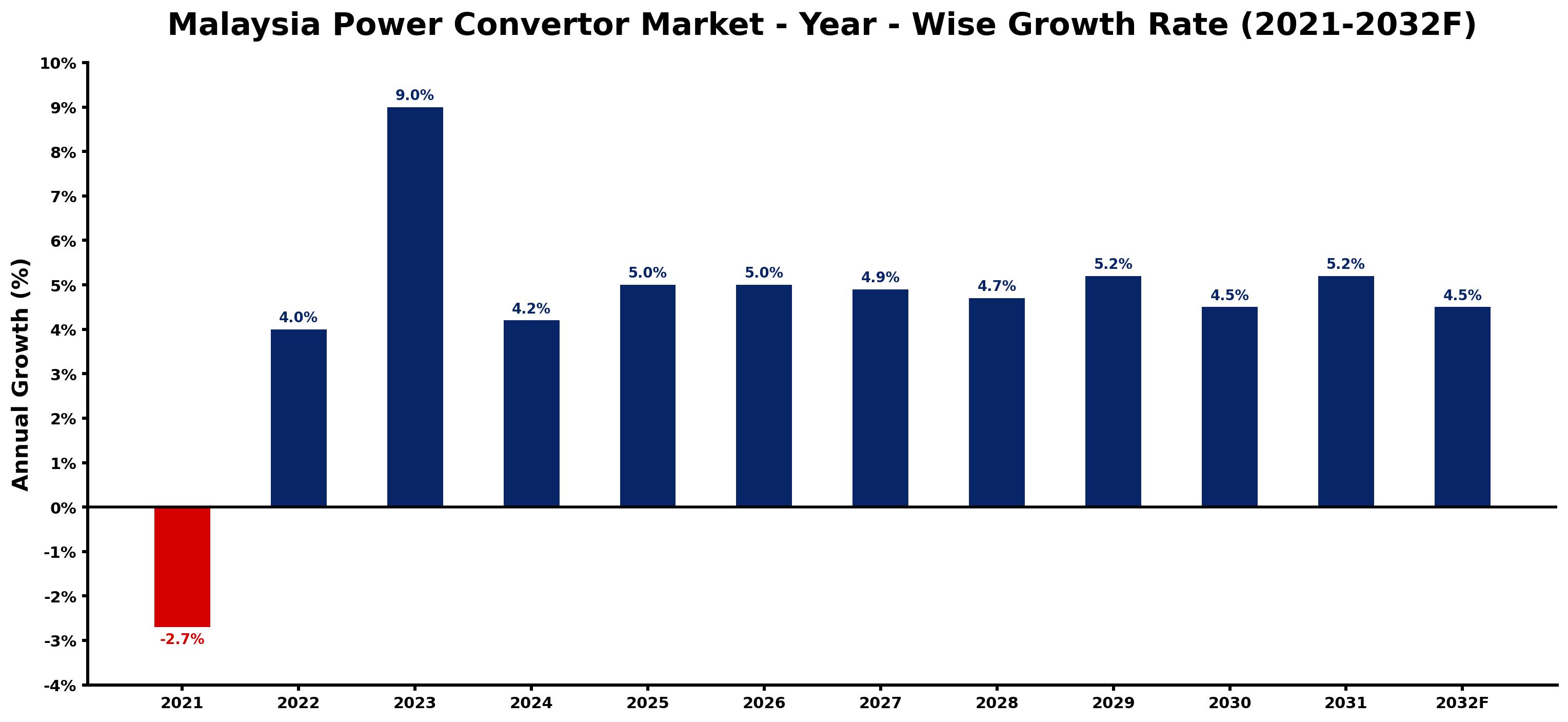
The table below presents the year wise growth rates along with the key drivers influencing the market
| Year | Growth Rate | Major Drivers |
| 2021 | -2.7% | Heightened economic uncertainty led to reduced capital investments in renewable energy projects, sharply impacting demand. |
| 2022 | 4.0% | Supply chain disruptions highlighted the need for localized manufacturing and power conversion. |
| 2023 | 9.0% | Corporate sustainability commitments pushed firms to invest in energy-efficient technologies. |
| 2024 | 4.2% | Urban expansion in Malaysia increases reliance on advanced electrical infrastructure and converters. |
| 2025 | 5.0% | Emerging technologies in solar energy require compatible power conversion systems for integration. |
| 2026 | 5.0% | Rising energy costs foster innovation in cost-effective power management solutions across industries. |
| 2027 | 4.9% | Smart city initiatives drive investments in intelligent energy distribution and management systems. |
| 2028 | 4.7% | Infrastructure upgrades in public transport necessitate robust and reliable power convertors. |
| 2029 | 5.2% | Increased electrification in rural areas expands market opportunities for affordable power solutions. |
| 2030 | 4.5% | Technological convergence prompts the development of multi-functional energy conversion devices. |
| 2031 | 5.2% | Regional collaborations enhance knowledge sharing and innovation in power conversion technologies. |
| 2032 | 4.5% | Growing consumer awareness of energy efficiency influences purchasing decisions in the market. |
Note - Market size estimations and growth projections presented in this report are based on 6Wresearch's advanced forecasting approach, validated with industry datasets as of June 2026.
Malaysia Power Convertor Market Synopsis
The Malaysia Power Convertor Market is projected to reach 5.0% and witness significant growth during the forecast period (2026-2032). This market is set to expand at a compound annual growth rate (CAGR) of 5.1%, driven by the increasing demand for AC/DC conversion systems across various sectors, notably automotive as well as aerospace and defense applications. Such growth is supported by a surge in government investments aimed at enhancing the nation's infrastructure, ultimately fostering the integration of power converters in industrial automation and building automation systems.
Malaysia Power Convertor Market Growth Drivers
The growth trajectory of the Malaysia Power Convertor Market can be attributed to several key factors:
- The rising requirement for efficient AC/DC conversion technology is primarily driven by advancements in electric vehicle (EV) manufacturing and deployment, resulting in a significant increase in demand for power converters in the automotive industry.
- Growth in the aerospace and defense sectors necessitates enhanced power distribution systems capable of supporting advanced avionics and mission-critical applications, thus propelling the demand for power converters.
- The ongoing digitalization of industries mandates improved power management solutions, creating a favorable environment for the adoption of advanced power converters.
- Government initiatives aimed at boosting infrastructure projects are further incentivizing businesses to adopt integrated automation solutions, driving the need for power converters.
- The burgeoning industrial automation market in Malaysia contributes to the growing demand for power converters, as these devices are essential for the control and regulation of power in automated processes.
Malaysia Power Convertor Market Challenges and Restraints
Despite its growth potential, the Malaysia Power Convertor Market faces several challenges that could hinder its advancement:
- The high costs associated with implementing advanced power converter technologies may deter small- and medium-sized enterprises (SMEs) from investing in these solutions, limiting overall market expansion.
- A lack of standardized installation guidelines and best practices for power convertors can lead to improper installations, resulting in increased downtime and decreased performance in applications.
- The complexity of integrating new technologies into existing systems presents a hurdle, as organizations may find it challenging to align their current infrastructure with advanced power converter solutions.
- Limited awareness and understanding of the benefits and functionalities of power converters among end-users can impede market growth, as potential customers may not fully exploit the advantages of these devices.
- The volatility in raw material prices for power converters could lead to fluctuations in production costs, affecting pricing strategies and profitability for manufacturers.
Malaysia Power Convertor Market Government Investment and Initiatives
The Malaysian government has been proactive in fostering an environment conducive to the growth of the power converter market. Strategic investments in infrastructure projects, including smart city initiatives and renewable energy systems, underscore the government's commitment to enhancing energy efficiency and automation. Additionally:
- Government policies aimed at promoting industrial automation are expected to further incentivize the use of power converters across various sectors.
- Public spending on modernization projects in sectors such as healthcare, manufacturing, and logistics is predicted to create new avenues for the adoption of power converter technologies.
- Support initiatives for research and development within the power electronics sector are likely to encourage innovation and the introduction of cutting-edge power converter solutions.
- Government-led training programs and workshops aimed at educating industry stakeholders on installation and application best practices can improve the market's overall competency.
- The introduction of tax deductions and subsidies for renewable energy projects can stimulate interest in power converters designed for such applications, driving their adoption in emerging energy markets.
Malaysia Power Convertor Market Latest Developments (May 2025 - June 2026)
The Malaysia Power Convertor Market has witnessed notable developments from May 2025 to June 2026, reflecting the dynamic shifts in technology and policy. Recent trends indicate:
- Increased collaborations among public and private sectors to deploy advanced power converter solutions in key infrastructure projects, setting the stage for enhanced market penetration.
- Growing interest in sustainability and energy efficiency has led to the development of eco-friendly power converter technologies, aligning with global standards and regulations.
- Continued investment in research and development has resulted in the emergence of innovative power converter designs that cater to evolving industry needs.
- Industry conferences and workshops have fostered knowledge sharing and networking opportunities, helping stakeholders stay updated with the latest technological advancements in the power conversion domain.
- Emerging competitive strategies among manufacturers highlight a focus on customization and integrated solutions, allowing businesses to tailor power conversion systems to specific application requirements.
Malaysia Power Convertor Market - Key Attractiveness of the Report
- 10 Years of Market Numbers
- Historical Data Starting from 2022 to 2025
- Base Year: 2025
- Forecast Data until 2032
- Key Performance Indicators Impacting the Market
- Major Upcoming Developments and Projects
Key Highlights of the Report:
- Malaysia Power Convertor Market Outlook
- Market Size of Malaysia Power Convertor Market, 2025
- Forecast of Malaysia Power Convertor Market, 2032
- Historical Data and Forecast of Malaysia Power Convertor Revenues & Volume for the Period 2022-2032
- Malaysia Power Convertor Market Trend Evolution
- Malaysia Power Convertor Market Drivers and Challenges
- Malaysia Power Convertor Price Trends
- Malaysia Power Convertor Porter's Five Forces
- Malaysia Power Convertor Industry Life Cycle
- Historical Data and Forecast of Malaysia Power Convertor Market Revenues & Volume By Product Types for the Period 2022-2032
- Historical Data and Forecast of Malaysia Power Convertor Market Revenues & Volume By Low Voltage Power Converter for the Period 2022-2032
- Historical Data and Forecast of Malaysia Power Convertor Market Revenues & Volume By High Voltage Power Converter for the Period 2022-2032
- Historical Data and Forecast of Malaysia Power Convertor Market Revenues & Volume By Applications for the Period 2022-2032
- Historical Data and Forecast of Malaysia Power Convertor Market Revenues & Volume By Electronics for the Period 2022-2032
- Historical Data and Forecast of Malaysia Power Convertor Market Revenues & Volume By Industrial for the Period 2022-2032
- Historical Data and Forecast of Malaysia Power Convertor Market Revenues & Volume By Infrastructure & Transportation for the Period 2022-2032
- Historical Data and Forecast of Malaysia Power Convertor Market Revenues & Volume By Power Utilities for the Period 2022-2032
- Historical Data and Forecast of Malaysia Power Convertor Market Revenues & Volume By Others for the Period 2022-2032
- Malaysia Power Convertor Import Export Trade Statistics
- Market Opportunity Assessment By Product Types
- Market Opportunity Assessment By Applications
- Malaysia Power Convertor Top Companies Market Share
- Malaysia Power Convertor Competitive Benchmarking By Technical and Operational Parameters
- Malaysia Power Convertor Company Profiles
- Malaysia Power Convertor Key Strategic Recommendations






































