Malaysia Predictive Analytics Market Size & Growth Rate (2026-2032)
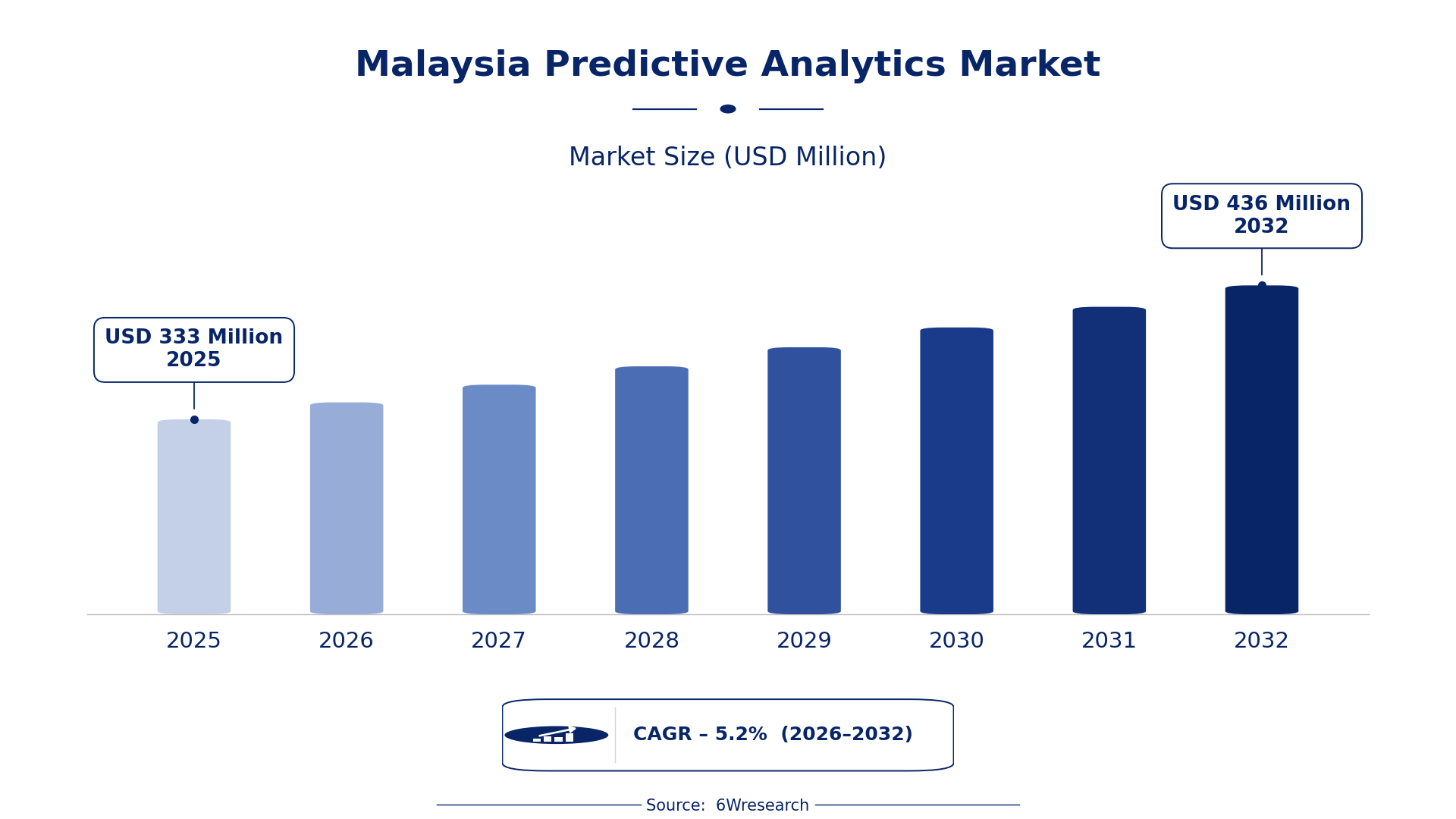
The Malaysia Predictive Analytics Market was estimated at USD 333 Million in 2025 and is projected to reach USD 436 Million by 2032, growing at a CAGR of 5.2% from 2026 to 2032.
Malaysia Predictive Analytics Market Synopsis
The driving force behind the Malaysia Predictive Analytics Market is the increasing recognition of data's value in decision-making across sectors. Organizations are tapping into historical and real-time data to derive actionable insights that inform strategic direction, enhancing operational efficiency and customer engagement.
Particularly in industries like finance, healthcare, and retail, predictive analytics is transforming traditional practices. As more businesses realize the competitive edge gained from data-driven strategies, the demand for sophisticated analytical tools is growing, propelling market growth.
Malaysia Predictive Analytics Market Year-wise Growth Rate and Key Drivers
This graph illustrates the annual growth rates of the Malaysia Predictive Analytics Market from 2021 to 2032, highlighting a steady upward trajectory and projected expansion over the forecast period.
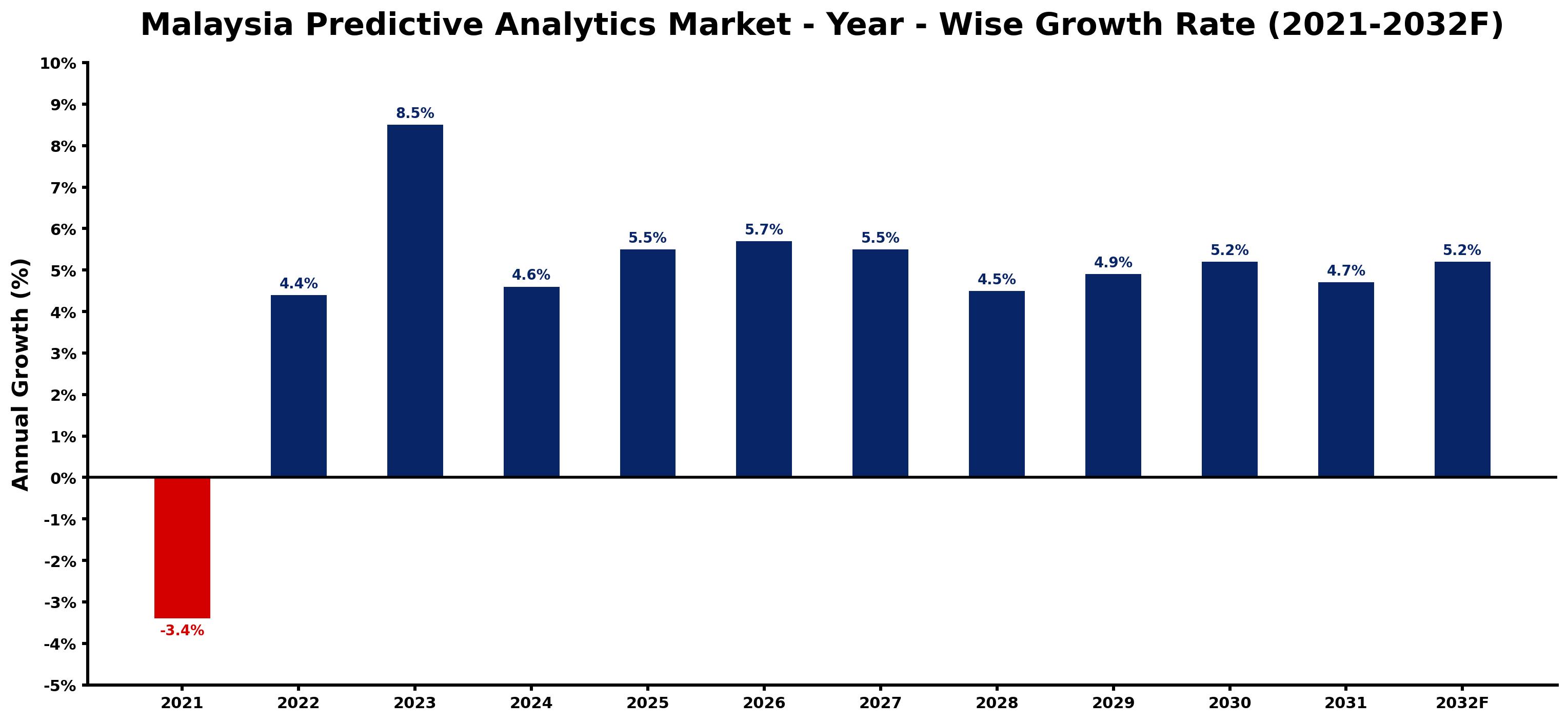
The table below presents the year‑wise growth rates along with the key drivers influencing the market
| Year | Growth Rate | Major Drivers |
| 2021 | -3.4% | Implementation delays from Malaysia's MDEC technology initiatives |
| 2022 | 4.4% | Government's MyDigital Blueprint boosting data analytics adoption. |
| 2023 | 8.5% | Increased demand for AI-driven insights in finance sector. |
| 2024 | 4.6% | Growing e-commerce market requires advanced customer analytics tools. |
| 2025 | 5.5% | Rise in regional tech startups leveraging predictive modeling. |
| 2026 | 5.7% | Local universities enhancing data science curriculum and programs. |
| 2027 | 5.5% | Investment in digital transformation by Malaysian SMEs accelerating. |
| 2028 | 4.5% | Healthcare sector adopting predictive analytics for patient outcomes. |
| 2029 | 4.9% | Telecommunications companies utilizing analytics for customer retention strategies. |
| 2030 | 5.2% | Government support for AI initiatives spurring analytics growth. |
| 2031 | 4.7% | Increased regulatory compliance demands driving risk assessment analytics. |
| 2032 | 5.2% | Demand for tourism analytics from growing travel industry. |
Note: Market size estimations and growth projections presented in this report are based on 6Wresearch's proprietary forecasting methodology, utilizing the latest available industry data, government publications, and primary research inputs.
Malaysia Predictive Analytics Market Key Takeaways
Below are some of the specific key takeaways from the market, including:
- The rise of big data technologies is directly influencing the demand for predictive analytics solutions.
- Companies are increasingly focusing on customer experience enhancement through predictive insights.
- Data privacy and security concerns are critical factors influencing the adoption of predictive analytics.
- The shortage of skilled data professionals is a notable barrier to widespread implementation.
- COVID-19 has accelerated the need for adaptive business strategies utilizing predictive analytics.
Evaluation of Restraints in Malaysia Predictive Analytics Market
Despite the promising outlook, the Malaysia Predictive Analytics Market encounters several restraints. Data quality remains a significant hurdle, as many organizations struggle to obtain and maintain accurate and relevant datasets. Privacy and security issues further complicate matters, especially as the need for access to sensitive information increases. Additionally, the dearth of qualified data scientists limits the capacity for firms to fully exploit predictive analytics capabilities. The rapid pace of change in business environments also raises concerns regarding the ongoing relevance of predictive models.
Malaysia Predictive Analytics Market Trends
Current trends indicate a heightened focus on integrating artificial intelligence (AI) with predictive analytics. Businesses are increasingly utilizing AI algorithms to refine predictive models, improving accuracy and reliability. on top of that, there is a noticeable shift towards real-time analytics, enabling organizations to make immediate adjustments based on the latest data. This trend is especially prevalent in the retail sector, where consumer behaviors are highly dynamic.
Malaysia Predictive Analytics Market Opportunities
The market presents numerous growth opportunities, particularly for companies that can offer tailored predictive analytics solutions. Industries such as healthcare and finance are ripe for innovation, especially in areas like risk management and patient care optimization. There is also potential for expansion in small and medium-sized enterprises, which are beginning to recognize the benefits of data analytics but lack the resources to implement comprehensive solutions. Collaborations between tech firms and traditional industries can catalyze further adoption.
Government Initiatives in the Malaysia Predictive Analytics Market
Government initiatives are playing a crucial role in shaping the Malaysia Predictive Analytics Market. The Malaysian government is increasingly prioritizing digital transformation and the adoption of data analytics across various sectors. This regulatory environment fosters investment and innovation, encouraging businesses to integrate predictive analytics into their operations.
- A national digital infrastructure upgrade programme now in its rollout phase aims to enhance data access and analytics capabilities across sectors.
- Currently underway is a public-private initiative focused on developing a skilled workforce in data analytics, addressing the talent gap in the industry.
- A regulatory framework introduced in 2025 mandates transparency in data handling, encouraging organizations to adopt best practices in analytics.
- Planned for 2027 is a government-funded initiative to support SMEs in adopting predictive analytics technologies, providing grants and training.
Future Insights of the Malaysia Predictive Analytics Market
Looking ahead to 2026-2032, the Malaysia Predictive Analytics Market is set for continued growth as businesses increasingly rely on data-driven insights to remain competitive. The integration of AI and machine learning will enhance predictive capabilities, enabling organizations to adapt to changing market conditions. As data privacy regulations evolve, companies will need to navigate compliance while maximizing the utility of their analytics tools. The push for a data-savvy workforce will further stimulate market growth, as more professionals become equipped to harness the power of predictive analytics.
Malaysia Predictive Analytics Market Latest Developments
Recent activity in the Malaysia Predictive Analytics Market reflects a growing commitment to harnessing data for strategic advantage. In the past year, numerous initiatives have surfaced, showcasing the sector's dynamic nature and its adaptation to emerging challenges.
- A major technology vendor launched a new predictive analytics platform in early 2025, aimed at enhancing real-time data processing capabilities for businesses.
- An initiative that began in mid-2025 focuses on integrating machine learning tools into existing analytics frameworks, currently underway across various industries.
- Plans are in motion for a conference in late 2026 dedicated to predictive analytics innovations, aiming to foster collaboration among industry leaders and stakeholders.
- A leading regional operator is expanding its analytics service offerings, with a rollout expected to begin in Q3 2025, targeting small businesses.
Malaysia Predictive Analytics Market - Key Attractiveness of the Report
- 10 Years of Market Numbers
- Historical Data Starting from 2022 to 2025
- Base Year: 2025
- Forecast Data until 2032
- Key Performance Indicators Impacting the Market
- Major Upcoming Developments and Projects
Key Highlights of the Report:
- Malaysia Predictive Analytics Market Outlook
- Market Size of Malaysia Predictive Analytics Market, 2025
- Forecast of Malaysia Predictive Analytics Market, 2032
- Historical Data and Forecast of Malaysia Predictive Analytics Revenues & Volume for the Period 2022-2032F
- Malaysia Predictive Analytics Market Trend Evolution
- Malaysia Predictive Analytics Market Drivers and Challenges
- Malaysia Predictive Analytics Price Trends
- Malaysia Predictive Analytics Porter's Five Forces
- Malaysia Predictive Analytics Industry Life Cycle
- Historical Data and Forecast of Malaysia Predictive Analytics Market Revenues & Volume By Component for the Period 2022-2032F
- Historical Data and Forecast of Malaysia Predictive Analytics Market Revenues & Volume By Solutions for the Period 2022-2032F
- Historical Data and Forecast of Malaysia Predictive Analytics Market Revenues & Volume By Services for the Period 2022-2032F
- Historical Data and Forecast of Malaysia Predictive Analytics Market Revenues & Volume By Deployment Mode for the Period 2022-2032F
- Historical Data and Forecast of Malaysia Predictive Analytics Market Revenues & Volume By Cloud for the Period 2022-2032F
- Historical Data and Forecast of Malaysia Predictive Analytics Market Revenues & Volume By On-premises for the Period 2022-2032F
- Historical Data and Forecast of Malaysia Predictive Analytics Market Revenues & Volume By Organization Size for the Period 2022-2032F
- Historical Data and Forecast of Malaysia Predictive Analytics Market Revenues & Volume By Large enterprises for the Period 2022-2032F
- Historical Data and Forecast of Malaysia Predictive Analytics Market Revenues & Volume By Small and medium-sized enterprises (SMEs) for the Period 2022-2032F
- Historical Data and Forecast of Malaysia Predictive Analytics Market Revenues & Volume By Vertical for the Period 2022-2032F
- Historical Data and Forecast of Malaysia Predictive Analytics Market Revenues & Volume By BFSI for the Period 2022-2032F
- Historical Data and Forecast of Malaysia Predictive Analytics Market Revenues & Volume By Manufacturing for the Period 2022-2032F
- Historical Data and Forecast of Malaysia Predictive Analytics Market Revenues & Volume By Retail and eCommerce for the Period 2022-2032F
- Historical Data and Forecast of Malaysia Predictive Analytics Market Revenues & Volume By Government and Defense for the Period 2022-2032F
- Historical Data and Forecast of Malaysia Predictive Analytics Market Revenues & Volume By Healthcare and Life Sciences for the Period 2022-2032F
- Historical Data and Forecast of Malaysia Predictive Analytics Market Revenues & Volume By Energy and Utilities for the Period 2022-2032F
- Historical Data and Forecast of Malaysia Predictive Analytics Market Revenues & Volume By Telecommunications and IT for the Period 2022-2032F
- Historical Data and Forecast of Malaysia Predictive Analytics Market Revenues & Volume By Transportation and Logistics for the Period 2022-2032F
- Malaysia Predictive Analytics Import Export Trade Statistics
- Market Opportunity Assessment By Component
- Market Opportunity Assessment By Deployment Mode
- Market Opportunity Assessment By Organization Size
- Market Opportunity Assessment By Vertical
- Malaysia Predictive Analytics Top Companies Market Share
- Malaysia Predictive Analytics Competitive Benchmarking By Technical and Operational Parameters
- Malaysia Predictive Analytics Company Profiles
- Malaysia Predictive Analytics Key Strategic Recommendations






































