Malaysia Predictive Maintenance Market Size & Growth Rate (2026-2032)
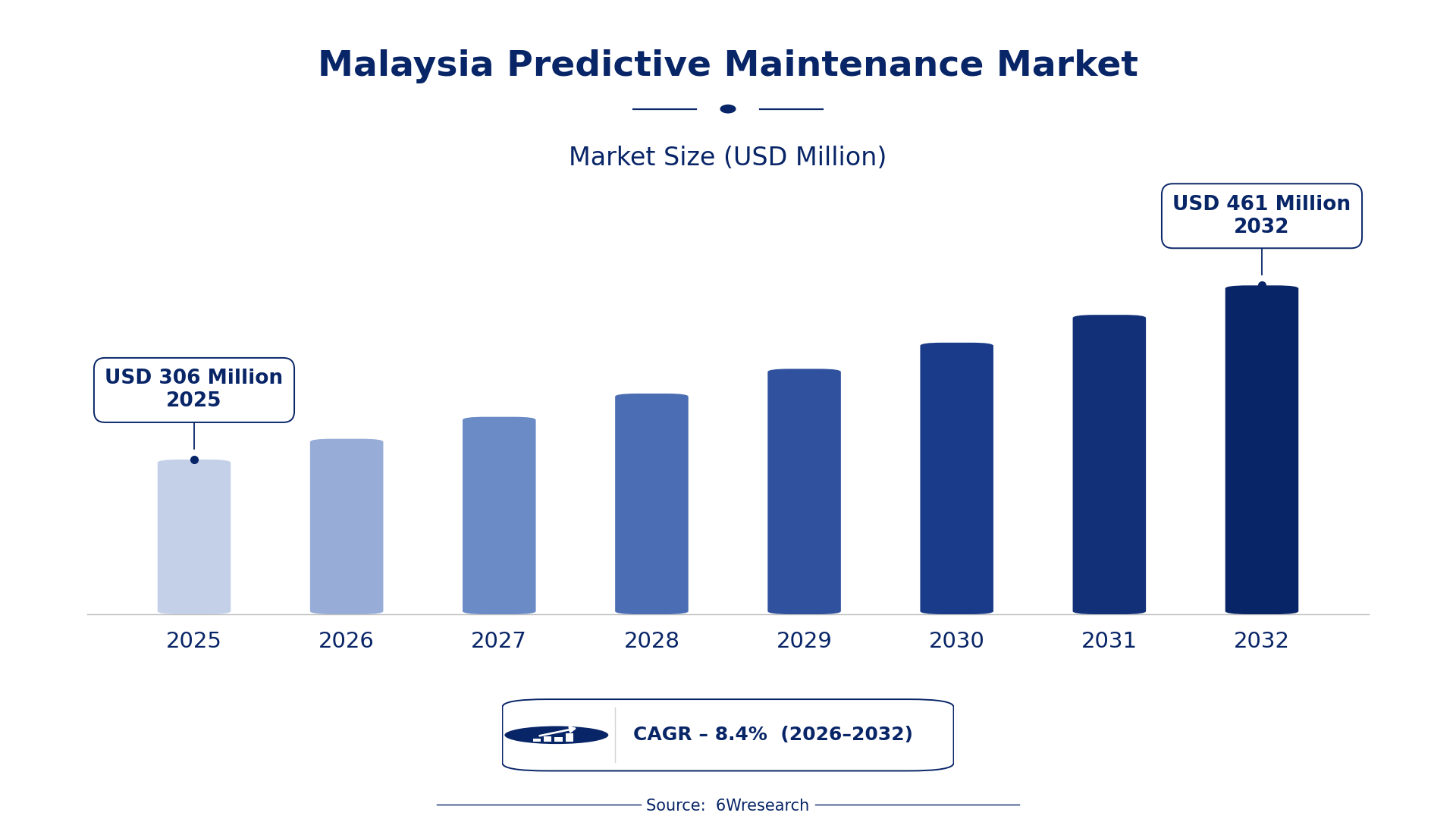
The Malaysia Predictive Maintenance Market was estimated at USD 306 Million in 2025 and is projected to reach USD 461 Million by 2032, growing at a CAGR of 8.4% from 2026 to 2032.
Malaysia Predictive Maintenance Market Synopsis
The predictive maintenance market in Malaysia is witnessing dynamic growth, primarily fueled by the integration of Industry 4.0 technologies across various sectors. Companies in manufacturing, energy, and transportation are increasingly adopting predictive maintenance strategies, recognizing their potential to enhance operational efficiency and reduce costs.
In this context, predictive maintenance solutions, leveraging advanced data analytics and IoT technologies, are becoming indispensable. Businesses are eager to minimize equipment failures and optimize maintenance schedules, indicating a shift towards more proactive asset management practices that can sustain growth in the long term.
Malaysia Predictive Maintenance Market Year-wise Growth Rate and Key Drivers
This graph illustrates the annual growth rates of the Malaysia Predictive Maintenance Market from 2021 to 2032, highlighting a steady upward trajectory and projected expansion over the forecast period.
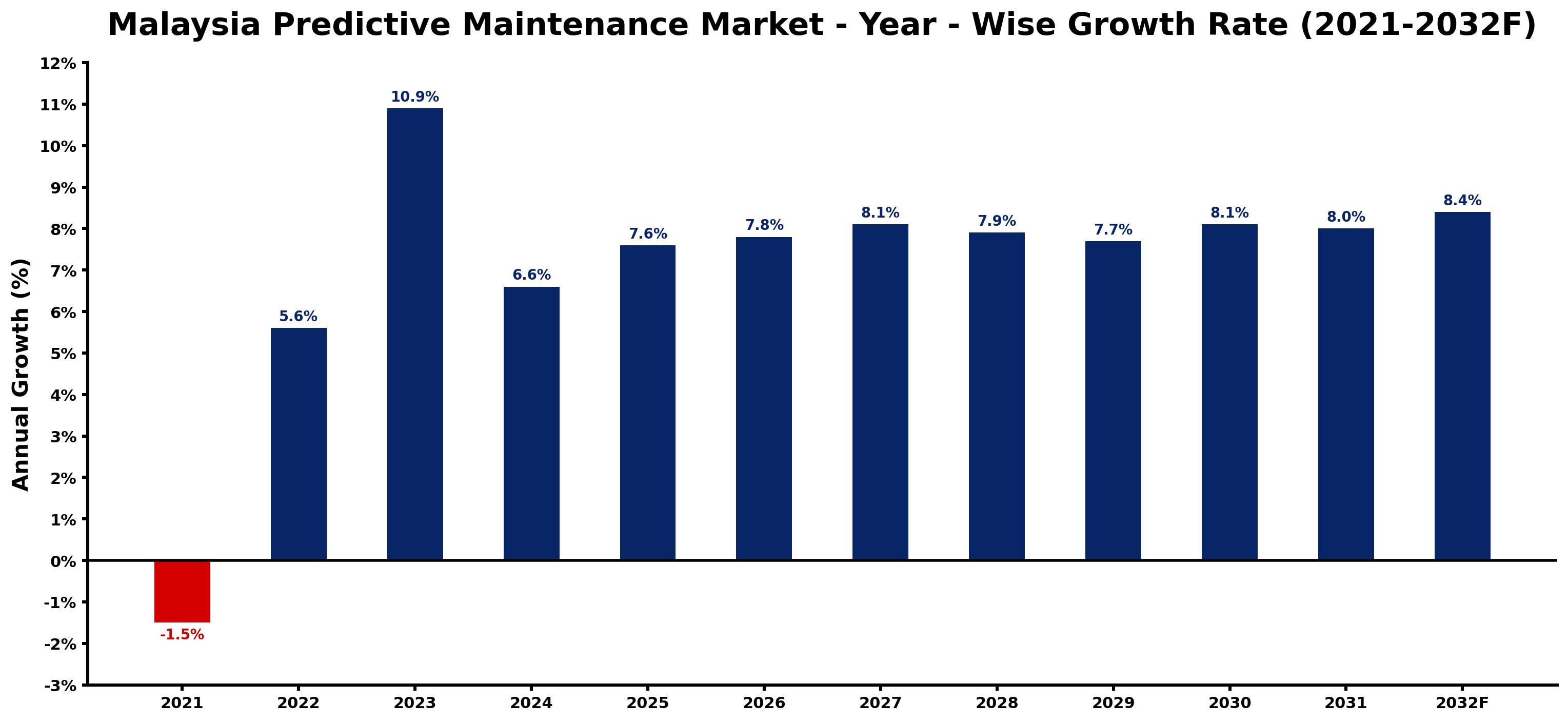
The table below presents the year‑wise growth rates along with the key drivers influencing the market
| Year | Growth Rate | Major Drivers |
| 2021 | -1.5% | Reduced government spending on infrastructure projects during pandemic. |
| 2022 | 5.6% | Malaysian government promotes Industry 4.0 technologies. |
| 2023 | 10.9% | Increased adoption of smart sensors in local industries. |
| 2024 | 6.6% | Focus on reducing operational costs in manufacturing sectors. |
| 2025 | 7.6% | Emerging need for real-time analytics among Malaysian businesses. |
| 2026 | 7.8% | Government incentives for predictive analytics training programs. |
| 2027 | 8.1% | Growing awareness of predictive maintenance benefits in SMEs. |
| 2028 | 7.9% | Enhanced connectivity from Malaysia's 5G rollout supports adoption. |
| 2029 | 7.7% | Rising investments in sustainable manufacturing practices drive demand. |
| 2030 | 8.1% | Collaboration between tech startups and traditional companies expands. |
| 2031 | 8.0% | Regulatory pressure on equipment uptime efficiency increases. |
| 2032 | 8.4% | Integration of AI technologies boosts predictive maintenance usage. |
Note: Market size estimations and growth projections presented in this report are based on 6Wresearch's proprietary forecasting methodology, utilizing the latest available industry data, government publications, and primary research inputs.
Malaysia Predictive Maintenance Market Key Takeaways
Below are some of the specific key takeaways from the market, including:
- The growing adoption of Industry 4.0 practices is a primary driver of market growth.
- Integration of IoT technologies is enhancing the effectiveness of predictive maintenance solutions.
- Cost-conscious businesses are increasingly prioritizing predictive maintenance to reduce operational downtime.
- Challenges such as equipment integration and model accuracy remain significant barriers.
- The COVID-19 pandemic has accelerated the demand for predictive maintenance as companies seek to optimize operations.
Evaluation of Restraints in Malaysia Predictive Maintenance Market
Despite the optimistic outlook, the Malaysia predictive maintenance market grapples with considerable restraints. Key among these is the challenge of retrofitting existing machinery with the necessary sensors and monitoring equipment, which can be both costly and complex. Organizations often face difficulties in ensuring the reliability and accuracy of predictive maintenance models, creating hesitancy in adoption. Additionally, the initial investment required for implementing these advanced solutions can be a deterrent for smaller enterprises, limiting their participation in this evolving market.
Malaysia Predictive Maintenance Market Trends
Several trends are shaping the Malaysian predictive maintenance market. First, the move towards digitalization is evident, with more businesses investing in data analytics to drive decision-making. Second, there’s a noticeable shift towards using machine learning algorithms to enhance predictive maintenance models, allowing for greater accuracy in forecasting equipment failures. Third, collaboration between technology providers and end-users is on the rise, fostering innovation and tailored solutions that meet specific industry needs.
Malaysia Predictive Maintenance Market Opportunities
The opportunities within the Malaysia predictive maintenance market are promising. Companies are increasingly recognizing the value of predictive analytics in improving asset management. This has opened doors for technology vendors to offer customized solutions that cater to various sectors, such as manufacturing and transportation. on top of that, as organizations strive for operational excellence, investment in training and development of workforce skills around predictive maintenance technologies presents a significant opportunity for growth.
Government Initiatives in the Malaysia Predictive Maintenance Market
Government policy is playing a critical role in shaping the predictive maintenance market in Malaysia. The focus on digital transformation and enhancing operational efficiency within industries is driving initiatives that support technology adoption. As the government prioritizes smart manufacturing and sustainability, policies are being established to create a conducive environment for innovation in predictive maintenance.
- A recently completed initiative includes a national digital infrastructure upgrade programme that enhances connectivity and data exchange capabilities.
- Currently, the government is promoting public-private partnerships aimed at facilitating the integration of IoT technologies into industrial practices.
- A planned regulatory framework expected to launch in 2025 aims to standardize practices around predictive maintenance and data security.
- Ongoing initiatives are focusing on providing financial incentives for companies adopting advanced maintenance solutions, aimed at boosting competitiveness.
- A strategic roadmap for Industry 4.0 implementation is under development, targeting advancements in predictive analytics across key sectors.
Future Insights of the Malaysia Predictive Maintenance Market
Looking forward to 2026-2032, the Malaysia predictive maintenance market is set to evolve rapidly. As industries continue to embrace digital transformation, the demand for sophisticated predictive maintenance solutions will likely increase. Businesses will prioritize investments in advanced analytics and machine learning technologies, allowing for more predictive and proactive maintenance practices. The emphasis on sustainability and cost reduction will further drive the adoption of these solutions, ensuring their place at the forefront of Malaysia’s industrial advancement.
Malaysia Predictive Maintenance Market Latest Developments
Recent activity in the Malaysia predictive maintenance market indicates a strong momentum towards innovation and technological integration. Over the past year, industry players have been focused on enhancing their offerings, responding to growing demand for efficient maintenance solutions. The landscape is marked by partnerships, technology rollouts, and increasing interest from various sectors seeking to improve their operational capabilities.
- A major technology vendor announced an ongoing rollout of an advanced predictive maintenance platform in early 2025, aimed at the manufacturing sector.
- In mid-2025, a leading regional operator initiated a partnership with an analytics firm to enhance their predictive maintenance capabilities across their logistics operations.
- A product launch scheduled for late 2026 will introduce a new suite of IoT-enabled predictive maintenance tools tailored for the energy sector.
- A pilot project focusing on integrating predictive maintenance solutions within transportation infrastructure is currently underway, expected to complete by late 2025.
- Upcoming in Q3 2026, a major conference will showcase innovations and best practices in predictive maintenance across various industries, facilitating knowledge sharing and collaboration.
Malaysia Predictive Maintenance Market - Key Attractiveness of the Report
- 10 Years of Market Numbers
- Historical Data Starting from 2022 to 2025
- Base Year: 2025
- Forecast Data until 2032
- Key Performance Indicators Impacting the Market
- Major Upcoming Developments and Projects
What are the government’s recent initiatives to support predictive maintenance?
Key Highlights of the Report:
- Malaysia Predictive Maintenance Market Outlook
- Market Size of Malaysia Predictive Maintenance Market, 2025
- Forecast of Malaysia Predictive Maintenance Market, 2032
- Historical Data and Forecast of Malaysia Predictive Maintenance Revenues & Volume for the Period 2022-2032F
- Malaysia Predictive Maintenance Market Trend Evolution
- Malaysia Predictive Maintenance Market Drivers and Challenges
- Malaysia Predictive Maintenance Price Trends
- Malaysia Predictive Maintenance Porter's Five Forces
- Malaysia Predictive Maintenance Industry Life Cycle
- Historical Data and Forecast of Malaysia Predictive Maintenance Market Revenues & Volume By Component for the Period 2022-2032F
- Historical Data and Forecast of Malaysia Predictive Maintenance Market Revenues & Volume By Solutions for the Period 2022-2032F
- Historical Data and Forecast of Malaysia Predictive Maintenance Market Revenues & Volume By Services for the Period 2022-2032F
- Historical Data and Forecast of Malaysia Predictive Maintenance Market Revenues & Volume By Organization Size for the Period 2022-2032F
- Historical Data and Forecast of Malaysia Predictive Maintenance Market Revenues & Volume By Large Enterprises for the Period 2022-2032F
- Historical Data and Forecast of Malaysia Predictive Maintenance Market Revenues & Volume By SME for the Period 2022-2032F
- Historical Data and Forecast of Malaysia Predictive Maintenance Market Revenues & Volume By Deployment Mode for the Period 2022-2032F
- Historical Data and Forecast of Malaysia Predictive Maintenance Market Revenues & Volume By On-premises for the Period 2022-2032F
- Historical Data and Forecast of Malaysia Predictive Maintenance Market Revenues & Volume By Cloud for the Period 2022-2032F
- Historical Data and Forecast of Malaysia Predictive Maintenance Market Revenues & Volume By Vertical for the Period 2022-2032F
- Historical Data and Forecast of Malaysia Predictive Maintenance Market Revenues & Volume By Government and Defense for the Period 2022-2032F
- Historical Data and Forecast of Malaysia Predictive Maintenance Market Revenues & Volume By Manufacturing for the Period 2022-2032F
- Historical Data and Forecast of Malaysia Predictive Maintenance Market Revenues & Volume By Energy and Utilities for the Period 2022-2032F
- Historical Data and Forecast of Malaysia Predictive Maintenance Market Revenues & Volume By Transportation and Logistics for the Period 2022-2032F
- Historical Data and Forecast of Malaysia Predictive Maintenance Market Revenues & Volume By Healthcare and Life Sciences for the Period 2022-2032F
- Malaysia Predictive Maintenance Import Export Trade Statistics
- Market Opportunity Assessment By Component
- Market Opportunity Assessment By Organization Size
- Market Opportunity Assessment By Deployment Mode
- Market Opportunity Assessment By Vertical
- Malaysia Predictive Maintenance Top Companies Market Share
- Malaysia Predictive Maintenance Competitive Benchmarking By Technical and Operational Parameters
- Malaysia Predictive Maintenance Company Profiles
- Malaysia Predictive Maintenance Key Strategic Recommendations






































