Malaysia Printed Electronics Market Size, Share & Growth Rate
The Malaysia Printed Electronics Market was estimated at USD 334 Million in 2025 and is projected to reach USD 436 Million by 2032, growing at a CAGR of 3.9% from 2026 to 2032. This growth trajectory is primarily driven by technological advancements and the rising adoption of printed electronics in diverse applications such as smart packaging, healthcare devices, and automotive components. Furthermore, with government initiatives aimed at bolstering the electronics sector, the market is set to benefit from enhanced research and development efforts, thus fostering innovation and competitiveness.
Malaysia Printed Electronics Market Year-wise Growth Rate and Key Drivers
This graph highlights how the Malaysia Printed Electronics Market has steadily grown over the years, supported by major growth factors.
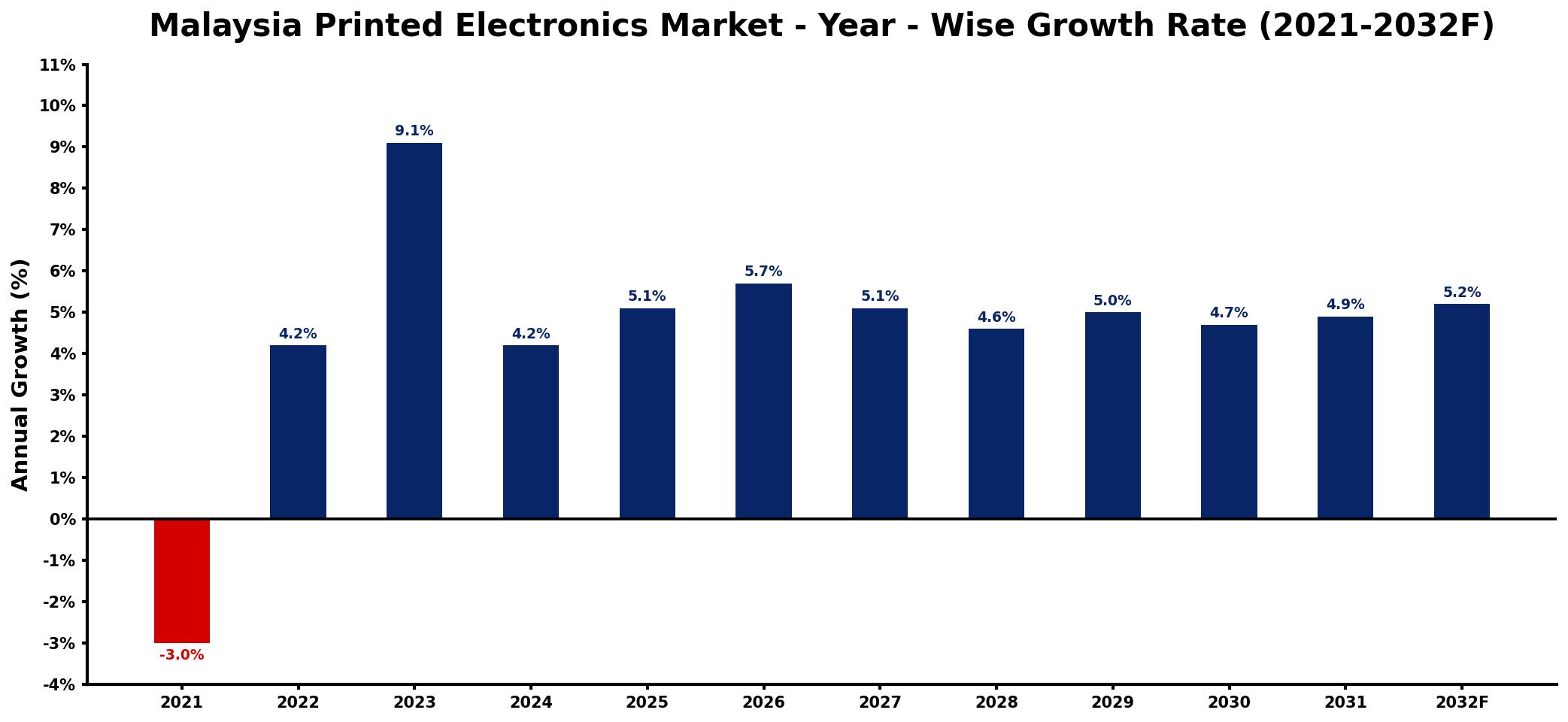
The table below presents the year‑wise growth rates along with the key drivers influencing the market
| Year | Growth Rate | Major Drivers |
| 2021 | -3.0% | decreased investment in new technologies |
| 2022 | 4.2% | growing demand for sustainable solutions |
| 2023 | 9.1% | expansion of smart packaging applications |
| 2024 | 4.2% | increase in manufacturing capabilities |
| 2025 | 5.1% | rising interest in wearable applications |
| 2026 | 5.7% | growth in automotive sector integration |
| 2027 | 5.1% | enhanced research and development funding |
| 2028 | 4.6% | surge in healthcare technology adoption |
| 2029 | 5.0% | emergence of innovative startup companies |
| 2030 | 4.7% | increased collaboration with universities |
| 2031 | 4.9% | increased pharmaceutical industry usage |
| 2032 | 5.2% | advancements in material science research |
Note: Market size estimations and growth projections presented in this report are based on 6Wresearch's proprietary forecasting methodology, utilizing the latest available industry data, government publications, and primary research inputs.
Malaysia Printed Electronics Market Synopsis
The printed electronics market in Malaysia has recently gained momentum, buoyed by the increasing integration of these technologies across various industries. This upward trend reflects a broader shift towards flexible and cost-effective solutions, positioning Malaysia as a key player in the Southeast Asian electronics landscape. As businesses seek innovative methods to streamline production processes and reduce costs, the demand for printed electronics is becoming increasingly pronounced.
Looking ahead, the market is expected to capitalize on its initial growth, with expanding applications in sectors such as healthcare and smart packaging driving demand. As technological innovations continue to emerge, Malaysia's printed electronics market is poised for dynamic evolution, creating opportunities for both domestic and international stakeholders.
Malaysia Printed Electronics Market Key Takeaways
- Projected growth from USD 334 Million in 2025 to USD 436 Million by 2032, at a CAGR of 3.9%.
- Strong demand for printed electronics driven by applications in RFID tags, flexible displays, and smart packaging.
- Government support and initiatives are fueling research and development in printed electronics.
- Emerging opportunities exist in the healthcare and automotive sectors.
- Increased focus on sustainable and lightweight solutions is reshaping the competitive landscape.
Evaluation of Restraints in Malaysia Printed Electronics Market
Despite the promising growth prospects, several restraints could hinder the advancement of the printed electronics market in Malaysia. Continuous investment in research and development is essential to maintain technological relevance; failure to innovate may result in stagnation. Additionally, traditional electronics manufacturing methods, which often provide higher performance and lower costs, present significant competition. To maintain a foothold, companies must effectively communicate the unique advantages of printed electronics, including flexibility, lightweight attributes, and eco-friendliness, to attract new clients and retain existing ones.
Malaysia Printed Electronics Market Trends
The Malaysia Printed Electronics Market is witnessing several significant trends that are reshaping its landscape. One notable trend is the increasing deployment of smart packaging solutions, which leverage printed electronics for enhanced user engagement and product tracking. Additionally, the healthcare sector is rapidly adopting printed electronics for innovative medical devices and diagnostics, particularly in the wake of heightened demand for contactless solutions. Sustainability is also gaining traction; manufacturers are increasingly prioritizing eco-friendly materials and processes as environmental concerns become more pronounced among consumers.
Malaysia Printed Electronics Market Opportunities
As the market evolves, numerous growth and investment opportunities emerge. The healthcare sector offers a particularly lucrative avenue, with the potential for innovations in wearable devices and diagnostics that utilize printed electronics. Moreover, smart city initiatives are paving the way for the integration of printed electronics in urban infrastructure, from energy-efficient sensors to interactive signage. These developments, coupled with expanding research collaborations, signal robust growth potential for stakeholders looking to invest in this dynamic market.
Government Initiatives in the Malaysia Printed Electronics Market
The Malaysian government is actively fostering the growth of the printed electronics market through a range of supportive policies and initiatives. These efforts include funding for research and development projects aimed at advancing technology in the electronics sector, as well as incentives to attract foreign investment in local manufacturing capabilities. Collaborative programs between government entities and educational institutions are also promoting knowledge transfer and skill development, ensuring that the workforce is equipped to meet the demands of this evolving industry.
Future Insights of the Malaysia Printed Electronics Market
Looking ahead to 2026-2032, the Malaysia Printed Electronics Market is expected to enter a phase of enhanced growth driven by continued technological advancements and broader acceptance across various sectors. The expansion of smart packaging and healthcare applications will likely dominate the landscape, supported by government initiatives aimed at bolstering the electronics sector. Additionally, as sustainability becomes a focal point for consumers and businesses alike, printed electronics is well-positioned to meet this demand through its inherent lightweight and flexible properties. Market participants that embrace innovation and prioritize sustainability will find themselves at the forefront of this burgeoning sector.
Malaysia Printed Electronics Market Latest Developments (2025 - 2026)
Recent industry developments indicate a strong push towards incorporating printed electronics in various applications. There has been a noticeable rise in partnerships between research institutions and businesses, aimed at driving innovation and improving manufacturing techniques. Additionally, companies are actively exploring new materials and processes to enhance the functionality of printed electronics. This collaborative environment is fostering a spirit of innovation, positioning the Malaysia printed electronics market for significant advancements in the near future.
Malaysia Printed Electronics Market - Key Attractiveness of the Report
- 10 Years of Market Numbers
- Historical Data Starting from 2022 to 2025
- Base Year: 2025
- Forecast Data until 2032
- Key Performance Indicators Impacting the Market
- Major Upcoming Developments and Projects
Key Highlights of the Report:
- Malaysia Printed Electronics Market Outlook
- Market Size of Malaysia Printed Electronics Market, 2025
- Forecast of Malaysia Printed Electronics Market, 2032
- Historical Data and Forecast of Malaysia Printed Electronics Revenues & Volume for the Period 2022-2032F
- Malaysia Printed Electronics Market Trend Evolution
- Malaysia Printed Electronics Market Drivers and Challenges
- Malaysia Printed Electronics Price Trends
- Malaysia Printed Electronics Porter's Five Forces
- Malaysia Printed Electronics Industry Life Cycle
- Historical Data and Forecast of Malaysia Printed Electronics Market Revenues & Volume By Material for the Period 2022-2032F
- Historical Data and Forecast of Malaysia Printed Electronics Market Revenues & Volume By Ink for the Period 2022-2032F
- Historical Data and Forecast of Malaysia Printed Electronics Market Revenues & Volume By Substrate for the Period 2022-2032F
- Historical Data and Forecast of Malaysia Printed Electronics Market Revenues & Volume By Technology for the Period 2022-2032F
- Historical Data and Forecast of Malaysia Printed Electronics Market Revenues & Volume By Screen for the Period 2022-2032F
- Historical Data and Forecast of Malaysia Printed Electronics Market Revenues & Volume By Inkjet for the Period 2022-2032F
- Historical Data and Forecast of Malaysia Printed Electronics Market Revenues & Volume By Flexographic for the Period 2022-2032F
- Historical Data and Forecast of Malaysia Printed Electronics Market Revenues & Volume By Gravure for the Period 2022-2032F
- Historical Data and Forecast of Malaysia Printed Electronics Market Revenues & Volume By Device for the Period 2022-2032F
- Historical Data and Forecast of Malaysia Printed Electronics Market Revenues & Volume By Displays for the Period 2022-2032F
- Historical Data and Forecast of Malaysia Printed Electronics Market Revenues & Volume By Photovoltaic for the Period 2022-2032F
- Historical Data and Forecast of Malaysia Printed Electronics Market Revenues & Volume By Lighting for the Period 2022-2032F
- Historical Data and Forecast of Malaysia Printed Electronics Market Revenues & Volume By RFID for the Period 2022-2032F
- Historical Data and Forecast of Malaysia Printed Electronics Market Revenues & Volume By Others for the Period 2022-2032F
- Malaysia Printed Electronics Import Export Trade Statistics
- Market Opportunity Assessment By Material
- Market Opportunity Assessment By Technology
- Market Opportunity Assessment By Device
- Malaysia Printed Electronics Top Companies Market Share
- Malaysia Printed Electronics Competitive Benchmarking By Technical and Operational Parameters
- Malaysia Printed Electronics Company Profiles
- Malaysia Printed Electronics Key Strategic Recommendations






































