Malaysia Processed Fruit Market Summary
The malaysia processed fruit market was estimated at USD 330 Million in 2025 and is projected to reach USD 428 Million by 2032, growing at a CAGR of 5.1% from 2026 to 2032.
Malaysia Processed Fruit Market Year-wise Growth Rate and Key Drivers
This graph highlights how the Malaysia Processed Fruit Market has steadily grown over the past five years, supported by major growth factors.
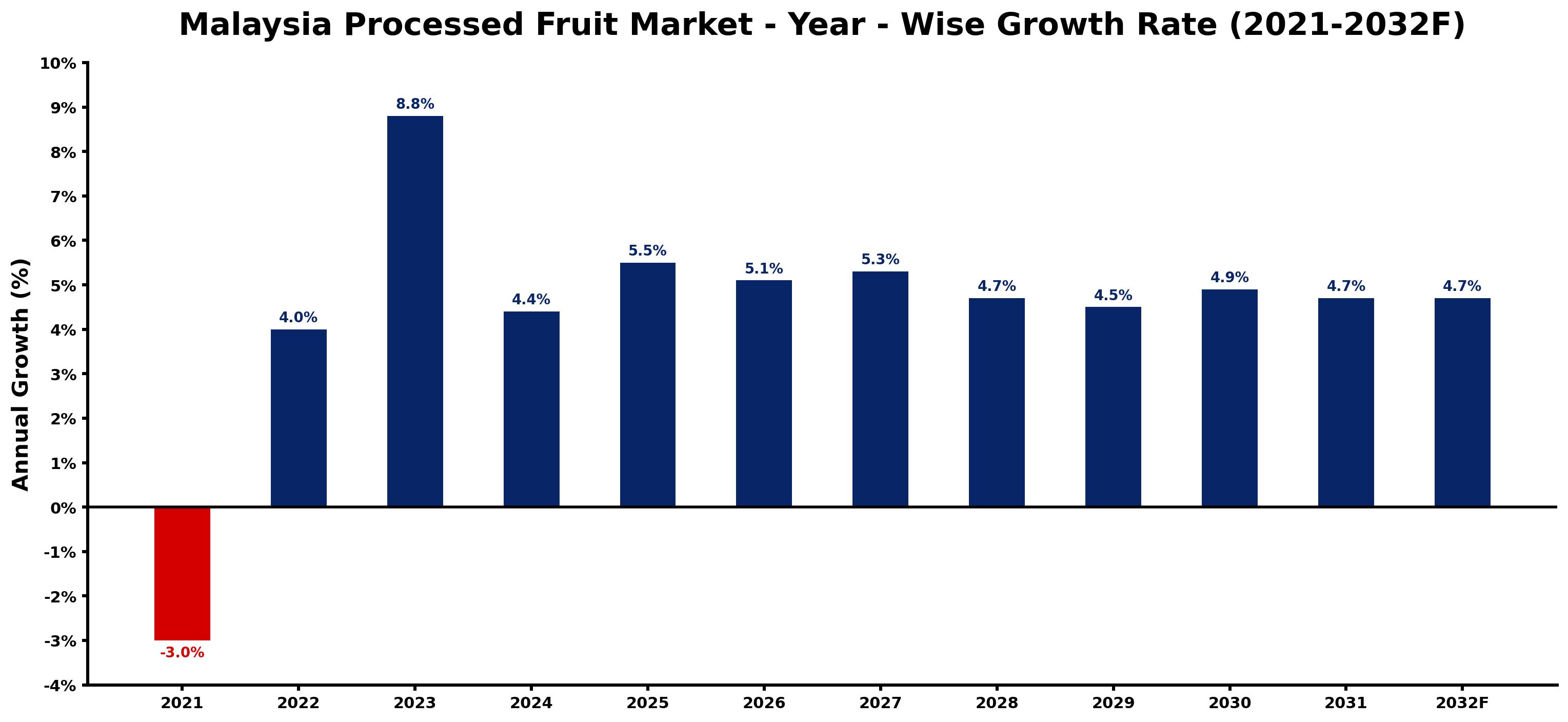
The table below presents the year wise growth rates along with the key drivers influencing the market
| Year | Growth Rate | Major Drivers |
| 2021 | -3.0% | Pandemicrelated supply chain disruptions significantly hindered the availability of processed fruit products in Malaysia. |
| 2022 | 4.0% | Urbanization trends encouraged convenience foods, elevating processed fruit market visibility. |
| 2023 | 8.8% | E-commerce expansion enabled wider distribution channels for processed fruit products. |
| 2024 | 4.4% | Local manufacturers began innovating flavors tailored to Malaysian palates, enhancing market appeal. |
| 2025 | 5.5% | Health awareness campaigns contributed to a surge in demand for nutritious processed options. |
| 2026 | 5.1% | Collaborations between brands and health influencers attracted younger demographics towards processed fruits. |
| 2027 | 5.3% | Emerging food trends embraced plant-based diets, increasing processed fruit's role in nutrition. |
| 2028 | 4.7% | Sustainability practices in agriculture made processed fruits more attractive to eco-conscious consumers. |
| 2029 | 4.5% | Technological advancements in preservation methods improved the quality and shelf life of products. |
| 2030 | 4.9% | Increased tourism provided opportunities for local brands to showcase unique processed fruit offerings. |
| 2031 | 4.7% | Regional trade agreements facilitated easier access to international processed fruit markets. |
| 2032 | 4.7% | Consumer demand for organic products prompted a rise in certified processed fruit selections. |
Note - Market size estimations and growth projections presented in this report are based on 6Wresearch's advanced forecasting approach, validated with industry datasets as of June 2026.
Malaysia Processed Fruit Market Synopsis
The Malaysia Processed Fruit Market is projected to reach 5.1% and witness significant growth during the forecast period (2026-2032). This growth is attributed to several factors, including accelerating urbanization, an increase in disposable income, and evolving consumer lifestyle choices. The demand for convenience food products is on the rise, leading to heightened consumer interest in processed fruits. Moreover, government initiatives aimed at promoting healthy snacking habits contribute positively to the market dynamics.
Malaysia Processed Fruit Market Growth Drivers
Several key drivers are propelling the expansion of the Malaysia processed fruit market. First, the rapid urbanization across Malaysia is leading to changing consumption patterns; urban consumers increasingly seek out convenient and health-focused food options. Second, rising disposable income enables consumers to spend more on processed fruit products, which are often seen as healthier alternatives compared to traditional snacks. Third, a growing awareness of nutritional benefits associated with processed fruits is influencing purchasing decisions.
- The increasing trend of health consciousness among Malaysian consumers is fostering a preference for nutritious snacks.
- Innovations in food processing technology enhance product variety and preservation, appealing to a broader audience.
- Changes in dietary habits, such as the adoption of plant-based diets, are driving demand for processed fruits.
- Strengthening distribution channels, including online retail platforms, are making processed fruit products more accessible.
- Marketing campaigns emphasizing the health benefits of processed fruits resonate well with consumers, further boosting demand.
Malaysia Processed Fruit Market Trends and Opportunities
The Malaysia processed fruit market is experiencing notable trends that present significant opportunities for growth. One prominent trend is the increasing preference for organic and natural processed fruit products, reflecting a broader consumer shift towards healthier and more sustainable choices. Additionally, innovations in packaging, such as biodegradable and eco-friendly materials, are gaining traction and cater to the environmentally conscious consumer segment.
- Consumers are actively seeking out diverse flavors and functional benefits from processed fruit products, encouraging manufacturers to innovate.
- The rise of convenience-oriented consumption patterns is leading to the introduction of single-serve packaging options, targeting on-the-go consumers.
- Growing demand for gluten-free and allergen-free options is pushing manufacturers to diversify their product offerings.
- The expansion of health-focused retail channels, including fitness centers and health food stores, creates new avenues for market penetration.
- Partnerships with health and wellness influencers are becoming a popular strategy for brands to reach targeted consumer demographics effectively.
Malaysia Processed Fruit Market Challenges and Restraints
Despite the positive growth trajectory, the Malaysia processed fruit market faces several challenges. High production costs associated with fruit processing can restrict profit margins and limit market competitiveness. Furthermore, fluctuations in raw material prices due to climate variability and supply chain disruptions can present significant hurdles for manufacturers. Additionally, the limited availability of refrigeration facilities, especially in rural areas, poses challenges for the storage and distribution of processed fruit products.
- Consumers' price sensitivity may lead to a preference for cheaper, less-healthy snack options over premium processed fruits.
- A lack of proper infrastructure in rural regions can reduce overall market penetration and accessibility.
- Seasonal variations in fruit supply can affect product availability and pricing stability.
- Increased competition from both local and international brands can pressure market players to lower their prices.
- Regulatory challenges pertaining to food safety standards and labeling requirements can complicate market entry for new products.
Malaysia Processed Fruit Market Government Investment and Initiatives
The Malaysian government has recognized the potential of the processed fruit sector and is actively investing in initiatives to enhance market growth. This includes programs aimed at improving agricultural practices to ensure a steady supply of high-quality raw materials, which is essential for processed fruit production. Government incentives for research and development in food technology are encouraging innovations that improve processing efficiency and product quality.
- Public investments in infrastructure development aim to enhance cold chain logistics, particularly in rural areas.
- Initiatives promoting entrepreneurship in agro-based industries are providing support for startups focusing on processed fruit products.
- Collaboration with agricultural institutions is fostering the development of best practices for fruit handling and processing.
- Government campaigns aimed at educating consumers about the health benefits of processed fruits are helping to stimulate demand.
- Subsidies for local fruit farmers are designed to stabilize supply and encourage sustainable practices within the sector.
Malaysia Processed Fruit Market Latest Developments (May 2025 - June 2026)
Recent developments in the Malaysia processed fruit market indicate a trend toward increased product diversification and innovation. Companies are actively launching new flavors and product lines to attract health-conscious consumers. Additionally, the industry is witnessing a surge in investments aimed at modernizing processing facilities and enhancing production capabilities. These advancements are essential as manufacturers strive to meet the growing demand for high-quality processed fruit products.
- New collaborations between technology firms and food processors are enabling the adoption of advanced processing techniques.
- Market players are focusing on sustainability initiatives to minimize waste and promote eco-friendly practices.
- There is an increasing trend for brands to engage in transparency about sourcing and processing methods, resonating with conscious consumers.
- Emerging online grocery platforms are facilitating the growth of the processed fruit segment by improving distribution efficiency.
- The introduction of attractive marketing campaigns targeting younger demographics is becoming a strategic focus area for many brands.
Malaysia Processed Fruit Market - Key Attractiveness of the Report
- 10 Years of Market Numbers
- Historical Data Starting from 2022 to 2025
- Base Year: 2025
- Forecast Data until 2032
- Key Performance Indicators Impacting the Market
- Major Upcoming Developments and Projects
Key Highlights of the Report:
- Malaysia Processed Fruit Market Outlook
- Market Size of Malaysia Processed Fruit Market, 2025
- Forecast of Malaysia Processed Fruit Market, 2032F
- Historical Data and Forecast of Malaysia Processed Fruit Revenues & Volume for the Period 2022-2032F
- Malaysia Processed Fruit Market Trend Evolution
- Malaysia Processed Fruit Market Drivers and Challenges
- Malaysia Processed Fruit Price Trends
- Malaysia Processed Fruit Porter's Five Forces
- Malaysia Processed Fruit Industry Life Cycle
- Historical Data and Forecast of Malaysia Processed Fruit Market Revenues & Volume By Product for the Period 2022-2032F
- Historical Data and Forecast of Malaysia Processed Fruit Market Revenues & Volume By Fresh for the Period 2022-2032F
- Historical Data and Forecast of Malaysia Processed Fruit Market Revenues & Volume By Fresh- Cut for the Period 2022-2032F
- Historical Data and Forecast of Malaysia Processed Fruit Market Revenues & Volume By Canned for the Period 2022-2032F
- Historical Data and Forecast of Malaysia Processed Fruit Market Revenues & Volume By Frozen for the Period 2022-2032F
- Historical Data and Forecast of Malaysia Processed Fruit Market Revenues & Volume By Drying &Dehydration for the Period 2022-2032F
- Historical Data and Forecast of Malaysia Processed Fruit Market Revenues & Volume By Processing Equipment for the Period 2022-2032F
- Historical Data and Forecast of Malaysia Processed Fruit Market Revenues & Volume By Pre-processing for the Period 2022-2032F
- Historical Data and Forecast of Malaysia Processed Fruit Market Revenues & Volume By Processing for the Period 2022-2032F
- Historical Data and Forecast of Malaysia Processed Fruit Market Revenues & Volume By Washing for the Period 2022-2032F
- Historical Data and Forecast of Malaysia Processed Fruit Market Revenues & Volume By Filling for the Period 2022-2032F
- Historical Data and Forecast of Malaysia Processed Fruit Market Revenues & Volume By Seasoning for the Period 2022-2032F
- Historical Data and Forecast of Malaysia Processed Fruit Market Revenues & Volume By Packaging for the Period 2022-2032F
- Malaysia Processed Fruit Import Export Trade Statistics
- Market Opportunity Assessment By Product
- Market Opportunity Assessment By Processing Equipment
- Malaysia Processed Fruit Top Companies Market Share
- Malaysia Processed Fruit Competitive Benchmarking By Technical and Operational Parameters
- Malaysia Processed Fruit Company Profiles
- Malaysia Processed Fruit Key Strategic Recommendations






































