Malaysia Prunes Market (2026-2032) Outlook | Analysis, Revenue, Industry, Forecast, Trends, Companies, Growth, Size, Value & Share
Market Forecast By Type (Chopped, Whole), By Distribution Channel (Online, Offline) And Competitive Landscape
| Product Code: ETC188738 | Publication Date: May 2022 | Updated Date: Jun 2026 | Product Type: Market Research Report | |
| Publisher: 6Wresearch | Author: Ravi Bhandari | No. of Pages: 60 | No. of Figures: 40 | No. of Tables: 7 |
Malaysia Prunes Market Size, Share & Growth Rate
The Malaysia Prunes Market was estimated at USD 288 Million in 2025 and is projected to reach USD 374 Million by 2032, growing at a CAGR of 3.8% from 2026 to 2032. This growth trajectory is fueled by increasing consumer awareness of the health benefits associated with prunes, particularly for digestive health. Moreover, the burgeoning trend of health-conscious snacking continues to encourage a wider demographic to embrace prunes in their diets.
Malaysia Prunes Market Growth Rate Analysis (2021-2032)
The prunes market in Malaysia has shown a notable recovery since 2021 when it faced a decline of 3.2%. This downturn was primarily attributed to pandemic-related disruptions impacting supply chains and consumer purchasing behaviors. However, a shift towards healthier snacking options began to emerge, leading to a 4.0% growth in 2022 and a substantial 9.1% increase in 2023 as consumer demand for nutritional foods surged. Continued investments in agricultural technology and enhanced distribution infrastructure are fostering this upward trend, with expected growth rates stabilizing around 4.4% to 5.6% through 2026. This is indicative of a robust market adapting to changing consumer preferences and increasing health awareness in Malaysia.
Malaysia Prunes Market Year-wise Growth Rate and Key Drivers
This graph highlights how the Malaysia Prunes Market has steadily grown over the past five years, supported by major growth factors.
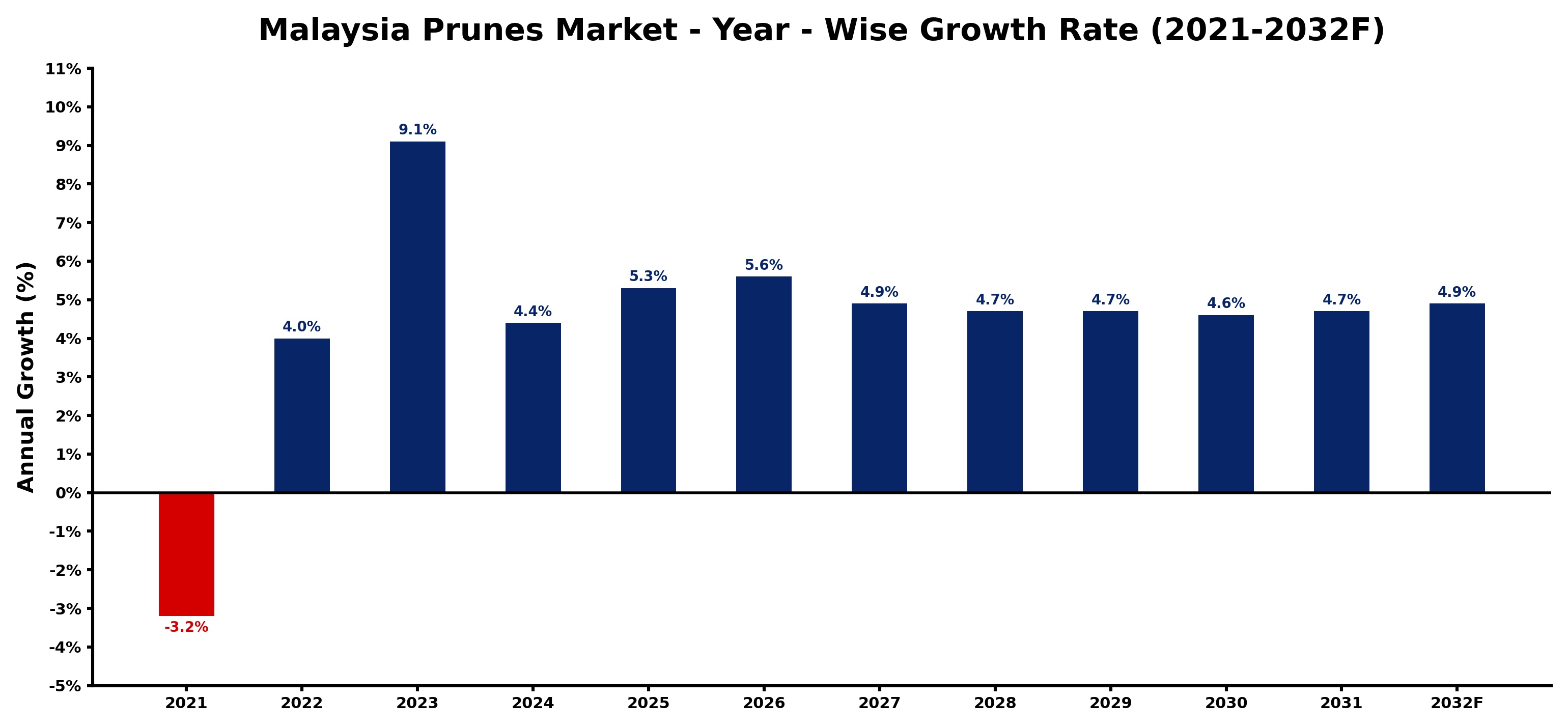
The table below presents the year‑wise growth rates along with the key drivers influencing the market
| Year | Growth Rate | Major Drivers |
| 2021 | -3.2% | Supply chain disruptions limited availability |
| 2022 | 4.0% | Health awareness drove consumption growth |
| 2023 | 9.1% | E-commerce platforms enhanced accessibility |
| 2024 | 4.4% | New product launches attracted consumers |
| 2025 | 5.3% | Increased marketing campaigns raised awareness |
| 2026 | 5.6% | Sustainability trends influenced purchasing decisions |
| 2027 | 4.9% | Consumer preferences shifted towards organic |
| 2028 | 4.7% | Export opportunities expanded market reach |
| 2029 | 4.7% | Innovative packaging improved product appeal |
| 2030 | 4.6% | Collaborations with local producers increased |
| 2031 | 4.7% | Nutritional benefits promoted consumer interest |
| 2032 | 4.9% | Culinary trends inspired new recipes |
Note - Market size estimations and growth projections presented in this report are based on 6Wresearch’s advanced forecasting approach, validated with industry datasets as of June 2026.
Malaysia Prunes Market Synopsis
The prune market in Malaysia has shown a remarkable growth pattern since it began gaining popularity in 2011, as consumers increasingly seek healthier snack alternatives. In 2025 alone, Malaysia spent approximately 1 Million MYR on prunes, indicating a robust demand primarily concentrated in urban areas such as Kuala Lumpur and Selangor, where consumer interest is notably high.
As the market evolves, a diverse array of products has emerged, including various forms of prunes such as dried and pitted varieties. This extensive range not only caters to the needs of consumers but also enhances the overall market appeal, enabling customers to purchase prunes online or in physical retail spaces with greater convenience.
Malaysia Prunes Market Key Takeaways
- Rising awareness of the health benefits of prunes is significantly driving market growth.
- Malaysian consumers are increasingly adopting prunes as versatile snack options and baking ingredients.
- The market is evolving with new product offerings, catering to diverse consumer preferences.
- Supply chain fluctuations have previously affected availability, but recovery is underway.
- Innovative marketing strategies are needed to engage younger demographics beyond the traditional consumer base.
Evaluation of Restraints in Malaysia Prunes Market
Despite the promising growth trajectory, the prune market in Malaysia faces several restraints. One major issue is the limited consumer awareness regarding the full spectrum of health benefits associated with prunes. Many consumers continue to view prunes as suitable primarily for older adults, which limits broader market appeal. Additionally, challenges in developing innovative consumption methods and recipes may hinder efforts to incorporate prunes into a more varied diet. Fluctuations in supply and demand also pose risks, potentially leading to price volatility and market instability.
Malaysia Prunes Market Trends
The Malaysian prune market is experiencing several emerging trends that significantly shape its future. There is a marked shift towards clean label products, where consumers increasingly favor prunes that are natural and free from artificial additives. Additionally, the integration of prunes into various culinary applications—ranging from health bars to gourmet desserts—has become a popular trend. Social media platforms are also playing a crucial role in promoting healthy snacking habits, encouraging a younger audience to explore the benefits of prunes.
Malaysia Prunes Market Opportunities
The prune market in Malaysia presents genuine growth opportunities that businesses can capitalize on. Expanding distribution channels, including e-commerce platforms, allows for greater accessibility and convenience for consumers. Furthermore, innovative product development, such as organic and functional prunes, can attract health-conscious customers. Collaborating with health professionals to promote the nutritional benefits of prunes could also enhance consumer interest and drive sales.
Government Initiatives in the Malaysia Prunes Market
The Malaysian government has been actively promoting health and wellness initiatives that align with the growing demand for nutritious food products, including prunes. Policies supporting local agriculture and food processing are designed to enhance the quality and availability of domestic prune production. Additionally, public health campaigns encouraging the consumption of natural ingredients further bolster the prune market's potential for growth.
Future Insights of the Malaysia Prunes Market
As we look towards the future of the Malaysia Prunes Market from 2026 to 2032, continued growth is expected due to an ongoing shift in consumer preferences favoring healthier snacks. The increasing incorporation of prunes in various food products and meal preparations is anticipated to widen the market's scope. Moreover, as health awareness continues to rise, promotional strategies targeting younger consumers will play a vital role in expanding the demographic reach of prunes.
Malaysia Prunes Market Latest Developments (May 2025 - June 2026)
Recent developments in the Malaysian prune market indicate a strengthening focus on health-oriented marketing strategies as brands strive to attract a diverse customer base. Additionally, innovations in product packaging that emphasize sustainability are gaining traction. There's a noticeable trend of increasing collaboration between producers and retailers to enhance distribution channels, ensuring greater accessibility to consumers.
Malaysia Prunes Market - Key Attractiveness of the Report
- 10 Years of Market Numbers
- Historical Data Starting from 2022 to 2025
- Base Year: 2025
- Forecast Data until 2032
- Key Performance Indicators Impacting the Market
- Major Upcoming Developments and Projects
Key Highlights of the Report:
- Malaysia Prunes Market Outlook
- Market Size of Malaysia Prunes Market, 2025
- Forecast of Malaysia Prunes Market, 2032
- Historical Data and Forecast of Malaysia Prunes Revenues & Volume for the Period 2022-2032F
- Malaysia Prunes Market Trend Evolution
- Malaysia Prunes Market Drivers and Challenges
- Malaysia Prunes Price Trends
- Malaysia Prunes Porter's Five Forces
- Malaysia Prunes Industry Life Cycle
- Historical Data and Forecast of Malaysia Prunes Market Revenues & Volume By Type for the Period 2022-2032F
- Historical Data and Forecast of Malaysia Prunes Market Revenues & Volume By Chopped for the Period 2022-2032F
- Historical Data and Forecast of Malaysia Prunes Market Revenues & Volume By Whole for the Period 2022-2032F
- Historical Data and Forecast of Malaysia Prunes Market Revenues & Volume By Distribution Channel for the Period 2022-2032F
- Historical Data and Forecast of Malaysia Prunes Market Revenues & Volume By Online for the Period 2022-2032F
- Historical Data and Forecast of Malaysia Prunes Market Revenues & Volume By Offline for the Period 2022-2032F
- Malaysia Prunes Import Export Trade Statistics
- Market Opportunity Assessment By Type
- Market Opportunity Assessment By Distribution Channel
- Malaysia Prunes Top Companies Market Share
- Malaysia Prunes Competitive Benchmarking By Technical and Operational Parameters
- Malaysia Prunes Company Profiles
- Malaysia Prunes Key Strategic Recommendations
Malaysia Prunes Market - Frequently Asked Questions
As of 2025, the Malaysia Prunes Market is valued at approximately USD 288 Million, showcasing substantial consumer interest and spending.
The demand for prunes in Malaysia is projected to continue growing, driven by increasing health awareness, with estimates forecasting a market size of USD 374 Million by 2032.
Factors such as rising health consciousness and the popularity of natural remedies for digestive health are significantly influencing Malaysian consumers' attitudes toward prunes.
Yes, trends such as clean label products and the use of prunes in diverse culinary applications are becoming increasingly popular among Malaysian consumers.
One of the significant challenges is overcoming the perception that prunes are primarily for older adults, which limits their appeal to a broader audience.
Companies can enhance their market presence by innovating product offerings, improving distribution channels, and effectively marketing the health benefits of prunes to a younger demographic.
6Wresearch actively monitors the Malaysia Prunes Market and publishes its comprehensive annual report, highlighting emerging trends, growth drivers, revenue analysis, and forecast outlook. Our insights help businesses to make data-backed strategic decisions with ongoing market dynamics. Our analysts track relevent industries related to the Malaysia Prunes Market, allowing our clients with actionable intelligence and reliable forecasts tailored to emerging regional needs.
Yes, we provide customisation as per your requirements. To learn more, feel free to contact us on sales@6wresearch.com
1 Executive Summary |
2 Introduction |
2.1 Key Highlights of the Report |
2.2 Report Description |
2.3 Market Scope & Segmentation |
2.4 Research Methodology |
2.5 Assumptions |
3 Malaysia Prunes Market Overview |
3.1 Malaysia Country Macro Economic Indicators |
3.2 Malaysia Prunes Market Revenues & Volume, 2022 & 2032F |
3.3 Malaysia Prunes Market - Industry Life Cycle |
3.4 Malaysia Prunes Market - Porter's Five Forces |
3.5 Malaysia Prunes Market Revenues & Volume Share, By Type, 2022 & 2032F |
3.6 Malaysia Prunes Market Revenues & Volume Share, By Distribution Channel, 2022 & 2032F |
4 Malaysia Prunes Market Dynamics |
4.1 Impact Analysis |
4.2 Market Drivers |
4.2.1 Increasing consumer awareness about the health benefits of prunes |
4.2.2 Growing demand for natural and organic food products |
4.2.3 Rising disposable income leading to higher spending on premium food items |
4.3 Market Restraints |
4.3.1 Seasonal availability of prunes leading to supply fluctuations |
4.3.2 Competition from other dried fruits and snacks in the market |
4.3.3 Price volatility due to fluctuations in global supply and demand |
5 Malaysia Prunes Market Trends |
6 Malaysia Prunes Market, By Types |
6.1 Malaysia Prunes Market, By Type |
6.1.1 Overview and Analysis |
6.1.2 Malaysia Prunes Market Revenues & Volume, By Type, 2022-2032F |
6.1.3 Malaysia Prunes Market Revenues & Volume, By Chopped, 2022-2032F |
6.1.4 Malaysia Prunes Market Revenues & Volume, By Whole, 2022-2032F |
6.2 Malaysia Prunes Market, By Distribution Channel |
6.2.1 Overview and Analysis |
6.2.2 Malaysia Prunes Market Revenues & Volume, By Online, 2022-2032F |
6.2.3 Malaysia Prunes Market Revenues & Volume, By Offline, 2022-2032F |
7 Malaysia Prunes Market Import-Export Trade Statistics |
7.1 Malaysia Prunes Market Export to Major Countries |
7.2 Malaysia Prunes Market Imports from Major Countries |
8 Malaysia Prunes Market Key Performance Indicators |
8.1 Consumer engagement on social media platforms for prune-related content |
8.2 Number of new product launches and innovations in the prune market |
8.3 Percentage of repeat customers purchasing prunes regularly |
9 Malaysia Prunes Market - Opportunity Assessment |
9.1 Malaysia Prunes Market Opportunity Assessment, By Type, 2022 & 2032F |
9.2 Malaysia Prunes Market Opportunity Assessment, By Distribution Channel, 2022 & 2032F |
10 Malaysia Prunes Market - Competitive Landscape |
10.1 Malaysia Prunes Market Revenue Share, By Companies, 2025 |
10.2 Malaysia Prunes Market Competitive Benchmarking, By Operating and Technical Parameters |
11 Company Profiles |
12 Recommendations |
13 Disclaimer |
Global Go To Market Strategy - 2030
Export potential enables firms to identify high-growth global markets with greater confidence by combining advanced trade intelligence with a structured quantitative methodology. The framework analyzes emerging demand trends and country-level import patterns while integrating macroeconomic and trade datasets such as GDP and population forecasts, bilateral import–export flows, tariff structures, elasticity differentials between developed and developing economies, geographic distance, and import demand projections. Using weighted trade values from 2020–2024 as the base period to project country-to-country export potential for 2030, these inputs are operationalized through calculated drivers such as gravity model parameters, tariff impact factors, and projected GDP per-capita growth. Through an analysis of hidden potentials, demand hotspots, and market conditions that are most favorable to success, this method enables firms to focus on target countries, maximize returns, and global expansion with data, backed by accuracy.
By factoring in the projected importer demand gap that is currently unmet and could be potential opportunity, it identifies the potential for the Exporter (Country) among 190 countries, against the general trade analysis, which identifies the biggest importer or exporter.
To discover high-growth global markets and optimize your business strategy:
Click Here
Pricing
- Single User License$ 1,995
- Department License$ 2,400
- Site License$ 3,120
- Global License$ 3,795

Leadership Perspectives from Industry Events
Search
Thought Leadership and Analyst Meet





Our Clients








6WResearch In News
- India Air Conditioner Market Set for Strong Rebound in 2026 After Weather-Led Correction and GST-Driven Recovery: 6Wresearch
- ADAS in India: How Automatic Emergency Braking, Blind Spot Detection & Driver Monitoring are Transforming Road Safety
- Doha a strategic location for EV manufacturing hub: IPA Qatar
- Demand for luxury TVs surging in the GCC, says Samsung
- Empowering Growth: The Thriving Journey of Bangladesh’s Cable Industry
- Demand for luxury TVs surging in the GCC, says Samsung
Latest Reports
- Poland Fire Protection Systems Market (2026-2032)
- Cape Verde Portable Hand-Thrown Extinguisher Market (2026-2032)
- Canada Portable Hand-Thrown Extinguisher Market (2026-2032)
- Cameroon Portable Hand-Thrown Extinguisher Market (2026-2032)
- Burundi Portable Hand-Thrown Extinguisher Market (2026-2032)
- Burkina Faso Portable Hand-Thrown Extinguisher Market (2026-2032)
- Bulgaria Portable Hand-Thrown Extinguisher Market (2026-2032)
- Brunei Portable Hand-Thrown Extinguisher Market (2026-2032)
- Botswana Portable Hand-Thrown Extinguisher Market (2026-2032)
- Bosnia and Herzegovina Portable Hand-Thrown Extinguisher Market (2026-2032)
Industry Events and Analyst Meet

HIMTEX 2026

India Refining Summit 2026

India EV Show 2026

EV tech India Expo 2026

Auto Tech Asia 2026
Whitepaper
- Middle East & Africa Commercial Security Market Click here to view more.
- Middle East & Africa Fire Safety Systems & Equipment Market Click here to view more.
- GCC Drone Market Click here to view more.
- Middle East Lighting Fixture Market Click here to view more.
- GCC Physical & Perimeter Security Market Click here to view more.


