Malaysia Rattan Products Market Size, Share & Growth Rate
The Malaysia Rattan Products Market was estimated at USD 324 Million in 2025 and is projected to reach USD 421 Million by 2032, growing at a CAGR of 3.8% from 2026 to 2032. This growth trajectory is fueled by increasing consumer awareness of sustainable living and the rising demand for eco-friendly furnishings. As more consumers seek to integrate nature-inspired designs into their homes, the appeal of rattan products is likely to expand significantly across various demographics.
Malaysia Rattan Products Market Year-wise Growth Rate and Key Drivers
This graph highlights how the Malaysia Rattan Products Market has steadily grown over the years, supported by major growth factors.
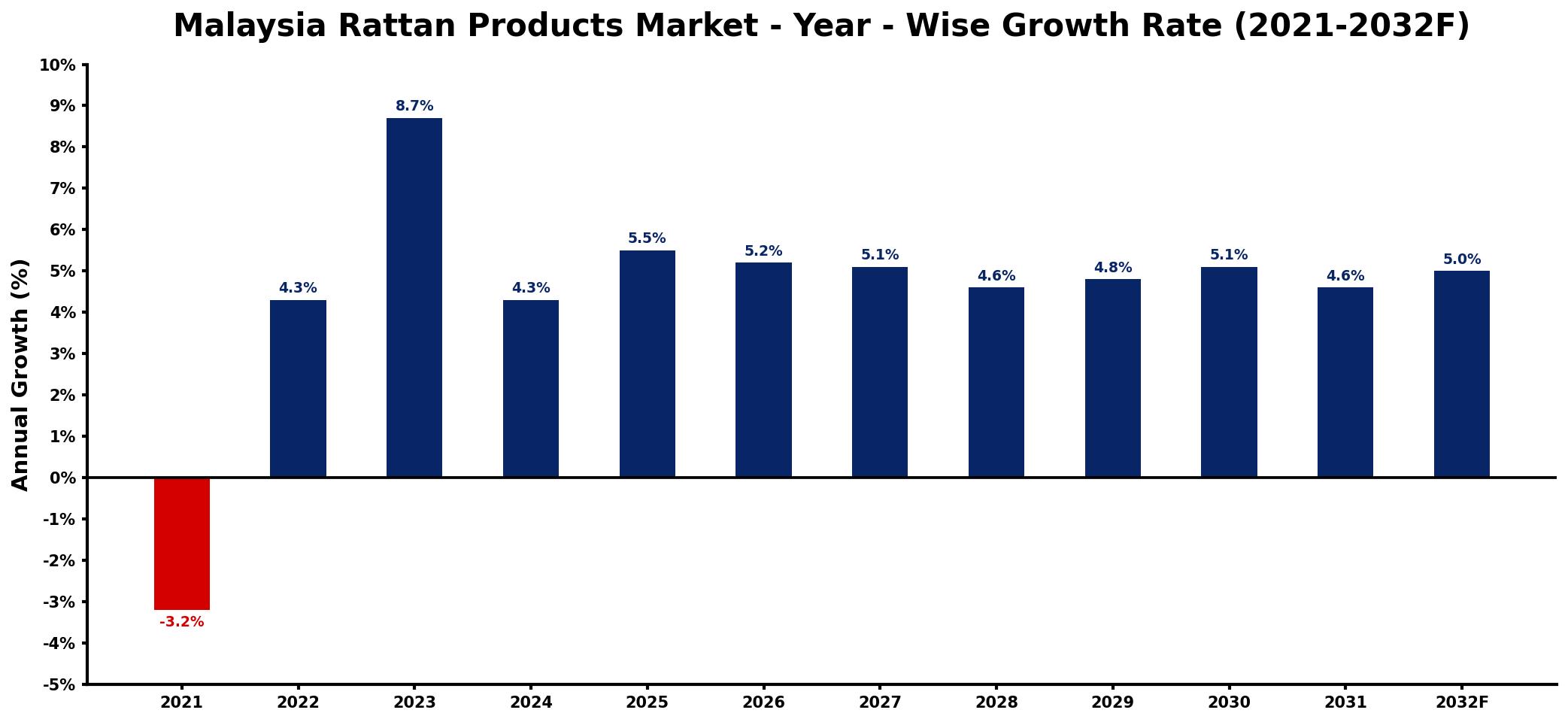
The table below presents the year‑wise growth rates along with the key drivers influencing the market
| Year | Growth Rate | Major Drivers |
| 2021 | -3.2% | decreased demand from tourism sector |
| 2022 | 4.3% | growing interest in eco-friendly materials |
| 2023 | 8.7% | rise in online retail channels |
| 2024 | 4.3% | increased export opportunities abroad |
| 2025 | 5.5% | expansion of local manufacturing capabilities |
| 2026 | 5.2% | growing consumer awareness sustainability |
| 2027 | 5.1% | increased investments in design innovation |
| 2028 | 4.6% | expansion into new market segments |
| 2029 | 4.8% | increased production capacity utilization |
| 2030 | 5.1% | growth in outdoor furniture market |
| 2031 | 4.6% | increased collaboration with designers |
| 2032 | 5.0% | growing downstream application demand |
Note: Market size estimations and growth projections presented in this report are based on 6Wresearch's proprietary forecasting methodology, utilizing the latest available industry data, government publications, and primary research inputs.
Malaysia Rattan Products Market Synopsis
The Malaysia rattan products market has shown resilience, recovering from pandemic-related disruptions and capitalizing on the growing trend toward sustainability. While recent years have seen a renewed interest in traditional craftsmanship, the market is also poised for innovation as manufacturers explore modern design trends.
As consumer preferences shift towards unique and environmentally-friendly products, the market is heading towards a phase of growth characterized by creativity and adaptability. With the potential to cater to both local and international markets, the future looks promising for the rattan sector in Malaysia.
Malaysia Rattan Products Market Key Takeaways
- Significant growth anticipated, driven by eco-conscious consumer behavior.
- Unique rattan furniture designs are enhancing market appeal across various segments.
- The lightweight and durable nature of rattan products supports diverse applications.
- Strategic focus on sustainable sourcing practices is vital for market competitiveness.
- Growing competition from synthetic alternatives highlights the need for differentiation.
Evaluation of Restraints in Malaysia Rattan Products Market
The Malaysia rattan products market is grappling with several constraints that could hinder its potential growth. The increasing availability and cost-effectiveness of alternative materials, particularly synthetic options, create significant competition for traditional rattan products. Additionally, sustainability concerns regarding rattan harvesting processes may lead to regulatory scrutiny and impact production practices. These challenges necessitate that rattan manufacturers adopt more responsible sourcing methods and focus on product innovation to retain their market share.
Malaysia Rattan Products Market Trends
Current trends within the Malaysia rattan products market indicate a shift towards customization and artisanal craftsmanship, appealing to consumers who value unique pieces. Furthermore, digital transformation is influencing sales channels, with e-commerce becoming a crucial platform for reaching a broader audience. Emerging eco-friendly practices, such as using sustainable dyes and finishes, are also reshaping product development, ensuring that the market aligns with growing environmental consciousness.
Malaysia Rattan Products Market Opportunities
The genuine growth opportunities within the Malaysia rattan products market lie in expanding exports and targeting niche segments such as luxury eco-friendly furnishings. There's also potential for collaboration with interior designers and architects who are increasingly incorporating sustainable materials into their projects. By leveraging modern marketing strategies and increasing visibility in international trade shows, rattan manufacturers can broaden their reach and tap into new customer bases.
Government Initiatives in the Malaysia Rattan Products Market
The Malaysian government has been proactive in promoting the rattan industry through various initiatives aimed at enhancing sustainability and boosting economic development. Policies focused on environmentally responsible harvesting and cultivation practices are being developed to protect local ecosystems while ensuring the longevity of the rattan supply chain. Furthermore, support for local artisans through funding and training programs is fostering innovation within the industry, enabling a revival of traditional craftsmanship alongside modern design.
Future Insights of the Malaysia Rattan Products Market
Looking ahead to the period from 2026 to 2032, the Malaysia rattan products market is expected to evolve significantly as consumer preferences continue to shift towards sustainable and aesthetically pleasing furnishings. As manufacturers adapt to these changes, we can anticipate a rise in innovative designs and high-quality craftsmanship. Additionally, the focus on building resilient supply chains and exploring new markets will play a critical role in maintaining growth momentum during this period.
Malaysia Rattan Products Market Latest Developments (2025 - 2026)
Recent developments in the Malaysia rattan products market highlight a growing emphasis on sustainable production practices, with several manufacturers adopting eco-friendly sourcing and manufacturing techniques. Industry events and trade fairs have underscored the potential for Malaysian rattan products in international markets. Innovative partnerships between local artisans and designers have also emerged, promoting the fusion of traditional craftsmanship with modern aesthetics.
Malaysia Rattan Products Market - Key Attractiveness of the Report
- 10 Years of Market Numbers
- Historical Data Starting from 2022 to 2025
- Base Year: 2025
- Forecast Data until 2032
- Key Performance Indicators Impacting the Market
- Major Upcoming Developments and Projects
Key Highlights of the Report:
- Malaysia Rattan Products Market Outlook
- Market Size of Malaysia Rattan Products Market, 2025
- Forecast of Malaysia Rattan Products Market, 2032
- Historical Data and Forecast of Malaysia Rattan Products Revenues & Volume for the Period 2022-2032F
- Malaysia Rattan Products Market Trend Evolution
- Malaysia Rattan Products Market Drivers and Challenges
- Malaysia Rattan Products Price Trends
- Malaysia Rattan Products Porter's Five Forces
- Malaysia Rattan Products Industry Life Cycle
- Historical Data and Forecast of Malaysia Rattan Products Market Revenues & Volume By Type for the Period 2022-2032F
- Historical Data and Forecast of Malaysia Rattan Products Market Revenues & Volume By Chair for the Period 2022-2032F
- Historical Data and Forecast of Malaysia Rattan Products Market Revenues & Volume By Table for the Period 2022-2032F
- Historical Data and Forecast of Malaysia Rattan Products Market Revenues & Volume By Storage for the Period 2022-2032F
- Historical Data and Forecast of Malaysia Rattan Products Market Revenues & Volume By Bed for the Period 2022-2032F
- Historical Data and Forecast of Malaysia Rattan Products Market Revenues & Volume By Others for the Period 2022-2032F
- Historical Data and Forecast of Malaysia Rattan Products Market Revenues & Volume By Application for the Period 2022-2032F
- Historical Data and Forecast of Malaysia Rattan Products Market Revenues & Volume By Household for the Period 2022-2032F
- Historical Data and Forecast of Malaysia Rattan Products Market Revenues & Volume By Commerical for the Period 2022-2032F
- Malaysia Rattan Products Import Export Trade Statistics
- Market Opportunity Assessment By Type
- Market Opportunity Assessment By Application
- Malaysia Rattan Products Top Companies Market Share
- Malaysia Rattan Products Competitive Benchmarking By Technical and Operational Parameters
- Malaysia Rattan Products Company Profiles
- Malaysia Rattan Products Key Strategic Recommendations






































