Malaysia Recycled Textiles Market Size, Share & Growth Rate
The Malaysia Recycled Textiles Market was estimated at USD 460 Million in 2025 and is projected to reach USD 599 Million by 2032, growing at a CAGR of 3.8% from 2026 to 2032. This upward trajectory is largely driven by heightened consumer awareness regarding environmental sustainability and the rising preference for eco-friendly apparel. As Malaysia increasingly embraces sustainable fashion, the demand for recycled textiles is set to expand further, fueled by initiatives from both consumers and industries alike.
Malaysia Recycled Textiles Market Year-wise Growth Rate and Key Drivers
This graph highlights how the Malaysia Recycled Textiles Market has steadily grown over the years, supported by major growth factors.
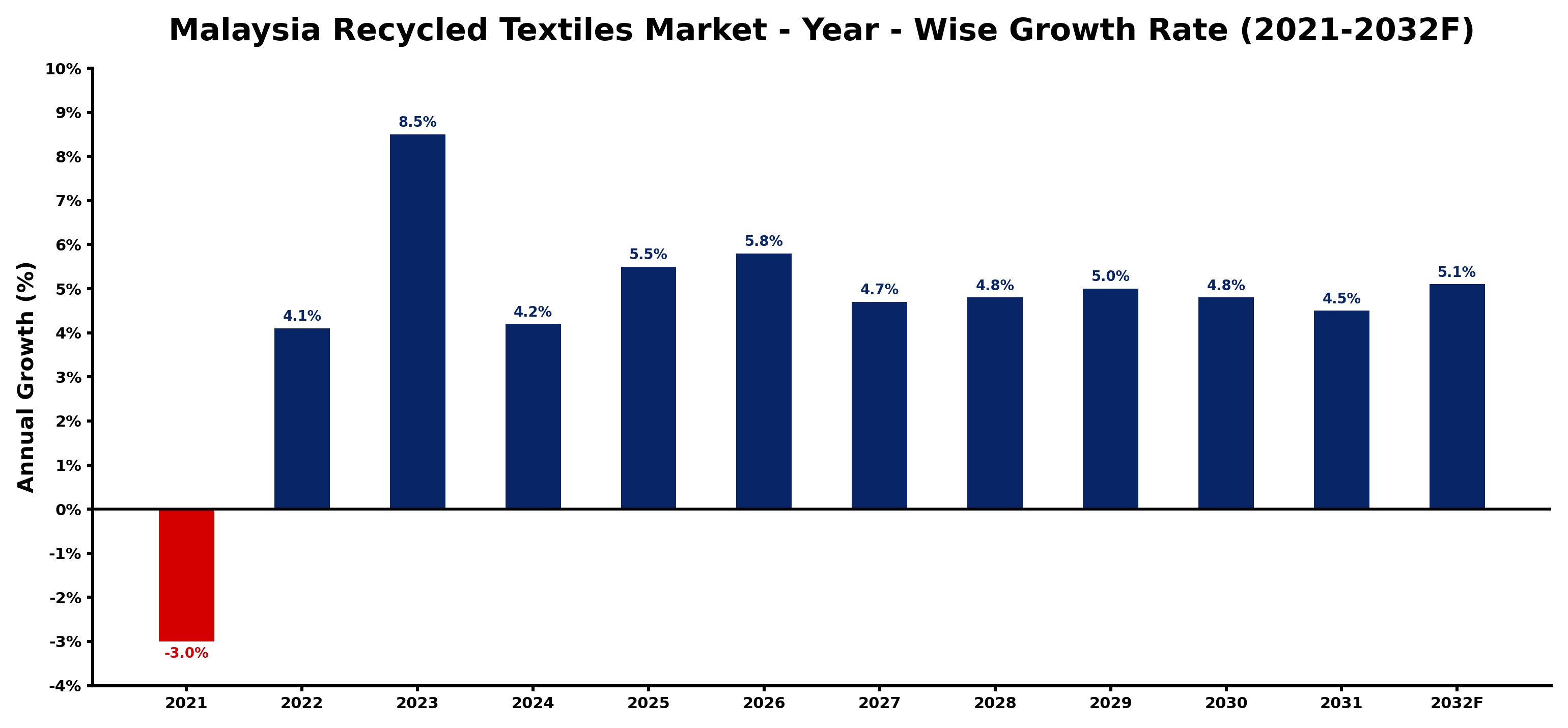
The table below presents the year‑wise growth rates along with the key drivers influencing the market
| Year | Growth Rate | Major Drivers |
| 2021 | -3.0% | Consumer awareness limited purchases |
| 2022 | 4.1% | Sustainability initiatives encouraged recycling |
| 2023 | 8.5% | Government policies supported industry growth |
| 2024 | 4.2% | Technological advancements improved efficiency |
| 2025 | 5.5% | Increased consumer demand for sustainability |
| 2026 | 5.8% | Collaboration with fashion brands expanded |
| 2027 | 4.7% | Circular economy practices gained traction |
| 2028 | 4.8% | E-commerce platforms enhanced accessibility |
| 2029 | 5.0% | Innovative recycling methods attracted investment |
| 2030 | 4.8% | Partnerships with NGOs fostered engagement |
| 2031 | 4.5% | Educational campaigns raised awareness |
| 2032 | 5.1% | Global trends influenced local markets |
Note - Market size estimations and growth projections presented in this report are based on 6Wresearch’s advanced forecasting approach, validated with industry datasets as of June 2026.
Malaysia Recycled Textiles Market Synopsis
The strongest force shaping the Malaysia Recycled Textiles Market today is the growing emphasis on sustainable fashion practices. Consumers are increasingly opting for products that align with their values, significantly driving the demand for recycled textiles. This cultural shift towards ethical consumption is compelling brands to integrate recycling into their operations, as well as exploring partnerships with recycling organizations.
As more companies recognize the potential of recycled materials, collaboration between apparel manufacturers and textile recyclers is becoming increasingly common. This synergy not only enhances the quality of recycled textiles but also addresses the logistical challenges faced in the recycling supply chain, ultimately benefiting the entire ecosystem.
Malaysia Recycled Textiles Market Key Takeaways
- The market is projected to grow steadily, reaching USD 599 Million by 2032.
- Consumer demand for sustainable products is a key driver of market growth.
- Collaboration between industries is essential for overcoming recycling supply chain challenges.
- Awareness of environmental issues is leading to a cultural shift towards recycling.
- There are significant opportunities for innovation in recycling technologies.
Evaluation of Restraints in Malaysia Recycled Textiles Market
Despite the positive outlook, the Malaysia Recycled Textiles Market faces significant constraints. One major challenge lies in consumer perception, as many still view recycled textiles as inferior to new materials. This perception can hinder market penetration, as consumers are hesitant to invest in products they perceive as lower quality. Furthermore, the complexity of the supply chain poses logistical issues, complicating the process of sourcing high-quality recycled materials. These factors collectively constrain market expansion despite a growing interest in sustainability.
Malaysia Recycled Textiles Market Trends
Current trends indicate a rapid evolution towards circular fashion, where brands strive to eliminate waste through innovative recycling methods. Additionally, digital platforms that promote the resale of second-hand garments are gaining traction, further fostering a culture of reusing textiles. Emerging technologies such as textile recycling machinery are also poised to revolutionize the industry, enabling higher-quality outputs and enhancing overall efficiency in the recycling process.
Malaysia Recycled Textiles Market Opportunities
The potential for growth in the Malaysia Recycled Textiles Market is significant, particularly in areas such as technological advancements in recycling processes and expanding consumer education campaigns. There is also an opportunity for businesses to develop more robust supply chains that ensure quality control and efficiency in recycling operations. Furthermore, innovative partnerships between brands and recycling organizations can create new business models that capitalize on sustainable practices, fostering long-term growth.
Government Initiatives in the Malaysia Recycled Textiles Market
The Malaysian government is increasingly recognizing the importance of sustainable practices within the textile industry. Policies aimed at promoting recycling and waste management have been introduced to encourage manufacturers to adopt eco-friendly practices. Additionally, public initiatives aimed at raising awareness about the importance of textile recycling are underway, further supporting the industry's growth. Investment in green technologies is also a priority, with various programs facilitating research and development in this sector.
Future Insights of the Malaysia Recycled Textiles Market
Looking ahead to 2026-2032, the Malaysia Recycled Textiles Market is set to experience continued growth as consumer consciousness around sustainability deepens. Advances in recycling technology are expected to enhance efficiency and output quality, thus attracting a broader customer base. Moreover, as companies increasingly adopt circular economy principles, we anticipate a significant transformation in the landscape of the textile industry, creating opportunities for long-term sustainability and profitability.
Malaysia Recycled Textiles Market Latest Developments (May 2025 - June 2026)
Recent developments in the Malaysia Recycled Textiles Market indicate a shift toward more innovative practices, with companies investing in new technologies for recycling processes. Additionally, partnerships between apparel brands and recycling facilities are becoming more common, enhancing the quality and availability of recycled materials. Initiatives promoting sustainable fashion among consumers are gaining traction, leading to a marked increase in interest in recycled textiles and related products.
Malaysia Recycled Textiles Market - Key Attractiveness of the Report
- 10 Years of Market Numbers
- Historical Data Starting from 2022 to 2025
- Base Year: 2025
- Forecast Data until 2032
- Key Performance Indicators Impacting the Market
- Major Upcoming Developments and Projects
Key Highlights of the Report:
- Malaysia Recycled Textiles Market Outlook
- Market Size of Malaysia Recycled Textiles Market, 2025
- Forecast of Malaysia Recycled Textiles Market, 2032
- Historical Data and Forecast of Malaysia Recycled Textiles Revenues & Volume for the Period 2022-2032F
- Malaysia Recycled Textiles Market Trend Evolution
- Malaysia Recycled Textiles Market Drivers and Challenges
- Malaysia Recycled Textiles Price Trends
- Malaysia Recycled Textiles Porter's Five Forces
- Malaysia Recycled Textiles Industry Life Cycle
- Historical Data and Forecast of Malaysia Recycled Textiles Market Revenues & Volume By Type for the Period 2022-2032F
- Historical Data and Forecast of Malaysia Recycled Textiles Market Revenues & Volume By Recycled Cotton for the Period 2022-2032F
- Historical Data and Forecast of Malaysia Recycled Textiles Market Revenues & Volume By Recycled Wool for the Period 2022-2032F
- Historical Data and Forecast of Malaysia Recycled Textiles Market Revenues & Volume By Recycled Polyester for the Period 2022-2032F
- Historical Data and Forecast of Malaysia Recycled Textiles Market Revenues & Volume By Recycled Nylon for the Period 2022-2032F
- Historical Data and Forecast of Malaysia Recycled Textiles Market Revenues & Volume By Others for the Period 2022-2032F
- Historical Data and Forecast of Malaysia Recycled Textiles Market Revenues & Volume By End-use Industry for the Period 2022-2032F
- Historical Data and Forecast of Malaysia Recycled Textiles Market Revenues & Volume By Automotive for the Period 2022-2032F
- Historical Data and Forecast of Malaysia Recycled Textiles Market Revenues & Volume By Retail for the Period 2022-2032F
- Historical Data and Forecast of Malaysia Recycled Textiles Market Revenues & Volume By Mining for the Period 2022-2032F
- Historical Data and Forecast of Malaysia Recycled Textiles Market Revenues & Volume By Building & Construction for the Period 2022-2032F
- Historical Data and Forecast of Malaysia Recycled Textiles Market Revenues & Volume By Others for the Period 2022-2032F
- Malaysia Recycled Textiles Import Export Trade Statistics
- Market Opportunity Assessment By Type
- Market Opportunity Assessment By End-use Industry
- Malaysia Recycled Textiles Top Companies Market Share
- Malaysia Recycled Textiles Competitive Benchmarking By Technical and Operational Parameters
- Malaysia Recycled Textiles Company Profiles
- Malaysia Recycled Textiles Key Strategic Recommendations






































