Malaysia Refined Petroleum Products Market Size, Share & Growth Rate
The Malaysia Refined Petroleum Products Market was estimated at USD 154 Million in 2025 and is projected to reach USD 200 Million by 2032, growing at a CAGR of 3.8% from 2026 to 2032. This growth trajectory is largely driven by robust economic activity, alongside an increase in transportation needs fueled by urbanization and industrialization. As Malaysia continues to solidify its position as a trade hub in Southeast Asia, the demand for essential refined petroleum products remains pivotal.
Malaysia Refined Petroleum Products Market Year-wise Growth Rate and Key Drivers
This graph highlights how the Malaysia Refined Petroleum Products Market has steadily grown over the years, supported by major growth factors.
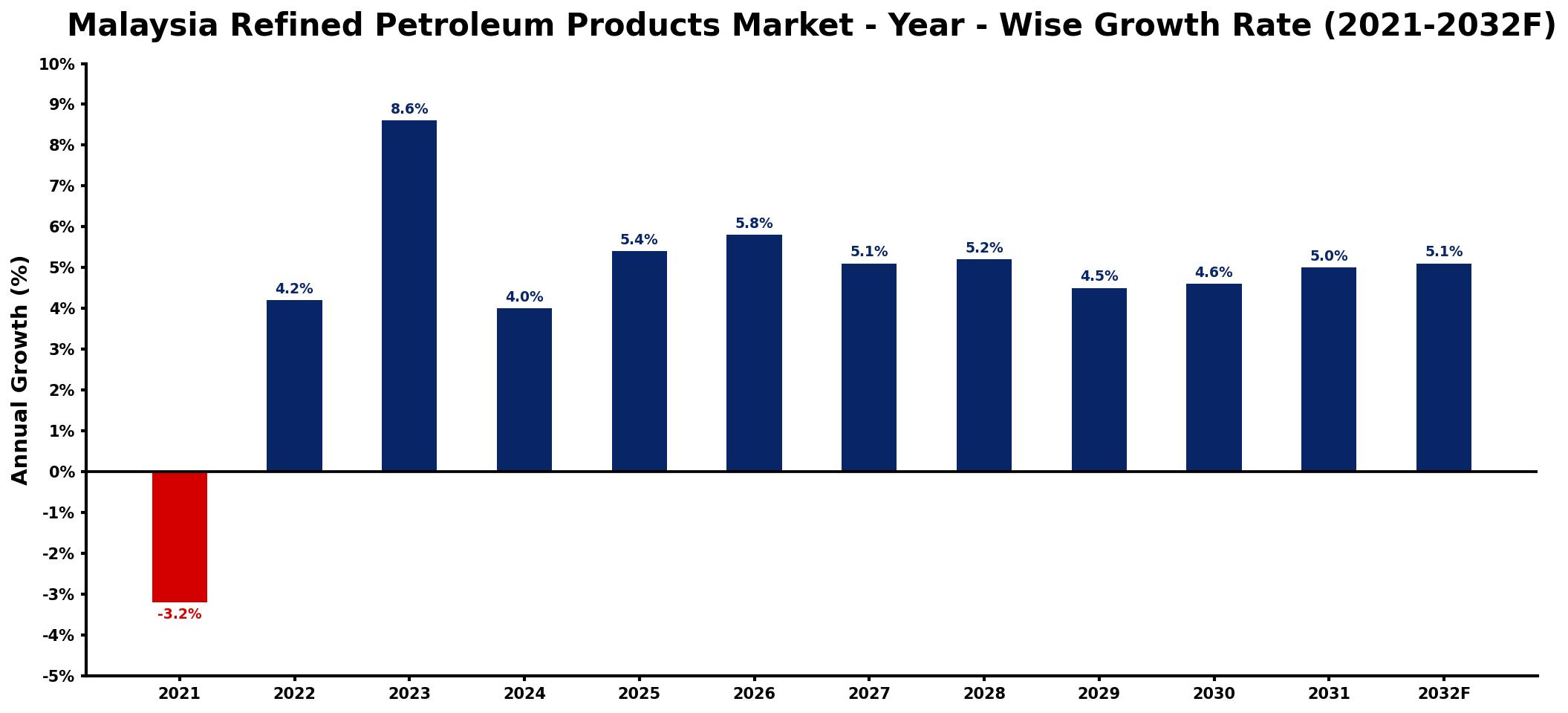
The table below presents the year‑wise growth rates along with the key drivers influencing the market
| Year | Growth Rate | Major Drivers |
| 2021 | -3.2% | decreased industrial energy consumption |
| 2022 | 4.2% | rising demand for transportation fuels |
| 2023 | 8.6% | increased investments in infrastructure |
| 2024 | 4.0% | growing regional trade activities |
| 2025 | 5.4% | expansion of renewable energy projects |
| 2026 | 5.8% | enhanced logistics and distribution networks |
| 2027 | 5.1% | increased consumer vehicle ownership |
| 2028 | 5.2% | growing urbanization and population |
| 2029 | 4.5% | rising exports to neighboring countries |
| 2030 | 4.6% | increased industrial production levels |
| 2031 | 5.0% | growing downstream application demand |
| 2032 | 5.1% | growing demand for clean energy |
Note: Market size estimations and growth projections presented in this report are based on 6Wresearch's proprietary forecasting methodology, utilizing the latest available industry data, government publications, and primary research inputs.
Malaysia Refined Petroleum Products Market Synopsis
In recent years, the refined petroleum products market in Malaysia has demonstrated resilience despite fluctuations in global energy dynamics. This market acts as a crucial backbone for various sectors, including transportation, manufacturing, and power generation, underpinning the nations economic framework.
Notably, the refined petroleum products available in Malaysia, such as gasoline, diesel, and jet fuel, are vital not just for local consumption, but also for export. The strategic geographical positioning of Malaysia enhances its role as a significant player in regional energy trade, ensuring a stable supply amid growing demand.
Malaysia Refined Petroleum Products Market Key Takeaways
- The market is projected to grow steadily, driven by industrialization and urbanization.
- Government policies play a critical role in shaping market dynamics and stability.
- Transition towards sustainable energy sources may redefine market opportunities in the long term.
- The COVID-19 pandemic has temporarily impacted demand, but a rebound is anticipated as the economy recovers.
- Petronas, the national oil company, remains a dominant force in ensuring product availability.
Evaluation of Restraints in Malaysia Refined Petroleum Products Market
Several factors could restrain the growth of the refined petroleum products market in Malaysia. Chief among these are the volatility of crude oil prices, which can create uncertainty in planning and investment decisions. Additionally, rising environmental concerns are prompting a shift in focus towards renewable energy, which may impact future demand for fossil fuels. Government regulations aimed at curbing emissions further add layers of complexity to the market landscape, requiring companies to innovate and adapt continuously.
Malaysia Refined Petroleum Products Market Trends
A growing trend in the market is the increasing emphasis on cleaner, more efficient petroleum products. Innovations in refining technology are enabling companies to produce fuels that meet stricter emission standards while still catering to the traditional energy demands. Moreover, the push towards electric vehicles and alternative energy sources is gradually reshaping consumer preferences, even as the demand for refined petroleum products remains robust.
Malaysia Refined Petroleum Products Market Opportunities
Despite the challenges, there are significant opportunities for growth within the refined petroleum products market. Investment in refining technology can enhance productivity and yield high-quality products that meet evolving regulatory standards. Additionally, as the economy recovers, increased consumer mobility will likely drive demand for fuels, particularly in the transportation sector. Expansion into regional markets presents another avenue for growth, leveraging Malaysia's strategic position in Southeast Asia.
Government Initiatives in the Malaysia Refined Petroleum Products Market
The Malaysian government has been proactive in implementing policies that support the refined petroleum products market. Initiatives aimed at enhancing infrastructure for fuel distribution, improving regulatory frameworks, and encouraging investments in cleaner technologies are all part of the government's strategy. Public spending on transportation and industrial projects will continue to reinforce the demand for refined petroleum products, thus ensuring market stability.
Future Insights of the Malaysia Refined Petroleum Products Market
Looking ahead to 2026-2032, the Malaysia Refined Petroleum Products Market is poised for steady growth, underpinned by economic recovery and increasing energy demands. While the transition to sustainable energy sources presents challenges, it also opens avenues for innovation and diversification. The growing need for reliable energy sources, coupled with an expanding industrial base, positions the market favorably for the upcoming years.
Malaysia Refined Petroleum Products Market Latest Developments (2025 - 2026)
Recent developments in the Malaysia refined petroleum products market indicate a renewed focus on technological advancements aimed at improving refining processes and product quality. The industry is also seeing an increase in collaborative efforts between public and private sectors to facilitate infrastructure upgrades. Additionally, initiatives promoting cleaner production methods are gaining traction as stakeholders aim to address environmental concerns while meeting domestic and export demands.
Malaysia Refined Petroleum Products Market - Key Attractiveness of the Report
- 10 Years of Market Numbers
- Historical Data Starting from 2022 to 2025
- Base Year: 2025
- Forecast Data until 2032
- Key Performance Indicators Impacting the Market
- Major Upcoming Developments and Projects
Key Highlights of the Report:
- Malaysia Refined Petroleum Products Market Outlook
- Market Size of Malaysia Refined Petroleum Products Market, 2025
- Forecast of Malaysia Refined Petroleum Products Market, 2032
- Historical Data and Forecast of Malaysia Refined Petroleum Products Revenues & Volume for the Period 2022-2032F
- Malaysia Refined Petroleum Products Market Trend Evolution
- Malaysia Refined Petroleum Products Market Drivers and Challenges
- Malaysia Refined Petroleum Products Price Trends
- Malaysia Refined Petroleum Products Porter's Five Forces
- Malaysia Refined Petroleum Products Industry Life Cycle
- Historical Data and Forecast of Malaysia Refined Petroleum Products Market Revenues & Volume By Product Type for the Period 2022-2032F
- Historical Data and Forecast of Malaysia Refined Petroleum Products Market Revenues & Volume By Diesel for the Period 2022-2032F
- Historical Data and Forecast of Malaysia Refined Petroleum Products Market Revenues & Volume By Gasoline for the Period 2022-2032F
- Historical Data and Forecast of Malaysia Refined Petroleum Products Market Revenues & Volume By Fuel Oils for the Period 2022-2032F
- Historical Data and Forecast of Malaysia Refined Petroleum Products Market Revenues & Volume By Kerosene for the Period 2022-2032F
- Historical Data and Forecast of Malaysia Refined Petroleum Products Market Revenues & Volume By Others for the Period 2022-2032F
- Historical Data and Forecast of Malaysia Refined Petroleum Products Market Revenues & Volume By Application for the Period 2022-2032F
- Historical Data and Forecast of Malaysia Refined Petroleum Products Market Revenues & Volume By Fuel for the Period 2022-2032F
- Historical Data and Forecast of Malaysia Refined Petroleum Products Market Revenues & Volume By Chemical for the Period 2022-2032F
- Historical Data and Forecast of Malaysia Refined Petroleum Products Market Revenues & Volume By Others for the Period 2022-2032F
- Historical Data and Forecast of Malaysia Refined Petroleum Products Market Revenues & Volume By Fraction for the Period 2022-2032F
- Historical Data and Forecast of Malaysia Refined Petroleum Products Market Revenues & Volume By Light Distillates for the Period 2022-2032F
- Historical Data and Forecast of Malaysia Refined Petroleum Products Market Revenues & Volume By Middle Distillates for the Period 2022-2032F
- Historical Data and Forecast of Malaysia Refined Petroleum Products Market Revenues & Volume By Heavy Oils for the Period 2022-2032F
- Malaysia Refined Petroleum Products Import Export Trade Statistics
- Market Opportunity Assessment By Product Type
- Market Opportunity Assessment By Application
- Market Opportunity Assessment By Fraction
- Malaysia Refined Petroleum Products Top Companies Market Share
- Malaysia Refined Petroleum Products Competitive Benchmarking By Technical and Operational Parameters
- Malaysia Refined Petroleum Products Company Profiles
- Malaysia Refined Petroleum Products Key Strategic Recommendations






































