Malaysia RegTech Market Size & Growth Rate (2026-2032)
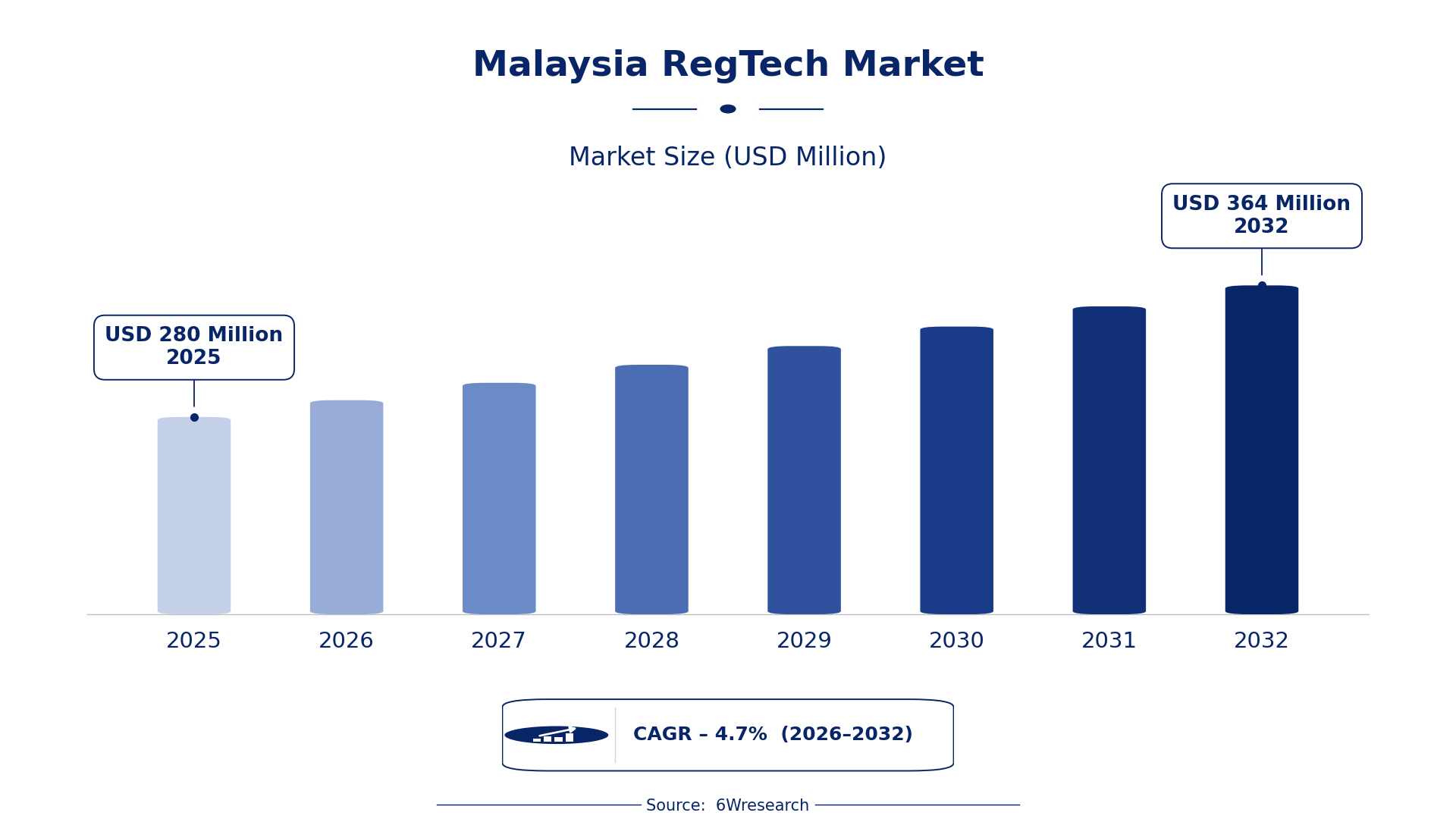
The Malaysia RegTech Market was estimated at USD 280 Million in 2025 and is projected to reach USD 364 Million by 2032, growing at a CAGR of 4.7% from 2026 to 2032.
Malaysia RegTech Market Synopsis
The demand for regulatory technology solutions in Malaysia is rising sharply, driven by the increasing complexity of compliance requirements across various sectors. Financial institutions are particularly keen on implementing RegTech solutions to streamline their operations, reduce costs, and enhance their ability to meet regulatory demands efficiently.
As businesses grapple with the challenges of evolving regulations, the focus on automation and real-time data analytics has never been more critical. These tools not only facilitate compliance but also empower organizations to make informed decisions based on comprehensive insights.
Malaysia RegTech Market Year-wise Growth Rate and Key Drivers
This graph illustrates the annual growth rates of the Malaysia RegTech Market from 2021 to 2032, highlighting a steady upward trajectory and projected expansion over the forecast period.
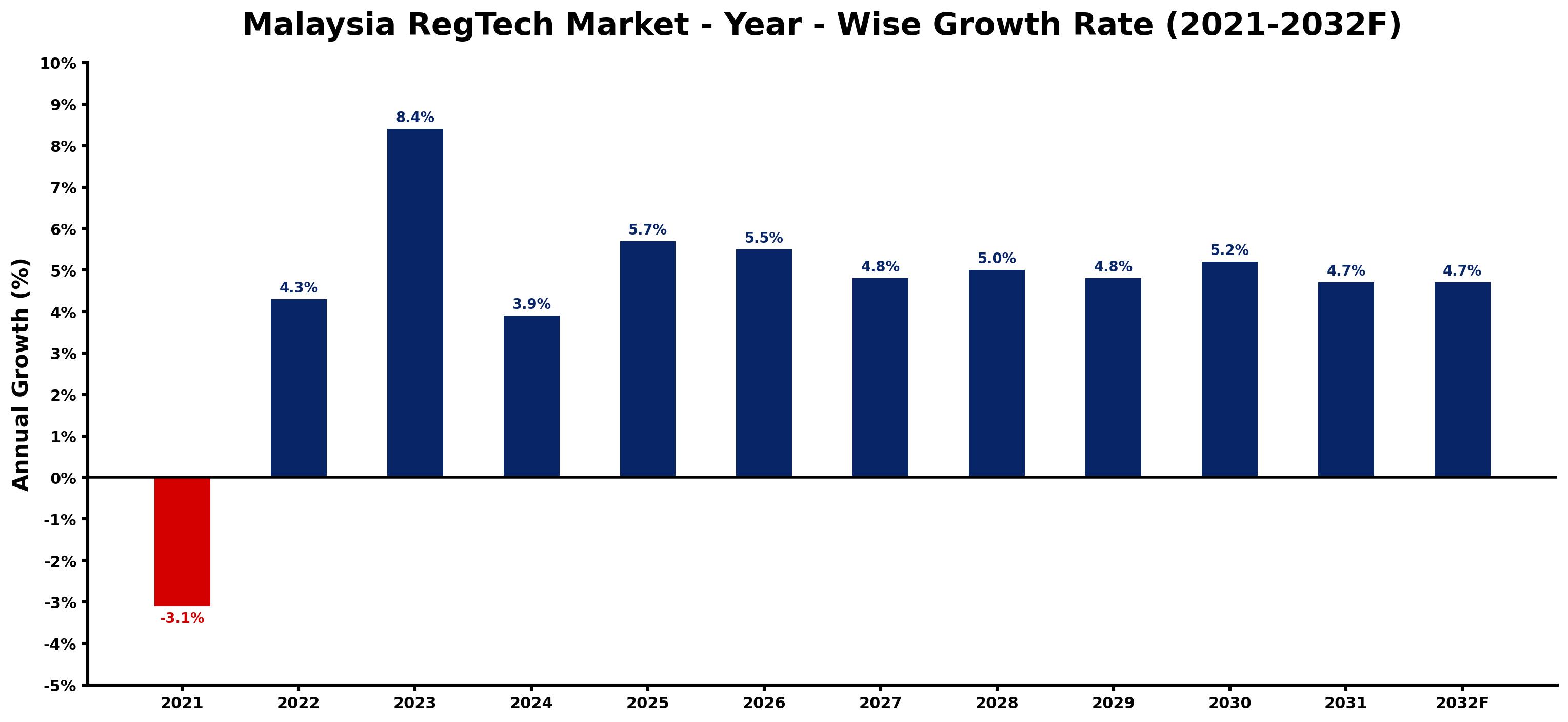
The table below presents the year‑wise growth rates along with the key drivers influencing the market
| Year | Growth Rate | Major Drivers |
| 2021 | -3.1% | Delayed implementation of Bank Negara Malaysia guidelines. |
| 2022 | 4.3% | Bank Negara Malaysia's focus on digital transformation policies. |
| 2023 | 8.4% | Increased demand for e-KYC and regulatory compliance solutions. |
| 2024 | 3.9% | Implementation of stricter anti-money laundering regulations. |
| 2025 | 5.7% | Growing interest in fintech collaborations with regulators. |
| 2026 | 5.5% | Boost in digital identity verification technologies adoption. |
| 2027 | 4.8% | Rise in digital transactions fueling compliance solutions demand. |
| 2028 | 5.0% | Emphasis on data privacy regulations enhancing RegTech adoption. |
| 2029 | 4.8% | Development of local start-ups targeting regulatory challenges. |
| 2030 | 5.2% | Government incentives for tech innovation in financial services. |
| 2031 | 4.7% | Increased partnerships between banks and RegTech firms. |
| 2032 | 4.7% | Continuous investment in cybersecurity measures by financial sector. |
Note: Market size estimations and growth projections presented in this report are based on 6Wresearch's proprietary forecasting methodology, utilizing the latest available industry data, government publications, and primary research inputs.
Malaysia RegTech Market Key Takeaways
Below are some of the specific key takeaways from the market, including:
- The market is experiencing a noticeable uptick in demand for AI-driven compliance solutions.
- Financial institutions are prioritizing cost-effective RegTech solutions to manage regulatory complexities.
- Real-time reporting capabilities are becoming essential for organizations striving for compliance.
- Cybersecurity and data privacy remain critical considerations in the adoption of RegTech solutions.
- Adoption rates are expected to rise significantly, particularly in response to recent regulatory changes.
Evaluation of Restraints in Malaysia RegTech Market
The Malaysia RegTech market faces several notable restraints that hinder its growth potential. One of the primary challenges is the rapid pace of regulatory changes that require solutions to be agile and adaptive. Organizations often find it difficult to keep up, which can lead to delays in the adoption of new technologies.
Additionally, concerns regarding cybersecurity and data privacy are significant. The sensitive nature of financial and personal data demands stringent security measures, which can complicate the implementation of RegTech solutions. Lastly, traditional financial institutions may hesitate to embrace these technologies due to a lack of understanding or trust in newer systems.
Malaysia RegTech Market Trends
Several trends are shaping the Malaysia RegTech market. Firstly, there is a notable shift towards AI and machine learning technologies, which enhance compliance processes through automation and predictive analytics. This trend is further fueled by the growing necessity for real-time reporting and data-driven decision-making.
Another trend is the increased collaboration between RegTech firms and traditional financial institutions, aimed at developing tailored solutions that address specific regulatory challenges. This partnership approach is essential for fostering innovation while ensuring compliance integrity.
Malaysia RegTech Market Opportunities
The Malaysia RegTech market presents numerous growth opportunities for both new and established players. The demand for customized solutions that cater to specific regulatory requirements is on the rise, creating a fertile ground for innovation. Companies that can offer scalable and flexible RegTech solutions will find lucrative prospects.
on top of that, as regulatory frameworks continue to evolve, the need for advanced compliance tools will become even more pronounced. Investments in cybersecurity technologies will also be critical, as organizations strive to protect sensitive data while meeting compliance obligations.
Government Initiatives in the Malaysia RegTech Market
The Malaysian government is actively shaping the RegTech environment through a series of initiatives aimed at bolstering regulatory compliance and promoting technological advancement. With a keen focus on enhancing the financial sector's resilience, these policies are designed to facilitate the adoption of innovative compliance solutions.
- A recently completed initiative involved the rollout of a digital infrastructure upgrade program to enhance data management capabilities across financial institutions.
- Currently underway is a regulatory framework that mandates improved transparency in billing and compliance reporting, aimed at streamlining regulatory processes.
- A planned public-private partnership is expected to foster innovation in RegTech solutions, with anticipated launch dates in the next two years.
- The government is also investing in education and training programs for financial professionals to better understand and implement RegTech solutions.
Future Insights of the Malaysia RegTech Market
Looking ahead to 2026-2032, the Malaysia RegTech market is expected to undergo significant transformation. As regulatory requirements continue to evolve, organizations will increasingly turn to technology to maintain compliance. The integration of advanced analytics and AI will become standard practice, allowing companies to proactively manage compliance risks.
on top of that, the collaboration between government bodies and the private sector will likely yield innovative solutions that address emerging regulatory challenges. This synergy will be crucial for fostering a culture of compliance that not only meets current standards but also anticipates future requirements.
Malaysia RegTech Market Latest Developments
Recent developments in the Malaysia RegTech market reflect a dynamic environment where innovation is paramount. Over the past 12-14 months, significant advancements have been made, particularly in the areas of automation and data analytics, to enhance compliance processes.
- A major technology vendor launched a new AI-driven compliance platform in early 2025, designed to streamline reporting and reduce manual oversight.
- An ongoing initiative by a leading regional operator focuses on integrating blockchain technology for secure and transparent transaction reporting.
- A partnership between several financial institutions and RegTech providers is currently underway, aimed at developing industry-wide compliance standards.
- Upcoming in Q3 2025 is a planned regulatory compliance workshop series to educate stakeholders on the latest tools and technologies available in the market.
Malaysia RegTech Market - Key Attractiveness of the Report
- 10 Years of Market Numbers
- Historical Data Starting from 2022 to 2025
- Base Year: 2025
- Forecast Data until 2032
- Key Performance Indicators Impacting the Market
- Major Upcoming Developments and Projects
Key Highlights of the Report:
- Malaysia RegTech Market Outlook
- Market Size of Malaysia RegTech Market, 2025
- Forecast of Malaysia RegTech Market, 2032
- Historical Data and Forecast of Malaysia RegTech Revenues & Volume for the Period 2022-2032F
- Malaysia RegTech Market Trend Evolution
- Malaysia RegTech Market Drivers and Challenges
- Malaysia RegTech Price Trends
- Malaysia RegTech Porter's Five Forces
- Malaysia RegTech Industry Life Cycle
- Historical Data and Forecast of Malaysia RegTech Market Revenues & Volume By Component for the Period 2022-2032F
- Historical Data and Forecast of Malaysia RegTech Market Revenues & Volume By Solutions for the Period 2022-2032F
- Historical Data and Forecast of Malaysia RegTech Market Revenues & Volume By Services for the Period 2022-2032F
- Historical Data and Forecast of Malaysia RegTech Market Revenues & Volume By Application for the Period 2022-2032F
- Historical Data and Forecast of Malaysia RegTech Market Revenues & Volume By Risk & Compliance Management for the Period 2022-2032F
- Historical Data and Forecast of Malaysia RegTech Market Revenues & Volume By Identity Management for the Period 2022-2032F
- Historical Data and Forecast of Malaysia RegTech Market Revenues & Volume By Regulatory Reporting for the Period 2022-2032F
- Historical Data and Forecast of Malaysia RegTech Market Revenues & Volume By AML and Fraud Management for the Period 2022-2032F
- Historical Data and Forecast of Malaysia RegTech Market Revenues & Volume By Regulatory Intelligence for the Period 2022-2032F
- Historical Data and Forecast of Malaysia RegTech Market Revenues & Volume By Organization Size for the Period 2022-2032F
- Historical Data and Forecast of Malaysia RegTech Market Revenues & Volume By SMEs for the Period 2022-2032F
- Historical Data and Forecast of Malaysia RegTech Market Revenues & Volume By Large Enterprises for the Period 2022-2032F
- Historical Data and Forecast of Malaysia RegTech Market Revenues & Volume By Deployment Mode for the Period 2022-2032F
- Historical Data and Forecast of Malaysia RegTech Market Revenues & Volume By On-Premises for the Period 2022-2032F
- Historical Data and Forecast of Malaysia RegTech Market Revenues & Volume By Cloud for the Period 2022-2032F
- Historical Data and Forecast of Malaysia RegTech Market Revenues & Volume By Vertical for the Period 2022-2032F
- Historical Data and Forecast of Malaysia RegTech Market Revenues & Volume By Banking for the Period 2022-2032F
- Historical Data and Forecast of Malaysia RegTech Market Revenues & Volume By Insurance for the Period 2022-2032F
- Historical Data and Forecast of Malaysia RegTech Market Revenues & Volume By Non-Financial for the Period 2022-2032F
- Malaysia RegTech Import Export Trade Statistics
- Market Opportunity Assessment By Component
- Market Opportunity Assessment By Application
- Market Opportunity Assessment By Organization Size
- Market Opportunity Assessment By Deployment Mode
- Market Opportunity Assessment By Vertical
- Malaysia RegTech Top Companies Market Share
- Malaysia RegTech Competitive Benchmarking By Technical and Operational Parameters
- Malaysia RegTech Company Profiles
- Malaysia RegTech Key Strategic Recommendations






































