Malaysia Rock Drilling Machine Market Size, Share & Growth Rate
The Malaysia Rock Drilling Machine Market was estimated at USD 483 Million in 2025 and is projected to reach USD 629 Million by 2032, growing at a CAGR of 3.8% from 2026 to 2032. This anticipated growth is driven primarily by robust governmental initiatives aimed at bolstering infrastructure, which is becoming increasingly critical amidst urbanization and economic expansion. Additionally, the demand for rock drilling machines is expected to rise in tandem with a surge in mining activities and construction projects across the region.
Malaysia Rock Drilling Machine Market Year-wise Growth Rate and Key Drivers
This graph highlights how the Malaysia Rock Drilling Machine Market has steadily grown over the years, supported by major growth factors.
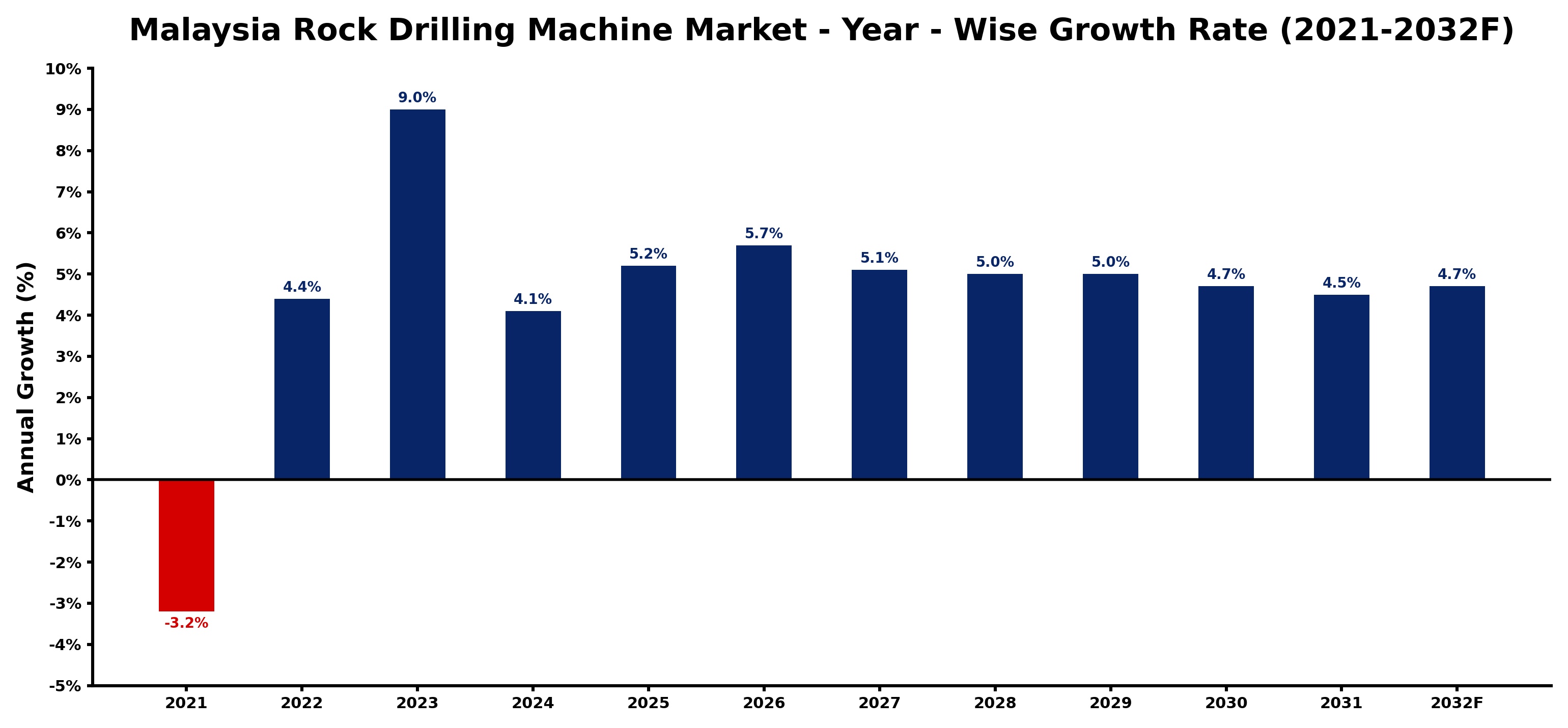
The table below presents the year‑wise growth rates along with the key drivers influencing the market
| Year | Growth Rate | Major Drivers |
| 2021 | -3.2% | Expansion of commercial construction activities |
| 2022 | 4.4% | Growing renewable energy integration projects |
| 2023 | 9.0% | Rapid growth in telecom and data center sectors |
| 2024 | 4.1% | Increasing industrial automation investments |
| 2025 | 5.2% | Growing urbanization and commercial development |
| 2026 | 5.7% | Growing urbanization and commercial development |
| 2027 | 5.1% | Expansion of transportation and logistics networks |
| 2028 | 5.0% | Increasing adoption of advanced technologies |
| 2029 | 5.0% | Increasing adoption of advanced technologies |
| 2030 | 4.7% | Rapid growth in telecom and data center sectors |
| 2031 | 4.5% | Expansion of manufacturing activities |
| 2032 | 4.7% | Government infrastructure modernization initiatives |
Note - Market size estimations and growth projections presented in this report are based on 6Wresearch’s advanced forecasting approach, validated with industry datasets as of June 2026.
Malaysia Rock Drilling Machine Market Synopsis
The surge in construction activities in Malaysia has led to an escalating need for efficient rock drilling machines, particularly in urban areas experiencing rapid development. The local construction sector's growth is bolstered by a burgeoning population and the resulting demand for residential and commercial infrastructure.
Additionally, Malaysia's mining sector is undergoing a transformation, with increased investments targeting resource extraction. This trend fuels demand for high-performance drilling machines that can withstand rigorous operational conditions and enhance productivity within both mining and construction settings.
Malaysia Rock Drilling Machine Market Key Takeaways
- The market is witnessing a significant growth trajectory due to intensified construction and mining activities.
- Government initiatives are playing a crucial role in facilitating infrastructure development across Malaysia.
- Technological advancements in rock drilling equipment are enhancing operational efficiency and safety.
- Despite a robust growth outlook, the market must navigate challenges such as skilled labor shortages.
- The recovery from COVID-19 is paving the way for renewed investments in construction and infrastructure projects.
Evaluation of Restraints in Malaysia Rock Drilling Machine Market
While the Malaysia Rock Drilling Machine Market is set for growth, it faces certain constraints. Fluctuating commodity prices can hinder investment in construction and mining projects, creating uncertainty in equipment procurement decisions. Furthermore, the industry grapples with a shortage of skilled operators necessary to optimize the use of advanced machinery, which may compromise operational effectiveness. Addressing these challenges will be crucial for maintaining the market's upward momentum.
Malaysia Rock Drilling Machine Market Trends
The market is seeing notable trends toward automation and smart technology integration in rock drilling machines. These innovations aim to improve efficiency and reduce labor costs, while also enhancing safety protocols. Moreover, there is a growing emphasis on environmentally-friendly drilling solutions, as companies seek to minimize their ecological footprint. The push for sustainability is likely to influence product development significantly in the coming years.
Malaysia Rock Drilling Machine Market Opportunities
The future landscape of the Malaysia Rock Drilling Machine Market presents considerable opportunities. With ongoing infrastructure projects, especially in urban centers, the demand for state-of-the-art drilling machines is expected to escalate. Moreover, investments in renewable energy projects, such as geothermal energy exploration, provide a new avenue for market growth. Companies that innovate and adapt to these evolving needs will likely capture significant market share.
Government Initiatives in the Malaysia Rock Drilling Machine Market
The Malaysian government has introduced several initiatives aimed at enhancing infrastructure development, which in turn fosters growth in the rock drilling machine market. Public spending on transportation, housing, and urban renewal projects is increasing, accompanied by supportive policies for foreign investments in mining and construction. These initiatives create a favorable environment for manufacturers and suppliers of rock drilling equipment.
Future Insights of the Malaysia Rock Drilling Machine Market
Looking ahead to 2026-2032, the Malaysia Rock Drilling Machine Market is expected to evolve significantly. Continued urbanization and demographic changes will drive up the demand for infrastructure, ensuring a steady need for advanced drilling technologies. Furthermore, as the mining sector adapts to industry 4.0 practices, we anticipate heightened focus on machine efficiency and sustainability, which will further shape market dynamics.
Malaysia Rock Drilling Machine Market Latest Developments (May 2025 - June 2026)
Recent developments in the Malaysia Rock Drilling Machine Market indicate a growing emphasis on technological advancements. New models are being launched that incorporate cutting-edge automation features, enhancing precision and reducing downtime. Additionally, collaborations between equipment manufacturers and construction firms are on the rise, focusing on tailored solutions that meet the specific needs of ongoing infrastructure projects.
Malaysia Rock Drilling Machine Market - Key Attractiveness of the Report
- 10 Years of Market Numbers
- Historical Data Starting from 2022 to 2025
- Base Year: 2025
- Forecast Data until 2032
- Key Performance Indicators Impacting the Market
- Major Upcoming Developments and Projects
Key Highlights of the Report:
- Malaysia Rock Drilling Machine Market Outlook
- Market Size of Malaysia Rock Drilling Machine Market, 2025
- Forecast of Malaysia Rock Drilling Machine Market, 2032
- Historical Data and Forecast of Malaysia Rock Drilling Machine Revenues & Volume for the Period 2022-2032F
- Malaysia Rock Drilling Machine Market Trend Evolution
- Malaysia Rock Drilling Machine Market Drivers and Challenges
- Malaysia Rock Drilling Machine Price Trends
- Malaysia Rock Drilling Machine Porter's Five Forces
- Malaysia Rock Drilling Machine Industry Life Cycle
- Historical Data and Forecast of Malaysia Rock Drilling Machine Market Revenues & Volume By Type for the Period 2022-2032F
- Historical Data and Forecast of Malaysia Rock Drilling Machine Market Revenues & Volume By Hydraulic Drills for the Period 2022-2032F
- Historical Data and Forecast of Malaysia Rock Drilling Machine Market Revenues & Volume By Electric Drills for the Period 2022-2032F
- Historical Data and Forecast of Malaysia Rock Drilling Machine Market Revenues & Volume By Others for the Period 2022-2032F
- Historical Data and Forecast of Malaysia Rock Drilling Machine Market Revenues & Volume By Application for the Period 2022-2032F
- Historical Data and Forecast of Malaysia Rock Drilling Machine Market Revenues & Volume By Mining Industry for the Period 2022-2032F
- Historical Data and Forecast of Malaysia Rock Drilling Machine Market Revenues & Volume By Construction Industry for the Period 2022-2032F
- Historical Data and Forecast of Malaysia Rock Drilling Machine Market Revenues & Volume By Others for the Period 2022-2032F
- Malaysia Rock Drilling Machine Import Export Trade Statistics
- Market Opportunity Assessment By Type
- Market Opportunity Assessment By Application
- Malaysia Rock Drilling Machine Top Companies Market Share
- Malaysia Rock Drilling Machine Competitive Benchmarking By Technical and Operational Parameters
- Malaysia Rock Drilling Machine Company Profiles
- Malaysia Rock Drilling Machine Key Strategic Recommendations






































