Malaysia Rocking Chairs Market Size, Share & Growth Rate
The Malaysia Rocking Chairs Market was estimated at USD 1252 Million in 2025 and is projected to reach USD 1882 Million by 2032, growing at a CAGR of 6.0% from 2026 to 2032. This growth trajectory is primarily fueled by rising disposable incomes and a burgeoning demand for upscale furniture. Additionally, the increasing trend toward urbanization is prompting consumers to seek out stylish and comfortable furniture options, further bolstering the market.
Malaysia Rocking Chairs Market Year-wise Growth Rate and Key Drivers
This graph highlights how the Malaysia Rocking Chairs Market has steadily grown over the years, supported by major growth factors.
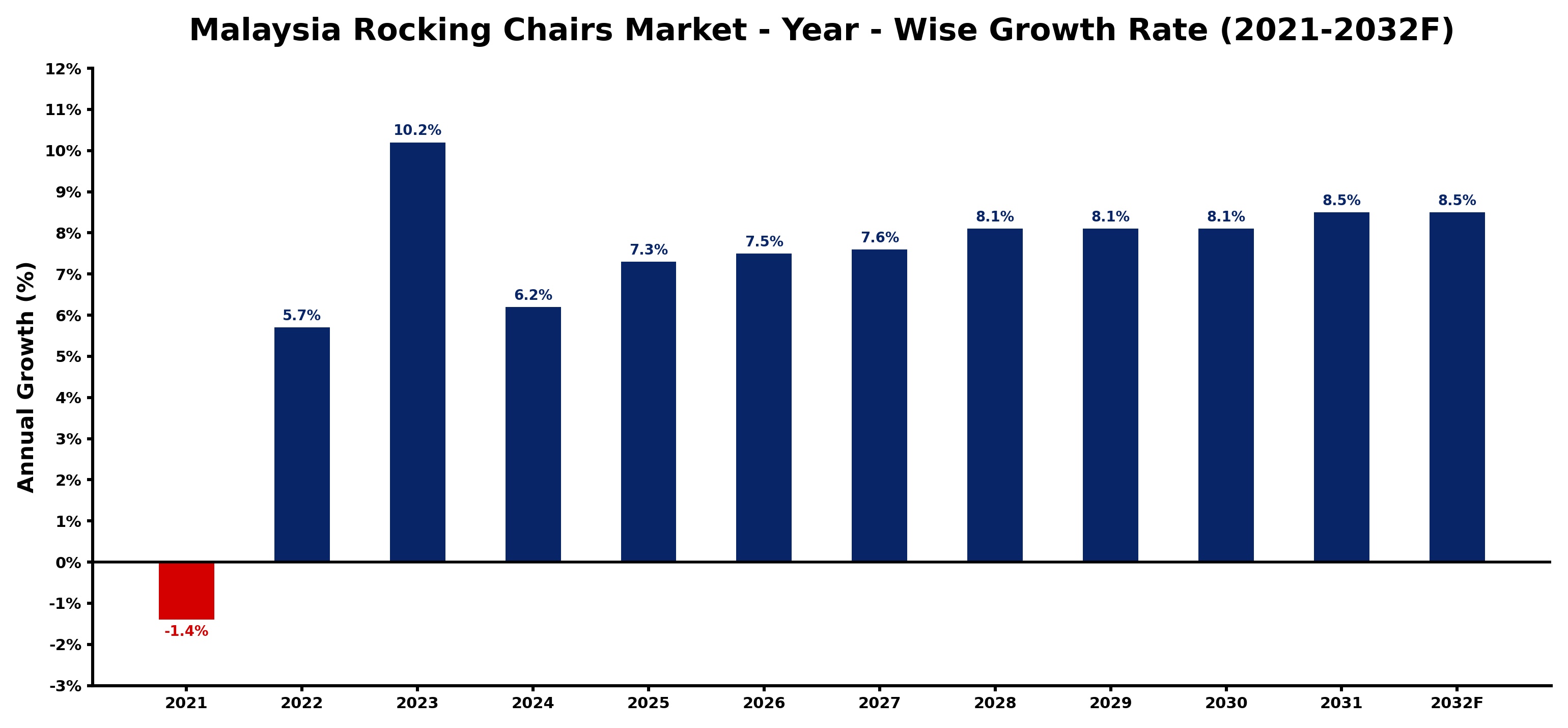
The table below presents the year‑wise growth rates along with the key drivers influencing the market
| Year | Growth Rate | Major Drivers |
| 2021 | -1.4% | Supply chain disruptions reduced exports of Malaysia's rocking chairs |
| 2022 | 5.7% | Precision engineering advancements boost rocking chair export manufacturing capabilities |
| 2023 | 10.2% | Advanced woodworking machinery upgrades enhance rocking chair production efficiency |
| 2024 | 6.2% | Export driven demand for Malaysia's rocking chairs spurred production scaling |
| 2025 | 7.3% | Increased consumer interest spurred rocking chair production efficiency improvements |
| 2026 | 7.5% | Upgraded assembly lines boosted rocking chair production efficiency |
| 2027 | 7.6% | Automation upgrades in chair production lines boosted export readiness |
| 2028 | 8.1% | Export driven demand boosts wooden chair production efficiency in Malaysia |
| 2029 | 8.1% | Foreign investment boosts local woodworking facilities and export capacity |
| 2030 | 8.1% | Export driven demand spurred local craftsmanship in rocking chair production |
| 2031 | 8.5% | Precision engineering upgrades boost rocking chair export production efficiency |
| 2032 | 8.5% | Modernized production techniques boost rocking chair export volumes |
Note - Market size estimations and growth projections presented in this report are based on 6Wresearch's advanced forecasting approach, validated with industry datasets as of June 2026.
Malaysia Rocking Chairs Market Synopsis
The Malaysian market for rocking chairs is characterized by a diverse range of designs and materials, catering to an evolving consumer preference for modern aesthetics. Local manufacturers are increasingly collaborating with international brands to introduce innovative models that prioritize both comfort and design.
In recent years, eco-friendly rocking chairs made from sustainable materials have gained traction as consumers become more environmentally conscious. This shift is prompting manufacturers to adopt greener practices while meeting the growing demand for luxurious furniture items.
Malaysia Rocking Chairs Market Key Takeaways
- The market is poised for steady growth, primarily driven by rising consumer affluence and urbanization.
- Increasing interest in home décor and interior design is making rocking chairs a popular choice among consumers.
- Demand for sustainable materials is reshaping manufacturing practices in the rocking chairs segment.
- Post-pandemic recovery is leading to renewed interest in home furnishings, boosting market dynamics.
- The market landscape is evolving with a mixture of local craftsmanship and international design trends.
Evaluation of Restraints in Malaysia Rocking Chairs Market
While the Malaysia rocking chairs market shows promising growth, several restraints exist that could impede progress. Manufacturers face challenges related to sourcing sustainable materials, which are increasingly in demand as consumers prioritize eco-friendliness. Additionally, fluctuations in raw material prices can impact production costs, making it essential for companies to develop innovative solutions that balance quality and affordability. The competitive landscape also necessitates continuous adaptation to consumer preferences and design trends, creating pressure on businesses to remain relevant.
Malaysia Rocking Chairs Market Trends
Current trends in the Malaysia rocking chairs market highlight a growing consumer affinity for multi-functional furniture. Rocking chairs that can double as recliners or include storage features are becoming increasingly appealing. Furthermore, the integration of technology in furniture design, such as built-in speakers or adjustable features, is attracting tech-savvy consumers. The rise of e-commerce platforms has also transformed the purchasing process, allowing customers to explore a vast array of options from the comfort of their homes.
Malaysia Rocking Chairs Market Opportunities
Significant growth opportunities exist within the Malaysia rocking chairs market, particularly for brands that embrace sustainability in their product offerings. Companies that invest in eco-friendly manufacturing processes and materials will likely capture the attention of a growing segment of environmentally conscious consumers. Additionally, leveraging online sales channels can facilitate market entry for new players, as well as expand reach for established brands. Customizable rocking chairs, tailored to individual preferences, could also carve out a niche market as personalization becomes a higher priority among consumers.
Government Initiatives in the Malaysia Rocking Chairs Market
The Malaysian government has been actively promoting sustainable manufacturing practices across various sectors, including furniture. Initiatives aimed at encouraging the use of eco-friendly materials and reducing carbon footprints align well with the demands of the rocking chairs market. Programs focused on enhancing local craftsmanship and supporting small manufacturers are also in place, providing opportunities for innovation and growth within the industry.
Future Insights of the Malaysia Rocking Chairs Market
Looking ahead to 2026-2032, the Malaysia rocking chairs market is expected to continue its upward trajectory, propelled by the sustained growth in disposable incomes and shifting consumer preferences toward luxury and comfort. The trend toward minimalistic and modern home decor will likely favor rocking chairs that blend seamlessly with contemporary interiors. As more consumers prioritize relaxation and well-being, the market will further benefit from the increased focus on wellness-oriented products.
Malaysia Rocking Chairs Market Latest Developments (May 2025 - June 2026)
Recent developments in the Malaysia rocking chairs market include a noticeable uptick in collaboration between local artisans and international furniture brands. This trend is fostering innovation in design and material use, catering to a more discerning consumer base. Moreover, the rise of online platforms is transforming the retail landscape, enabling new entrants to offer competitive products alongside established brands. As the market evolves, a strong emphasis on sustainability and comfort is becoming more pronounced, aligning with consumer expectations.
Malaysia Rocking Chairs Market - Key Attractiveness of the Report
- 10 Years of Market Numbers
- Historical Data Starting from 2022 to 2025
- Base Year: 2025
- Forecast Data until 2032
- Key Performance Indicators Impacting the Market
- Major Upcoming Developments and Projects
Key Highlights of the Report:
- Malaysia Rocking Chairs Market Outlook
- Market Size of Malaysia Rocking Chairs Market, 2025
- Forecast of Malaysia Rocking Chairs Market, 2032
- Historical Data and Forecast of Malaysia Rocking Chairs Revenues & Volume for the Period 2022-2032F
- Malaysia Rocking Chairs Market Trend Evolution
- Malaysia Rocking Chairs Market Drivers and Challenges
- Malaysia Rocking Chairs Price Trends
- Malaysia Rocking Chairs Porter's Five Forces
- Malaysia Rocking Chairs Industry Life Cycle
- Historical Data and Forecast of Malaysia Rocking Chairs Market Revenues & Volume By Types for the Period 2022-2032F
- Historical Data and Forecast of Malaysia Rocking Chairs Market Revenues & Volume By Metal for the Period 2022-2032F
- Historical Data and Forecast of Malaysia Rocking Chairs Market Revenues & Volume By Fabric for the Period 2022-2032F
- Historical Data and Forecast of Malaysia Rocking Chairs Market Revenues & Volume By Leather for the Period 2022-2032F
- Historical Data and Forecast of Malaysia Rocking Chairs Market Revenues & Volume By Plastic for the Period 2022-2032F
- Historical Data and Forecast of Malaysia Rocking Chairs Market Revenues & Volume By Others for the Period 2022-2032F
- Historical Data and Forecast of Malaysia Rocking Chairs Market Revenues & Volume By Application for the Period 2022-2032F
- Historical Data and Forecast of Malaysia Rocking Chairs Market Revenues & Volume By Department Stores for the Period 2022-2032F
- Historical Data and Forecast of Malaysia Rocking Chairs Market Revenues & Volume By Grocery Stores and Supermarkets for the Period 2022-2032F
- Historical Data and Forecast of Malaysia Rocking Chairs Market Revenues & Volume By Warehouse Retailers for the Period 2022-2032F
- Historical Data and Forecast of Malaysia Rocking Chairs Market Revenues & Volume By Convenience Retailer for the Period 2022-2032F
- Historical Data and Forecast of Malaysia Rocking Chairs Market Revenues & Volume By Discount Retailer for the Period 2022-2032F
- Historical Data and Forecast of Malaysia Rocking Chairs Market Revenues & Volume By Others for the Period 2022-2032F
- Malaysia Rocking Chairs Import Export Trade Statistics
- Market Opportunity Assessment By Types
- Market Opportunity Assessment By Application
- Malaysia Rocking Chairs Top Companies Market Share
- Malaysia Rocking Chairs Competitive Benchmarking By Technical and Operational Parameters
- Malaysia Rocking Chairs Company Profiles
- Malaysia Rocking Chairs Key Strategic Recommendations






































