Roofing Market: Malaysia vs Top 5 Major Economies in 2027 (Asia)
In the Asia region, the Roofing market in Malaysia is projected to expand at a stable growth rate of 0.06% by 2027. The largest economy is China, followed by India, Japan, Australia and South Korea.
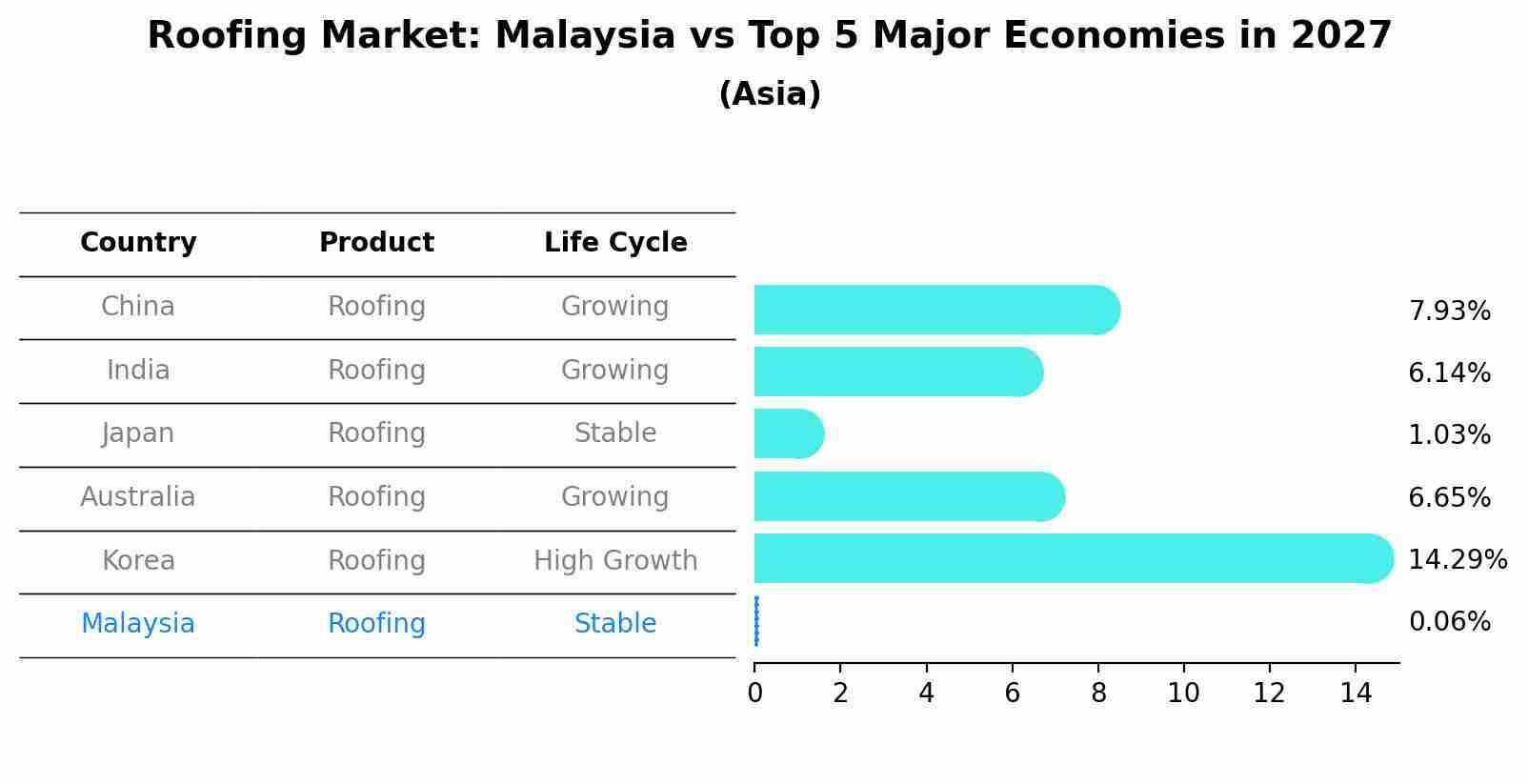
Malaysia Roofing Market Growth Rate
According to 6Wresearch internal database and industry insights, the Malaysia Roofing Market is projected to grow at a compound annual growth rate (CAGR) of 5.9% during the forecast period (2026–2032).
Topics Covered in the Malaysia Roofing Market Report
The Malaysia Roofing Market report thoroughly covers the market by roofing material, roofing type, and application. The report provides an unbiased and detailed analysis of ongoing market trends, opportunities/high-growth areas, and market drivers, which help stakeholders devise and align their strategies according to current and future market dynamics.
Malaysia Roofing Market Highlights
| Report Name | Malaysia Roofing Market |
| Forecast Period | 2026–2032 |
| CAGR | 5.9% |
| Growing Sector | Residential Sector |
Malaysia Roofing Market Synopsis
The Malaysian roofing market is growing tremendously, driven by increasing construction activities across Malaysia. Key drivers of the market include growing development of infrastructure in both rural and urban areas and growing urbanization. There is an increasing demand for sustainable and durable roofing solutions among consumers in Malaysia. A few challenges, like high cost, changing raw material prices, and regulatory policy restrictions, hinder this industry's growth. Overall, the market is expanding, which is fueled by demand for green roofing solutions within Malaysia.
Evaluation of Growth Drivers in the Malaysia Roofing Market
Below are the key growth drivers and their impacts on the market dynamics:
| Drivers | Primary Segments Affected | Why it Matters (Evidence) |
| Growth in Residential Construction | Tile Roofing, Metal Roofing | Increasing housing demand drives roofing installations. |
| Expansion of Commercial Infrastructure | Flat Roof, Metal Roofing | The need for long-lasting and scalable roofing solutions is critical in commercial buildings. |
| Industrial Development | Metal Roofing | Industrial facilities such as warehouses prefer roofing that offers long-lasting performance at a lower cost. |
| Rising Demand for Energy Efficiency | All Segments | The increasing use of insulated roofing solutions helps minimize energy consumption. |
| Government Infrastructure Projects | All Segments | Public projects increase demand for roofing materials. |
Malaysia Roofing Market size is expected to grow at a significant CAGR of 5.9% during the forecast period 2026–2032. The market is driven by increasing investments in infrastructure, rising urban development, and increasing demand for weather-resistant roofing solutions. Further, advancements in roofing technologies, such as reflective coatings and durable composites, are increasing product performance. Additionally, consumers rising knowledge of green building practices and government support for sustainable construction are propelling adoption of eco-friendly roofing solutions across residential, commercial, and industrial segments. These combined factors altogether contribute to the growth of the market.
Evaluation of Restraints in the Malaysia Roofing Market
Below are the key restraints and their influence on the market dynamics:
| Restraints | Primary Segments Affected | What This Means (Evidence) |
| High Cost of Advanced Roofing Materials | Tile Roofing, Metal Roofing | Premium materials may limit adoption among budget buyers. |
| Fluctuating Raw Material Prices | All Segments | The volatility of prices influences both production and pricing strategies. |
| Availability of Alternatives | Bituminous Roofing | Substitute materials may reduce demand, which could slow down the adoption of the market. |
| Skilled Labor Shortage | All Segments | Installation complexity may delay projects, which is impacting the market expansion. |
| Environmental Concerns | Bituminous Roofing | Sustainability concerns may restrict usage, which is slowing down the development of the market. |
Malaysia Roofing Market Challenges
The Malaysia Roofing Industry faces many issues. These challenges include fluctuating raw material costs and strict government regulations on compliance with fire safety and energy. Climate-related challenges, such as heavy rainfall and prolonged UV exposure, may delay the adoption of the market. Along with this, delays in obtaining certifications and managing complex approval procedures can slow down project timelines, which could create a barrier to the expansion of the market.
Malaysia Roofing Market Trends
The following are key trends shaping the growth of the market:
- Technological Advancements in Roofing Materials: Innovations in roofing materials, such as heat-reflective coatings and insulated panels, are improving durability and energy efficiency.
- Shift Towards Green Roofing: The increasing public understanding of environmental sustainability leads to increased use of environmentally safe roofing materials.
- Growth of Smart Buildings: The development of smart construction and green buildings creates demand for innovative roofing technologies which include solar-integrated roofs.
- Evolving Preference for Metal Roofing: People prefer metal roofing as it provides long-lasting protection that requires minimal upkeep while remaining affordable for residential use.
Investment Opportunities in the Malaysia Roofing Market
The following are the major investment opportunities that are expected to increase the revenue of the market.
- Expansion of Distribution Networks: The establishment of both offline and online distribution networks will improve roofing material distribution, which is expected to fuel the growth of the market.
- Development of Green Roofing Solutions: The market for green roofing products will expand as companies invest in environmentally friendly roofing solutions.
- Infrastructure and Construction Projects: Participation in government and private infrastructure projects will create consistent demand for roofing materials.
- Technological Integration in Roofing Systems: Companies that invest in modern roofing technologies which include solar roofing and smart roofing systems will gain unlimited growth potential.
Top 5 Leading Players in the Malaysia Roofing Market
Some leading players operating in the market include:
1. BMI Monier (Monier Malaysia)
| Company Name | BMI Monier (Monier Malaysia) |
| Established Year | 1999 |
| Headquarters | Kuala Lumpur, Malaysia |
| Official Website | Click Here |
A dominant market leader in the Malaysian roofing industry, BMI Monier provides a comprehensive range of pitched and flat roofing systems. They are widely recognized for their high-quality concrete and clay tiles, as well as energy-efficient waterproofing solutions.
2. Swissma Building Technologies
| Company Name | Swissma Building Technologies |
| Established Year | 1997 |
| Headquarters | Shah Alam, Selangor |
| Official Website | Click Here |
A premier specialist in metal roofing and wall cladding, Swissma integrates European technologies into the local market. They are known for providing bespoke architectural solutions using premium materials like copper, titanium zinc, and high-tensile coated steel.
3. Astino Berhad
| Company Name | Astino Berhad |
| Established Year | 2000 |
| Headquarters | Seberang Perai, Penang |
| Official Website | Click Here |
A leading manufacturer of metal building materials listed on Bursa Malaysia. Under the brand name Astino®, the company operates multiple manufacturing plants across Peninsular Malaysia, specializing in pre-painted metal roofing sheets and structural steel products.
4. UAC Berhad
| Company Name | UAC Berhad |
| Established Year | 1963 |
| Headquarters | Petaling Jaya, Selangor |
| Official Website | Click Here |
A pioneer in the manufacture of eco-friendly cellulose fibre cement building materials. UAC is a key player in the roofing sector, offering durable and fire-resistant roofing sheets and fascia boards that are utilized in residential, industrial, and institutional buildings globally.
5. Thung Hing Group
| Company Name | Thung Hing Group |
| Established Year | 1983 |
| Headquarters | Selayang, Selangor |
| Official Website | Click Here |
With over four decades of experience, Thung Hing is a significant manufacturer of metal roofing, rainwater harvesting systems, and structural steel products. The company focuses on high-durability solutions, including innovative metal deck roofing and high-performance insulation systems.
Government Regulations Introduced in the Malaysia Roofing Market
As per Malaysian government data, it enforces standards under the Uniform Building By-Laws and structurally compliant roofing materials. The Construction Industry Development Board (CIDB) requires quality certifications for installation, and it is expected to fuel the expansion of the market. The Green Building Index provides incentives that drive sustainable building practices through its requirements for insulated roofing systems. Local standards which include MS 1515 provide organizations with mandatory energy performance standards.
Future Insights of the Malaysia Roofing Market
The Malaysia roofing market industry is deemed for evolution during the forecasted period. Specifically in areas geared toward smart, sustainable solutions, solar-integrated, cool-roof systems will grow in appeal amid energy cost pressures. Urban redevelopment and retrofitting existing structures present growth lanes. Digital sales and service platforms will streamline procurement. Strategic innovation and regulatory policies will fuel the growth of the market.
Market Segmentation Analysis
This report provides an inclusive study of the following market segments and their leading categories:
By Roofing Material – Metal Roofing to Dominate
According to Sarthi, Senior Research Analyst, 6Wresearch, metal roofing is expected to dominate the Malaysia Roofing Market due to its durability, cost-effectiveness and widespread use in industrial and commercial sectors.
By Roofing Type – Slope Roof to Dominate
Slope roofs are expected to dominate the Malaysia Roofing Market owing to their widespread adoption in residential buildings and their suitability for tropical climates. Their ability to efficiently drain water during heavy rainfall make them a preferred choice across the country.
By Application – Residential Sector to Dominate
Residential segment is expected to witness major growth due to increasing housing demand and the evolving trend of urbanization. The increasing need for aesthetically appealing roofing solutions in residential construction is accelerating the expansion of the market.
Key Attractiveness of the Report
- 10 Years of Market Numbers
- Historical Data Starting from 2022 to 2025
- Base Year: 2025
- Forecast Data until 2032
- Key Performance Indicators Impacting the Market
- Major Upcoming Developments and Projects
Key Highlights of the Report:
- Malaysia Roofing Market Outlook
- Market Size of Malaysia Roofing Market, 2025
- Forecast of Malaysia Roofing Market, 2032
- Historical Data and Forecast of Malaysia Roofing Revenues & Volume for the Period 2022-2032
- Malaysia Roofing Market Trend Evolution
- Malaysia Roofing Market Drivers and Challenges
- Malaysia Roofing Price Trends
- Malaysia Roofing Porter's Five Forces
- Malaysia Roofing Industry Life Cycle
- Historical Data and Forecast of Malaysia Roofing Market Revenues & Volume By Roofing Material for the Period 2022-2032
- Historical Data and Forecast of Malaysia Roofing Market Revenues & Volume By Bituminous Roofing for the Period 2022-2032
- Historical Data and Forecast of Malaysia Roofing Market Revenues & Volume By Metal Roofing for the Period 2022-2032
- Historical Data and Forecast of Malaysia Roofing Market Revenues & Volume By Tile Roofing for the Period 2022-2032
- Historical Data and Forecast of Malaysia Roofing Market Revenues & Volume By Others for the Period 2022-2032
- Historical Data and Forecast of Malaysia Roofing Market Revenues & Volume By Roofing Type for the Period 2022-2032
- Historical Data and Forecast of Malaysia Roofing Market Revenues & Volume By Flat Roof for the Period 2022-2032
- Historical Data and Forecast of Malaysia Roofing Market Revenues & Volume By Slope Roof for the Period 2022-2032
- Historical Data and Forecast of Malaysia Roofing Market Revenues & Volume By Application for the Period 2022-2032
- Historical Data and Forecast of Malaysia Roofing Market Revenues & Volume By Residential for the Period 2022-2032
- Historical Data and Forecast of Malaysia Roofing Market Revenues & Volume By Commercial for the Period 2022-2032
- Historical Data and Forecast of Malaysia Roofing Market Revenues & Volume By Industrial for the Period 2022-2032
- Malaysia Roofing Import Export Trade Statistics
- Market Opportunity Assessment By Roofing Material
- Market Opportunity Assessment By Roofing Type
- Market Opportunity Assessment By Application
- Malaysia Roofing Top Companies Market Share
- Malaysia Roofing Competitive Benchmarking By Technical and Operational Parameters
- Malaysia Roofing Company Profiles
- Malaysia Roofing Key Strategic Recommendations
Markets Covered
The report offers a comprehensive study of the subsequent market segments:
By Roofing Material:
- Bituminous Roofing
- Metal Roofing
- Tile Roofing
- Others
By Roofing Type:
- Flat Roof
- Slope Roof
By Application:
- Residential
- Commercial
- Industrial






































