Malaysia Rubber Compound Market Size, Share & Growth Rate
The Malaysia Rubber Compound Market was estimated at USD 188 Million in 2025 and is projected to reach USD 246 Million by 2032, growing at a CAGR of 3.9% from 2026 to 2032. This growth is underpinned by the country's established rubber industry, which is known for its high-quality production capabilities. The escalating demand from diverse sectors such as automotive, construction, and manufacturing is further driving the market's upward trajectory.
Malaysia Rubber Compound Market Year-wise Growth Rate and Key Drivers
This graph highlights how the Malaysia Rubber Compound Market has steadily grown over the years, supported by major growth factors.
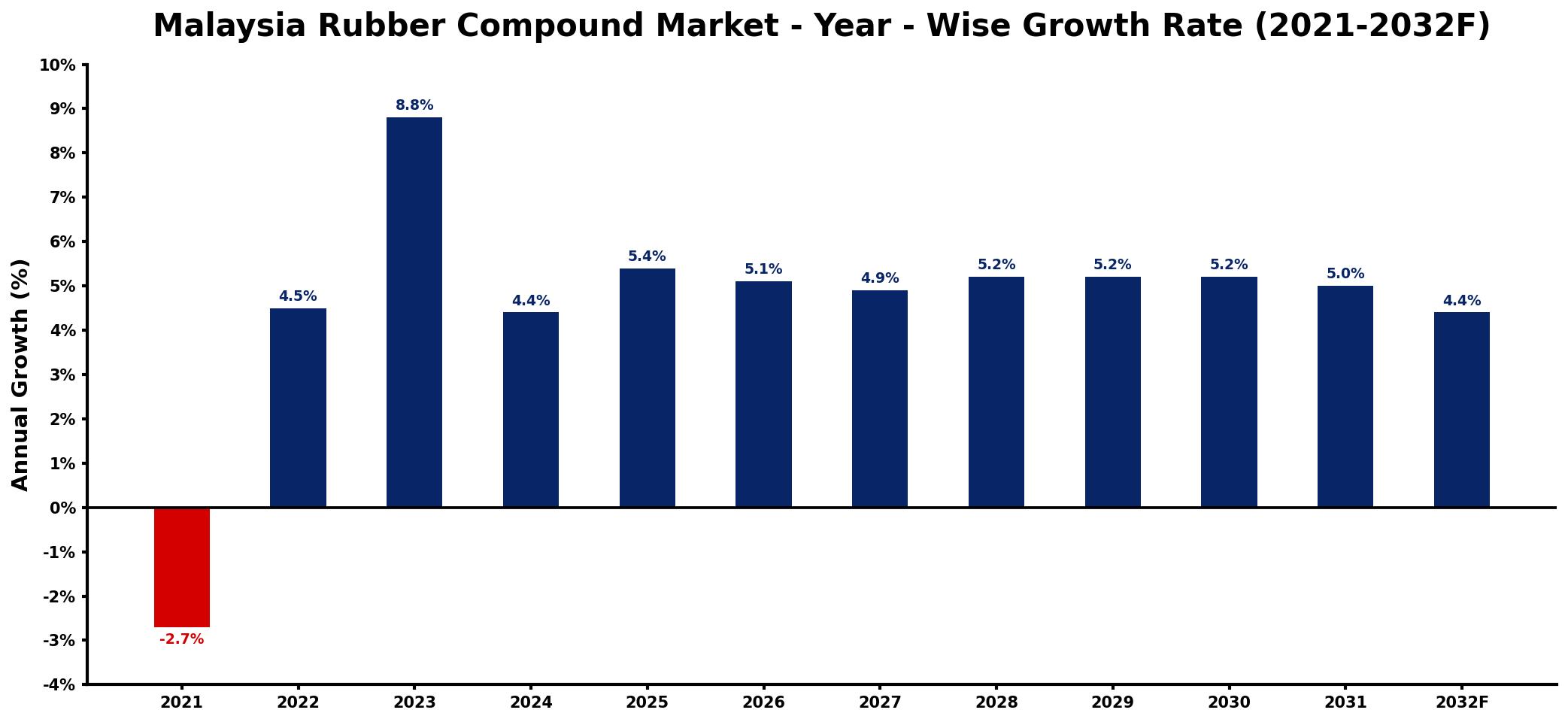
The table below presents the year‑wise growth rates along with the key drivers influencing the market
| Year | Growth Rate | Major Drivers |
| 2021 | -2.7% | decreased automotive production levels |
| 2022 | 4.5% | rising demand from footwear industry |
| 2023 | 8.8% | expansion in construction projects |
| 2024 | 4.4% | increased investment in infrastructure |
| 2025 | 5.4% | growing electric vehicle market |
| 2026 | 5.1% | surge in industrial applications |
| 2027 | 4.9% | enhanced export opportunities emerging |
| 2028 | 5.2% | rising consumer goods production |
| 2029 | 5.2% | advanced manufacturing technologies adoption |
| 2030 | 5.2% | increased focus on sustainability practices |
| 2031 | 5.0% | growing demand for healthcare products |
| 2032 | 4.4% | expanding automotive aftermarket services |
Note: Market size estimations and growth projections presented in this report are based on 6Wresearch's proprietary forecasting methodology, utilizing the latest available industry data, government publications, and primary research inputs.
Malaysia Rubber Compound Market Synopsis
The Malaysian rubber compound sector is characterized by its robust production infrastructure, which is critical in meeting the growing needs of various industries. Innovations and advancements in rubber processing technologies play a pivotal role in enhancing product quality and expanding application areas.
Strong domestic demand, coupled with a significant export market, positions Malaysia as a key player on the global stage. The increasing integration of rubber compounds in high-performance applications such as electric vehicles and sustainable construction materials further fuels market growth.
Malaysia Rubber Compound Market Key Takeaways
- The market is supported by a robust domestic infrastructure for rubber production and processing.
- Rising demand from automotive, construction, and manufacturing sectors drives growth.
- Innovations in rubber processing enhance product quality and expand application areas.
- The export potential of rubber compounds positions Malaysia competitively on the global stage.
- Economic recovery post-COVID-19 is expected to bolster market expansion in the near future.
Evaluation of Restraints in Malaysia Rubber Compound Market
While the Malaysia Rubber Compound Market holds significant promise, several constraints temper its growth potential. Fluctuations in raw rubber prices can impact profit margins and operational stability for manufacturers. Additionally, environmental concerns surrounding rubber cultivation and processing may lead to regulatory hurdles. Moreover, the increasing competition from synthetic alternatives poses a challenge to traditional rubber compound producers. These factors necessitate strategic approaches to mitigate risks and maintain market competitiveness.
Malaysia Rubber Compound Market Trends
The market is witnessing several trends that are shaping its future. A notable shift towards sustainable practices is becoming prevalent as manufacturers focus on eco-friendly rubber production methods. Additionally, the integration of advanced materials in rubber compounds to enhance performance in electric vehicles is gaining traction. These trends highlight the industry's commitment to innovation and sustainability, which are essential for capturing new market segments.
Malaysia Rubber Compound Market Opportunities
With the automotive industry shifting towards electric vehicles, there lies a significant opportunity for the rubber compound sector to cater to specialized applications within this realm. Furthermore, the expansion of construction activities, particularly in sustainable building materials, creates new avenues for growth. Investments in research and development to improve rubber processing techniques are likely to yield high returns, propelling the market further.
Government Initiatives in the Malaysia Rubber Compound Market
The Malaysian government plays a critical role in supporting the rubber industry through various policies and initiatives aimed at boosting production and exports. Programs focused on research and development are being implemented to enhance rubber processing technologies and promote sustainable practices. Public spending in infrastructure development is also expected to benefit the construction sector, indirectly supporting the demand for rubber compounds.
Future Insights of the Malaysia Rubber Compound Market
Looking ahead to 2026-2032, the Malaysia Rubber Compound Market is set to evolve significantly. With sustained growth driven by demand from the automotive and construction sectors, the market is expected to adopt more innovative processing technologies. Additionally, increasing awareness of environmental sustainability will likely push manufacturers toward greener production methods. The blend of these factors will establish Malaysia as a formidable player in the global rubber compound landscape.
Malaysia Rubber Compound Market Latest Developments (2025 - 2026)
Recent developments in the Malaysia Rubber Compound Market reflect a heightened focus on innovation and sustainability. Companies are increasingly investing in research initiatives to develop high-performance rubber compounds that meet the evolving demands of key industries. Additionally, industry players are exploring partnerships and collaborations to enhance their technological capabilities and market reach, demonstrating a collective effort to adapt to changing market dynamics.
Malaysia Rubber Compound Market - Key Attractiveness of the Report
- 10 Years of Market Numbers
- Historical Data Starting from 2022 to 2025
- Base Year: 2025
- Forecast Data until 2032
- Key Performance Indicators Impacting the Market
- Major Upcoming Developments and Projects
Key Highlights of the Report:
- Malaysia Rubber Compound Market Outlook
- Market Size of Malaysia Rubber Compound Market, 2025
- Forecast of Malaysia Rubber Compound Market, 2032
- Historical Data and Forecast of Malaysia Rubber Compound Revenues & Volume for the Period 2022-2032F
- Malaysia Rubber Compound Market Trend Evolution
- Malaysia Rubber Compound Market Drivers and Challenges
- Malaysia Rubber Compound Price Trends
- Malaysia Rubber Compound Porter's Five Forces
- Malaysia Rubber Compound Industry Life Cycle
- Historical Data and Forecast of Malaysia Rubber Compound Market Revenues & Volume By Rubber Type for the Period 2022-2032F
- Historical Data and Forecast of Malaysia Rubber Compound Market Revenues & Volume By Silicone Rubber for the Period 2022-2032F
- Historical Data and Forecast of Malaysia Rubber Compound Market Revenues & Volume By Fluoro Rubber for the Period 2022-2032F
- Historical Data and Forecast of Malaysia Rubber Compound Market Revenues & Volume By Butyronitrile Rubber for the Period 2022-2032F
- Historical Data and Forecast of Malaysia Rubber Compound Market Revenues & Volume By EPDM Rubber for the Period 2022-2032F
- Historical Data and Forecast of Malaysia Rubber Compound Market Revenues & Volume By Chloroprene Rubber for the Period 2022-2032F
- Historical Data and Forecast of Malaysia Rubber Compound Market Revenues & Volume By Others for the Period 2022-2032F
- Historical Data and Forecast of Malaysia Rubber Compound Market Revenues & Volume By End-User for the Period 2022-2032F
- Historical Data and Forecast of Malaysia Rubber Compound Market Revenues & Volume By Tires for the Period 2022-2032F
- Historical Data and Forecast of Malaysia Rubber Compound Market Revenues & Volume By Hose & Belting for the Period 2022-2032F
- Historical Data and Forecast of Malaysia Rubber Compound Market Revenues & Volume By Roofing & Geo Membranes for the Period 2022-2032F
- Historical Data and Forecast of Malaysia Rubber Compound Market Revenues & Volume By Footwear for the Period 2022-2032F
- Historical Data and Forecast of Malaysia Rubber Compound Market Revenues & Volume By Wire & Cable Insulation for the Period 2022-2032F
- Historical Data and Forecast of Malaysia Rubber Compound Market Revenues & Volume By Others for the Period 2022-2032F
- Malaysia Rubber Compound Import Export Trade Statistics
- Market Opportunity Assessment By Rubber Type
- Market Opportunity Assessment By End-User
- Malaysia Rubber Compound Top Companies Market Share
- Malaysia Rubber Compound Competitive Benchmarking By Technical and Operational Parameters
- Malaysia Rubber Compound Company Profiles
- Malaysia Rubber Compound Key Strategic Recommendations






































