Malaysia Sage Essential Oil Market Size, Share & Growth Rate
The Malaysia Sage Essential Oil Market was estimated at USD 180 Million in 2025 and is projected to reach USD 235 Million by 2032, growing at a CAGR of 3.9% from 2026 to 2032. This positive growth trajectory is supported by an increasing consumer preference for natural wellness products, particularly in the areas of aromatherapy and holistic health. As awareness about the therapeutic benefits of sage essential oil rises, its market penetration is expected to expand, driven by both retail and online sales channels.
Malaysia Sage Essential Oil Market Year-wise Growth Rate and Key Drivers
This graph highlights how the Malaysia Sage Essential Oil Market has steadily grown over the years, supported by major growth factors.
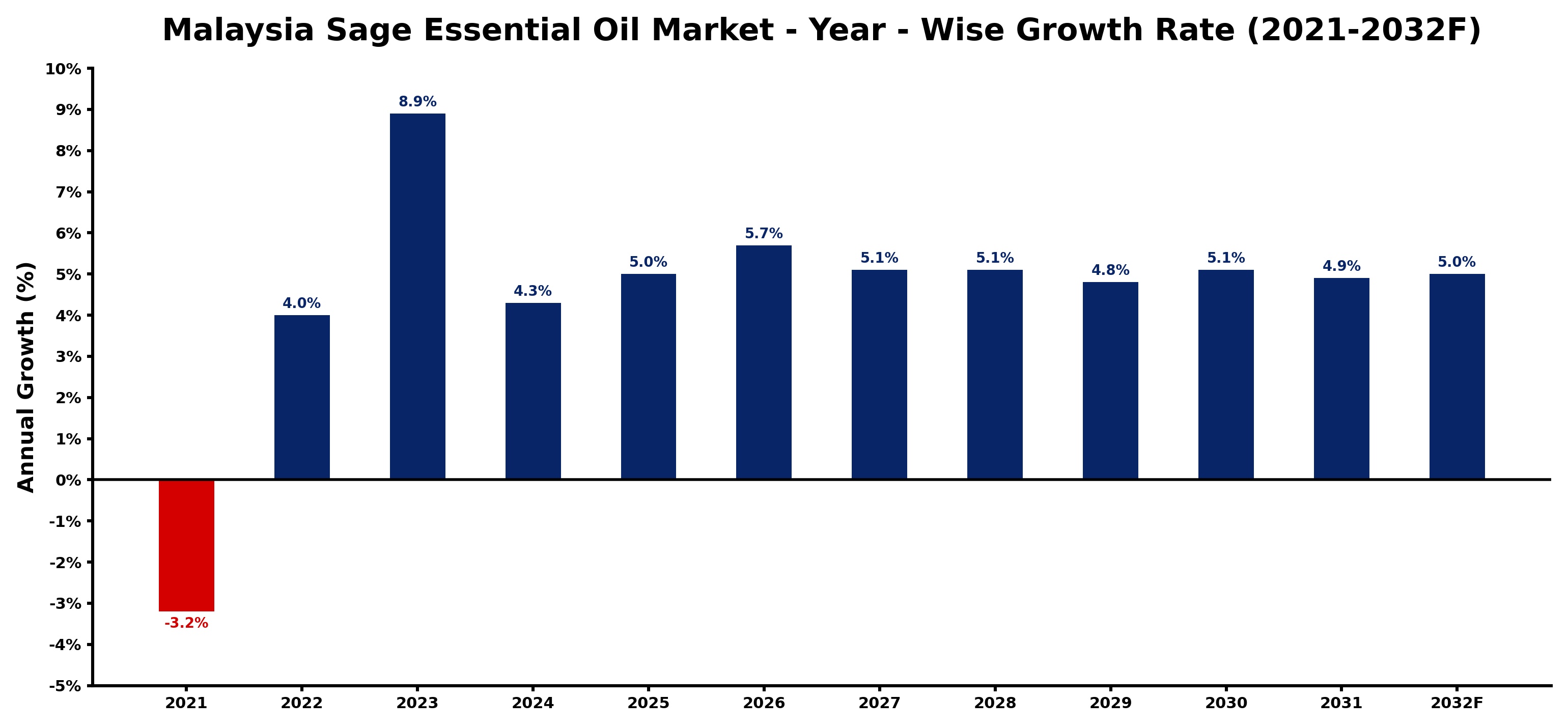
The table below presents the year‑wise growth rates along with the key drivers influencing the market
| Year | Growth Rate | Major Drivers |
| 2021 | -3.2% | Decreased global demand led to reduced Malaysian sage oil exports |
| 2022 | 4.0% | Precision engineering advancements boosted Malaysia's sage oil extraction efficiency |
| 2023 | 8.9% | Domestic manufacturers boost sage oil extraction for export markets |
| 2024 | 4.3% | Increased manufacturing investments boosted sage oil extraction capacity |
| 2025 | 5.0% | Precision engineering advancements boosted sage essential oil extraction efficiency |
| 2026 | 5.7% | Domestic demand for sage essential oil fuels export manufacturing growth |
| 2027 | 5.1% | Export demand surge boosts sage oil extraction technology investments |
| 2028 | 5.1% | Capacity enhancements at sage oil distilleries boosted export readiness |
| 2029 | 4.8% | Manufacturing investments in sustainable extraction enhance essential oil production capacity |
| 2030 | 5.1% | Export driven demand for sage oil boosted distillation facility investments |
| 2031 | 4.9% | Export driven investments boost sage essential oil processing facilities |
| 2032 | 5.0% | Precision engineering advancements optimize sage oil extraction techniques |
Note - Market size estimations and growth projections presented in this report are based on 6Wresearch’s advanced forecasting approach, validated with industry datasets as of June 2026.
Malaysia Sage Essential Oil Market Synopsis
Sage essential oil is gaining traction in Malaysia, primarily due to its wide-ranging applications in stress relief and cognitive enhancement. In 2025, the country imported approximately 10 tonnes of this oil, with India being the main supplier, accounting for a dominant 93% of the imports.
Despite being relatively new to the Malaysian market, sage essential oil is quickly capturing the attention of consumers who are increasingly looking for natural remedies. The unique market dynamics, coupled with a growing wellness industry, suggest that sage essential oil will not only be a passing trend but a mainstay in many households.
Malaysia Sage Essential Oil Market Key Takeaways
- The market is poised for steady growth, benefiting from the expanding wellness and aromatherapy sectors.
- Key drivers include the increasing demand for natural products among health-conscious consumers.
- The primary import source of sage essential oil is India, highlighting a significant reliance on international trade.
- Challenges related to sustainability and consumer education present opportunities for market improvement.
- COVID-19 has caused temporary disruptions, but recovery is on the horizon as consumer interest in wellness rebounds.
Evaluation of Restraints in Malaysia Sage Essential Oil Market
While the Malaysia Sage Essential Oil Market shows potential for growth, several constraints hinder its full development. Sustainability is a major concern, as increased demand could lead to overharvesting of sage plants, adversely affecting local ecosystems. Moreover, there exists a lack of comprehensive consumer education regarding the safe and effective use of sage essential oil. These factors necessitate responsible sourcing and informative initiatives to ensure the market grows sustainably.
Malaysia Sage Essential Oil Market Trends
Current trends indicate a notable shift towards natural and organic products, particularly in personal care and home wellness sectors. The increasing incorporation of sage essential oil in products such as candles, diffusers, and health supplements is a testament to its growing relevance. Additionally, the rise of e-commerce platforms is facilitating greater accessibility for consumers seeking these products. As the market matures, innovation in product formulations and applications is expected to enhance its appeal further.
Malaysia Sage Essential Oil Market Opportunities
There are significant opportunities for growth within the Malaysia Sage Essential Oil Market, particularly in developing innovative product lines that cater to the health and wellness segment. Establishing partnerships with wellness influencers and practitioners can bolster consumer trust and promote responsible sourcing practices. Moreover, educating consumers on the benefits and proper usage of sage essential oil can further drive its adoption, positioning it as a staple in holistic health routines.
Government Initiatives in the Malaysia Sage Essential Oil Market
The Malaysian government has implemented various initiatives aimed at promoting the essential oils industry, including grants for sustainable agricultural practices and incentives for research and development in natural remedies. Additionally, public campaigns to promote local sourcing and environmental conservation are in line with enhancing consumer awareness. Such governmental support can play a pivotal role in ensuring the sustainable growth of the sage essential oil sector.
Future Insights of the Malaysia Sage Essential Oil Market
Looking ahead to 2026-2032, the Malaysia Sage Essential Oil Market is expected to evolve significantly. As consumer trends shift towards natural health solutions, the market is likely to see increased diversification in product offerings. The integration of modern technology in sourcing and distribution could enhance supply chain efficiency, making sage essential oil more accessible. By prioritizing education and sustainability, stakeholders can foster a market that not only thrives economically but also respects environmental concerns.
Malaysia Sage Essential Oil Market Latest Developments (May 2025 - June 2026)
Recent industry movements indicate a heightened interest in organic certification for essential oils, which aligns with the growing consumer trend towards natural products. Many suppliers are also beginning to explore innovative extraction methods that preserve the quality and efficacy of sage essential oil. In addition, various wellness brands are launching new products featuring sage essential oil, signaling a robust market development aimed at consumer health and well-being.
Malaysia Sage Essential Oil Market - Key Attractiveness of the Report
- 10 Years of Market Numbers
- Historical Data Starting from 2022 to 2025
- Base Year: 2025
- Forecast Data until 2032
- Key Performance Indicators Impacting the Market
- Major Upcoming Developments and Projects
Key Highlights of the Report:
- Malaysia Sage Essential Oil Market Outlook
- Market Size of Malaysia Sage Essential Oil Market, 2025
- Forecast of Malaysia Sage Essential Oil Market, 2032
- Historical Data and Forecast of Malaysia Sage Essential Oil Revenues & Volume for the Period 2022-2032F
- Malaysia Sage Essential Oil Market Trend Evolution
- Malaysia Sage Essential Oil Market Drivers and Challenges
- Malaysia Sage Essential Oil Price Trends
- Malaysia Sage Essential Oil Porter's Five Forces
- Malaysia Sage Essential Oil Industry Life Cycle
- Historical Data and Forecast of Malaysia Sage Essential Oil Market Revenues & Volume By Nature for the Period 2022-2032F
- Historical Data and Forecast of Malaysia Sage Essential Oil Market Revenues & Volume By Organic for the Period 2022-2032F
- Historical Data and Forecast of Malaysia Sage Essential Oil Market Revenues & Volume By Conventional for the Period 2022-2032F
- Historical Data and Forecast of Malaysia Sage Essential Oil Market Revenues & Volume By End User for the Period 2022-2032F
- Historical Data and Forecast of Malaysia Sage Essential Oil Market Revenues & Volume By Cosmetics & Personal Care Industry for the Period 2022-2032F
- Historical Data and Forecast of Malaysia Sage Essential Oil Market Revenues & Volume By Household Care Industry for the Period 2022-2032F
- Historical Data and Forecast of Malaysia Sage Essential Oil Market Revenues & Volume By Pharmaceutical Industry for the Period 2022-2032F
- Historical Data and Forecast of Malaysia Sage Essential Oil Market Revenues & Volume By Distribution Channel for the Period 2022-2032F
- Historical Data and Forecast of Malaysia Sage Essential Oil Market Revenues & Volume By Direct for the Period 2022-2032F
- Historical Data and Forecast of Malaysia Sage Essential Oil Market Revenues & Volume By Business-to-Business for the Period 2022-2032F
- Historical Data and Forecast of Malaysia Sage Essential Oil Market Revenues & Volume By Indirect for the Period 2022-2032F
- Historical Data and Forecast of Malaysia Sage Essential Oil Market Revenues & Volume By Hypermarket/Supermarket for the Period 2022-2032F
- Historical Data and Forecast of Malaysia Sage Essential Oil Market Revenues & Volume By Specialty Stores for the Period 2022-2032F
- Historical Data and Forecast of Malaysia Sage Essential Oil Market Revenues & Volume By Online Sales Channel for the Period 2022-2032F
- Malaysia Sage Essential Oil Import Export Trade Statistics
- Market Opportunity Assessment By Nature
- Market Opportunity Assessment By End User
- Market Opportunity Assessment By Distribution Channel
- Malaysia Sage Essential Oil Top Companies Market Share
- Malaysia Sage Essential Oil Competitive Benchmarking By Technical and Operational Parameters
- Malaysia Sage Essential Oil Company Profiles
- Malaysia Sage Essential Oil Key Strategic Recommendations






































