Malaysia Saw Blade Market Size, Share & Growth Rate
The Malaysia Saw Blade Market was estimated at USD 333 Million in 2025 and is projected to reach USD 435 Million by 2032, growing at a CAGR of 3.9% from 2026 to 2032. This positive trajectory is primarily driven by the robust construction and woodworking industries, which are witnessing significant investments and expansion. Additionally, a rising demand for high-quality saw blades from both professionals and DIY enthusiasts fuels innovation and upgrades in manufacturing processes.
Malaysia Saw Blade Market Year-wise Growth Rate and Key Drivers
This graph highlights how the Malaysia Saw Blade Market has steadily grown over the years, supported by major growth factors.
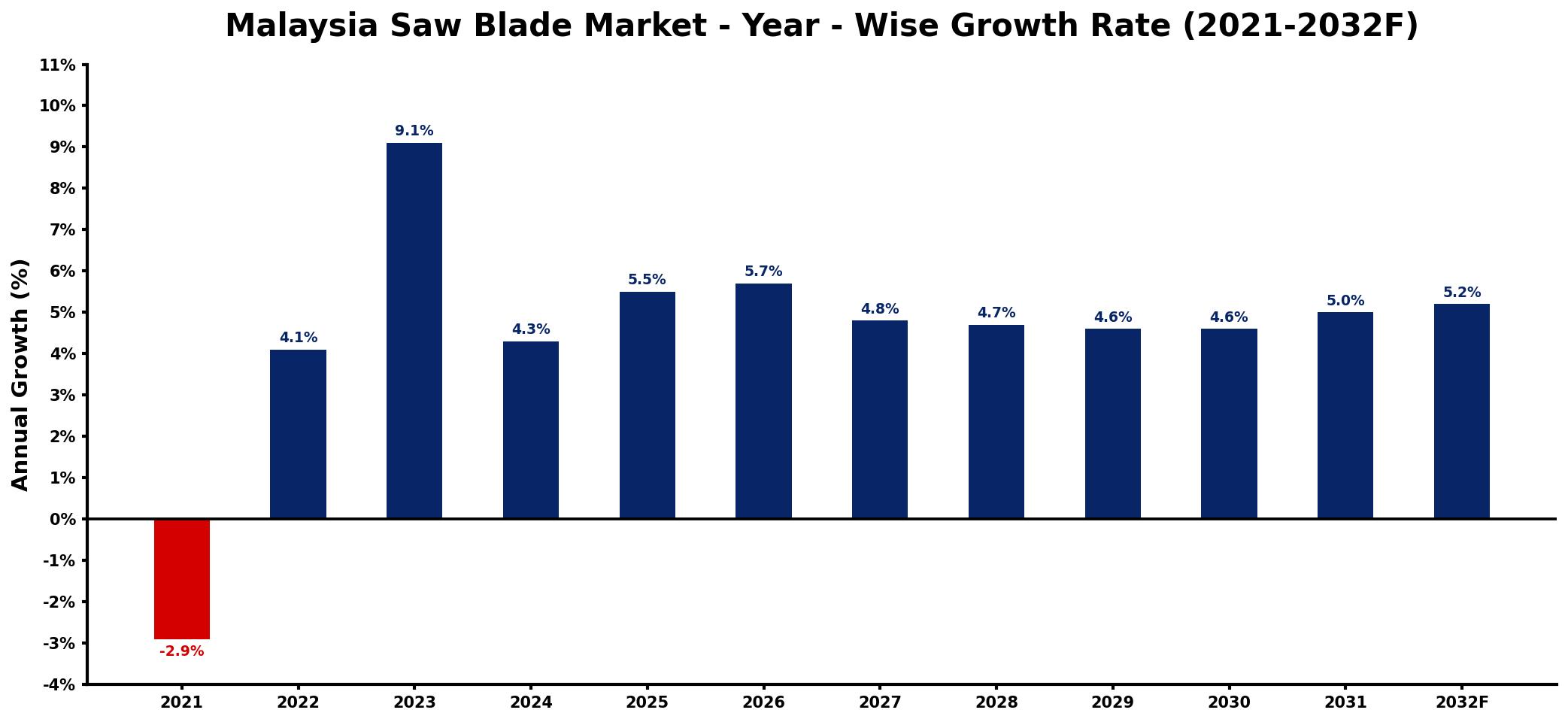
The table below presents the year‑wise growth rates along with the key drivers influencing the market
| Year | Growth Rate | Major Drivers |
| 2021 | -2.9% | decreased construction activity levels |
| 2022 | 4.1% | resurgence in construction projects |
| 2023 | 9.1% | expansion in manufacturing sector |
| 2024 | 4.3% | growth in renewable energy investments |
| 2025 | 5.5% | increased demand from automotive industry |
| 2026 | 5.7% | rising infrastructure development plans |
| 2027 | 4.8% | enhanced export opportunities emerging |
| 2028 | 4.7% | technological advancements driving efficiency |
| 2029 | 4.6% | strong residential sector recovery |
| 2030 | 4.6% | growing interest in DIY projects |
| 2031 | 5.0% | increased government infrastructure spending |
| 2032 | 5.2% | sustainable practices gaining traction |
Note: Market size estimations and growth projections presented in this report are based on 6Wresearch's proprietary forecasting methodology, utilizing the latest available industry data, government publications, and primary research inputs.
Malaysia Saw Blade Market Synopsis
The most significant force shaping the Malaysia Saw Blade Market is the ongoing infrastructure development driven by government initiatives. This push not only supports the construction industry but also stimulates demand across various sectors such as furniture manufacturing and woodworking.
As the woodworking industry flourishes, there is an increasing need for advanced saw blade solutions that enhance productivity and precision. Manufacturers are responding by focusing on technological advancements and material improvements to meet the evolving demands of both industrial users and hobbyists.
Malaysia Saw Blade Market Key Takeaways
- Infrastructure development initiatives are significantly boosting saw blade demand across Malaysia.
- Technological innovations in blade design are enhancing durability and cutting performance.
- Both professional and DIY markets are contributing to the rising demand for high-quality saw blades.
- The competitive landscape includes a mix of established international brands and local manufacturers providing cost-effective solutions.
- Market growth is supported by the government's commitment to promoting the manufacturing sector.
Evaluation of Restraints in Malaysia Saw Blade Market
While the Malaysia Saw Blade Market is positioned for growth, certain restraints may hinder its progress. Increasing raw material costs are a significant concern, as they can impact overall production expenses. Furthermore, competitive pricing strategies from international manufacturers can create challenges for local players, potentially affecting market share. As the market evolves, these factors will need careful navigation to ensure continued growth and innovation.
Malaysia Saw Blade Market Trends
Several trends are emerging within the Malaysia Saw Blade Market. First, there is a noticeable shift towards eco-friendly and sustainable materials in blade production, reflecting broader environmental concerns. Furthermore, manufacturers are increasingly integrating advanced technologies, such as laser cutting and precision engineering, into their processes. This not only enhances product quality but also caters to a more discerning customer base seeking high-performance tools.
Malaysia Saw Blade Market Opportunities
Opportunities for growth in the Malaysia Saw Blade Market lie in expanding into niche segments, such as specialized blades for specific industries or applications. The rise in DIY home improvement projects also presents a lucrative avenue, as more consumers seek quality tools for personal use. Furthermore, local manufacturers have the potential to capitalize on the growing demand for cost-effective solutions, thereby gaining a competitive edge against international brands.
Government Initiatives in the Malaysia Saw Blade Market
The Malaysian government is actively promoting the manufacturing sector through various initiatives aimed at enhancing local production capabilities. Investments in infrastructure projects have been prioritized, with public spending directed towards improving facilities that support the woodworking and construction industries. Additionally, policies encouraging technological advancements and innovation in manufacturing processes are set to positively influence the saw blade market.
Future Insights of the Malaysia Saw Blade Market
Looking ahead to the period from 2026 to 2032, the Malaysia Saw Blade Market is expected to continue its upward trajectory, driven by ongoing investments in infrastructure and the growth of the woodworking sector. As technology evolves, manufacturers will likely introduce more sophisticated products that cater to precise cutting needs, ultimately enhancing market competition. The continued focus on quality and sustainability will further shape the landscape, guiding consumer preferences and industry standards.
Malaysia Saw Blade Market Latest Developments (2025 - 2026)
Recent developments within the Malaysia Saw Blade Market indicate a strong shift towards innovation, with manufacturers exploring new materials and designs to meet rising demand. Collaborations between local companies and international technology providers are emerging, fostering an environment of knowledge exchange and product enhancement. Additionally, there has been an uptick in trade fairs and industry events focused on showcasing cutting-edge saw blade technologies.
Malaysia Saw Blade Market - Key Attractiveness of the Report
- 10 Years of Market Numbers
- Historical Data Starting from 2022 to 2025
- Base Year: 2025
- Forecast Data until 2032
- Key Performance Indicators Impacting the Market
- Major Upcoming Developments and Projects
Key Highlights of the Report:
- Malaysia Saw Blade Market Outlook
- Market Size of Malaysia Saw Blade Market, 2025
- Forecast of Malaysia Saw Blade Market, 2032
- Historical Data and Forecast of Malaysia Saw Blade Revenues & Volume for the Period 2022-2032F
- Malaysia Saw Blade Market Trend Evolution
- Malaysia Saw Blade Market Drivers and Challenges
- Malaysia Saw Blade Price Trends
- Malaysia Saw Blade Porter's Five Forces
- Malaysia Saw Blade Industry Life Cycle
- Historical Data and Forecast of Malaysia Saw Blade Market Revenues & Volume By Product Type for the Period 2022-2032F
- Historical Data and Forecast of Malaysia Saw Blade Market Revenues & Volume By Circular Saw for the Period 2022-2032F
- Historical Data and Forecast of Malaysia Saw Blade Market Revenues & Volume By Band Saw for the Period 2022-2032F
- Historical Data and Forecast of Malaysia Saw Blade Market Revenues & Volume By Chain Saw for the Period 2022-2032F
- Historical Data and Forecast of Malaysia Saw Blade Market Revenues & Volume By Hand Saw for the Period 2022-2032F
- Historical Data and Forecast of Malaysia Saw Blade Market Revenues & Volume By Others for the Period 2022-2032F
- Historical Data and Forecast of Malaysia Saw Blade Market Revenues & Volume By Application for the Period 2022-2032F
- Historical Data and Forecast of Malaysia Saw Blade Market Revenues & Volume By Wood Cutting for the Period 2022-2032F
- Historical Data and Forecast of Malaysia Saw Blade Market Revenues & Volume By Metal Cutting for the Period 2022-2032F
- Historical Data and Forecast of Malaysia Saw Blade Market Revenues & Volume By Stone Cutting for the Period 2022-2032F
- Historical Data and Forecast of Malaysia Saw Blade Market Revenues & Volume By Others for the Period 2022-2032F
- Malaysia Saw Blade Import Export Trade Statistics
- Market Opportunity Assessment By Product Type
- Market Opportunity Assessment By Application
- Malaysia Saw Blade Top Companies Market Share
- Malaysia Saw Blade Competitive Benchmarking By Technical and Operational Parameters
- Malaysia Saw Blade Company Profiles
- Malaysia Saw Blade Key Strategic Recommendations






































