Scaffolding Market: Malaysia vs Top 5 Major Economies in 2027 (Asia)
In the Asia region, the Scaffolding market in Malaysia is projected to expand at a growing growth rate of 8.52% by 2027. The largest economy is China, followed by India, Japan, Australia and South Korea.
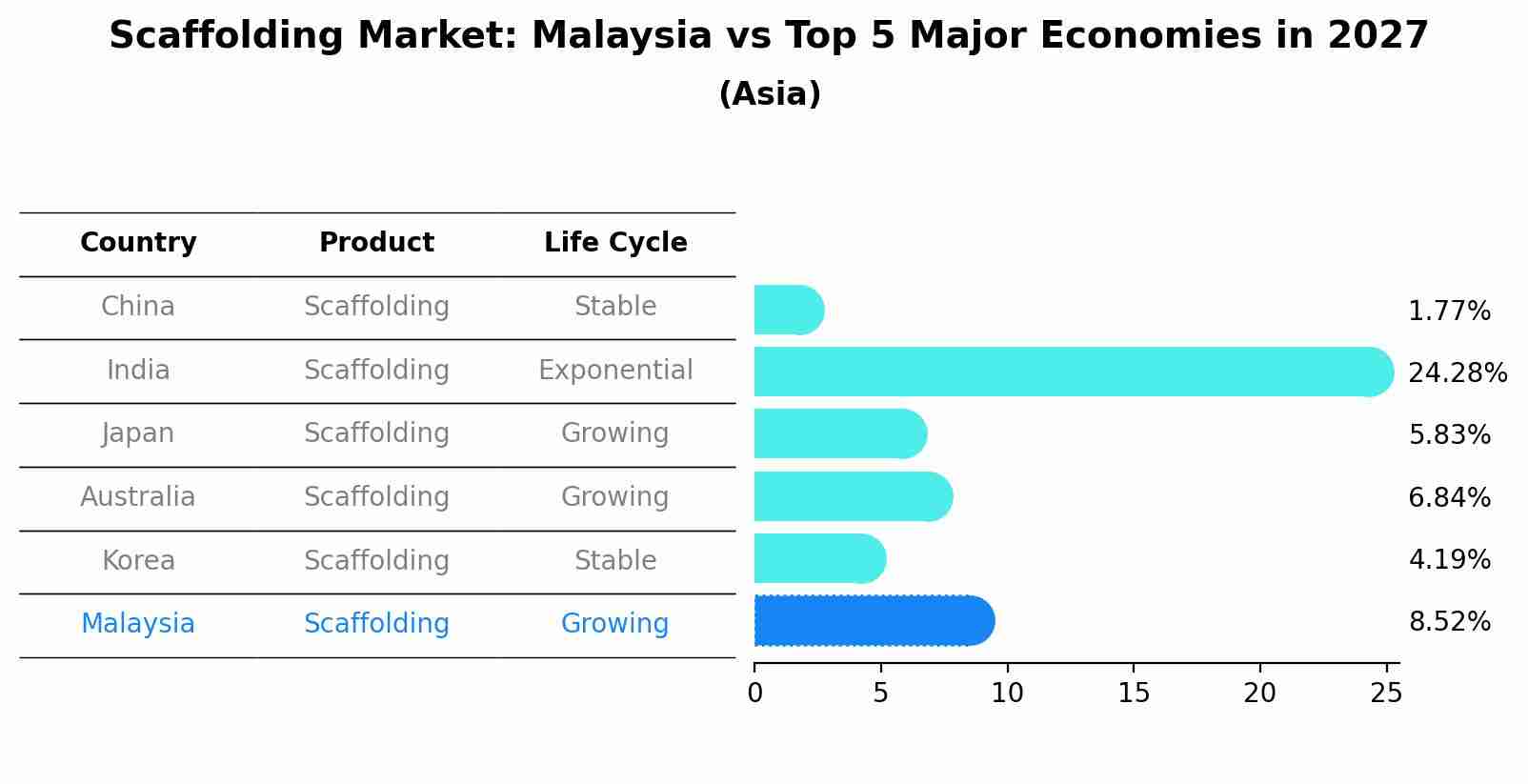
Malaysia Scaffolding Market Growth Rate
According to 6Wresearch internal database and industry insights, the Malaysia Scaffolding Market is projected to grow at a compound annual growth rate (CAGR) of 5.8% during the forecast period (2026-2032).
Topics Covered in the Malaysia Scaffolding Market Report
The Malaysia Scaffolding Market report thoroughly covers the market by product type and applications. The market report provides an unbiased and detailed analysis of ongoing market trends, opportunities/high growth areas, and market drivers, which help stakeholders devise and align their market strategies according to the current and future market dynamics.
Malaysia Scaffolding Market Highlights
| Report Name | Malaysia Scaffolding Market |
| Forecast Period | 2026-2032 |
| CAGR | 5.8% |
| Growing Sector | Commercial Construction & Infrastructure Projects |
Malaysia Scaffolding Market Synopsis
Malaysia Scaffolding Market is expected to witness steady growth driven by rising construction activities, urban development, and industrial expansion across the country. Increasing demand for safe and efficient construction practices has encouraged the adoption of advanced scaffolding systems. In addition to that, the infrastructure development projects such as roads, commercial projects, and constructions of buildings have helped increase the need for scaffolding solutions. With the availability of investments from other countries and government policies, this trend is further helping the industry grow. Furthermore, increased awareness about worker safety regulations is also propelling the scaffolding market in Malaysia.
Evaluation of Growth Drivers in the Malaysia Scaffolding Market
Below mentioned are some prominent drivers and their influence on the market dynamics:
| Drivers | Primary Segments Affected | Why it Matters (Evidence) |
| Rising Construction Activities | All Types; Residential & Commercial | Increasing building projects drive consistent demand for scaffolding systems. |
| Infrastructure Development Projects | Supported & Rolling; Industrial | Government investments in highways and rail boost scaffolding usage. |
| Growing Emphasis on Worker Safety | All Types; Commercial | Safety regulations encourage adoption of high-quality scaffolding materials. |
| Expansion of Industrial Sector | Steel Scaffolding; Industrial | Industrial facilities require durable scaffolding for maintenance and construction. |
| Adoption of Advanced Scaffolding Systems | Suspended; Commercial | Modern systems improve efficiency and reduce construction time. |
Malaysia Scaffolding Market is expected to grow at the CAGR of 5.8% during the forecast period of 2026-2032. The growth in the Malaysian scaffolding market is attributed to the fast-paced urbanization process, construction activity, and investments in infrastructural development in the country. The growing emphasis on the safety of the workers as well as compliance with international standards in the construction industry has been another important factor behind the rising demand for high-end scaffolding solutions. Besides, advancements in scaffolding technology, such as the introduction of lightweight aluminum scaffolding and modular designs, are leading to improvements in efficiency. The backing from the government for construction projects is also promoting growth.
Evaluation of Restraints in the Malaysia Scaffolding Market
Below mentioned are some major restraints and their influence on the market dynamics:
| Restraints | Primary Segments Affected | What This Means (Evidence) |
| High Initial Investment Costs | Aluminum & Steel; All Applications | Advanced scaffolding systems require significant upfront investment. |
| Scarcity of Skilled Workers | All Types; Industry | The lack of skilled workers may interfere with the process of installation and safety measures. |
| Unpredictability of Raw Material Costs | Steel; Industry | The unpredictable cost of raw materials influences manufacturing activities. |
| Safety Requirements | All Types; Business | The safety requirement makes running the business difficult. |
| Maintenance Cost of Machinery | Rolling and Hanging; Industry | Machinery maintenance becomes expensive in operations. |
Malaysia Scaffolding Industry Challenges
Despite steady growth, the Malaysia Scaffolding Industry faces several challenges that affect its overall development. Another issue related to scaffolding is that of its high costs which make it difficult for small-time contractors to afford. Moreover, there is a shortage of qualified personnel who can install and maintain these systems safely. The pricing of raw materials such as steel also varies frequently. There are also stringent regulations on scaffolding that make it complicated. Overall, all these issues pose barriers for the further development of scaffolding.
Malaysia Scaffolding Market Trends
Key evolving patterns shaping the Malaysia Scaffolding Market Growth include:
- Utilization of Light Aluminum Scaffolding: There is an increasing utilization of aluminum scaffolding due to its convenience and easy assembling, which helps to cut down labor cost.
- Utilization of Modular Scaffolding Systems: With the help of modular scaffolding systems, there is fast assembling of scaffolding. It helps to increase productivity in construction projects.
- Priority for Safe Scaffolding Systems: The companies prefer those scaffolding systems which satisfy international safety standards.
- Increased Demand for Renting Scaffolding: Small-sized contractors have an increasing requirement of rented scaffolding equipment.
Investment Opportunities in the Malaysia Scaffolding Market
Some best investment opportunities in the Malaysia Scaffolding Market include:
- Rental Scaffolding Businesses – The creation of rental companies may be suitable for smaller and mid-sized construction companies. This will lower the costs of ownership while increasing availability.
- Production of Lightweight Products – The investment in aluminum scaffolding can be utilized to respond to the increasing demand for portability. This sector has good growth prospects.
- Scaffoldings for Industrial Infrastructure Development – The involvement of investors in projects that require substantial industrial development will create a consistent source of orders.
- Innovation in Technology for Scaffolding – The use of technology in scaffoldings through developing intelligent and monitoring scaffolds can ensure safety.
Top 5 Leading Players in the Malaysia Scaffolding Market
Some leading players operating in the Malaysia Scaffolding Market include:
1. Layher Holding GmbH & Co. KG
| Company Name | Layher Holding GmbH & Co. KG |
| Established Year | 1945 |
| Headquarters | Germany |
| Official Website | Click Here |
Layher specializes in modular scaffolding systems widely used in construction and industrial projects. The company offers high-quality, durable solutions designed for safety and efficiency, making it a preferred choice in infrastructure and commercial developments across global markets.
2. PERI Group
| Company Name | PERI Group |
| Established Year | 1969 |
| Headquarters | Germany |
| Official Website | Click Here |
PERI provides advanced scaffolding and formwork systems tailored for complex construction projects. Its innovative designs and strong engineering support help improve construction efficiency and safety, making it a key player in Malaysia's growing infrastructure sector.
3. Waco International
| Company Name | Waco International |
| Established Year | 1952 |
| Headquarters | South Africa |
| Official Website | - |
Waco International offers scaffolding and formwork solutions across multiple industries. The company focuses on safety, quality, and project-specific solutions, supporting construction, industrial maintenance, and infrastructure projects with reliable and efficient scaffolding systems.
4. ULMA Construction
| Company Name | ULMA Construction |
| Established Year | 1961 |
| Headquarters | Spain |
| Official Website | Click Here |
ULMA provides comprehensive scaffolding systems known for their adaptability and safety features. The company supports large-scale infrastructure and commercial projects, offering innovative solutions that enhance productivity and ensure compliance with international safety standards.
5. KHK Scaffolding & Formwork LLC
| Company Name | KHK Scaffolding & Formwork LLC |
| Established Year | 1991 |
| Headquarters | UAE |
| Official Website | Click Here |
KHK Scaffolding delivers customized scaffolding and formwork solutions for construction and industrial sectors. Its focus on quality materials and safety compliance makes it a reliable partner for infrastructure development projects in Malaysia and other regions.
Government Regulations Introduced in the Malaysia Scaffolding Market
According to Malaysia's Government Data, several measures have been put in place to ensure safety and infrastructural development in the construction industry. The Construction Industry Development Board (CIDB), for example, has instituted rigid safety guidelines with regard to the use of scaffolding. In addition, there is the Occupational Safety and Health Act (OSHA), which ensures that safety protocols are followed in order to maintain the safety of the employees. There are initiatives like the Construction 4.0 Strategic Program that aims at enhancing the technology within the construction sector. Public infrastructure initiatives such as MRT and highway construction initiatives also contribute to market expansion.
Future Insights of the Malaysia Scaffolding Market
The Malaysia Scaffolding Market Share is expected to grow steadily due to ongoing infrastructure development, increasing urbanization, and rising adoption of advanced construction technologies. Concerns about safety among workers along with adherence to international standards will keep driving the demand for quality scaffolding equipment in the coming years. In addition to this, development of commercial and industrial constructions will provide steady growth prospects in the market. Innovations related to lightweight products and modular scaffolding will play an important role in the future industry environment. Along with this, digital technology is expected to revolutionize the industry landscape in coming years.
Market Segmentation Analysis
The report offers a comprehensive study of the subsequent market segments and their leading categories.
Supported Scaffolding to Dominate the Market – By Type
According to Mohit, Senior Research Analyst, 6Wresearch, the Supported Scaffolding segment dominates the Malaysia Scaffolding Market due to its widespread usage in construction projects. This method is more favorable due to its stability, affordability, and load-bearing capabilities. Growth in the Malaysian Scaffolding Market. More construction activities in residential and commercial buildings have led to a rise in the demand for supported scaffolding systems. Moreover, these scaffolding systems can be easily assembled and adapted to different constructions.
Steel to Dominate the Market – By Material
Steel scaffolding is considered the largest market player due to its durability, strength, and compatibility with major construction work. This type of scaffolding has gained wide popularity for the erection of commercial structures and infrastructure projects that require heavy loading capacity.
Key Attractiveness of the Report
- 10 Years of Market Numbers.
- Historical Data Starting from 2022 to 2025.
- Base Year: 2025.
- Forecast Data until 2032.
- Key Performance Indicators Impacting the Market.
- Major Upcoming Developments and Projects.
Key Highlights of the Report:
- Malaysia Scaffolding Market Outlook
- Market Size of Malaysia Scaffolding Market, 2025
- Forecast of Malaysia Scaffolding Market, 2032
- Historical Data and Forecast of Malaysia Scaffolding Revenues & Volume for the Period 2022-2032
- Malaysia Scaffolding Market Trend Evolution
- Malaysia Scaffolding Market Drivers and Challenges
- Malaysia Scaffolding Price Trends
- Malaysia Scaffolding Porter's Five Forces
- Malaysia Scaffolding Industry Life Cycle
- Historical Data and Forecast of Malaysia Scaffolding Market Revenues & Volume By Type for the Period 2022-2032
- Historical Data and Forecast of Malaysia Scaffolding Market Revenues & Volume By Supported Scaffolding for the Period 2022-2032
- Historical Data and Forecast of Malaysia Scaffolding Market Revenues & Volume By Suspended Scaffolding for the Period 2022-2032
- Historical Data and Forecast of Malaysia Scaffolding Market Revenues & Volume By Rolling Scaffolding for the Period 2022-2032
- Historical Data and Forecast of Malaysia Scaffolding Market Revenues & Volume By Material for the Period 2022-2032
- Historical Data and Forecast of Malaysia Scaffolding Market Revenues & Volume By Aluminum for the Period 2022-2032
- Historical Data and Forecast of Malaysia Scaffolding Market Revenues & Volume By Wood for the Period 2022-2032
- Historical Data and Forecast of Malaysia Scaffolding Market Revenues & Volume By Steel for the Period 2022-2032
- Historical Data and Forecast of Malaysia Scaffolding Market Revenues & Volume By End User for the Period 2022-2032
- Historical Data and Forecast of Malaysia Scaffolding Market Revenues & Volume By Residential for the Period 2022-2032
- Historical Data and Forecast of Malaysia Scaffolding Market Revenues & Volume By Commercial for the Period 2022-2032
- Historical Data and Forecast of Malaysia Scaffolding Market Revenues & Volume By Industrial for the Period 2022-2032
- Malaysia Scaffolding Import Export Trade Statistics
- Market Opportunity Assessment By Type
- Market Opportunity Assessment By Material
- Market Opportunity Assessment By End User
- Malaysia Scaffolding Top Companies Market Share
- Malaysia Scaffolding Competitive Benchmarking By Technical and Operational Parameters
- Malaysia Scaffolding Company Profiles
- Malaysia Scaffolding Key Strategic Recommendations
Market Covered
The report offers a comprehensive study of the subsequent market segments:
By Type
- Supported Scaffolding
- Suspended Scaffolding
- Rolling Scaffolding
By Material
- Aluminum
- Wood
- Steel
By End User
- Residential
- Commercial
- Industrial






































