Malaysia Semiconductors and Related Devices Market Summary
The malaysia semiconductors and related devices market was estimated at USD 510 Million in 2025 and is projected to reach USD 758 Million by 2032, growing at a CAGR of 7.6% from 2026 to 2032.
Malaysia Semiconductors and Related Devices Market Year-wise Growth Rate and Key Drivers
This graph highlights how the Malaysia Semiconductors and Related Devices Market has steadily grown over the past five years, supported by major growth factors.
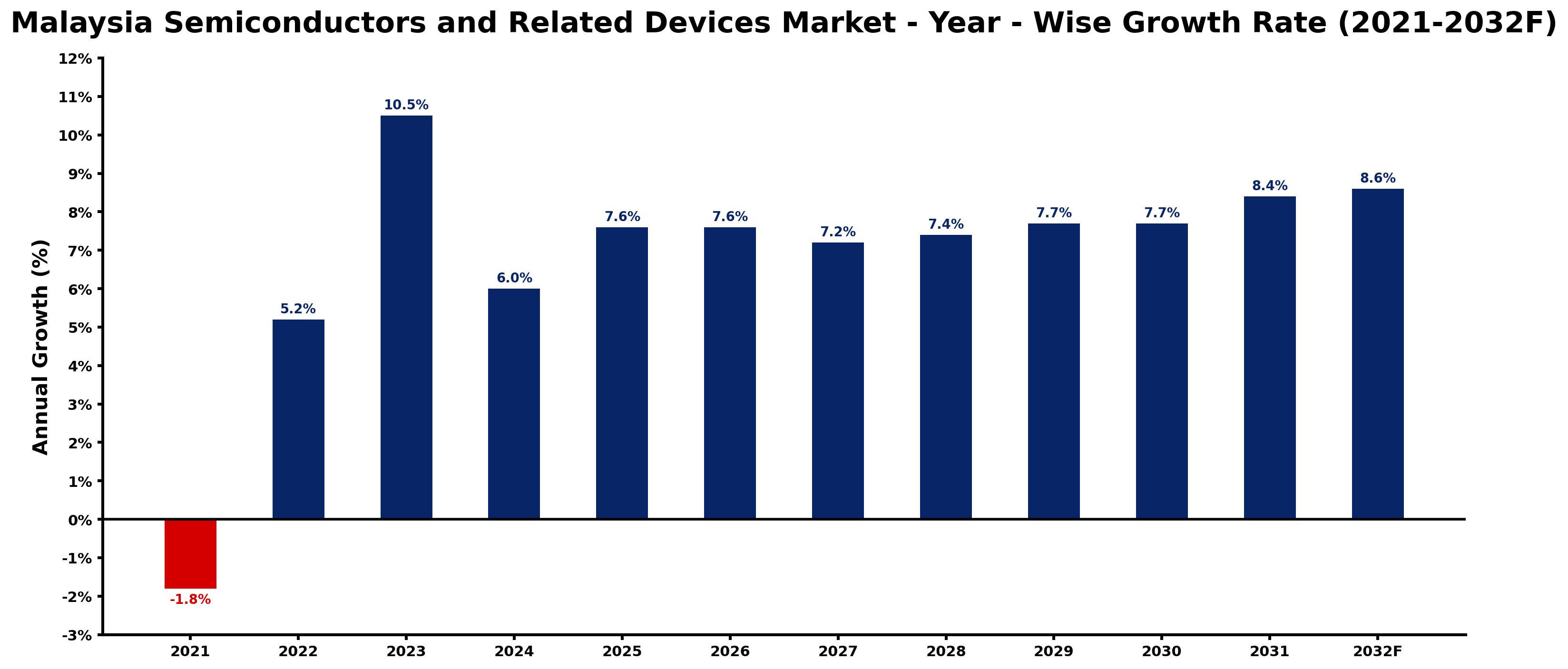
The table below presents the year wise growth rates along with the key drivers influencing the market
| Year | Growth Rate | Major Drivers |
| 2021 | -1.8% | Disruptions in global supply chains hampered production efficiency and led to delayed semiconductor deliveries to manufacturers. |
| 2022 | 5.2% | Investments in research and development strengthened Malaysia's position in advanced manufacturing technologies. |
| 2023 | 10.5% | Partnerships with global tech giants enhanced the skill set of local engineers and technologists. |
| 2024 | 6.0% | The semiconductor talent pool grew through targeted educational programs and industry collaborations. |
| 2025 | 7.6% | Emerging applications in automotive and IoT catalyzed the demand for specialized semiconductor devices. |
| 2026 | 7.6% | Local government incentives attracted foreign direct investment into semiconductor fabrication facilities. |
| 2027 | 7.2% | Increased focus on sustainable manufacturing practices created opportunities for green technologies. |
| 2028 | 7.4% | Major tech companies established regional headquarters, boosting local semiconductor ecosystems significantly. |
| 2029 | 7.7% | Innovations in materials science improved efficiency and performance of semiconductor components. |
| 2030 | 7.7% | Industry collaborations focused on AI and machine learning drove product development and market growth. |
| 2031 | 8.4% | Supply chain diversification strategies mitigated risks and improved resilience in semiconductor sourcing. |
| 2032 | 8.6% | Increased global competition prompted local firms to enhance innovation and customer responsiveness. |
Note - Market size estimations and growth projections presented in this report are based on 6Wresearch's advanced forecasting approach, validated with industry datasets as of June 2026.
Malaysia Semiconductors and Related Devices Market Synopsis
The Malaysia Semiconductors and Related Devices Market is projected to reach 7.6% and witness significant growth during the forecast period (2026-2032). Growing demand for consumer electronics, the rising adoption of Internet of Things (IoT) solutions, and increased investment in research and development are key factors propelling the growth of the Malaysia semiconductors and related devices market. The country's strategic initiatives aimed at enhancing technology infrastructure further position it as a competitive player in the global semiconductor landscape.
Malaysia Semiconductors and Related Devices Market Growth Drivers
The growth trajectory of the Malaysia semiconductors and related devices market is underpinned by several influential drivers:
- Rising Demand for Consumer Electronics: Increasing consumer affluence and the proliferation of smart devices are driving the demand for semiconductors in Malaysia. The popularity of smartphones, laptops, and smart home appliances is particularly noteworthy.
- IoT Adoption Across Industries: As various sectors, including healthcare, manufacturing, and transportation, integrate IoT solutions, the demand for semiconductors is expected to surge, creating new opportunities for innovation and technology advancement.
- Research and Development Investments: Malaysia's commitment to technological R&D fosters an environment conducive for semiconductor development, enhancing capabilities and product offerings in the market.
- Government Initiatives: Policies designed to attract investments in high-tech industries, including the Manufacturing Transformation Programme (MTP), play a vital role in bolstering the market, stimulating growth and innovation.
- Global Supply Chain Resilience: The ongoing reconfiguration of global supply chains presents opportunities for Malaysian semiconductor manufacturers to position themselves as reliable suppliers to international markets.
Malaysia Semiconductors and Related Devices Market Challenges and Restraints
While the market holds significant growth potential, it faces several challenges that could impact its trajectory:
- Counterfeit Products: The proliferation of counterfeit semiconductor products at competitive prices poses a serious threat to market growth and manufacturer reputations.
- Rapid Technological Advancements: The fast pace of technological evolution necessitates constant innovation, which can be resource-intensive, particularly for smaller players within the industry.
- Global Competition: As global demand for semiconductors increases, Malaysian manufacturers face stiff competition from established markets, making it essential to differentiate through quality and innovation.
- Talent Shortages: The demand for skilled professionals in semiconductor technology often outpaces supply, potentially stalling progress and innovation within the sector.
- Economic Dependencies: Fluctuations in the global economy, particularly in key markets, can adversely affect the demand for semiconductors, creating uncertainties for local manufacturers.
Malaysia Semiconductors and Related Devices Market Government Investment and Initiatives
The Malaysian government has implemented a variety of initiatives aimed at enhancing the semiconductor sector. The Manufacturing Transformation Programme (MTP) aims to modernize and transform Malaysia's manufacturing landscape, encouraging investments in technology-driven sectors. Furthermore, policies that promote foreign direct investments have been implemented to attract multinational corporations, fostering a more competitive market environment. Incentives such as tax exemptions for R&D expenditures and grants for technology upgrades also serve to stimulate local capabilities in semiconductor manufacturing. These initiatives are designed not only to enhance domestic production but also to integrate Malaysia more thoroughly into global supply chains.
Malaysia Semiconductors and Related Devices Market Latest Developments (May 2025 - June 2026)
Recent developments in the Malaysia semiconductors and related devices market indicate a strong commitment to innovation and growth. During this interim period, policies aimed at fostering partnership between public and private sectors have gained traction, enhancing collaborative efforts towards R&D initiatives. Additionally, emphasis has been placed on upgrading manufacturing technologies to meet global standards, ensuring that Malaysian products remain competitive. The trend towards sustainable practices in semiconductor production has also been observed, with increased focus on environmentally friendly technologies. Finally, collaborative research initiatives between academic institutions and industry players are expected to yield novel solutions and improvements in semiconductor manufacturing processes.
Malaysia Semiconductors and Related Devices Market - Key Attractiveness of the Report
- 10 Years of Market Numbers
- Historical Data Starting from 2022 to 2025
- Base Year: 2025
- Forecast Data until 2032
- Key Performance Indicators Impacting the Market
- Major Upcoming Developments and Projects
Key Highlights of the Report:
- Malaysia Semiconductors and Related Devices Market Outlook
- Market Size of Malaysia Semiconductors and Related Devices Market, 2025
- Forecast of Malaysia Semiconductors and Related Devices Market, 2032F
- Historical Data and Forecast of Malaysia Semiconductors and Related Devices Revenues & Volume for the Period 2022-2032F
- Malaysia Semiconductors and Related Devices Market Trend Evolution
- Malaysia Semiconductors and Related Devices Market Drivers and Challenges
- Malaysia Semiconductors and Related Devices Price Trends
- Malaysia Semiconductors and Related Devices Porter's Five Forces
- Malaysia Semiconductors and Related Devices Industry Life Cycle
- Historical Data and Forecast of Malaysia Semiconductors and Related Devices Market Revenues & Volume By Types for the Period 2022-2032F
- Historical Data and Forecast of Malaysia Semiconductors and Related Devices Market Revenues & Volume By Integrated Circuits for the Period 2022-2032F
- Historical Data and Forecast of Malaysia Semiconductors and Related Devices Market Revenues & Volume By Memory Chips for the Period 2022-2032F
- Historical Data and Forecast of Malaysia Semiconductors and Related Devices Market Revenues & Volume By Microprocessors for the Period 2022-2032F
- Historical Data and Forecast of Malaysia Semiconductors and Related Devices Market Revenues & Volume By Others ? for the Period 2022-2032F
- Historical Data and Forecast of Malaysia Semiconductors and Related Devices Market Revenues & Volume By End-users for the Period 2022-2032F
- Historical Data and Forecast of Malaysia Semiconductors and Related Devices Market Revenues & Volume By Information Technology for the Period 2022-2032F
- Historical Data and Forecast of Malaysia Semiconductors and Related Devices Market Revenues & Volume By Aerospace & Defense for the Period 2022-2032F
- Historical Data and Forecast of Malaysia Semiconductors and Related Devices Market Revenues & Volume By Consumer Electronics for the Period 2022-2032F
- Historical Data and Forecast of Malaysia Semiconductors and Related Devices Market Revenues & Volume By Automotive for the Period 2022-2032F
- Historical Data and Forecast of Malaysia Semiconductors and Related Devices Market Revenues & Volume By Healthcare for the Period 2022-2032F
- Historical Data and Forecast of Malaysia Semiconductors and Related Devices Market Revenues & Volume By Others for the Period 2022-2032F
- Malaysia Semiconductors and Related Devices Import Export Trade Statistics
- Market Opportunity Assessment By Types
- Market Opportunity Assessment By End-users
- Malaysia Semiconductors and Related Devices Top Companies Market Share
- Malaysia Semiconductors and Related Devices Competitive Benchmarking By Technical and Operational Parameters
- Malaysia Semiconductors and Related Devices Company Profiles
- Malaysia Semiconductors and Related Devices Key Strategic Recommendations






































