Malaysia Service Delivery Automation Market Size & Growth Rate (2026-2032)
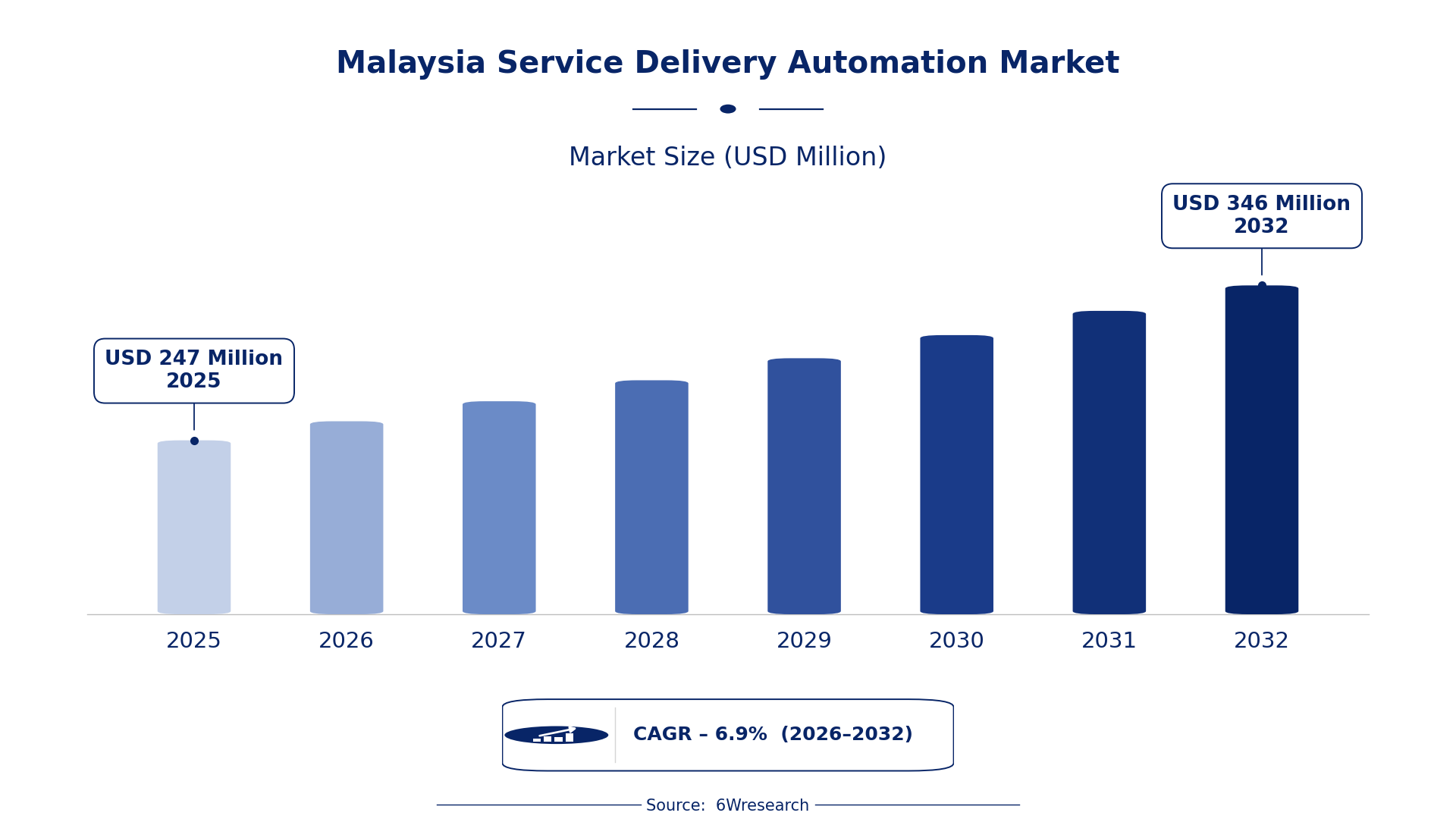
The Malaysia Service Delivery Automation Market was estimated at USD 247 Million in 2025 and is projected to reach USD 346 Million by 2032, growing at a CAGR of 6.9% from 2026 to 2032.
Malaysia Service Delivery Automation Market Synopsis
Malaysia's service delivery automation market is on a remarkable trajectory, spurred by organizations eager to enhance operational efficiency. Businesses are increasingly adopting automation technologies, including robotic process automation (RPA) and intelligent process automation (IPA), to optimize workflows across sectors such as banking, telecommunications, and healthcare.
The COVID-19 pandemic served as a catalyst, forcing many organizations to rethink their traditional service delivery models. The push for digital transformation has made automation not just beneficial but essential for maintaining competitiveness in a challenging economic environment.
Malaysia Service Delivery Automation Market Year-wise Growth Rate and Key Drivers
This graph illustrates the annual growth rates of the Malaysia Service Delivery Automation Market from 2021 to 2032, highlighting a steady upward trajectory and projected expansion over the forecast period.
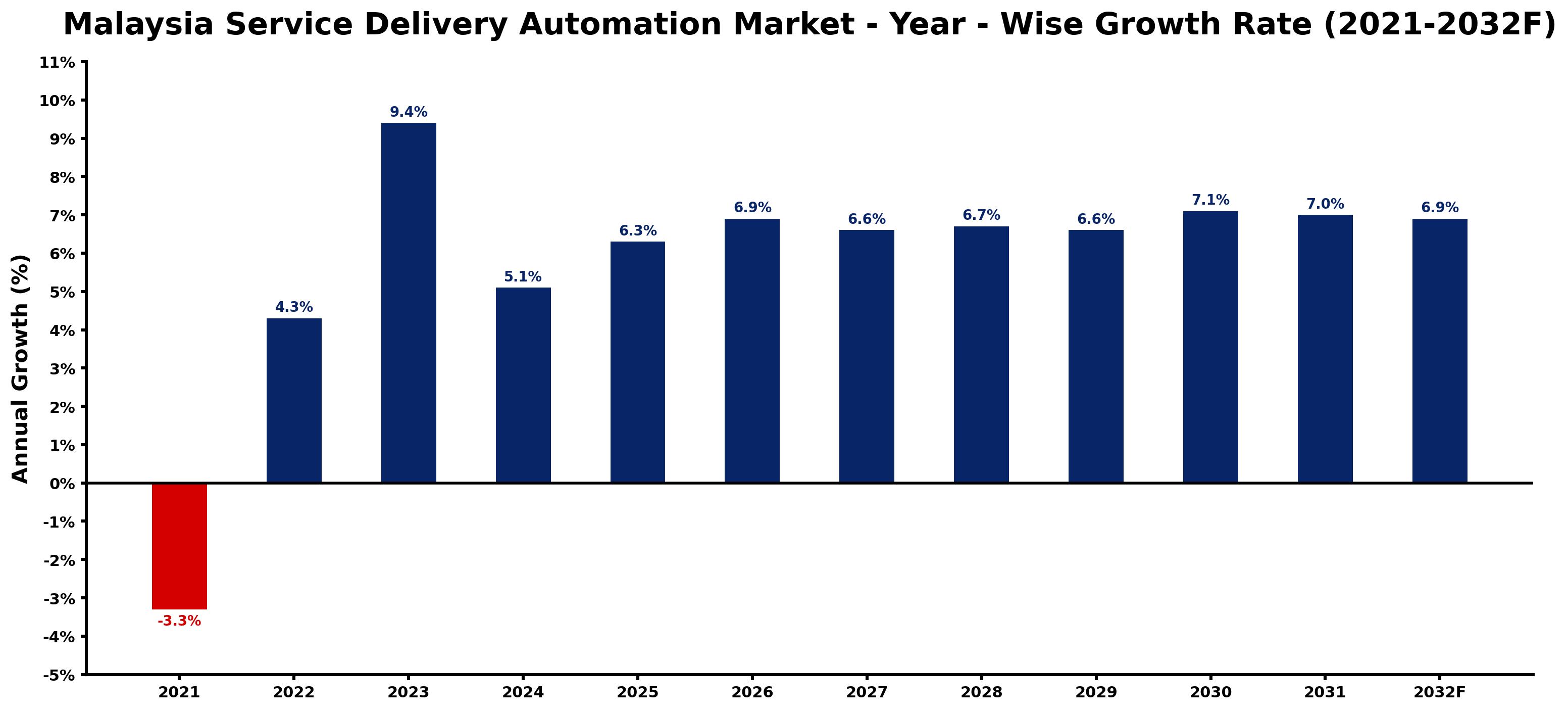
The table below presents the year‑wise growth rates along with the key drivers influencing the market
| Year | Growth Rate | Major Drivers |
| 2021 | -3.3% | Pandemic restrictions hampered automation project implementations. |
| 2022 | 4.3% | Malaysian Digital Economy Blueprint fosters automation investments. |
| 2023 | 9.4% | Growing fintech sector drives service efficiency needs. |
| 2024 | 5.1% | Governmental push for digital transformation initiatives accelerates adoption. |
| 2025 | 6.3% | Increased interest in virtual assistants enhances automation solutions. |
| 2026 | 6.9% | Surge in online shopping boosts service delivery automation. |
| 2027 | 6.6% | Labor shortages drive automation in customer service roles. |
| 2028 | 6.7% | Rising consumer expectations elevate demand for efficient services. |
| 2029 | 6.6% | Regulatory support for digital identity strengthens service automation. |
| 2030 | 7.1% | Emergence of 5G technology enhances real-time service delivery. |
| 2031 | 7.0% | Growth of e-commerce leads to higher automation levels. |
| 2032 | 6.9% | Adoption of cloud solutions accelerates operational efficiencies. |
Note: Market size estimations and growth projections presented in this report are based on 6Wresearch's proprietary forecasting methodology, utilizing the latest available industry data, government publications, and primary research inputs.
Malaysia Service Delivery Automation Market Key Takeaways
Below are some of the specific key takeaways from the market, including:
- Robotic process automation is gaining traction across various industries.
- Intelligent process automation solutions are increasingly being adopted to streamline operations.
- The market is projected to grow at a steady CAGR of 5.8% between 2026 and 2032.
- COVID-19 has accelerated the adoption of automation technologies in Malaysia.
- Key challenges include process integration and cultural resistance within organizations.
Evaluation of Restraints in Malaysia Service Delivery Automation Market
While the market is on a growth path, several restraints hinder its full potential. One of the primary barriers is the challenge of integrating automated processes into existing workflows. Organizations often face resistance from employees who fear job displacement or struggle to adapt to new technologies. These cultural hurdles can slow down the pace of automation adoption, impeding the overall market growth.
Malaysia Service Delivery Automation Market Trends
Several trends are shaping the Malaysia Service Delivery Automation market. Firstly, there is a noticeable shift towards cloud-based automation solutions, allowing for greater scalability and flexibility. Secondly, the integration of artificial intelligence with automation technologies is becoming common, enhancing the ability to process complex tasks. Lastly, the focus on customer experience is driving the demand for automation in customer support functions, where quick and accurate service delivery is paramount.
Malaysia Service Delivery Automation Market Opportunities
The opportunities within the Malaysia Service Delivery Automation market are vast. Businesses that invest in automation technologies can expect enhanced productivity and cost savings. Additionally, sectors like healthcare and banking are increasingly seeking automation solutions to improve service delivery, creating fertile ground for innovation and investment. As organizations continue to prioritize operational resilience, the demand for tailored automation solutions will likely surge.
Government Initiatives in the Malaysia Service Delivery Automation Market
Government policy in Malaysia plays a crucial role in shaping the service delivery automation market. With a focus on digital transformation, the government is implementing various initiatives that support businesses in adopting automation technologies. This regulatory environment aims to boost productivity, drive economic growth, and improve service quality across sectors.
- A national digital transformation initiative launched in 2023 focuses on upgrading the technological infrastructure for businesses.
- Currently underway is a programme encouraging public-private partnerships aimed at developing automation capabilities in the healthcare sector.
- A recently completed initiative introduced training programmes to enhance workforce skills in automation technologies.
- Upcoming regulations are expected to mandate digital compliance standards for service delivery processes by 2025.
Future Insights of the Malaysia Service Delivery Automation Market
Looking ahead, the Malaysia Service Delivery Automation market is set for substantial growth. The ongoing emphasis on digital transformation will continue to fuel demand for automation solutions. Companies that are early adopters of advanced automation technologies will likely gain a competitive edge, as operational efficiency becomes increasingly critical. By 2032, the integration of AI into automation processes is expected to redefine service delivery standards across various industries.
Malaysia Service Delivery Automation Market Latest Developments
Recent developments in the Malaysia Service Delivery Automation market highlight a dynamic shift towards automation technologies. Organizations are increasingly recognizing the importance of automation in enhancing operational resilience and customer satisfaction. As businesses adapt to a post-pandemic landscape, many are investing in innovative solutions to streamline their service delivery processes.
- A leading regional operator rolled out a new RPA solution in Q1 2025, aimed at automating back-office operations.
- A major technology vendor announced a partnership with local businesses in early 2025 to provide customized automation solutions.
- An initiative that began in late 2024 is currently underway to deploy intelligent process automation in customer support services.
- By mid-2025, a planned expansion of automation capabilities in the telecommunications sector is expected to enhance service delivery.
Malaysia Service Delivery Automation Market - Key Attractiveness of the Report
- 10 Years of Market Numbers
- Historical Data Starting from 2022 to 2025
- Base Year: 2025
- Forecast Data until 2032
- Key Performance Indicators Impacting the Market
- Major Upcoming Developments and Projects
Key Highlights of the Report:
- Malaysia Service Delivery Automation Market Outlook
- Market Size of Malaysia Service Delivery Automation Market, 2025
- Forecast of Malaysia Service Delivery Automation Market, 2032
- Historical Data and Forecast of Malaysia Service Delivery Automation Revenues & Volume for the Period 2022-2032F
- Malaysia Service Delivery Automation Market Trend Evolution
- Malaysia Service Delivery Automation Market Drivers and Challenges
- Malaysia Service Delivery Automation Price Trends
- Malaysia Service Delivery Automation Porter's Five Forces
- Malaysia Service Delivery Automation Industry Life Cycle
- Historical Data and Forecast of Malaysia Service Delivery Automation Market Revenues & Volume By Type for the Period 2022-2032F
- Historical Data and Forecast of Malaysia Service Delivery Automation Market Revenues & Volume By IT Process Automation for the Period 2022-2032F
- Historical Data and Forecast of Malaysia Service Delivery Automation Market Revenues & Volume By Business Process Automation for the Period 2022-2032F
- Historical Data and Forecast of Malaysia Service Delivery Automation Market Revenues & Volume By Vertical for the Period 2022-2032F
- Historical Data and Forecast of Malaysia Service Delivery Automation Market Revenues & Volume By BFSI for the Period 2022-2032F
- Historical Data and Forecast of Malaysia Service Delivery Automation Market Revenues & Volume By IT, Telecommunication & Media for the Period 2022-2032F
- Historical Data and Forecast of Malaysia Service Delivery Automation Market Revenues & Volume By Travel, Hospitality & Transportation for the Period 2022-2032F
- Historical Data and Forecast of Malaysia Service Delivery Automation Market Revenues & Volume By Retail & Consumer Goods for the Period 2022-2032F
- Historical Data and Forecast of Malaysia Service Delivery Automation Market Revenues & Volume By Healthcare & Pharmaceuticals for the Period 2022-2032F
- Historical Data and Forecast of Malaysia Service Delivery Automation Market Revenues & Volume By Manufacturing & Logistics for the Period 2022-2032F
- Historical Data and Forecast of Malaysia Service Delivery Automation Market Revenues & Volume By Others for the Period 2022-2032F
- Historical Data and Forecast of Malaysia Service Delivery Automation Market Revenues & Volume By Organization Size for the Period 2022-2032F
- Historical Data and Forecast of Malaysia Service Delivery Automation Market Revenues & Volume By Large Enterprises for the Period 2022-2032F
- Historical Data and Forecast of Malaysia Service Delivery Automation Market Revenues & Volume By SME??s for the Period 2022-2032F
- Malaysia Service Delivery Automation Import Export Trade Statistics
- Market Opportunity Assessment By Type
- Market Opportunity Assessment By Vertical
- Market Opportunity Assessment By Organization Size
- Malaysia Service Delivery Automation Top Companies Market Share
- Malaysia Service Delivery Automation Competitive Benchmarking By Technical and Operational Parameters
- Malaysia Service Delivery Automation Company Profiles
- Malaysia Service Delivery Automation Key Strategic Recommendations






































