Malaysia Smart Grid Security Market Size & Growth Rate (2026-2032)
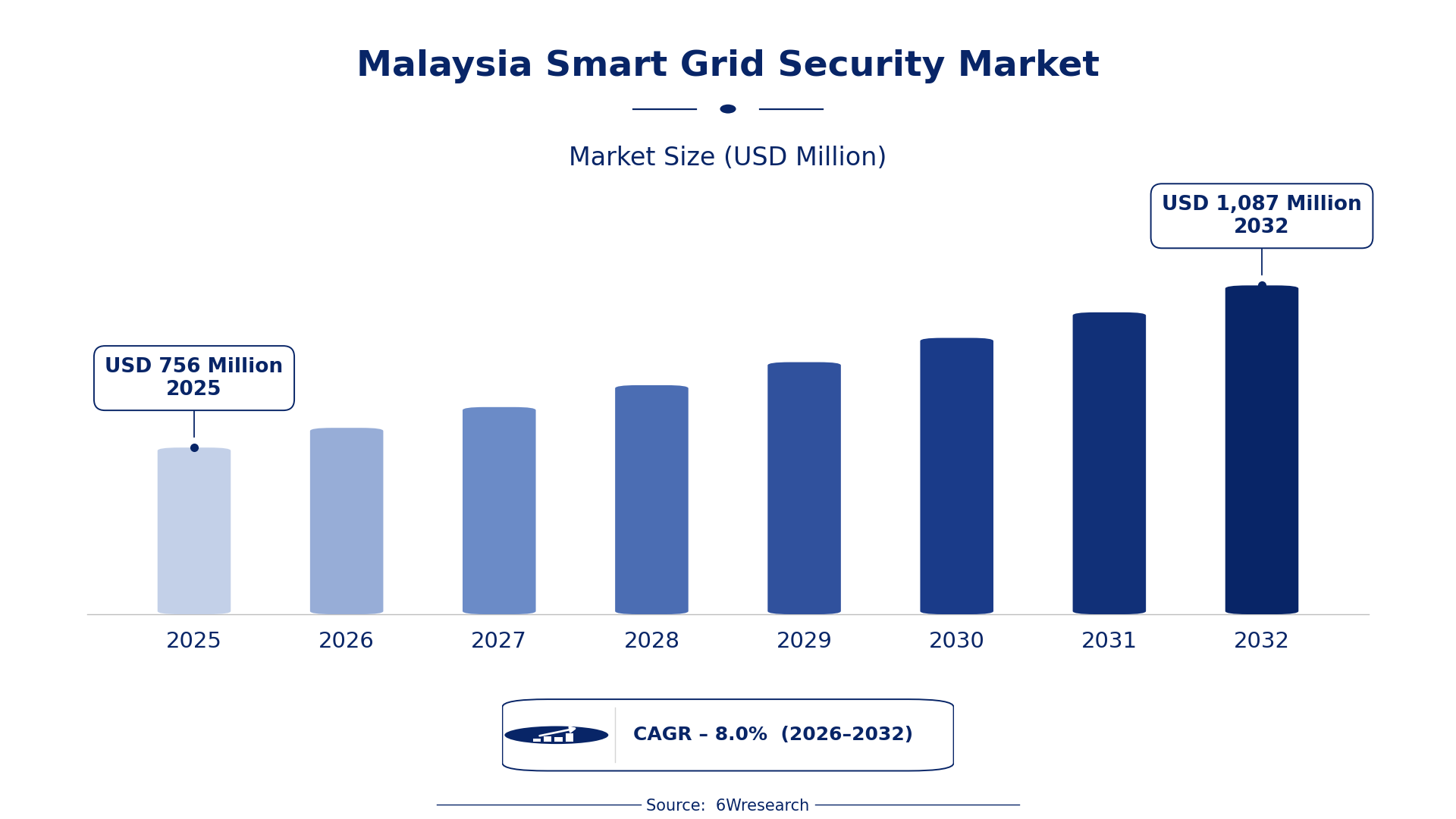
The Malaysia Smart Grid Security Market was estimated at USD 756 Million in 2025 and is projected to reach USD 1087 Million by 2032, growing at a CAGR of 8.0% from 2026 to 2032.
Malaysia Smart Grid Security Market Synopsis
The Malaysia Smart Grid Security market has experienced noteworthy expansion in recent years, fueled by increasing reliance on digital technologies within the energy sector. This momentum reflects the country's commitment to modernizing its energy infrastructure, yet it also brings new challenges, particularly in cybersecurity.
As Malaysia forges ahead with smart grid implementations, the demand for comprehensive security measures is becoming critical. The convergence of advanced technologies creates a fertile ground for cyber threats, making effective defense mechanisms non-negotiable for safeguarding energy infrastructure.
Malaysia Smart Grid Security Market Year-wise Growth Rate and Key Drivers
This graph illustrates the annual growth rates of the Malaysia Smart Grid Security Market from 2021 to 2032, highlighting a steady upward trajectory and projected expansion over the forecast period.
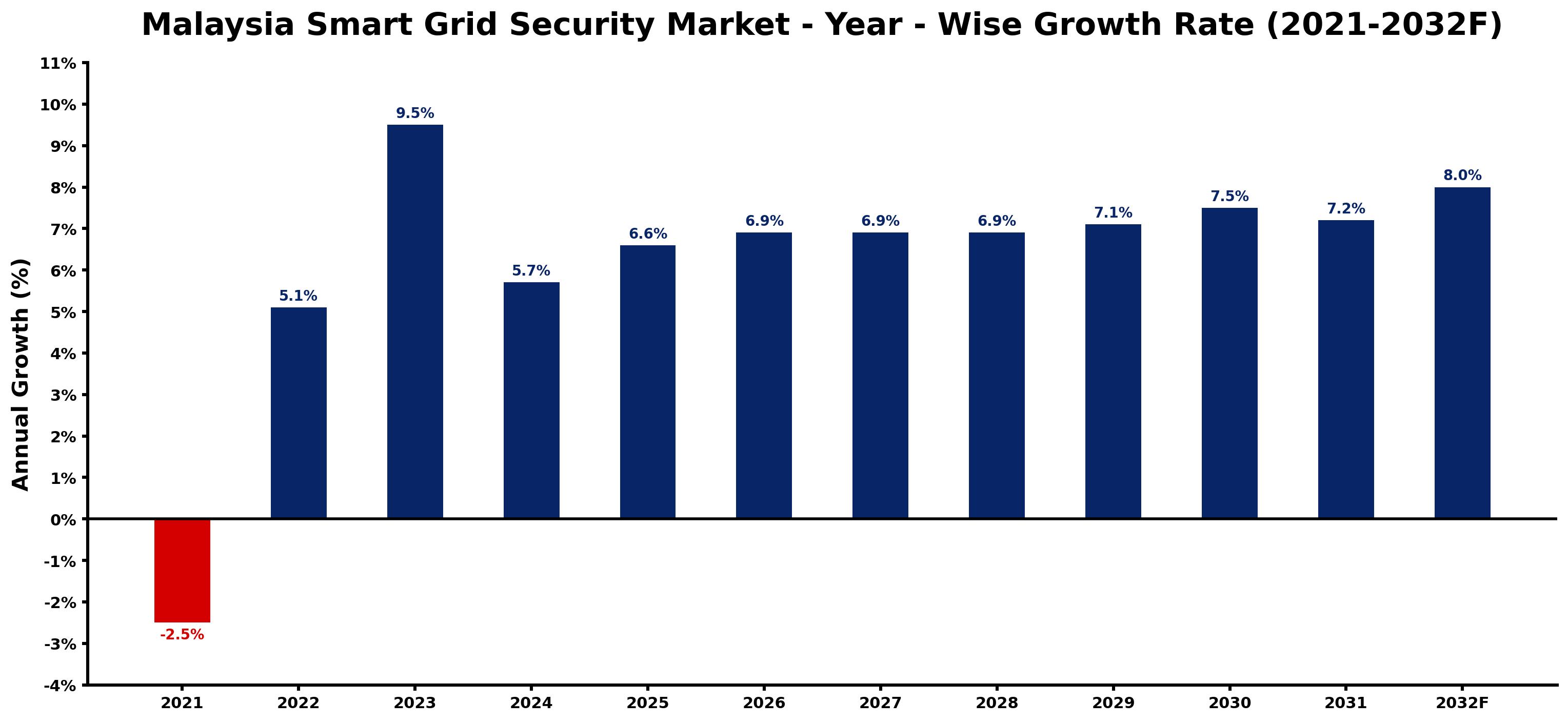
The table below presents the year‑wise growth rates along with the key drivers influencing the market
| Year | Growth Rate | Major Drivers |
| 2021 | -2.5% | Delayed regulatory approvals from Suruhanjaya Tenaga Malaysia. |
| 2022 | 5.1% | Strengthened Cybersecurity Framework by MCMC |
| 2023 | 9.5% | Increased investment in smart grid technologies statewide |
| 2024 | 5.7% | Launch of national renewable energy integration policies |
| 2025 | 6.6% | Enhanced regulatory requirements for consumer data protection |
| 2026 | 6.9% | Government incentives for smart grid infrastructure development |
| 2027 | 6.9% | Growth in electric vehicle adoption driving grid security needs |
| 2028 | 6.9% | Rising public-private partnerships for energy security solutions |
| 2029 | 7.1% | Cybersecurity skills training initiatives boosting local talent |
| 2030 | 7.5% | Implementation of Energy Transition Roadmap by ministry |
| 2031 | 7.2% | Heightened awareness of smart grid vulnerabilities post-breach |
| 2032 | 8.0% | Regional collaborations focusing on smart energy solutions |
Note: Market size estimations and growth projections presented in this report are based on 6Wresearch's proprietary forecasting methodology, utilizing the latest available industry data, government publications, and primary research inputs.
Malaysia Smart Grid Security Market Key Takeaways
Below are some of the specific key takeaways from the market, including:
- Growing concerns about cyber threats have escalated the demand for smart grid security solutions.
- Investment in energy modernization is a primary growth driver for the market.
- Complex security requirements pose challenges for existing infrastructure.
- Leading players are focusing on innovation to stay ahead of evolving threats.
- Government initiatives are actively shaping the regulatory framework for smart grid security.
Evaluation of Restraints in Malaysia Smart Grid Security Market
While the market shows promise, it faces notable limitations. One significant barrier is the complexity inherent in securing a smart grid, where myriad devices and protocols operate simultaneously. This interconnectivity can create vulnerabilities that are challenging to address comprehensively. on top of that, organizations struggle with developing adequate encryption and authentication mechanisms, essential for protecting sensitive energy data. These factors complicate the security landscape and slow down the pace of adoption.
Malaysia Smart Grid Security Market Trends
Several trends are emerging in the Malaysia Smart Grid Security market that are worth monitoring. The integration of artificial intelligence and machine learning into cybersecurity protocols is gaining traction, allowing for predictive capabilities against potential threats. There's also a growing emphasis on public-private partnerships to bolster security measures, fostering collaboration between governmental bodies and private sector players. Additionally, as the energy sector shifts toward renewable sources, there’s a corresponding shift in security strategies tailored to these technologies.
Malaysia Smart Grid Security Market Opportunities
Opportunities for growth are abundant in the Malaysia Smart Grid Security market. The increasing push for digital transformation across various sectors presents an opening for innovative security solutions. Companies that can develop tailored offerings, particularly those integrating AI-driven analytics and real-time monitoring, are likely to thrive. on top of that, with government initiatives focused on enhancing national cybersecurity frameworks, market players can expect supportive policy environments that favor investment and innovation.
Government Initiatives in the Malaysia Smart Grid Security Market
Government policy is playing a crucial role in shaping the Malaysia Smart Grid Security market. The Malaysian government has recognized the urgent need for a secure energy infrastructure, leading to a series of initiatives aimed at enhancing the cybersecurity posture of its energy systems. Regulatory frameworks are evolving to address the unique challenges posed by smart grid technologies, ensuring a proactive approach to cybersecurity.
- A national cybersecurity framework was launched in 2023, aimed at addressing the vulnerabilities associated with smart grids.
- Currently underway is an initiative to assess the cybersecurity capabilities of existing smart grid installations to identify potential weaknesses.
- A public-private partnership program is planned for 2026, aimed at fostering collaboration between the government and technology providers to enhance grid security.
- In late 2024, a series of workshops focused on cybersecurity best practices for energy operators were conducted to raise awareness across the sector.
- A new policy mandating regular security audits for smart grid technologies was introduced in 2025, enhancing accountability and compliance.
Future Insights of the Malaysia Smart Grid Security Market
Looking ahead, the Malaysia Smart Grid Security market is likely to witness robust development from 2026 to 2032. As the country continues to invest in modernizing its energy infrastructure, the urgency for effective cybersecurity solutions will only amplify. Emerging technologies, particularly in AI and data analytics, are expected to redefine security strategies, providing more adaptive and responsive frameworks for threat detection and response. This will drive not just market growth, but also an evolution in the methods used to protect critical energy assets.
Malaysia Smart Grid Security Market Latest Developments
In the past year, activity in the Malaysia Smart Grid Security market has accelerated, reflecting a heightened awareness of cybersecurity challenges. Key stakeholders are making significant strides to address vulnerabilities and improve infrastructure resilience. Initiatives aimed at fostering innovation and enhancing security measures are becoming more prominent as the country focuses on a secure energy future.
- A major technology vendor initiated a project in mid-2025 to upgrade its intrusion detection systems across multiple grid facilities, enhancing monitoring capabilities.
- A leading regional operator began integrating blockchain technology into its data transmission processes in early 2025 to bolster security and transparency.
- Ongoing partnerships between cybersecurity firms and energy providers are focusing on developing new security protocols, with results expected to be revealed by the end of 2026.
- In late 2025, a series of collaborative training programs on smart grid security best practices were launched to build workforce capability in addressing cybersecurity threats.
- A planned rollout of advanced encryption methods across energy transmission channels is set for early 2027, aimed at significantly enhancing data protection.
Malaysia Smart Grid Security Market - Key Attractiveness of the Report
- 10 Years of Market Numbers
- Historical Data Starting from 2022 to 2025
- Base Year: 2025
- Forecast Data until 2032
- Key Performance Indicators Impacting the Market
- Major Upcoming Developments and Projects
Key Highlights of the Report:
- Malaysia Smart Grid Security Market Outlook
- Market Size of Malaysia Smart Grid Security Market, 2025
- Forecast of Malaysia Smart Grid Security Market, 2032
- Historical Data and Forecast of Malaysia Smart Grid Security Revenues & Volume for the Period 2022-2032F
- Malaysia Smart Grid Security Market Trend Evolution
- Malaysia Smart Grid Security Market Drivers and Challenges
- Malaysia Smart Grid Security Price Trends
- Malaysia Smart Grid Security Porter's Five Forces
- Malaysia Smart Grid Security Industry Life Cycle
- Historical Data and Forecast of Malaysia Smart Grid Security Market Revenues & Volume By Deployment Mode for the Period 2022-2032F
- Historical Data and Forecast of Malaysia Smart Grid Security Market Revenues & Volume By Cloud for the Period 2022-2032F
- Historical Data and Forecast of Malaysia Smart Grid Security Market Revenues & Volume By On-premises for the Period 2022-2032F
- Historical Data and Forecast of Malaysia Smart Grid Security Market Revenues & Volume By Subsystem for the Period 2022-2032F
- Historical Data and Forecast of Malaysia Smart Grid Security Market Revenues & Volume By SCADA/ICS for the Period 2022-2032F
- Historical Data and Forecast of Malaysia Smart Grid Security Market Revenues & Volume By AMI for the Period 2022-2032F
- Historical Data and Forecast of Malaysia Smart Grid Security Market Revenues & Volume By Demand Response for the Period 2022-2032F
- Historical Data and Forecast of Malaysia Smart Grid Security Market Revenues & Volume By Home Energy Management for the Period 2022-2032F
- Historical Data and Forecast of Malaysia Smart Grid Security Market Revenues & Volume By Security Type for the Period 2022-2032F
- Historical Data and Forecast of Malaysia Smart Grid Security Market Revenues & Volume By Endpoint for the Period 2022-2032F
- Historical Data and Forecast of Malaysia Smart Grid Security Market Revenues & Volume By Network for the Period 2022-2032F
- Historical Data and Forecast of Malaysia Smart Grid Security Market Revenues & Volume By Application for the Period 2022-2032F
- Historical Data and Forecast of Malaysia Smart Grid Security Market Revenues & Volume By Database for the Period 2022-2032F
- Historical Data and Forecast of Malaysia Smart Grid Security Market Revenues & Volume By Service for the Period 2022-2032F
- Historical Data and Forecast of Malaysia Smart Grid Security Market Revenues & Volume By Professional services for the Period 2022-2032F
- Historical Data and Forecast of Malaysia Smart Grid Security Market Revenues & Volume By Consulting for the Period 2022-2032F
- Historical Data and Forecast of Malaysia Smart Grid Security Market Revenues & Volume By Education and training for the Period 2022-2032F
- Historical Data and Forecast of Malaysia Smart Grid Security Market Revenues & Volume By Support and maintenance for the Period 2022-2032F
- Historical Data and Forecast of Malaysia Smart Grid Security Market Revenues & Volume By Managed services for the Period 2022-2032F
- Historical Data and Forecast of Malaysia Smart Grid Security Market Revenues & Volume By Solution for the Period 2022-2032F
- Historical Data and Forecast of Malaysia Smart Grid Security Market Revenues & Volume By Antivirus and antimalware for the Period 2022-2032F
- Historical Data and Forecast of Malaysia Smart Grid Security Market Revenues & Volume By Firewall for the Period 2022-2032F
- Historical Data and Forecast of Malaysia Smart Grid Security Market Revenues & Volume By Identity and Access Management (IAM) for the Period 2022-2032F
- Historical Data and Forecast of Malaysia Smart Grid Security Market Revenues & Volume By Encryption for the Period 2022-2032F
- Historical Data and Forecast of Malaysia Smart Grid Security Market Revenues & Volume By Security and vulnerability management for the Period 2022-2032F
- Historical Data and Forecast of Malaysia Smart Grid Security Market Revenues & Volume By Intrusion Detection System/Intrusion Prevention System (IDS/IPS) for the Period 2022-2032F
- Malaysia Smart Grid Security Import Export Trade Statistics
- Market Opportunity Assessment By Deployment Mode
- Market Opportunity Assessment By Subsystem
- Market Opportunity Assessment By Security Type
- Market Opportunity Assessment By Service
- Market Opportunity Assessment By Solution
- Malaysia Smart Grid Security Top Companies Market Share
- Malaysia Smart Grid Security Competitive Benchmarking By Technical and Operational Parameters
- Malaysia Smart Grid Security Company Profiles
- Malaysia Smart Grid Security Key Strategic Recommendations






































