Malaysia Smart Toilet Market Size, Share & Growth Rate
The Malaysia Smart Toilet Market was estimated at USD 1069 Million in 2025 and is projected to reach USD 1534 Million by 2032, growing at a CAGR of 5.3% from 2026 to 2032. This growth is driven by increasing disposable incomes and a shift towards modern bathroom amenities that enhance comfort and convenience. As homeowners embrace smart home technologies, the demand for sophisticated bathroom fixtures, including smart toilets, is rapidly gaining momentum.
Malaysia Smart Toilet Market Year-wise Growth Rate and Key Drivers
This graph highlights how the Malaysia Smart Toilet Market has steadily grown over the years, supported by major growth factors.
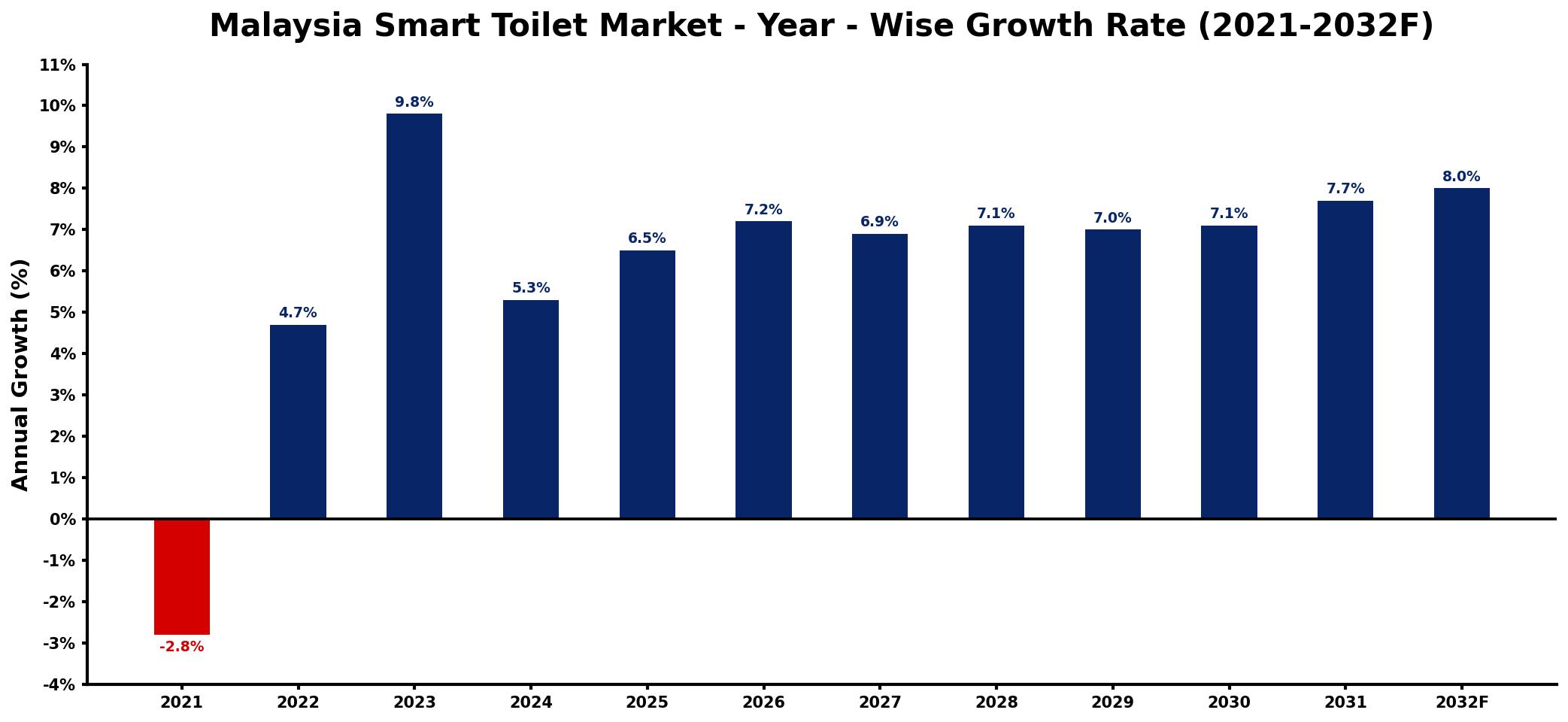
The table below presents the year‑wise growth rates along with the key drivers influencing the market
| Year | Growth Rate | Major Drivers |
| 2021 | -2.8% | decreased consumer spending on luxury |
| 2022 | 4.7% | rising demand for innovative solutions |
| 2023 | 9.8% | increased investment in technology |
| 2024 | 5.3% | growing interest in sustainable options |
| 2025 | 6.5% | expansion of urban residential projects |
| 2026 | 7.2% | higher awareness of hygiene standards |
| 2027 | 6.9% | increased adoption in hospitality sector |
| 2028 | 7.1% | rising procurement volume requirements |
| 2029 | 7.0% | increased capital investment inflows |
| 2030 | 7.1% | rising disposable income among consumers |
| 2031 | 7.7% | increased availability of financing options |
| 2032 | 8.0% | growing influence of eco-friendly solutions |
Note: Market size estimations and growth projections presented in this report are based on 6Wresearch's proprietary forecasting methodology, utilizing the latest available industry data, government publications, and primary research inputs.
Malaysia Smart Toilet Market Synopsis
The Malaysian consumer is becoming increasingly discerning, seeking advanced sanitation solutions that offer both luxury and practicality. This shift is reflected in the growing preference for smart toilets equipped with automated flushing, heated seating, and bidet functionalities, appealing to a market that values both hygiene and comfort.
The market is not just a reflection of changing consumer preferences; it is also indicative of the broader trend towards home automation. As technology continues to evolve, the integration of smart toilets into the home is seen as an essential upgrade for modern living, driven by the increasing awareness of water conservation and sustainable bathroom solutions.
Malaysia Smart Toilet Market Key Takeaways
- The market is expected to see substantial growth, supported by rising disposable incomes and a focus on modern living.
- Technological advancements, such as self-cleaning features and touchless controls, are increasingly attracting consumers.
- The COVID-19 pandemic has accelerated interest in hygienic, touchless bathroom solutions.
- Education and awareness initiatives are crucial to overcome the barriers of affordability and knowledge among consumers.
- Leading manufacturers are innovating to meet the growing demand for advanced sanitary solutions.
Evaluation of Restraints in Malaysia Smart Toilet Market
Despite the promising growth trajectory of the smart toilet market in Malaysia, several key restraints may impact its expansion. Chief among these is the perception of high costs associated with smart toilets compared to traditional models, which can deter a segment of potential consumers. Additionally, there exists a general lack of awareness about the features and benefits of smart toilets, hindering widespread adoption. This indicates a crucial need for market players to implement effective consumer education strategies and competitive pricing models to better position their offerings.
Malaysia Smart Toilet Market Trends
Several trends are reshaping the landscape of the Malaysia smart toilet market. The increasing embrace of home automation technologies has made smart toilets a sought-after feature in modern residences. As health and hygiene continue to gain emphasis post-pandemic, consumers are particularly attracted to the bidet functionalities and self-cleaning capabilities of smart toilets. Moreover, eco-conscious consumers are drawn to water-saving features, aligning with the broader sustainability movement in home appliances.
Malaysia Smart Toilet Market Opportunities
The potential for growth in the Malaysia smart toilet market is significant. Opportunities lie in increasing product offerings that incorporate the latest technologies, such as app connectivity and customizable settings for user comfort. Additionally, expanding market awareness through educational campaigns about the benefits of smart toilets can capture the interest of a wider audience. Innovative financing options and promotional strategies could further enhance market penetration, making advanced bathroom solutions more accessible.
Government Initiatives in the Malaysia Smart Toilet Market
The Malaysian government has recognized the importance of modernization in home infrastructure, promoting initiatives that encourage the adoption of smart technologies, including smart toilets. Public spending on infrastructure improvements often includes modern bathroom facilities in new housing developments. Additionally, various programs aim to support sustainability and water conservation, indirectly fostering a conducive environment for smart toilet adoption. Collaborative efforts between the government and the private sector can further bolster market growth.
Future Insights of the Malaysia Smart Toilet Market
Looking ahead to 2026-2032, the Malaysia smart toilet market is expected to witness robust growth driven by continual advancements in technology and shifting consumer preferences towards hygiene and convenience. As smart home integration becomes more prevalent, the demand for smart toilets will likely increase, supported by innovations in user interface and environmental sustainability. Furthermore, the ongoing expansion of urban areas and rising living standards will contribute to an uptick in market participation and investment opportunities.
Malaysia Smart Toilet Market Latest Developments (2025 - 2026)
In recent months, the Malaysia smart toilet market has experienced a surge in new product launches that showcase enhanced features such as voice activation and personalized user profiles. Additionally, industry collaborations have focused on promoting integrated home solutions that include smart toilets as part of broader smart home systems. Efforts to raise consumer awareness through workshops and demonstrations are also on the rise, reflecting a concerted push towards increasing market penetration in urban centers.
Malaysia Smart Toilet Market - Key Attractiveness of the Report
- 10 Years of Market Numbers
- Historical Data Starting from 2022 to 2025
- Base Year: 2025
- Forecast Data until 2032
- Key Performance Indicators Impacting the Market
- Major Upcoming Developments and Projects
Key Highlights of the Report:
- Malaysia Smart Toilet Market Outlook
- Market Size of Malaysia Smart Toilet Market, 2025
- Forecast of Malaysia Smart Toilet Market, 2032
- Historical Data and Forecast of Malaysia Smart Toilet Revenues & Volume for the Period 2022-2032F
- Malaysia Smart Toilet Market Trend Evolution
- Malaysia Smart Toilet Market Drivers and Challenges
- Malaysia Smart Toilet Price Trends
- Malaysia Smart Toilet Porter's Five Forces
- Malaysia Smart Toilet Industry Life Cycle
- Historical Data and Forecast of Malaysia Smart Toilet Market Revenues & Volume By Technology for the Period 2022-2032F
- Historical Data and Forecast of Malaysia Smart Toilet Market Revenues & Volume By Mobile Application for the Period 2022-2032F
- Historical Data and Forecast of Malaysia Smart Toilet Market Revenues & Volume By Non-Mobile Application for the Period 2022-2032F
- Historical Data and Forecast of Malaysia Smart Toilet Market Revenues & Volume By Type for the Period 2022-2032F
- Historical Data and Forecast of Malaysia Smart Toilet Market Revenues & Volume By Wall Hung Toilet for the Period 2022-2032F
- Historical Data and Forecast of Malaysia Smart Toilet Market Revenues & Volume By Close-Coupled for the Period 2022-2032F
- Historical Data and Forecast of Malaysia Smart Toilet Market Revenues & Volume By Single Floor Standing Toilet for the Period 2022-2032F
- Historical Data and Forecast of Malaysia Smart Toilet Market Revenues & Volume By One-Piece Toilet for the Period 2022-2032F
- Historical Data and Forecast of Malaysia Smart Toilet Market Revenues & Volume By Others for the Period 2022-2032F
- Historical Data and Forecast of Malaysia Smart Toilet Market Revenues & Volume By Usage for the Period 2022-2032F
- Historical Data and Forecast of Malaysia Smart Toilet Market Revenues & Volume By Residential for the Period 2022-2032F
- Historical Data and Forecast of Malaysia Smart Toilet Market Revenues & Volume By Commercial for the Period 2022-2032F
- Historical Data and Forecast of Malaysia Smart Toilet Market Revenues & Volume By Distribution Channel for the Period 2022-2032F
- Historical Data and Forecast of Malaysia Smart Toilet Market Revenues & Volume By Online Stores for the Period 2022-2032F
- Historical Data and Forecast of Malaysia Smart Toilet Market Revenues & Volume By Offline Stores for the Period 2022-2032F
- Malaysia Smart Toilet Import Export Trade Statistics
- Market Opportunity Assessment By Technology
- Market Opportunity Assessment By Type
- Market Opportunity Assessment By Usage
- Market Opportunity Assessment By Distribution Channel
- Malaysia Smart Toilet Top Companies Market Share
- Malaysia Smart Toilet Competitive Benchmarking By Technical and Operational Parameters
- Malaysia Smart Toilet Company Profiles
- Malaysia Smart Toilet Key Strategic Recommendations






































