Malaysia Sodium Aluminium Phosphate Market Size, Share & Growth Rate
The Malaysia Sodium Aluminium Phosphate Market was estimated at USD 177 Million in 2025 and is projected to reach USD 229 Million by 2032, growing at a CAGR of 3.7% from 2026 to 2032. This upward trajectory is primarily driven by the expanding applications of SALP in the food, ceramics, and construction industries, which reflect a growing consumer demand influenced by evolving lifestyles and increased disposable income. As urbanization continues to accelerate, the demand for sodium aluminium phosphate is expected to rise significantly, creating robust growth opportunities across various end-user markets.
Malaysia Sodium Aluminium Phosphate Market Year-wise Growth Rate and Key Drivers
This graph highlights how the Malaysia Sodium Aluminium Phosphate Market has steadily grown over the years, supported by major growth factors.
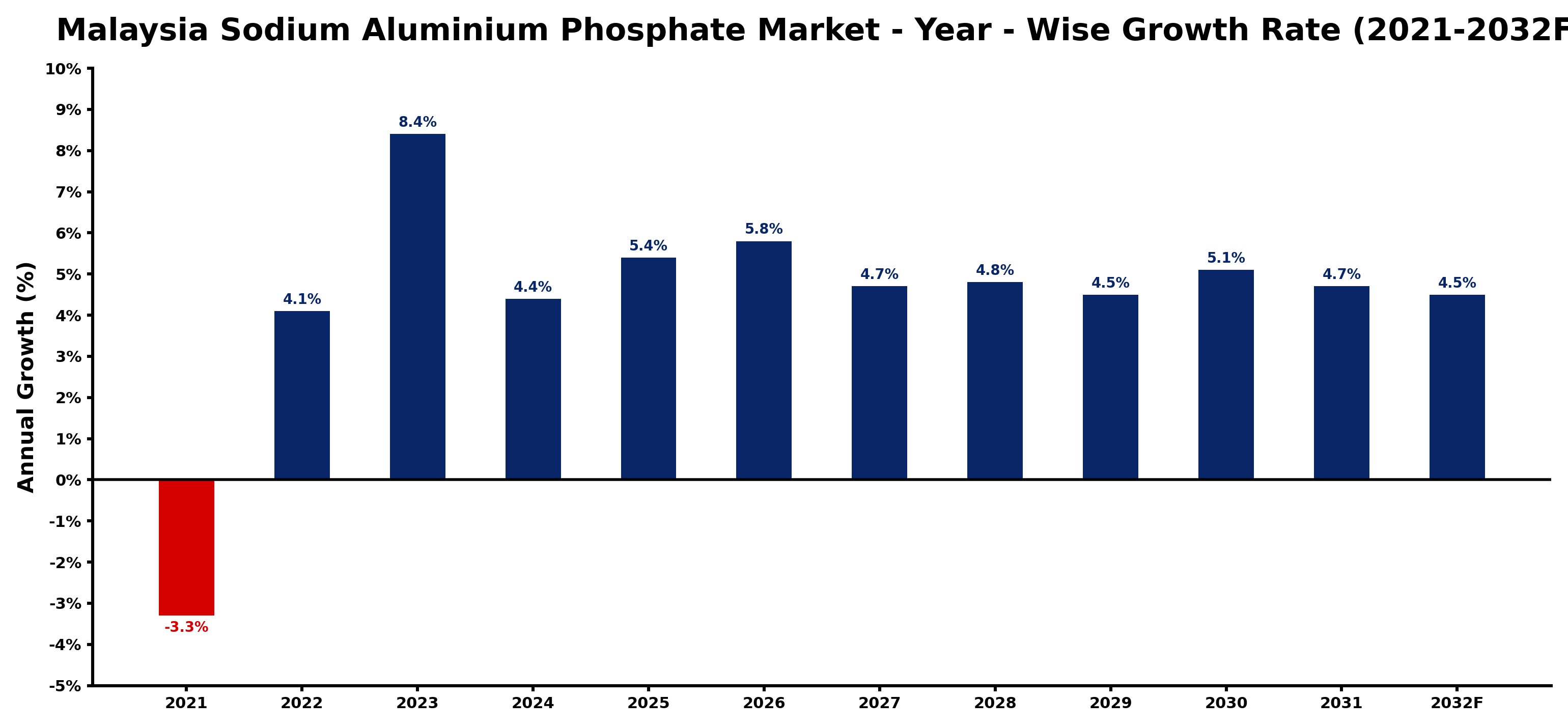
The table below presents the year‑wise growth rates along with the key drivers influencing the market
| Year | Growth Rate | Major Drivers |
| 2021 | -3.3% | Supply chain disruptions limited availability |
| 2022 | 4.1% | Foodservice expansion drove growth |
| 2023 | 8.4% | Retail expansion increased availability |
| 2024 | 4.4% | Supermarket penetration improved access |
| 2025 | 5.4% | Premium pasta adoption gained traction |
| 2026 | 5.8% | Durum wheat imports stabilized supply |
| 2027 | 4.7% | Western cuisine adoption increased |
| 2028 | 4.8% | Health food interest surged upward |
| 2029 | 4.5% | Product diversification attracted consumers |
| 2030 | 5.1% | Grocery availability enhanced distribution |
| 2031 | 4.7% | Pasta brand expansion grew significantly |
| 2032 | 4.5% | Online grocery channels boosted sales |
Note - Market size estimations and growth projections presented in this report are based on 6Wresearch’s advanced forecasting approach, validated with industry datasets as of June 2026.
Malaysia Sodium Aluminium Phosphate Market Synopsis
In Malaysia, sodium aluminium phosphate is increasingly utilized in the food sector, particularly as a leavening agent in baking applications. The compound's versatility in the construction industry as an additive in materials further enhances its market potential. This dual-functionality supports its adoption across multiple sectors, bolstered by consumer preferences for convenience and quality.
Moreover, the rise of middle-class consumers with higher purchasing power is contributing to increased SALP consumption in everyday products. As manufacturers respond to this trend with innovative product formulations, the market for sodium aluminium phosphate continues to expand, meeting the growing demand for quality and safety in production processes.
Malaysia Sodium Aluminium Phosphate Market Key Takeaways
- The market is projected to experience significant growth, reaching USD 229 Million by 2032.
- Sodium aluminium phosphate's role as a vital ingredient in food and construction materials drives its increasing applications.
- Consumer health concerns and evolving dietary trends shape the market landscape and drive innovation.
- The expansion of the middle class in Malaysia is positively influencing purchasing behaviors and market demand.
- Industry players must focus on compliance with stringent food safety regulations to capture market opportunities.
Evaluation of Restraints in Malaysia Sodium Aluminium Phosphate Market
Despite its growth potential, the Malaysia Sodium Aluminium Phosphate Market faces certain restraints that could inhibit its expansion. Among these is the increasing scrutiny regarding health and safety standards associated with food additives. As consumers become more health-conscious, manufacturers must navigate a landscape shaped by shifting dietary preferences and regulatory requirements. This necessitates ongoing innovation in product formulations and adherence to evolving safety regulations, which can pose a challenge for market participants striving to remain competitive.
Malaysia Sodium Aluminium Phosphate Market Trends
Several trends are currently influencing the Malaysia Sodium Aluminium Phosphate Market. Firstly, there is a notable shift towards clean-label products, with consumers seeking transparency in ingredient lists. Additionally, advancements in food technology are driving innovation in sodium aluminium phosphate applications, particularly in baking and food preservation. Furthermore, as sustainability becomes increasingly important, manufacturers are exploring eco-friendly production practices, aiming to minimize environmental impacts while maintaining product quality.
Malaysia Sodium Aluminium Phosphate Market Opportunities
The market presents substantial growth and investment opportunities, particularly in sectors such as food processing and construction materials. As demand for healthier food options rises, companies can capitalize on the need for sodium aluminium phosphate in natural and organic food products. Additionally, with ongoing infrastructural developments in Malaysia, the construction industry offers a lucrative avenue for growth, as SALP is an integral component in enhancing the performance of building materials.
Government Initiatives in the Malaysia Sodium Aluminium Phosphate Market
The Malaysian government has undertaken various initiatives to support the growth of the chemical sector, including sodium aluminium phosphate production. Public spending on infrastructure development and food safety enhancements creates a favorable environment for market players. Additionally, policies promoting local manufacturing and research and development investments are expected to drive innovation within the industry, further facilitating market expansion.
Future Insights of the Malaysia Sodium Aluminium Phosphate Market
Looking ahead to the period between 2026 and 2032, the Malaysia Sodium Aluminium Phosphate Market is poised for growth driven by several key factors. The ongoing expansion of the food and beverage industry, coupled with a robust construction sector, will reinforce demand. Innovations in product applications and a stronger emphasis on sustainability will likely reshape market dynamics. As consumer preferences continue to evolve, companies that prioritize health, safety, and sustainability will position themselves favorably in the market landscape.
Malaysia Sodium Aluminium Phosphate Market Latest Developments (May 2025 - June 2026)
Recent developments in the Malaysia Sodium Aluminium Phosphate Market indicate a trend toward increased collaboration among industry players to enhance product quality and safety. Companies are investing in research initiatives aimed at developing more efficient production methods and innovative applications for SALP. Moreover, regulatory bodies are expected to introduce updated guidelines aimed at improving safety standards in food additives, influencing market dynamics significantly.
Malaysia Sodium Aluminium Phosphate Market - Key Attractiveness of the Report
- 10 Years of Market Numbers
- Historical Data Starting from 2022 to 2025
- Base Year: 2025
- Forecast Data until 2032
- Key Performance Indicators Impacting the Market
- Major Upcoming Developments and Projects
Key Highlights of the Report:
- Malaysia Sodium Aluminium Phosphate Market Outlook
- Market Size of Malaysia Sodium Aluminium Phosphate Market, 2025
- Forecast of Malaysia Sodium Aluminium Phosphate Market, 2032
- Historical Data and Forecast of Malaysia Sodium Aluminium Phosphate Revenues & Volume for the Period 2022-2032F
- Malaysia Sodium Aluminium Phosphate Market Trend Evolution
- Malaysia Sodium Aluminium Phosphate Market Drivers and Challenges
- Malaysia Sodium Aluminium Phosphate Price Trends
- Malaysia Sodium Aluminium Phosphate Porter's Five Forces
- Malaysia Sodium Aluminium Phosphate Industry Life Cycle
- Historical Data and Forecast of Malaysia Sodium Aluminium Phosphate Market Revenues & Volume By Product Type for the Period 2022-2032F
- Historical Data and Forecast of Malaysia Sodium Aluminium Phosphate Market Revenues & Volume By Acidic Sodium Aluminium Phosphate for the Period 2022-2032F
- Historical Data and Forecast of Malaysia Sodium Aluminium Phosphate Market Revenues & Volume By Basic Sodium Aluminium Phosphate for the Period 2022-2032F
- Historical Data and Forecast of Malaysia Sodium Aluminium Phosphate Market Revenues & Volume By End use for the Period 2022-2032F
- Historical Data and Forecast of Malaysia Sodium Aluminium Phosphate Market Revenues & Volume By Bakery Products for the Period 2022-2032F
- Historical Data and Forecast of Malaysia Sodium Aluminium Phosphate Market Revenues & Volume By Confectionery for the Period 2022-2032F
- Historical Data and Forecast of Malaysia Sodium Aluminium Phosphate Market Revenues & Volume By Tortillas for the Period 2022-2032F
- Historical Data and Forecast of Malaysia Sodium Aluminium Phosphate Market Revenues & Volume By Donut and Cake Mixes for the Period 2022-2032F
- Historical Data and Forecast of Malaysia Sodium Aluminium Phosphate Market Revenues & Volume By Cheese for the Period 2022-2032F
- Historical Data and Forecast of Malaysia Sodium Aluminium Phosphate Market Revenues & Volume By Function for the Period 2022-2032F
- Historical Data and Forecast of Malaysia Sodium Aluminium Phosphate Market Revenues & Volume By Dough Strengtheners and Conditioners for the Period 2022-2032F
- Historical Data and Forecast of Malaysia Sodium Aluminium Phosphate Market Revenues & Volume By Leavening Agent for the Period 2022-2032F
- Historical Data and Forecast of Malaysia Sodium Aluminium Phosphate Market Revenues & Volume By pH Control Agent for the Period 2022-2032F
- Historical Data and Forecast of Malaysia Sodium Aluminium Phosphate Market Revenues & Volume By Acidulant for the Period 2022-2032F
- Malaysia Sodium Aluminium Phosphate Import Export Trade Statistics
- Market Opportunity Assessment By Product Type
- Market Opportunity Assessment By End use
- Market Opportunity Assessment By Function
- Malaysia Sodium Aluminium Phosphate Top Companies Market Share
- Malaysia Sodium Aluminium Phosphate Competitive Benchmarking By Technical and Operational Parameters
- Malaysia Sodium Aluminium Phosphate Company Profiles
- Malaysia Sodium Aluminium Phosphate Key Strategic Recommendations






































