Malaysia Sodium fluoride Market Size, Share & Growth Rate
The Malaysia Sodium fluoride Market was estimated at USD 283 Million in 2025 and is projected to reach USD 367 Million by 2032, growing at a CAGR of 3.8% from 2026 to 2032. This upward trajectory is primarily driven by an increasing demand for sodium fluoride in both dental care products and water treatment applications. Additionally, the rising awareness about oral health among the Malaysian population further supports this growth.
Malaysia Sodium fluoride Market Year-wise Growth Rate and Key Drivers
This graph highlights how the Malaysia Sodium fluoride Market has steadily grown over the years, supported by major growth factors.
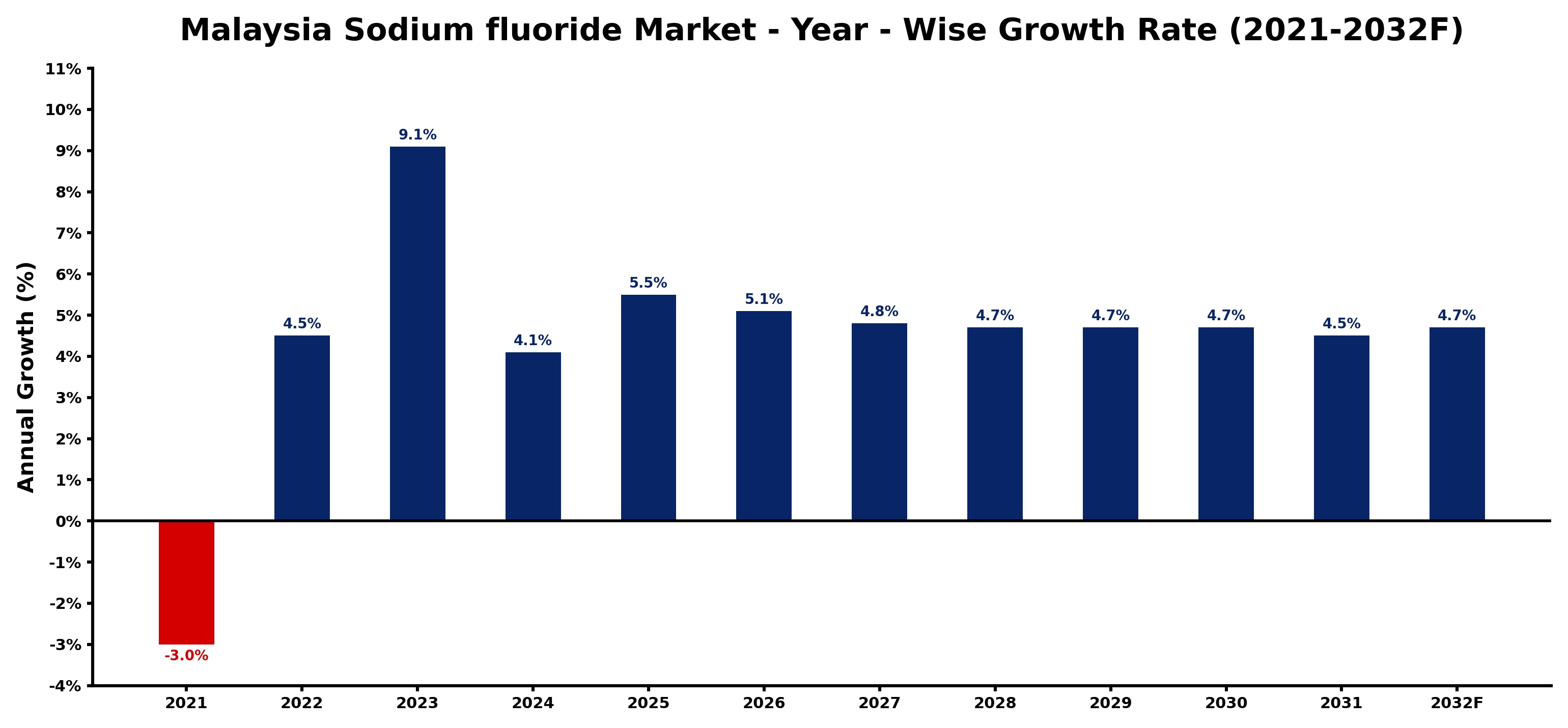
The table below presents the year‑wise growth rates along with the key drivers influencing the market
| Year | Growth Rate | Major Drivers |
| 2021 | -3.0% | Reduced automotive demand hampered sodium fluoride manufacturing output |
| 2022 | 4.5% | Manufacturing investments boost sodium fluoride production for export markets |
| 2023 | 9.1% | Precision engineering investments boost sodium fluoride production efficiency |
| 2024 | 4.1% | New manufacturing facilities boost sodium fluoride production capabilities |
| 2025 | 5.5% | Manufacturing investments boosted local sodium fluoride production capacity |
| 2026 | 5.1% | Precision engineering investments boost sodium fluoride manufacturing capabilities |
| 2027 | 4.8% | Export manufacturing resurgence boosts sodium fluoride production capabilities |
| 2028 | 4.7% | Export driven automotive sector demand boosts sodium fluoride production capacity |
| 2029 | 4.7% | Domestic chemical manufacturers invest in advanced sodium fluoride production technology |
| 2030 | 4.7% | Domestic precision engineering firms maximize capacity with new technologies |
| 2031 | 4.5% | Export oriented automotive investments boosted sodium fluoride production capacity |
| 2032 | 4.7% | Domestic semiconductor manufacturing drives demand for industrial chemicals |
Note - Market size estimations and growth projections presented in this report are based on 6Wresearch’s advanced forecasting approach, validated with industry datasets as of June 2026.
Malaysia Sodium fluoride Market Synopsis
The sodium fluoride market in Malaysia is experiencing a period of steady expansion, mainly fueled by the rising focus on dental hygiene and water fluoridation initiatives. However, the market must navigate through challenges posed by growing concerns over the health implications of excessive fluoride consumption.
Looking ahead, the market appears poised for moderate growth, with various industrial applications contributing to its resilience. The future trajectory will be shaped by public perception, regulatory frameworks, and ongoing government efforts aimed at promoting safe fluoride use across diverse sectors.
Malaysia Sodium fluoride Market Key Takeaways
- The market is projected to witness a CAGR of 3.8% from 2026 to 2032.
- Increased awareness about dental health drives steady demand for sodium fluoride.
- Water treatment applications and industrial use remain significant growth areas.
- Government initiatives promote oral health awareness, boosting market potential.
- Concerns regarding excessive fluoride intake may affect consumer perceptions.
Evaluation of Restraints in Malaysia Sodium fluoride Market
Despite the robust growth prospects, the Malaysia sodium fluoride market faces significant restraints stemming from public concerns over fluoride's potential health risks. This has led to heightened scrutiny from regulatory bodies, resulting in possible restrictions on fluoride levels in products. Manufacturers must not only navigate these regulatory landscapes but also invest in consumer education and scientific research to address safety concerns effectively. Engaging with stakeholders to foster transparency could mitigate resistance and strengthen market confidence.
Malaysia Sodium fluoride Market Trends
Currently, there is a growing trend towards innovative formulations of sodium fluoride products, particularly within the dental care sector. Companies are increasingly focusing on developing fluoride-enriched toothpaste with additional health benefits. Moreover, the demand for fluoride in water treatment is aligning with sustainability efforts, as industries seek to enhance water quality. Technological advancements in delivery mechanisms are also emerging, aimed at improving fluoride efficacy while minimizing risks associated with overexposure.
Malaysia Sodium fluoride Market Opportunities
The sodium fluoride market in Malaysia presents ample opportunities for growth, especially in the dental care segment where public health initiatives are promoting fluoride use. Additionally, expanding applications in agriculture, specifically in the manufacturing of pesticides and herbicides, indicate a burgeoning market. Investing in educational campaigns highlighting the safety and efficacy of controlled fluoride use could also open avenues for market expansion and foster consumer trust.
Government Initiatives in the Malaysia Sodium fluoride Market
The Malaysian government has undertaken various initiatives to enhance public awareness regarding oral health, notably through dental health campaigns and fluoride programs. These initiatives often focus on promoting the benefits of fluoride use in preventing dental cavities and improving overall public health. There is also ongoing dialogue about establishing guidelines that ensure safe fluoride usage in both consumer products and water treatment facilities, aiming to balance public health objectives with safety considerations.
Future Insights of the Malaysia Sodium fluoride Market
The period from 2026 to 2032 is expected to see the Malaysia sodium fluoride market evolving amidst shifting consumer preferences and regulatory landscapes. As the public becomes more informed about dental health, the demand for fluoride-based products is likely to increase. Additionally, enhanced focus on environmental considerations may lead industries to invest in innovative practices that utilize sodium fluoride more responsibly. The overall outlook remains positive, contingent upon effective communication and education regarding fluoride's benefits and risks.
Malaysia Sodium fluoride Market Latest Developments (May 2025 - June 2026)
Recent developments in the Malaysia sodium fluoride market indicate a shift toward integrating more sustainable practices. Several initiatives are being launched to enhance the safety of fluoride use in dental care and industrial applications. Additionally, ongoing collaborations between public health organizations and dental associations are fostering a more informed consumer base, which is essential for mitigating concerns surrounding fluoride exposure.
Malaysia Sodium fluoride Market - Key Attractiveness of the Report
- 10 Years of Market Numbers
- Historical Data Starting from 2022 to 2025
- Base Year: 2025
- Forecast Data until 2032
- Key Performance Indicators Impacting the Market
- Major Upcoming Developments and Projects
Key Highlights of the Report:
- Malaysia Sodium fluoride Market Outlook
- Market Size of Malaysia Sodium fluoride Market, 2025
- Forecast of Malaysia Sodium fluoride Market, 2032
- Historical Data and Forecast of Malaysia Sodium fluoride Revenues & Volume for the Period 2022-2032F
- Malaysia Sodium fluoride Market Trend Evolution
- Malaysia Sodium fluoride Market Drivers and Challenges
- Malaysia Sodium fluoride Price Trends
- Malaysia Sodium fluoride Porter's Five Forces
- Malaysia Sodium fluoride Industry Life Cycle
- Historical Data and Forecast of Malaysia Sodium fluoride Market Revenues & Volume By Grade for the Period 2022-2032F
- Historical Data and Forecast of Malaysia Sodium fluoride Market Revenues & Volume By Food Grade for the Period 2022-2032F
- Historical Data and Forecast of Malaysia Sodium fluoride Market Revenues & Volume By Pharmaceutical Grade for the Period 2022-2032F
- Historical Data and Forecast of Malaysia Sodium fluoride Market Revenues & Volume By Industrial Grade for the Period 2022-2032F
- Historical Data and Forecast of Malaysia Sodium fluoride Market Revenues & Volume By Applications for the Period 2022-2032F
- Historical Data and Forecast of Malaysia Sodium fluoride Market Revenues & Volume By Dental Products for the Period 2022-2032F
- Historical Data and Forecast of Malaysia Sodium fluoride Market Revenues & Volume By Water Treatment for the Period 2022-2032F
- Historical Data and Forecast of Malaysia Sodium fluoride Market Revenues & Volume By Insecticides & Pesticides for the Period 2022-2032F
- Historical Data and Forecast of Malaysia Sodium fluoride Market Revenues & Volume By Pharmaceuticals for the Period 2022-2032F
- Historical Data and Forecast of Malaysia Sodium fluoride Market Revenues & Volume By Others for the Period 2022-2032F
- Malaysia Sodium fluoride Import Export Trade Statistics
- Market Opportunity Assessment By Grade
- Market Opportunity Assessment By Applications
- Malaysia Sodium fluoride Top Companies Market Share
- Malaysia Sodium fluoride Competitive Benchmarking By Technical and Operational Parameters
- Malaysia Sodium fluoride Company Profiles
- Malaysia Sodium fluoride Key Strategic Recommendations






































