Malaysia Sodium Hydride Market Size, Share & Growth Rate
The Malaysia Sodium Hydride Market was estimated at USD 473 Million in 2025 and is projected to reach USD 621 Million by 2032, growing at a CAGR of 4.0% from 2026 to 2032. This growth trajectory is supported by a robust demand for sodium hydride within the burgeoning pharmaceutical and chemical industries, where it is recognized as an essential reducing agent and catalyst. Additionally, ongoing research and development efforts aimed at enhancing catalytic processes are expected to further bolster market expansion during this period.
Malaysia Sodium Hydride Market Year-wise Growth Rate and Key Drivers
This graph highlights how the Malaysia Sodium Hydride Market has steadily grown over the years, supported by major growth factors.
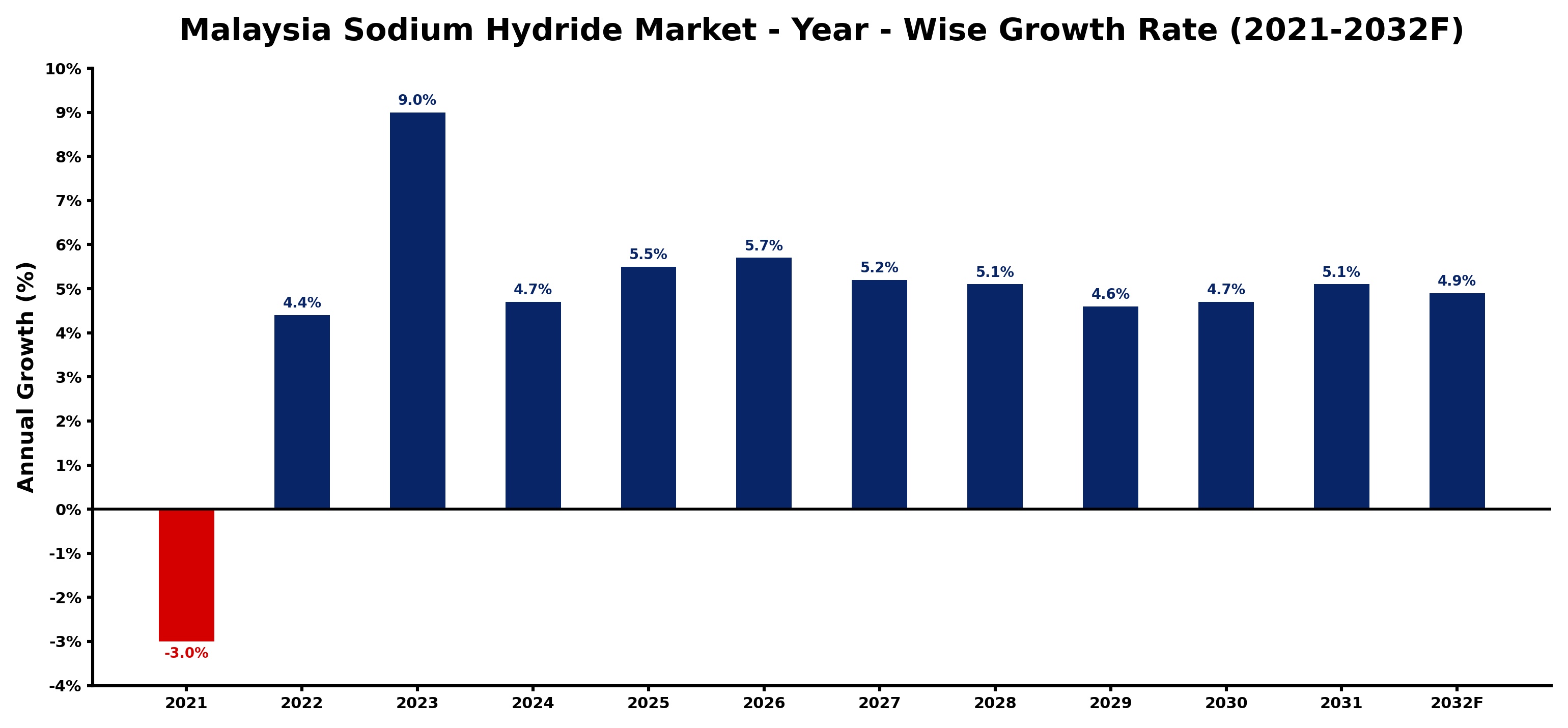
The table below presents the year‑wise growth rates along with the key drivers influencing the market
| Year | Growth Rate | Major Drivers |
| 2021 | -3.0% | Supply chain disruptions affected production |
| 2022 | 4.4% | Chemical manufacturing demand increased significantly |
| 2023 | 9.0% | Industrial applications expanded rapidly |
| 2024 | 4.7% | Research initiatives enhanced product development |
| 2025 | 5.5% | Export opportunities opened new markets |
| 2026 | 5.7% | Technological advancements improved efficiency |
| 2027 | 5.2% | Sustainability trends drove innovation |
| 2028 | 5.1% | Regulatory support encouraged investments |
| 2029 | 4.6% | Partnerships enhanced market reach |
| 2030 | 4.7% | Consumer preferences shifted positively |
| 2031 | 5.1% | Market diversification strategies flourished |
| 2032 | 4.9% | Investment in R&D accelerated growth |
Note - Market size estimations and growth projections presented in this report are based on 6Wresearch’s advanced forecasting approach, validated with industry datasets as of June 2026.
Malaysia Sodium Hydride Market Synopsis
The sodium hydride market in Malaysia is currently at an inflection point, fueled by the increasing utilization of organic synthesis within various industrial applications. As a strong reducing agent, sodium hydride plays a critical role in producing pharmaceutical intermediates, thereby underpinning its significance in the region's economic landscape.
Furthermore, the market is witnessing a noticeable uptick in research activities focused on catalysts, which is driving innovations and product development. As local companies strive to meet international quality standards, this sector is poised for considerable growth, attracting both investment and attention from key stakeholders.
Malaysia Sodium Hydride Market Key Takeaways
- Growing demand from the pharmaceutical sector is a primary driver of sodium hydride consumption.
- The market is benefiting from a heightened focus on research and development in chemical synthesis.
- Regulatory compliance and safety standards present ongoing challenges for market participants.
- Local manufacturers are increasingly emphasizing quality and efficiency to maintain competitive advantage.
- The gradual recovery from the pandemic is expected to stabilize market dynamics and demand levels.
Evaluation of Restraints in Malaysia Sodium Hydride Market
While the sodium hydride market shows promising growth potential, it faces significant restraints primarily stemming from safety concerns and stringent regulatory frameworks. The handling and storage of sodium hydride are associated with various risks, necessitating compliance with robust safety measures. Additionally, the evolving landscape of chemical synthesis methods may challenge traditional demand patterns, urging stakeholders to innovate and adapt their approaches to maintain relevance in a changing marketplace.
Malaysia Sodium Hydride Market Trends
Several trends are currently shaping the Malaysia sodium hydride market, including an increasing integration of sustainable practices in chemical processes. As industries pivot towards greener methodologies, there is growing interest in alternative synthesis routes that may offer enhanced safety and efficiency. Moreover, advances in catalytic technology are opening up new applications for sodium hydride, further expanding its market reach beyond traditional sectors.
Malaysia Sodium Hydride Market Opportunities
The market presents genuine growth opportunities, particularly within the pharmaceutical and agrochemical sectors, where sodium hydride is instrumental. Investments aimed at improving production processes and safety measures can yield significant returns as demand for quality pharmaceuticals rises. Additionally, collaborations between industry players and research institutions can foster innovation, driving new applications and expanding market opportunities.
Government Initiatives in the Malaysia Sodium Hydride Market
The Malaysian government has been proactive in promoting the development of the chemical industry through various initiatives and policy frameworks. Public spending on research and development is aimed at fostering innovation and supporting local manufacturers in enhancing their capabilities. Such governmental support, coupled with incentives for environmentally friendly practices, is expected to create a conducive environment for the growth of the sodium hydride market.
Future Insights of the Malaysia Sodium Hydride Market
Looking ahead to the period from 2026 to 2032, the Malaysia sodium hydride market is poised for steady growth, driven by increasing industrial activities and a continued focus on R&D. The pharmaceutical sector's expansion will play a pivotal role in shaping demand, alongside ongoing efforts to improve production efficiency and safety. Embracing technological advancements and sustainable practices will be crucial for market participants seeking to capitalize on emerging opportunities.
Malaysia Sodium Hydride Market Latest Developments (May 2025 - June 2026)
Recent developments in the Malaysian sodium hydride market indicate a renewed focus on innovation and safety protocols. Companies are increasingly investing in R&D to explore alternative synthesis routes that enhance efficiency and mitigate safety risks. Additionally, industry stakeholders are collaborating with regulatory bodies to ensure compliance with evolving standards, facilitating a more streamlined operational framework for market players.
Malaysia Sodium Hydride Market - Key Attractiveness of the Report
- 10 Years of Market Numbers
- Historical Data Starting from 2022 to 2025
- Base Year: 2025
- Forecast Data until 2032
- Key Performance Indicators Impacting the Market
- Major Upcoming Developments and Projects
Key Highlights of the Report:
- Malaysia Sodium Hydride Market Outlook
- Market Size of Malaysia Sodium Hydride Market, 2025
- Forecast of Malaysia Sodium Hydride Market, 2032
- Historical Data and Forecast of Malaysia Sodium Hydride Revenues & Volume for the Period 2022-2032F
- Malaysia Sodium Hydride Market Trend Evolution
- Malaysia Sodium Hydride Market Drivers and Challenges
- Malaysia Sodium Hydride Price Trends
- Malaysia Sodium Hydride Porter's Five Forces
- Malaysia Sodium Hydride Industry Life Cycle
- Historical Data and Forecast of Malaysia Sodium Hydride Market Revenues & Volume By Product Range for the Period 2022-2032F
- Historical Data and Forecast of Malaysia Sodium Hydride Market Revenues & Volume By Sodium Hydride 60% for the Period 2022-2032F
- Historical Data and Forecast of Malaysia Sodium Hydride Market Revenues & Volume By Sodium Hydride 55% for the Period 2022-2032F
- Historical Data and Forecast of Malaysia Sodium Hydride Market Revenues & Volume By Sodium Hydride 45% for the Period 2022-2032F
- Historical Data and Forecast of Malaysia Sodium Hydride Market Revenues & Volume By Other for the Period 2022-2032F
- Historical Data and Forecast of Malaysia Sodium Hydride Market Revenues & Volume By Application for the Period 2022-2032F
- Historical Data and Forecast of Malaysia Sodium Hydride Market Revenues & Volume By Chemical Industry for the Period 2022-2032F
- Historical Data and Forecast of Malaysia Sodium Hydride Market Revenues & Volume By Pharmaceutical Industry for the Period 2022-2032F
- Historical Data and Forecast of Malaysia Sodium Hydride Market Revenues & Volume By Pesticide Industry for the Period 2022-2032F
- Malaysia Sodium Hydride Import Export Trade Statistics
- Market Opportunity Assessment By Product Range
- Market Opportunity Assessment By Application
- Malaysia Sodium Hydride Top Companies Market Share
- Malaysia Sodium Hydride Competitive Benchmarking By Technical and Operational Parameters
- Malaysia Sodium Hydride Company Profiles
- Malaysia Sodium Hydride Key Strategic Recommendations






































