Malaysia Split Air conditioners Market Summary
The malaysia split air conditioners market was estimated at USD 544 Million in 2025 and is projected to reach USD 817 Million by 2032, growing at a CAGR of 7.7% from 2026 to 2032.
Malaysia Split Air conditioners Market Year-wise Growth Rate and Key Drivers
This graph highlights how the Malaysia Split Air conditioners Market has steadily grown over the past five years, supported by major growth factors.
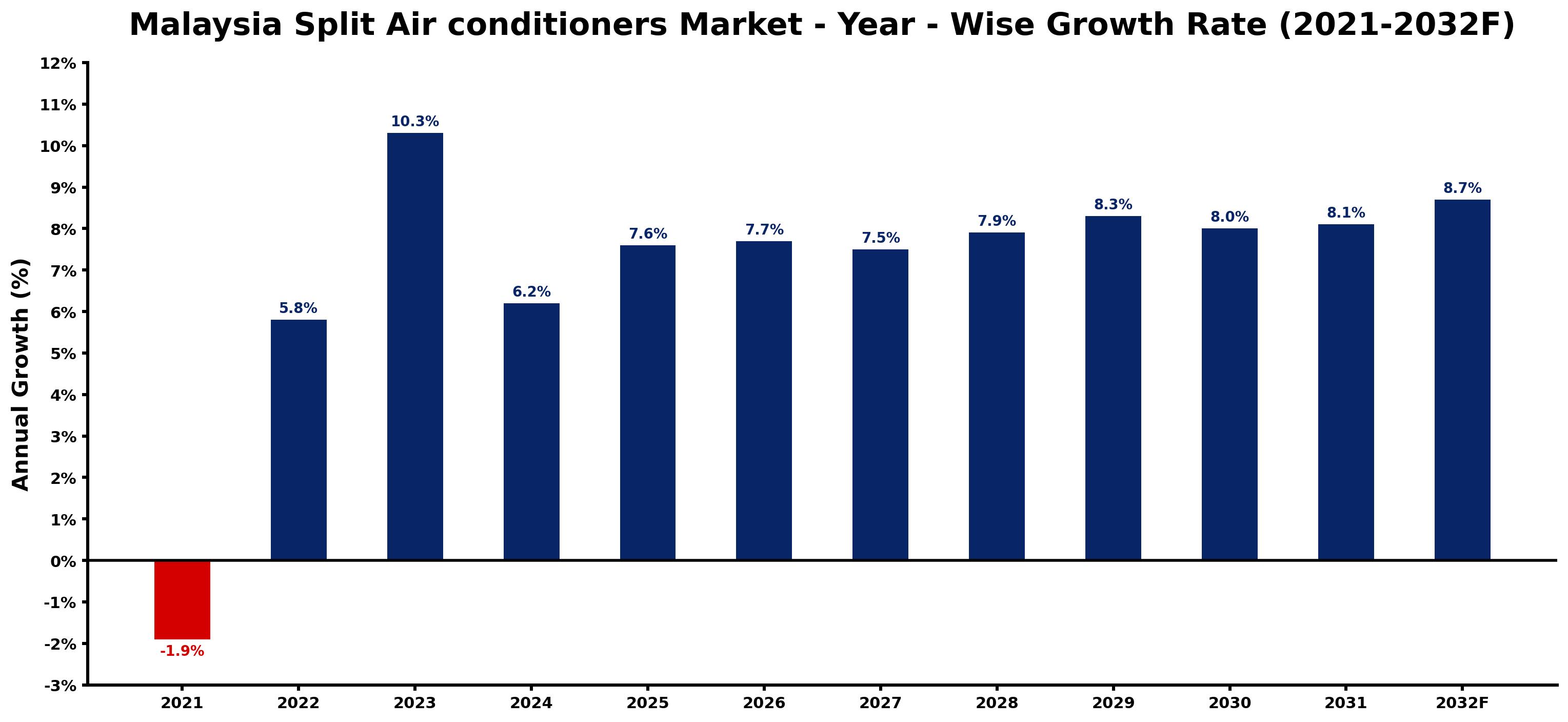
The table below presents the year wise growth rates along with the key drivers influencing the market
| Year | Growth Rate | Major Drivers |
| 2021 | -1.9% | A surplus of inventory led to aggressive discounting, diminishing overall market revenue for split air conditioners. |
| 2022 | 5.8% | Post-pandemic recovery spurs residential and commercial spending on HVAC systems. |
| 2023 | 10.3% | Adoption of energy-efficient split air conditioners creates a competitive market edge. |
| 2024 | 6.2% | Construction activity rebounds, boosting demand for cooling solutions in urban areas. |
| 2025 | 7.6% | Consumer preferences shift towards smart home technology, integrating air conditioning systems. |
| 2026 | 7.7% | Rising temperatures prompt discussions on climate resilience and energy-efficient cooling. |
| 2027 | 7.5% | Increased disposable incomes allow households to invest in premium air conditioning brands. |
| 2028 | 7.9% | Technological innovations in cooling systems enhance energy efficiency and reduce costs. |
| 2029 | 8.3% | Natural disasters underscore the importance of reliable cooling systems in homes. |
| 2030 | 8.0% | Government incentives for sustainable energy lead to higher split AC installations. |
| 2031 | 8.1% | Growing awareness of indoor air quality drives demand for advanced filtration systems. |
| 2032 | 8.7% | Emerging trends in health and wellness elevate the significance of comfortable living environments. |
Note - Market size estimations and growth projections presented in this report are based on 6Wresearch's advanced forecasting approach, validated with industry datasets as of June 2026.
Malaysia Split Air conditioners Market Synopsis
The Malaysia Split Air conditioners Market is projected to reach 7.7% and witness significant growth during the forecast period (2026-2032). This growth is driven by several factors, including an increasing demand for energy-efficient cooling solutions amidst rising temperatures and fluctuating climatic conditions. The landscape of the Malaysia Split Air conditioners market is evolving rapidly, buoyed by rising disposable incomes and a growing awareness among consumers regarding the health benefits associated with maintaining optimal indoor air quality.
Malaysia Split Air conditioners Market Growth Drivers
Several key drivers are propelling the growth of the Malaysia Split Air conditioners market. Primarily, consumers are seeking energy-efficient options that not only reduce electricity consumption but also lower their carbon footprint. Additionally, rising disposable income has enhanced spending capacity, allowing more households to invest in air conditioning systems. The increasing urbanization in Malaysia, coupled with a burgeoning middle class, is further driving demand. Moreover, the heightened awareness of health-related issues linked to air quality is motivating consumers to opt for advanced air conditioning systems that offer better filtration and temperature control.
- Energy efficiency is a major selling point, as consumers prioritize lower utility bills and sustainable practices.
- Urbanization leads to higher housing developments, necessitating effective climate control solutions.
- The middle class's expanding economic power allows for increased investments in home comfort.
- Health concerns, particularly regarding indoor air quality, are encouraging consumers to adopt air conditioning solutions.
- Technological advancements, such as inverter technology and smart home compatibility, enhance consumer interest in new systems.
Malaysia Split Air conditioners Market Trends and Opportunities
The landscape of the Malaysia Split Air conditioners market is undergoing significant changes, characterized by various trends that indicate future opportunities. One predominant trend is the shift towards smarter, Wi-Fi-enabled air conditioning units, which allow users to control temperatures remotely, thereby enhancing convenience and energy savings. The rise of inverter technology is revolutionizing the market by significantly improving energy efficiency and lowering operational costs. Furthermore, the demand for air conditioners with advanced filtration systems is surging, as consumers increasingly value the health benefits related to cleaner air quality within their homes.
- Smart technology integration is transforming user interaction and energy management in air conditioning systems.
- Inverter technology adoption ensures lower energy consumption and quieter operation.
- Health-centric features are becoming a focal point in the product development of new air conditioning units.
- Increased competition among manufacturers is driving innovation and affordability in the market.
- A focus on eco-friendly refrigerants is gaining traction, aligning with global sustainability goals.
Malaysia Split Air conditioners Market Challenges and Restraints
While the Malaysia Split Air conditioners market presents numerous opportunities, it is also faced with noteworthy challenges. High initial costs associated with purchasing advanced systems, although offset by energy savings over time, can deter budget-conscious consumers. Additionally, the presence of cheaper, less efficient alternatives may undermine the market for high-quality, energy-efficient units. There is also an ongoing concern regarding the availability of skilled technicians for installation and maintenance, which can impact consumer confidence in adopting new technologies.
- High upfront costs can be a barrier for many consumers, especially in the middle-income segment.
- Substandard alternatives in the market may dilute consumer trust in high-quality brands.
- A shortage of skilled technicians to install and service advanced HVAC systems poses a risk to market growth.
- The fluctuating cost of raw materials can affect pricing strategies negatively.
- Seasonal demand variations may impact manufacturers' production planning and inventory management.
Malaysia Split Air conditioners Market Government Investment and Initiatives
Government initiatives play a crucial role in shaping the Malaysia Split Air conditioners market. Various policies are being implemented to promote energy efficiency in cooling systems, including tax exemptions and financial incentives for consumers purchasing energy-efficient appliances. Additionally, the government is investing in public awareness campaigns aimed at educating consumers about the long-term benefits of adopting modern air conditioning technologies. Sustainable development goals are also influencing public spending on energy-efficient infrastructure, which will indirectly bolster the split air conditioners market.
- Fiscal incentives encourage consumers to opt for energy-efficient air conditioning solutions.
- Public awareness initiatives aim to educate citizens on the importance of energy conservation and air quality.
- Government funding for sustainable infrastructure projects will enhance market opportunities.
- Regulatory frameworks are being established to ensure compliance with energy efficiency standards.
- Collaboration with industry stakeholders is fostering innovation in environmentally friendly technologies.
Malaysia Split Air conditioners Market Latest Developments (May 2025 - June 2026)
The recent period from May 2025 to June 2026 has seen a number of developments within the Malaysia Split Air conditioners market. Industry stakeholders are increasingly focusing on incorporating smart technologies in air conditioning systems, leading to product innovations aimed at enhancing energy efficiency and user convenience. Manufacturers are adapting their product lines in response to consumer demand for advanced filtration systems that help mitigate indoor air pollution. Additionally, the introduction of various government policies supporting energy-efficient appliances has further energized market activity, as stakeholders prepare for upcoming changes in consumer preferences and regulatory requirements.
- Innovations in smart technologies are expanding product functionalities and user interactivity.
- Manufacturers are responding to health concerns by improving filtration and air purification technologies.
- Government policies supporting energy efficiency have led to increased market investments.
- Market players are engaging in strategic partnerships to enhance their offerings and distribution networks.
- Consumer education campaigns have been crucial in promoting adoption of modern air conditioning solutions.
Malaysia Split Air conditioners Market - Key Attractiveness of the Report
- 10 Years of Market Numbers
- Historical Data Starting from 2022 to 2025
- Base Year: 2025
- Forecast Data until 2032
- Key Performance Indicators Impacting the Market
- Major Upcoming Developments and Projects
Key Highlights of the Report:
- Malaysia Split Air conditioners Market Outlook
- Market Size of Malaysia Split Air conditioners Market, 2025
- Forecast of Malaysia Split Air conditioners Market, 2032F
- Historical Data and Forecast of Malaysia Split Air conditioners Revenues & Volume for the Period 2022-2032F
- Malaysia Split Air conditioners Market Trend Evolution
- Malaysia Split Air conditioners Market Drivers and Challenges
- Malaysia Split Air conditioners Price Trends
- Malaysia Split Air conditioners Porter's Five Forces
- Malaysia Split Air conditioners Industry Life Cycle
- Historical Data and Forecast of Malaysia Split Air conditioners Market Revenues & Volume By Product Type for the Period 2022-2032F
- Historical Data and Forecast of Malaysia Split Air conditioners Market Revenues & Volume By Ductless for the Period 2022-2032F
- Historical Data and Forecast of Malaysia Split Air conditioners Market Revenues & Volume By VRF for the Period 2022-2032F
- Historical Data and Forecast of Malaysia Split Air conditioners Market Revenues & Volume By Ducted for the Period 2022-2032F
- Historical Data and Forecast of Malaysia Split Air conditioners Market Revenues & Volume By Application for the Period 2022-2032F
- Historical Data and Forecast of Malaysia Split Air conditioners Market Revenues & Volume By Residential for the Period 2022-2032F
- Historical Data and Forecast of Malaysia Split Air conditioners Market Revenues & Volume By Commercial for the Period 2022-2032F
- Malaysia Split Air conditioners Import Export Trade Statistics
- Market Opportunity Assessment By Product Type
- Market Opportunity Assessment By Application
- Malaysia Split Air conditioners Top Companies Market Share
- Malaysia Split Air conditioners Competitive Benchmarking By Technical and Operational Parameters
- Malaysia Split Air conditioners Company Profiles
- Malaysia Split Air conditioners Key Strategic Recommendations






































