Malaysia Sports Equipment Market Size, Share & Growth Rate
The Malaysia Sports Equipment Market was estimated at USD 400 Million in 2025 and is projected to reach USD 521 Million by 2032, growing at a CAGR of 3.8% from 2026 to 2032. This upward trend is largely propelled by a burgeoning interest in sports and fitness activities among Malaysians, driven by a collective shift toward healthier lifestyles. As consumers increasingly seek high-quality gear, the market is expected to witness a consistent demand surge across various sports and fitness segments.
Malaysia Sports Equipment Market Year-wise Growth Rate and Key Drivers
This graph highlights how the Malaysia Sports Equipment Market has steadily grown over the years, supported by major growth factors.
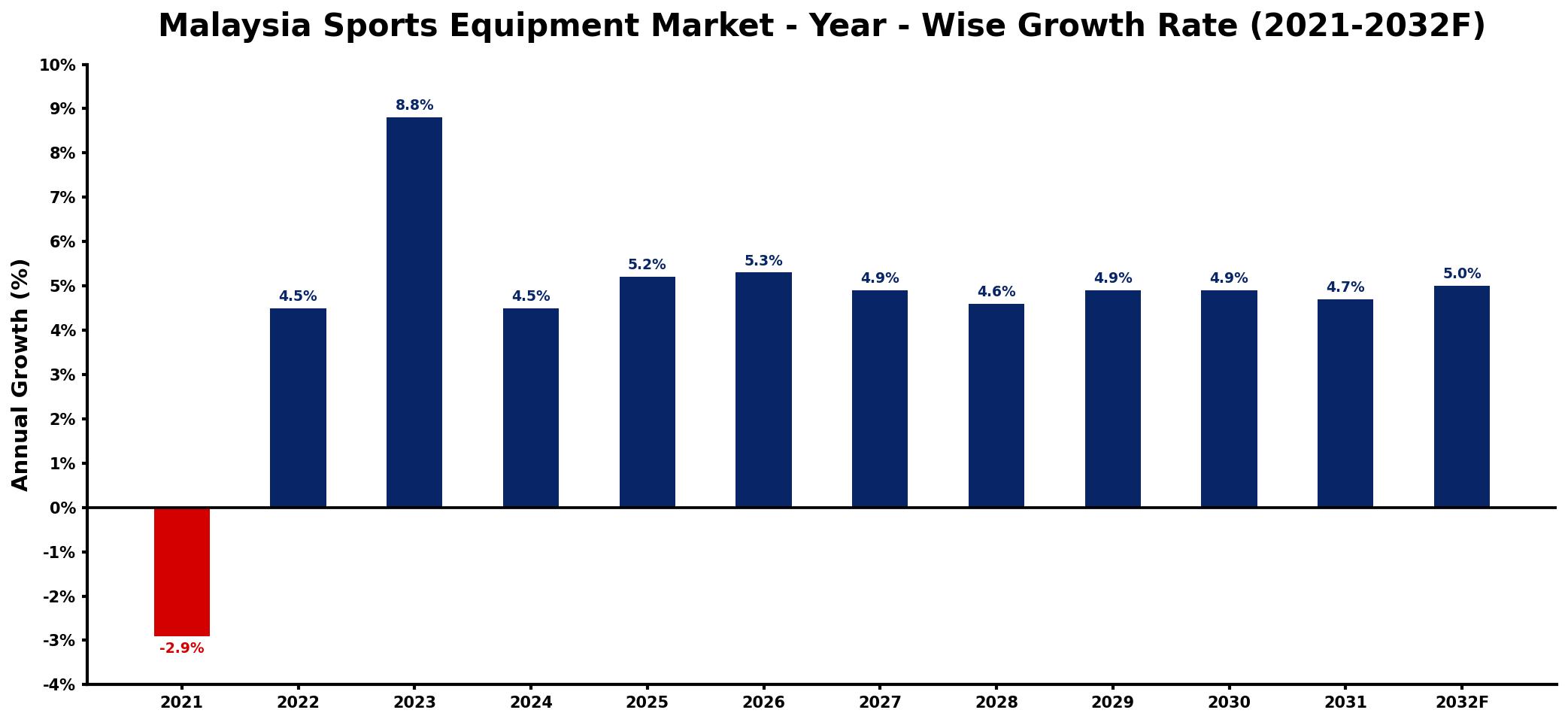
The table below presents the year‑wise growth rates along with the key drivers influencing the market
| Year | Growth Rate | Major Drivers |
| 2021 | -2.9% | decrease in consumer spending |
| 2022 | 4.5% | increased health awareness initiatives |
| 2023 | 8.8% | growing popularity of fitness |
| 2024 | 4.5% | expansion of retail distribution channels |
| 2025 | 5.2% | rise in youth participation |
| 2026 | 5.3% | increased digital marketing strategies |
| 2027 | 4.9% | growth in online sales platforms |
| 2028 | 4.6% | emerging trends in wellness |
| 2029 | 4.9% | investment in local manufacturing |
| 2030 | 4.9% | growing commercial sector adoption |
| 2031 | 4.7% | enhanced corporate sponsorship opportunities |
| 2032 | 5.0% | greater focus on sustainability practices |
Note: Market size estimations and growth projections presented in this report are based on 6Wresearch's proprietary forecasting methodology, utilizing the latest available industry data, government publications, and primary research inputs.
Malaysia Sports Equipment Market Synopsis
The Malaysia Sports Equipment Market has recently gained significant momentum, characterized by a growing engagement in diverse sporting activities. More consumers are investing in sports gear, aligning with the trend toward a healthier, more active lifestyle. As this momentum builds, the outlook suggests a sustained expansion, aided by factors such as enhanced access to e-commerce platforms and strategic marketing initiatives.
While challenges from the recent pandemic continue to influence some segments, particularly indoor equipment, there remains a strong inclination towards outdoor sports. The increased focus on wellness and the desire for recreational activities are likely to sustain this upward trajectory, making it a promising period for stakeholders in the Malaysia Sports Equipment Market.
Malaysia Sports Equipment Market Key Takeaways
- The market is projected to grow from USD 400 Million in 2025 to USD 521 Million by 2032.
- A rising health consciousness among Malaysians is fueling demand for sports equipment across multiple categories.
- E-commerce platforms are transforming how consumers access sports equipment, driving sales and market growth.
- Investments in marketing by manufacturers and retailers are enhancing brand visibility and competition.
- Shifts in consumer behavior due to the pandemic have created new opportunities, particularly in outdoor sports.
Evaluation of Restraints in Malaysia Sports Equipment Market
The Malaysia Sports Equipment Market faces several restraints that can impede its growth. The aftermath of the pandemic has resulted in supply chain disruptions, affecting the timely production and distribution of equipment. Additionally, the economic climate poses challenges to consumer purchasing power, which may impact sales performance in various sectors. Moreover, as competition intensifies on e-commerce platforms, businesses must continuously innovate and adapt their strategies to remain relevant and profitable.
Malaysia Sports Equipment Market Trends
Current trends in the Malaysia Sports Equipment Market are notably centered around the increasing integration of technology in sports gear. Smart equipment, such as fitness trackers and connected exercise machines, is becoming more prevalent, reflecting the demands of a tech-savvy consumer base. Additionally, there is a rising interest in sustainable and eco-friendly products, pushing brands to innovate with materials that align with environmental consciousness. The trend towards personalized and customizable sports equipment is also gaining traction, catering to individual preferences and enhancing user experience.
Malaysia Sports Equipment Market Opportunities
There are considerable opportunities for growth and investment within the Malaysia Sports Equipment Market. Brands that can effectively tap into the rising trend of outdoor activities stand to benefit significantly, particularly in sectors such as cycling and hiking. Additionally, enhancing e-commerce capabilities presents a critical pathway for reaching a broader audience. Companies focusing on unique marketing strategies, partnerships with fitness influencers, or local athletes can create stronger connections with consumers and establish themselves as market leaders.
Government Initiatives in the Malaysia Sports Equipment Market
The Malaysian government has introduced various initiatives aimed at promoting sports and fitness, fostering a culture of active living among its citizens. These include programs that encourage community sports participation and investments in sports infrastructure. Furthermore, government policies support local manufacturers, enhancing their competitiveness in the marketplace. Public spending on sports development is expected to continue, creating a favorable environment for growth within the sports equipment sector.
Future Insights of the Malaysia Sports Equipment Market
Looking ahead to 2026-2032, the Malaysia Sports Equipment Market is poised for continued expansion. The sustained emphasis on health and fitness, coupled with advancements in technology and e-commerce, are likely to drive demand for sports equipment. As more Malaysians prioritize physical well-being, industry players who can align their offerings with this cultural shift will be well-positioned to capitalize on emerging trends and consumer preferences.
Malaysia Sports Equipment Market Latest Developments (2025 - 2026)
Recent developments within the Malaysia Sports Equipment Market indicate a strategic pivot towards enhancing online sales channels and diversifying product ranges. Many companies are focusing on creating innovative and user-friendly online shopping experiences, while also prioritizing sustainability in their product offerings. Engagement with local communities through sponsorships and events has become increasingly common, further boosting brand visibility and consumer connection.
Malaysia Sports Equipment Market - Key Attractiveness of the Report
- 10 Years of Market Numbers
- Historical Data Starting from 2022 to 2025
- Base Year: 2025
- Forecast Data until 2032
- Key Performance Indicators Impacting the Market
- Major Upcoming Developments and Projects
Key Highlights of the Report:
- Malaysia Sports Equipment Market Outlook
- Market Size of Malaysia Sports Equipment Market, 2025
- Forecast of Malaysia Sports Equipment Market, 2032
- Historical Data and Forecast of Malaysia Sports Equipment Revenues & Volume for the Period 2022-2032F
- Malaysia Sports Equipment Market Trend Evolution
- Malaysia Sports Equipment Market Drivers and Challenges
- Malaysia Sports Equipment Price Trends
- Malaysia Sports Equipment Porter's Five Forces
- Malaysia Sports Equipment Industry Life Cycle
- Historical Data and Forecast of Malaysia Sports Equipment Market Revenues & Volume By Product for the Period 2022-2032F
- Historical Data and Forecast of Malaysia Sports Equipment Market Revenues & Volume By Ball over net games for the Period 2022-2032F
- Historical Data and Forecast of Malaysia Sports Equipment Market Revenues & Volume By Ball games for the Period 2022-2032F
- Historical Data and Forecast of Malaysia Sports Equipment Market Revenues & Volume By Fitness/Strength equipment for the Period 2022-2032F
- Historical Data and Forecast of Malaysia Sports Equipment Market Revenues & Volume By Athletic training equipment for the Period 2022-2032F
- Historical Data and Forecast of Malaysia Sports Equipment Market Revenues & Volume By Others for the Period 2022-2032F
- Historical Data and Forecast of Malaysia Sports Equipment Market Revenues & Volume By Distribution Channel for the Period 2022-2032F
- Historical Data and Forecast of Malaysia Sports Equipment Market Revenues & Volume By Online retail for the Period 2022-2032F
- Historical Data and Forecast of Malaysia Sports Equipment Market Revenues & Volume By Specialty & sports shops for the Period 2022-2032F
- Historical Data and Forecast of Malaysia Sports Equipment Market Revenues & Volume By Department & discount stores for the Period 2022-2032F
- Malaysia Sports Equipment Import Export Trade Statistics
- Market Opportunity Assessment By Product
- Market Opportunity Assessment By Distribution Channel
- Malaysia Sports Equipment Top Companies Market Share
- Malaysia Sports Equipment Competitive Benchmarking By Technical and Operational Parameters
- Malaysia Sports Equipment Company Profiles
- Malaysia Sports Equipment Key Strategic Recommendations






































