Malaysia Stackers Market Size, Share & Growth Rate
The Malaysia Stackers Market was estimated at USD 228 Million in 2025 and is projected to reach USD 295 Million by 2032, growing at a CAGR of 3.7% from 2026 to 2032. This growth trajectory is driven by increasing automation in warehouse operations and a heightened demand for high load capacity stackers. As industries ramp up production levels, especially in manufacturing and logistics, the necessity for efficient material handling solutions will become more pronounced.
Malaysia Stackers Market Year-wise Growth Rate and Key Drivers
This graph highlights how the Malaysia Stackers Market has steadily grown over the years, supported by major growth factors.
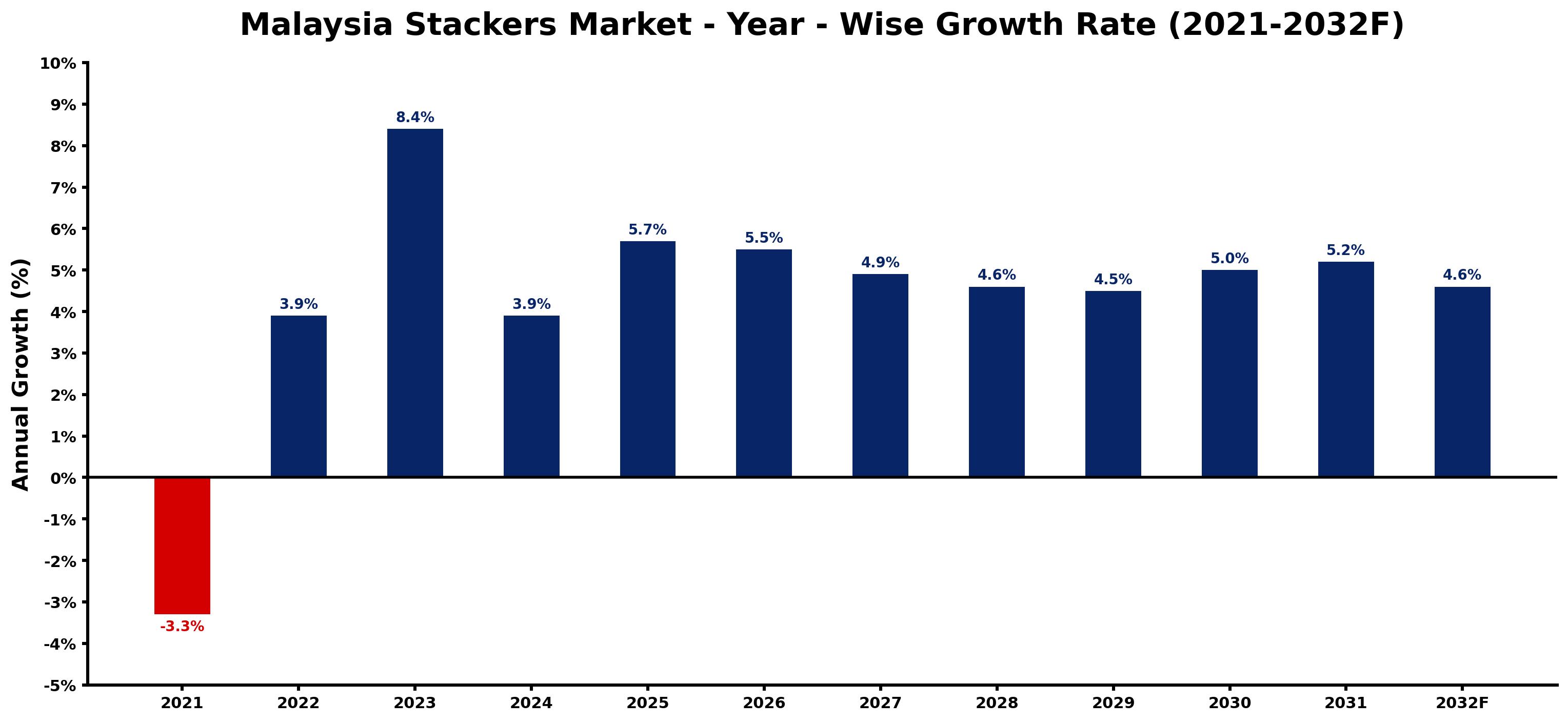
The table below presents the year‑wise growth rates along with the key drivers influencing the market
| Year | Growth Rate | Major Drivers |
| 2021 | -3.3% | Increasing adoption of advanced technologies |
| 2022 | 3.9% | Government infrastructure modernization initiatives |
| 2023 | 8.4% | Rapid growth in telecom and data center sectors |
| 2024 | 3.9% | Growing urbanization and commercial development |
| 2025 | 5.7% | Rapid growth in telecom and data center sectors |
| 2026 | 5.5% | Increasing smart city development projects |
| 2027 | 4.9% | Rising electricity demand across industries |
| 2028 | 4.6% | Expansion of transportation and logistics networks |
| 2029 | 4.5% | Government infrastructure modernization initiatives |
| 2030 | 5.0% | Increasing smart city development projects |
| 2031 | 5.2% | Rapid growth in telecom and data center sectors |
| 2032 | 4.6% | Increasing smart city development projects |
Note - Market size estimations and growth projections presented in this report are based on 6Wresearch’s advanced forecasting approach, validated with industry datasets as of June 2026.
Malaysia Stackers Market Synopsis
The surge in e-commerce and the push for enhanced supply chain efficiencies in Malaysia are primary factors fuelling demand for stackers. As businesses look to optimize their warehouse operations, stackers have become indispensable tools for handling heavy materials and maximizing storage efficiency.
Moreover, advancements in technology, particularly in IoT and automation, are reshaping the landscape of warehousing. Companies are increasingly adopting stackers equipped with smart technologies, which not only streamline operations but also improve safety and productivity levels in the workplace.
Malaysia Stackers Market Key Takeaways
- Projected market growth driven by the automation of warehouse operations.
- High load capacity stackers are in increasing demand across various industries.
- Adoption of IoT and AI technologies is expected to transform warehouse management.
- Investments in infrastructure development will bolster industrial production.
- Organizations are prioritizing cost reduction strategies through multi-shift operations.
Evaluation of Restraints in Malaysia Stackers Market
Despite the positive growth outlook, the Malaysia stackers market faces certain restraints. One significant challenge is the high initial investment costs associated with advanced stacker technologies. Companies, particularly smaller enterprises, may find it difficult to allocate budgets for modern equipment upgrades. Additionally, the limited availability of skilled labor to operate advanced stacking systems could hinder market growth. Furthermore, the fluctuations in raw material prices may impact the overall production costs, affecting profit margins for manufacturers.
Malaysia Stackers Market Trends
The market is currently witnessing a trend towards eco-friendly and energy-efficient stackers as companies aim to reduce their carbon footprint. This aligns with global sustainability goals and is particularly appealing to environmentally-conscious consumers. Additionally, the integration of smart technologies into stackers is on the rise, enhancing operational efficiency and safety through real-time data analytics and remote monitoring capabilities. As manufacturers continue to innovate, the demand for technologically advanced solutions is expected to grow.
Malaysia Stackers Market Opportunities
There are numerous opportunities for growth in the Malaysia stackers market, particularly for companies willing to innovate and adapt to new technologies. The ongoing push for logistics and supply chain efficiency presents a significant avenue for expansion. Furthermore, with the rise of e-commerce, there is an increasing demand for automated solutions in warehouses, paving the way for advanced stackers that can meet evolving consumer needs. Investment in research and development could lead to new product offerings and market capture.
Government Initiatives in the Malaysia Stackers Market
The Malaysian government has been proactive in promoting industrial growth through various initiatives. Investments in infrastructure development are a key focus, aimed at enhancing logistical capabilities and overall productivity. Additionally, public spending on technology adoption in warehouses, including automation and advanced material handling systems, supports the transition to more efficient operational models. Such initiatives are expected to foster a conducive environment for market players in the stackers industry.
Future Insights of the Malaysia Stackers Market
Looking ahead, the Malaysia stackers market is set for substantial growth between 2026 and 2032. As companies increasingly embrace automation and advanced material handling solutions, stackers will become even more integral to warehouse operations. The anticipated growth in e-commerce, along with ongoing infrastructure investments, will provide a robust foundation for market expansion. Additionally, the trend towards energy-efficient and smart solutions will likely dominate product development, creating an attractive landscape for both existing and new market entrants.
Malaysia Stackers Market Latest Developments (May 2025 - June 2026)
Recent developments in the Malaysia stackers market highlight a shift towards integrated technology solutions, with companies increasingly incorporating IoT and AI capabilities into their stackers. The industry is witnessing a growing number of partnerships between manufacturers and technology firms to enhance product offerings. Moreover, there is a notable uptick in training programs aimed at upskilling the workforce to handle advanced material handling equipment. These trends indicate a progressive move towards more sophisticated warehouse operations.
Malaysia Stackers Market - Key Attractiveness of the Report
- 10 Years of Market Numbers
- Historical Data Starting from 2022 to 2025
- Base Year: 2025
- Forecast Data until 2032
- Key Performance Indicators Impacting the Market
- Major Upcoming Developments and Projects
Key Highlights of the Report:
- Malaysia Stackers Market Outlook
- Market Size of Malaysia Stackers Market, 2025
- Forecast of Malaysia Stackers Market, 2032
- Historical Data and Forecast of Malaysia Stackers Revenues & Volume for the Period 2022-2032F
- Malaysia Stackers Market Trend Evolution
- Malaysia Stackers Market Drivers and Challenges
- Malaysia Stackers Price Trends
- Malaysia Stackers Porter's Five Forces
- Malaysia Stackers Industry Life Cycle
- Historical Data and Forecast of Malaysia Stackers Market Revenues & Volume By Type for the Period 2022-2032F
- Historical Data and Forecast of Malaysia Stackers Market Revenues & Volume By Electric for the Period 2022-2032F
- Historical Data and Forecast of Malaysia Stackers Market Revenues & Volume By Manual/Hydraulic for the Period 2022-2032F
- Historical Data and Forecast of Malaysia Stackers Market Revenues & Volume By Semi-Electric for the Period 2022-2032F
- Historical Data and Forecast of Malaysia Stackers Market Revenues & Volume By End-User for the Period 2022-2032F
- Historical Data and Forecast of Malaysia Stackers Market Revenues & Volume By Retail & Wholesale for the Period 2022-2032F
- Historical Data and Forecast of Malaysia Stackers Market Revenues & Volume By Logistics for the Period 2022-2032F
- Historical Data and Forecast of Malaysia Stackers Market Revenues & Volume By Automobile for the Period 2022-2032F
- Historical Data and Forecast of Malaysia Stackers Market Revenues & Volume By Food & Beverages for the Period 2022-2032F
- Historical Data and Forecast of Malaysia Stackers Market Revenues & Volume By Others for the Period 2022-2032F
- Malaysia Stackers Import Export Trade Statistics
- Market Opportunity Assessment By Type
- Market Opportunity Assessment By End-User
- Malaysia Stackers Top Companies Market Share
- Malaysia Stackers Competitive Benchmarking By Technical and Operational Parameters
- Malaysia Stackers Company Profiles
- Malaysia Stackers Key Strategic Recommendations






































