Malaysia Submarine Periscopes Market Size, Share & Growth Rate
The Malaysia Submarine Periscopes Market was estimated at USD 208 Million in 2025 and is projected to reach USD 273 Million by 2032, growing at a CAGR of 4.0% from 2026 to 2032. This upward trajectory can be attributed to Malaysia's strategic investments in enhancing its naval defense capabilities, particularly in safeguarding its maritime interests. As the country modernizes its naval fleet, the demand for advanced periscope systems equipped with enhanced imaging and stealth features will be pivotal.
Malaysia Submarine Periscopes Market Year-wise Growth Rate and Key Drivers
This graph highlights how the Malaysia Submarine Periscopes Market has steadily grown over the years, supported by major growth factors.
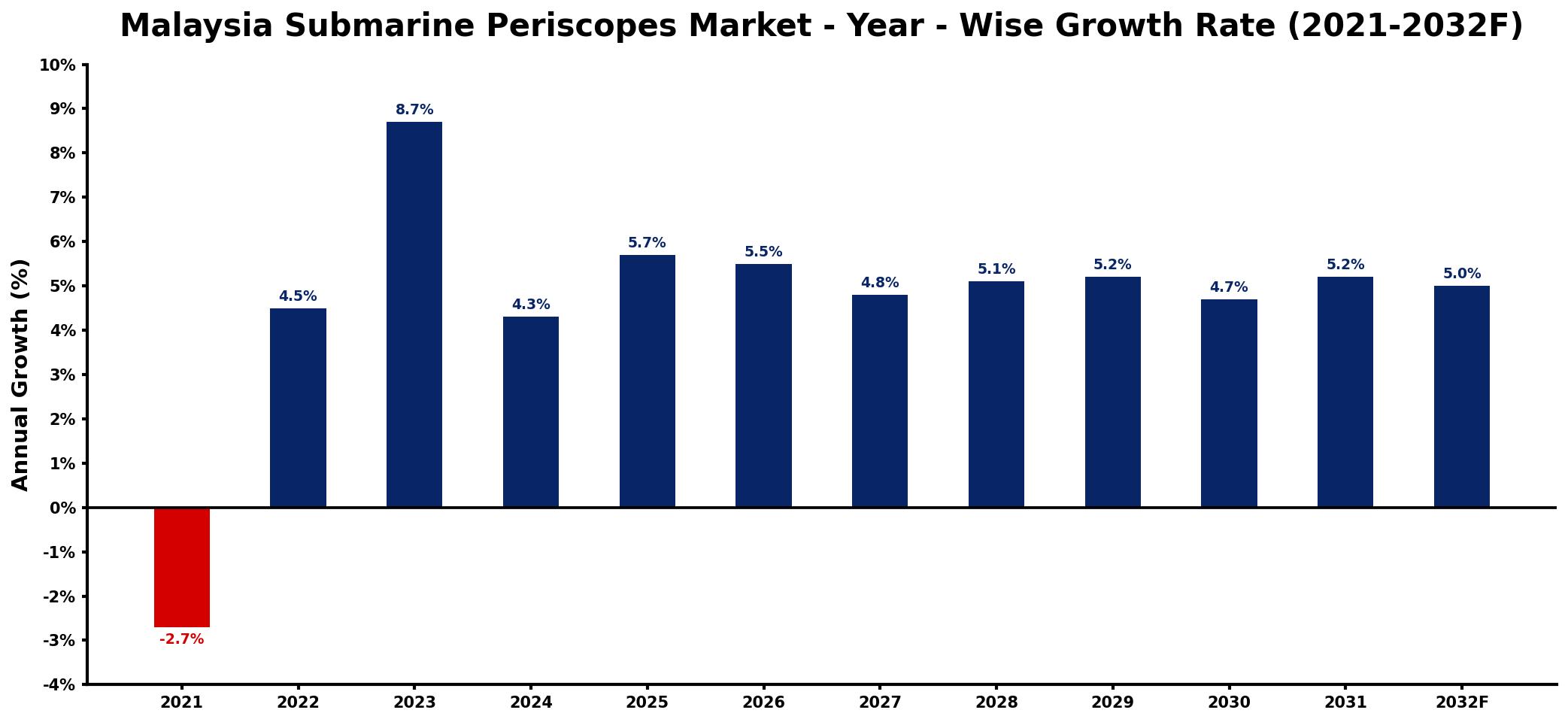
The table below presents the year‑wise growth rates along with the key drivers influencing the market
| Year | Growth Rate | Major Drivers |
| 2021 | -2.7% | Decreased defense spending priorities |
| 2022 | 4.5% | Increased naval modernization initiatives |
| 2023 | 8.7% | Growing focus on maritime security |
| 2024 | 4.3% | Expansion of underwater surveillance systems |
| 2025 | 5.7% | Rising demand for advanced technologies |
| 2026 | 5.5% | Strengthening regional defense collaborations |
| 2027 | 4.8% | Increased investments in naval capabilities |
| 2028 | 5.1% | Growing interest in defense innovation |
| 2029 | 5.2% | Enhanced training for naval personnel |
| 2030 | 4.7% | Strengthened geopolitical tensions driving investments |
| 2031 | 5.2% | Growing partnerships with defense contractors |
| 2032 | 5.0% | Emerging technologies boosting defense investments |
Note: Market size estimations and growth projections presented in this report are based on 6Wresearch's proprietary forecasting methodology, utilizing the latest available industry data, government publications, and primary research inputs.
Malaysia Submarine Periscopes Market Synopsis
The modernization of the Malaysian Navy is the primary force shaping the submarine periscopes market today. With an emphasis on upgrading existing submarine fleets and procuring new vessels, Malaysia is committed to advancing its defense technology. Submarine periscopes, being critical components for effective underwater operations, stand at the forefront of this modernization drive.
Investment in local defense capabilities further influences the market, driving research and development initiatives among local manufacturers. This commitment not only supports national security but also aims to meet the stringent requirements set forth by defense standards, ensuring the functionality and reliability of periscope systems.
Malaysia Submarine Periscopes Market Key Takeaways
- The market is driven by Malaysia's focus on enhancing naval defense capabilities.
- Investment in advanced technologies is crucial for meeting evolving defense needs.
- Local manufacturers are emphasizing R&D to create state-of-the-art periscope systems.
- Modernization efforts will increase the demand for sophisticated imaging and stealth features.
- Strategic maritime interests necessitate a robust submarine fleet, boosting periscope acquisitions.
Evaluation of Restraints in Malaysia Submarine Periscopes Market
Despite its potential, the Malaysia submarine periscopes market faces several challenges that may hinder growth. A significant concern is the need to maintain a robust domestic defense industry capable of delivering high-quality components. Moreover, the rapid pace of technological advancements necessitates continuous adaptation and investment, which can strain resources. Additionally, addressing security concerns related to military equipment remains paramount, as stakeholders work to ensure both operational effectiveness and the integrity of national defense systems.
Malaysia Submarine Periscopes Market Trends
Emerging trends in the Malaysia submarine periscopes market include a growing emphasis on stealth technology and advanced imaging capabilities. As military operations become more sophisticated, demand for periscopes that offer improved situational awareness and reduced detectability is escalating. The integration of digital technologies, including AI and enhanced optics, is further revolutionizing periscope functionalities, providing naval forces with a significant tactical advantage in underwater surveillance and reconnaissance.
Malaysia Submarine Periscopes Market Opportunities
The market offers numerous growth and investment opportunities, particularly in the realms of research and development. Companies focused on innovative designs and technologies are well-positioned to cater to the needs of an increasingly modernized navy. Additionally, partnerships between government and private sectors to enhance local production capabilities present avenues for sustainable growth. Expanding into regional markets could also prove beneficial, allowing Malaysia to leverage its expertise in submarine technology.
Government Initiatives in the Malaysia Submarine Periscopes Market
The Malaysian government has initiated several policies aimed at bolstering its defense sector, including submarine capabilities. Public spending in defense has seen an uptick, focusing on naval modernization and advanced technology acquisitions. Programs designed to promote local defense industry participation not only support domestic manufacturers but also enhance national security. Incentives for research and development further align with strategic objectives to ensure that Malaysia remains competitive in the maritime domain.
Future Insights of the Malaysia Submarine Periscopes Market
Looking towards 2026-2032, the Malaysia submarine periscopes market is anticipated to evolve significantly. With the continued emphasis on modernization and technological advancements, manufacturers will likely explore novel innovations to meet the demands of the naval defense sector. The integration of smart technologies and enhanced operational capabilities is expected to become standard, positioning Malaysia as a leader in submarine warfare technology within the region.
Malaysia Submarine Periscopes Market Latest Developments (2025 - 2026)
Recent industry developments indicate a growing collaboration between local and international technology providers, aimed at enhancing the sophistication of submarine periscope systems. Additionally, the sector is witnessing an uptick in joint ventures focused on R&D initiatives, leading to innovative advancements in imaging technology. There is a keen interest in integrating next-generation sensors to further improve reconnaissance capabilities, ensuring that Malaysia's naval fleet remains competitive and capable in a rapidly evolving maritime landscape.
Malaysia Submarine Periscopes Market - Key Attractiveness of the Report
- 10 Years of Market Numbers
- Historical Data Starting from 2022 to 2025
- Base Year: 2025
- Forecast Data until 2032
- Key Performance Indicators Impacting the Market
- Major Upcoming Developments and Projects
Key Highlights of the Report:
- Malaysia Submarine Periscopes Market Outlook
- Market Size of Malaysia Submarine Periscopes Market, 2025
- Forecast of Malaysia Submarine Periscopes Market, 2032
- Historical Data and Forecast of Malaysia Submarine Periscopes Revenues & Volume for the Period 2022-2032F
- Malaysia Submarine Periscopes Market Trend Evolution
- Malaysia Submarine Periscopes Market Drivers and Challenges
- Malaysia Submarine Periscopes Price Trends
- Malaysia Submarine Periscopes Porter's Five Forces
- Malaysia Submarine Periscopes Industry Life Cycle
- Historical Data and Forecast of Malaysia Submarine Periscopes Market Revenues & Volume By Type for the Period 2022-2032F
- Historical Data and Forecast of Malaysia Submarine Periscopes Market Revenues & Volume By Navigation or Observation Periscope for the Period 2022-2032F
- Historical Data and Forecast of Malaysia Submarine Periscopes Market Revenues & Volume By Targeting or Commander's Periscope for the Period 2022-2032F
- Historical Data and Forecast of Malaysia Submarine Periscopes Market Revenues & Volume By Application for the Period 2022-2032F
- Historical Data and Forecast of Malaysia Submarine Periscopes Market Revenues & Volume By Observation for the Period 2022-2032F
- Historical Data and Forecast of Malaysia Submarine Periscopes Market Revenues & Volume By Measure Distance for the Period 2022-2032F
- Malaysia Submarine Periscopes Import Export Trade Statistics
- Market Opportunity Assessment By Type
- Market Opportunity Assessment By Application
- Malaysia Submarine Periscopes Top Companies Market Share
- Malaysia Submarine Periscopes Competitive Benchmarking By Technical and Operational Parameters
- Malaysia Submarine Periscopes Company Profiles
- Malaysia Submarine Periscopes Key Strategic Recommendations






































