Malaysia Sugar Mill Machinery Market Size, Share & Growth Rate
The Malaysia Sugar Mill Machinery Market was estimated at USD 389 Million in 2025 and is projected to reach USD 504 Million by 2032, growing at a CAGR of 3.8% from 2026 to 2032. This growth trajectory is largely driven by the country's increasing sugarcane production and the ongoing modernization of sugar processing facilities. As consumer preferences shift towards higher-quality sugar products and the push for more efficient milling processes intensifies, the demand for advanced machinery is expected to rise significantly.
Malaysia Sugar Mill Machinery Market Year-wise Growth Rate and Key Drivers
This graph highlights how the Malaysia Sugar Mill Machinery Market has steadily grown over the years, supported by major growth factors.
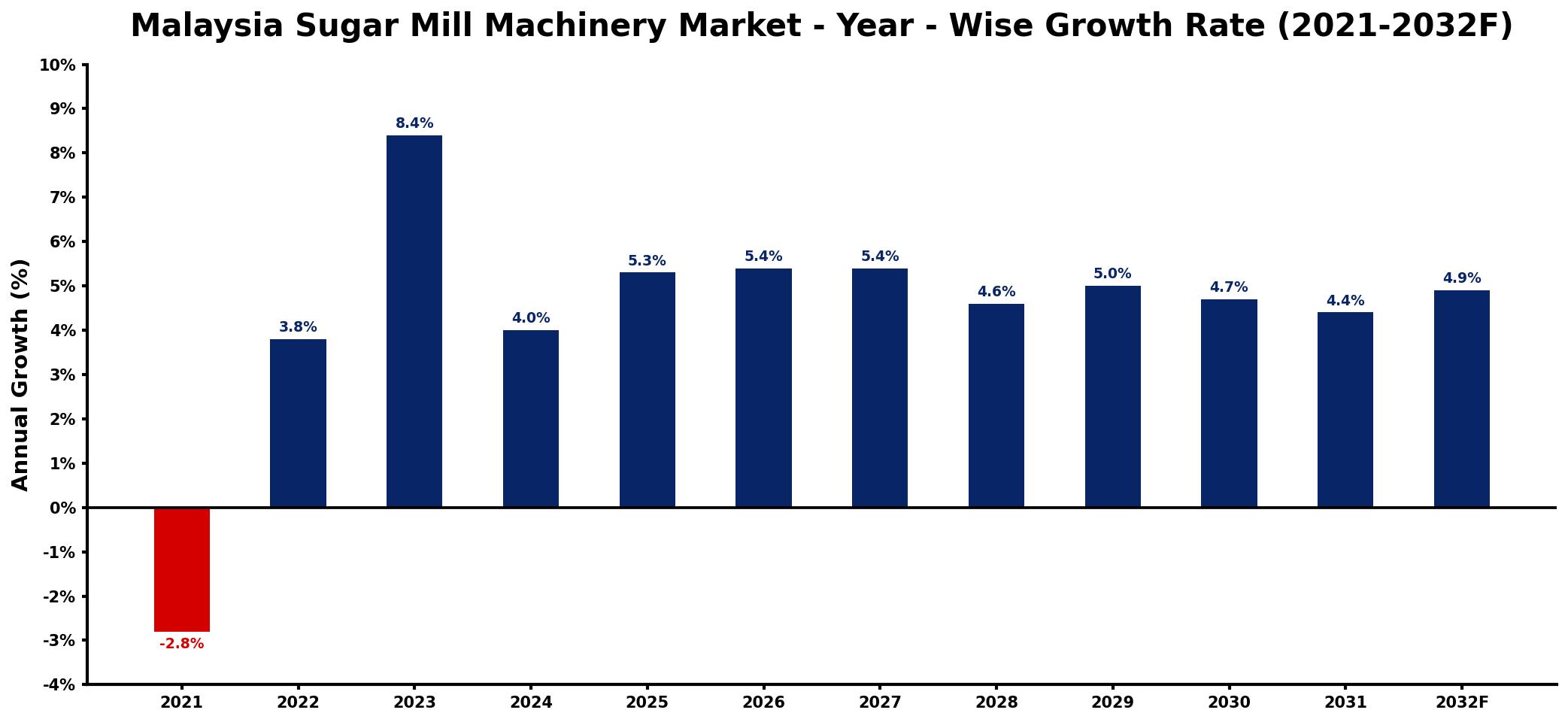
The table below presents the year‑wise growth rates along with the key drivers influencing the market
| Year | Growth Rate | Major Drivers |
| 2021 | -2.8% | Decreased agricultural production investment |
| 2022 | 3.8% | Rise in renewable energy initiatives |
| 2023 | 8.4% | Increased industrial automation adoption |
| 2024 | 4.0% | Growing demand for biofuels |
| 2025 | 5.3% | Expansion of food processing sector |
| 2026 | 5.4% | Investment in sustainable practices |
| 2027 | 5.4% | Technological advancements in production |
| 2028 | 4.6% | Emergence of new export markets |
| 2029 | 5.0% | Strengthening supply chain partnerships |
| 2030 | 4.7% | Rising consumer health awareness |
| 2031 | 4.4% | Increased focus on energy efficiency |
| 2032 | 4.9% | Growth in alternative sweeteners market |
Note: Market size estimations and growth projections presented in this report are based on 6Wresearch's proprietary forecasting methodology, utilizing the latest available industry data, government publications, and primary research inputs.
Malaysia Sugar Mill Machinery Market Synopsis
The Malaysia sugar mill machinery market is positioned as a vital segment within the broader sugar industry, reflecting the increasing importance of technological advancements in sugar production. As the demand for sugar continues to grow, particularly due to a rising population and urbanization, the need for efficient machinery that enhances productivity and reduces environmental impact becomes imperative.
In recent years, the industry has seen a marked shift toward automation and digitalization, as sugar mill operators seek innovative solutions to optimize their processes. This evolving landscape presents both challenges and opportunities, necessitating significant investment in upgrading machinery to meet modern standards.
Malaysia Sugar Mill Machinery Market Key Takeaways
- The market is projected to grow steadily, with an estimated value increase from USD 389 Million in 2025 to USD 504 Million by 2032.
- Technological advancements and automation are key drivers of demand for modern sugar mill machinery.
- Government policies and initiatives aimed at supporting the sugar industry contribute to market stability.
- Investment in sustainability and energy efficiency is crucial for the future of sugar production.
- Post-pandemic recovery efforts are anticipated to boost modernization investments in sugar mills.
Evaluation of Restraints in Malaysia Sugar Mill Machinery Market
Despite the growth potential, the Malaysia sugar mill machinery market faces several restraints that could hinder its expansion. Continuous innovation is necessary to keep pace with evolving industry standards, but this requires substantial research and development investments that may be challenging for smaller players. Moreover, the cyclical nature of the market, influenced by sugar prices and crop yields, creates financial uncertainties. Aging infrastructure poses another significant concern, as operators must balance the costs of upgrading machinery with the need to comply with modern efficiency and environmental standards.
Malaysia Sugar Mill Machinery Market Trends
Current trends within the Malaysia sugar mill machinery market highlight a growing emphasis on eco-friendly technologies and practices. Manufacturers are increasingly focused on developing machinery that minimizes energy consumption and reduces waste. Additionally, the incorporation of smart technology and data analytics is transforming traditional milling processes, allowing for real-time monitoring and optimization. These innovations not only enhance productivity but also align with global sustainability goals, further shaping the future landscape of the industry.
Malaysia Sugar Mill Machinery Market Opportunities
There are significant growth opportunities for stakeholders in the Malaysia sugar mill machinery market. The modernization of aging mills presents a prime avenue for investment, as operators seek to enhance efficiency and comply with stricter environmental regulations. Furthermore, the increasing global demand for high-quality sugar products opens up avenues for local manufacturers to innovate and diversify their offerings. Collaborations with technology firms to integrate IoT and automation into machinery could also unlock new levels of productivity and operational efficiency.
Government Initiatives in the Malaysia Sugar Mill Machinery Market
The Malaysian government plays a significant role in supporting the sugar industry through various initiatives aimed at promoting modernization and sustainability. Policies that encourage investment in new technologies and infrastructure development are crucial for maintaining the sector's competitiveness. Additionally, programs focused on research and development assist industry stakeholders in exploring innovative solutions that can drive efficiency and meet evolving consumer demands.
Future Insights of the Malaysia Sugar Mill Machinery Market
Looking ahead to 2026-2032, the Malaysia sugar mill machinery market is anticipated to undergo significant transformation. The ongoing push for modernization will likely continue, driven by the imperative for greater efficiency and sustainability. Furthermore, as consumer trends evolve and the focus on high-quality sugar products intensifies, manufacturers will be compelled to innovate their offerings. Investments in automation and digital technology will be pivotal in shaping the future landscape of sugar production in Malaysia.
Malaysia Sugar Mill Machinery Market Latest Developments (2025 - 2026)
Recent developments in the Malaysia sugar mill machinery market indicate a robust trend toward modernization and technological integration. Companies are increasingly investing in smart machinery that leverages automation and data analytics to streamline operations. Additionally, there is a notable shift toward collaborative initiatives among industry stakeholders to address sustainability challenges and enhance production efficiency. As these trends take shape, the market is expected to experience renewed vigor, positioning itself for sustainable growth in the coming years.
Malaysia Sugar Mill Machinery Market - Key Attractiveness of the Report
- 10 Years of Market Numbers
- Historical Data Starting from 2022 to 2025
- Base Year: 2025
- Forecast Data until 2032
- Key Performance Indicators Impacting the Market
- Major Upcoming Developments and Projects
Key Highlights of the Report:
- Malaysia Sugar Mill Machinery Market Outlook
- Market Size of Malaysia Sugar Mill Machinery Market, 2025
- Forecast of Malaysia Sugar Mill Machinery Market, 2032
- Historical Data and Forecast of Malaysia Sugar Mill Machinery Revenues & Volume for the Period 2022-2032F
- Malaysia Sugar Mill Machinery Market Trend Evolution
- Malaysia Sugar Mill Machinery Market Drivers and Challenges
- Malaysia Sugar Mill Machinery Price Trends
- Malaysia Sugar Mill Machinery Porter's Five Forces
- Malaysia Sugar Mill Machinery Industry Life Cycle
- Historical Data and Forecast of Malaysia Sugar Mill Machinery Market Revenues & Volume By Machinery Type for the Period 2022-2032F
- Historical Data and Forecast of Malaysia Sugar Mill Machinery Market Revenues & Volume By Cane Handling Equipment for the Period 2022-2032F
- Historical Data and Forecast of Malaysia Sugar Mill Machinery Market Revenues & Volume By Cutting & Grinding Equipment for the Period 2022-2032F
- Historical Data and Forecast of Malaysia Sugar Mill Machinery Market Revenues & Volume By Processing Equipment for the Period 2022-2032F
- Historical Data and Forecast of Malaysia Sugar Mill Machinery Market Revenues & Volume By Packaging Equipment for the Period 2022-2032F
- Historical Data and Forecast of Malaysia Sugar Mill Machinery Market Revenues & Volume By Refineries Type for the Period 2022-2032F
- Historical Data and Forecast of Malaysia Sugar Mill Machinery Market Revenues & Volume By Front End Refineries for the Period 2022-2032F
- Historical Data and Forecast of Malaysia Sugar Mill Machinery Market Revenues & Volume By Back End Refineries for the Period 2022-2032F
- Malaysia Sugar Mill Machinery Import Export Trade Statistics
- Market Opportunity Assessment By Machinery Type
- Market Opportunity Assessment By Refineries Type
- Malaysia Sugar Mill Machinery Top Companies Market Share
- Malaysia Sugar Mill Machinery Competitive Benchmarking By Technical and Operational Parameters
- Malaysia Sugar Mill Machinery Company Profiles
- Malaysia Sugar Mill Machinery Key Strategic Recommendations






































