Malaysia Sulphur Market Size, Share & Growth Rate
The Malaysia Sulphur Market was estimated at USD 435 Million in 2025 and is projected to reach USD 564 Million by 2032, growing at a CAGR of 3.8% from 2026 to 2032. This growth trajectory is primarily driven by the rising demand for sulphur in agricultural applications, particularly for fertilizer production. Additionally, the increasing utilization of sulphur in the chemical and energy sectors underscores its critical role in various industrial processes across Malaysia.
Malaysia Sulphur Market Year-wise Growth Rate and Key Drivers
This graph highlights how the Malaysia Sulphur Market has steadily grown over the years, supported by major growth factors.
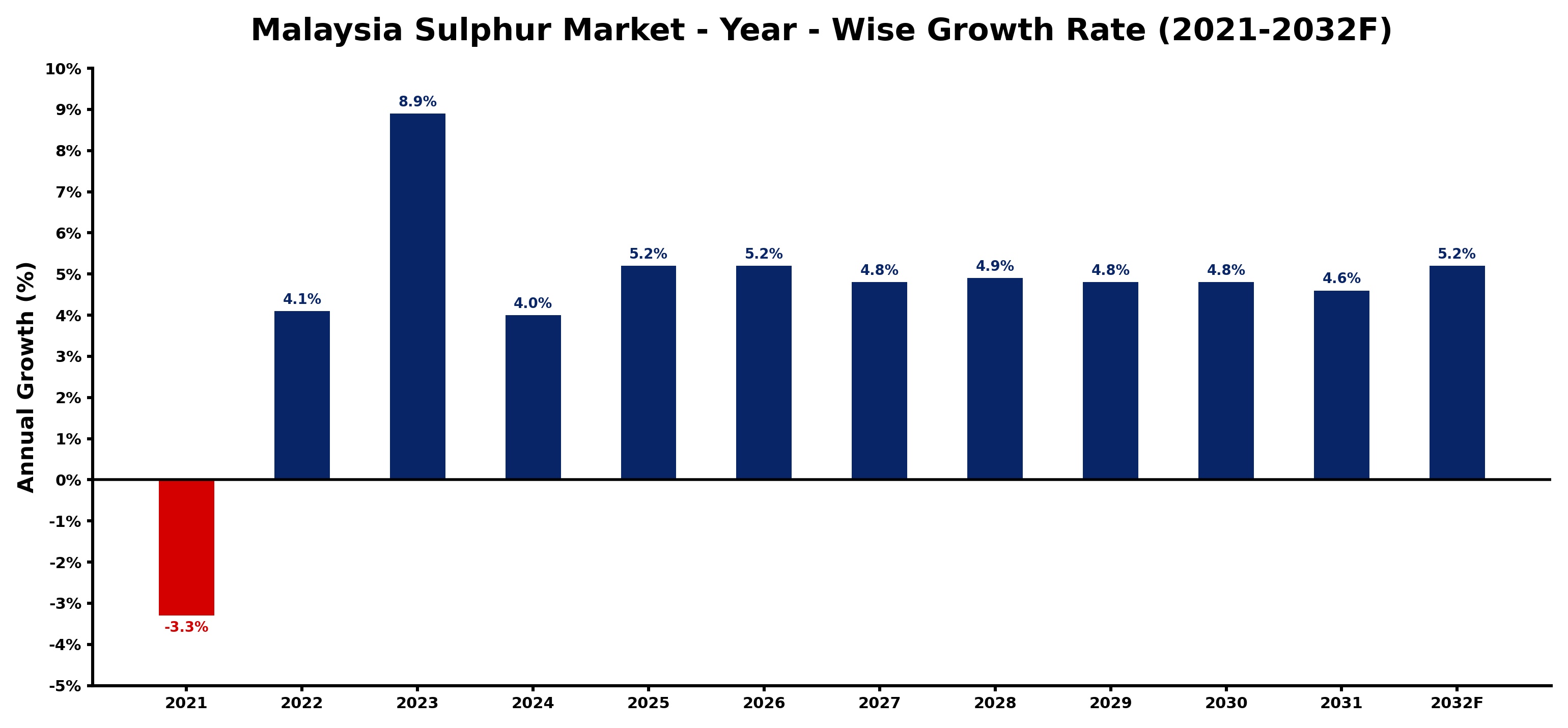
The table below presents the year‑wise growth rates along with the key drivers influencing the market
| Year | Growth Rate | Major Drivers |
| 2021 | -3.3% | Supply chain disruptions limited availability |
| 2022 | 4.1% | Industrial demand recovery accelerated growth |
| 2023 | 8.9% | Agricultural sector expansion increased usage |
| 2024 | 4.0% | Construction projects drove higher consumption |
| 2025 | 5.2% | Chemical production growth enhanced demand |
| 2026 | 5.2% | Energy sector investments boosted usage |
| 2027 | 4.8% | Environmental regulations increased adoption |
| 2028 | 4.9% | Technological advancements improved efficiency |
| 2029 | 4.8% | Export opportunities expanded market reach |
| 2030 | 4.8% | Sustainable practices gained market traction |
| 2031 | 4.6% | Partnerships enhanced distribution networks |
| 2032 | 5.2% | Innovation in product applications flourished |
Note - Market size estimations and growth projections presented in this report are based on 6Wresearch’s advanced forecasting approach, validated with industry datasets as of June 2026.
Malaysia Sulphur Market Synopsis
In recent years, the Malaysia sulphur market has showcased significant potential due to its diverse industrial applications. A critical component in the manufacturing of fertilizers, sulphur's role is paramount in enhancing agricultural yields and ensuring food security. Furthermore, its contributions to the chemical and energy sectors amplify its importance within the nation's industrial landscape.
As sustainability becomes a focal point for many industries, the demand for sulphur-based fertilizers has surged. Government initiatives aimed at promoting sustainable farming practices have further cemented the position of sulphur as an essential element in Malaysia's economic framework. These factors collectively highlight the importance of sulphur as a vital raw material across multiple sectors.
Malaysia Sulphur Market Key Takeaways
- The sulphur market in Malaysia is witnessing steady growth due to its essential applications in agriculture and industry.
- Government regulations supporting sustainable farming practices are boosting sulphur consumption in fertilizers.
- The market is influenced by fluctuations in energy prices, affecting sulphur availability and sourcing.
- Environmental considerations are driving innovations in emission control technologies utilizing sulphur.
- Strategic partnerships among local and international companies are shaping the competitive landscape.
Evaluation of Restraints in Malaysia Sulphur Market
The Malaysia sulphur market encounters notable restraints primarily tied to sourcing and environmental compliance. Being a byproduct of oil and gas refining, fluctuations in the global energy landscape can create uncertainties in sulphur availability. Moreover, adherence to strict environmental regulations surrounding sulphur emissions poses challenges for production processes. These factors contribute to market volatility and place pressures on sulphur suppliers to navigate a complex regulatory environment while maintaining consistent production levels.
Malaysia Sulphur Market Trends
The shift toward sustainable practices is driving a notable trend in the Malaysian sulphur market. With an increasing focus on environmentally friendly fertilizers, there is a growing demand for sulphur-based products that comply with regulatory standards. Technological advancements in production methods are also emerging, allowing for more efficient and cleaner sulphur processing. Furthermore, the integration of sulphur in emission control systems highlights a trend toward cleaner energy solutions, reflecting broader environmental priorities.
Malaysia Sulphur Market Opportunities
Opportunities in the Malaysia sulphur market are abundant, particularly in the agricultural sector, where innovation in fertilizers presents significant growth potential. As farmers increasingly adopt sustainable practices, there is a rising demand for high-quality sulphur fertilizers that enhance soil health and crop productivity. Additionally, the development of emission control technologies offers avenues for market expansion, with sulphur playing a pivotal role in meeting environmental standards and supporting cleaner industrial processes.
Government Initiatives in the Malaysia Sulphur Market
The Malaysian government has recognized the significance of sulphur in enhancing agricultural productivity and driving industrial growth. Various policies and public spending initiatives are being implemented to promote sustainable farming practices that utilize sulphur-based fertilizers. These initiatives include grants for research and development in agricultural technology, as well as incentives for industries adopting cleaner production methods. Such supportive measures reinforce the government's commitment to balancing economic growth with environmental sustainability.
Future Insights of the Malaysia Sulphur Market
Looking ahead to the period between 2026 and 2032, the Malaysia sulphur market is expected to experience sustained growth driven by the convergence of agricultural demand and industrial application. As the agricultural sector shifts towards more sustainable practices, the role of sulphur in enhancing fertilizer efficiency will only increase. Additionally, innovations in emission reduction technologies could solidify sulphur's position as a strategic component in energy transitions. Overall, the market's trajectory remains closely aligned with national sustainability goals and global environmental trends.
Malaysia Sulphur Market Latest Developments (May 2025 - June 2026)
Recent developments in the Malaysia sulphur market have focused on enhancing production capabilities and improving environmental compliance measures. Key stakeholders are investing in cleaner production technologies that align with stringent regulatory standards, reflecting a commitment to sustainability. Additionally, collaborations between the public and private sectors have emerged, aimed at fostering innovations in sulphur application within agriculture and energy. These trends indicate a proactive approach in adapting to market demands and regulatory challenges.
Malaysia Sulphur Market - Key Attractiveness of the Report
- 10 Years of Market Numbers
- Historical Data Starting from 2022 to 2025
- Base Year: 2025
- Forecast Data until 2032
- Key Performance Indicators Impacting the Market
- Major Upcoming Developments and Projects
Key Highlights of the Report:
- Malaysia Sulphur Market Outlook
- Market Size of Malaysia Sulphur Market, 2025
- Forecast of Malaysia Sulphur Market, 2032
- Historical Data and Forecast of Malaysia Sulphur Revenues & Volume for the Period 2022-2032F
- Malaysia Sulphur Market Trend Evolution
- Malaysia Sulphur Market Drivers and Challenges
- Malaysia Sulphur Price Trends
- Malaysia Sulphur Porter's Five Forces
- Malaysia Sulphur Industry Life Cycle
- Historical Data and Forecast of Malaysia Sulphur Market Revenues & Volume By Product Type for the Period 2022-2032F
- Historical Data and Forecast of Malaysia Sulphur Market Revenues & Volume By Natural Gas for the Period 2022-2032F
- Historical Data and Forecast of Malaysia Sulphur Market Revenues & Volume By Crude Oil for the Period 2022-2032F
- Historical Data and Forecast of Malaysia Sulphur Market Revenues & Volume By Others for the Period 2022-2032F
- Historical Data and Forecast of Malaysia Sulphur Market Revenues & Volume By End Users for the Period 2022-2032F
- Historical Data and Forecast of Malaysia Sulphur Market Revenues & Volume By Sulfuric Acid (Fertilizers) for the Period 2022-2032F
- Historical Data and Forecast of Malaysia Sulphur Market Revenues & Volume By Sulfuric Acid (Metal Manufacturing) for the Period 2022-2032F
- Historical Data and Forecast of Malaysia Sulphur Market Revenues & Volume By Chemical Processing for the Period 2022-2032F
- Malaysia Sulphur Import Export Trade Statistics
- Market Opportunity Assessment By Product Type
- Market Opportunity Assessment By End Users
- Malaysia Sulphur Top Companies Market Share
- Malaysia Sulphur Competitive Benchmarking By Technical and Operational Parameters
- Malaysia Sulphur Company Profiles
- Malaysia Sulphur Key Strategic Recommendations






































