Malaysia Supply Chain Analytics Market Size & Growth Rate (2026-2032)
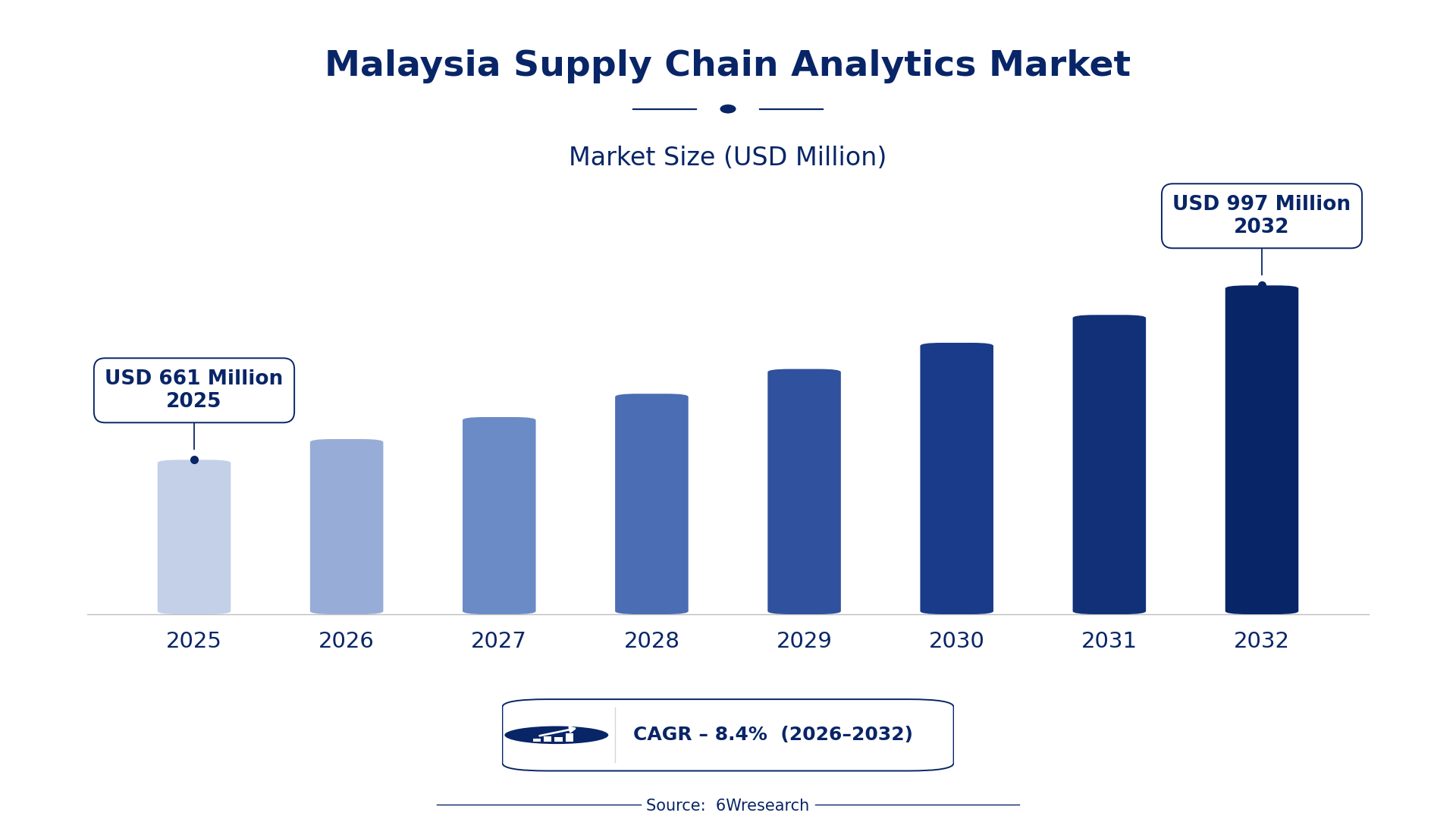
The Malaysia Supply Chain Analytics Market was estimated at USD 661 Million in 2025 and is projected to reach USD 997 Million by 2032, growing at a CAGR of 8.4% from 2026 to 2032.
Malaysia Supply Chain Analytics Market Synopsis
The growth trajectory of the Malaysia Supply Chain Analytics Market reflects a pivotal shift in how businesses operate. Companies are increasingly prioritizing analytics to enhance visibility and streamline operations. The complexity of today's supply chains drives this demand, necessitating advanced analytics tools that enable effective decision-making.
As firms grapple with global supply chain challenges, the emphasis on data-driven strategies is becoming non-negotiable. Analytics solutions are being harnessed for improved demand forecasting, inventory management, and logistics efficiency, positioning organizations to compete more effectively in both domestic and international markets.
Malaysia Supply Chain Analytics Market Year-wise Growth Rate and Key Drivers
This graph illustrates the annual growth rates of the Malaysia Supply Chain Analytics Market from 2021 to 2032, highlighting a steady upward trajectory and projected expansion over the forecast period.
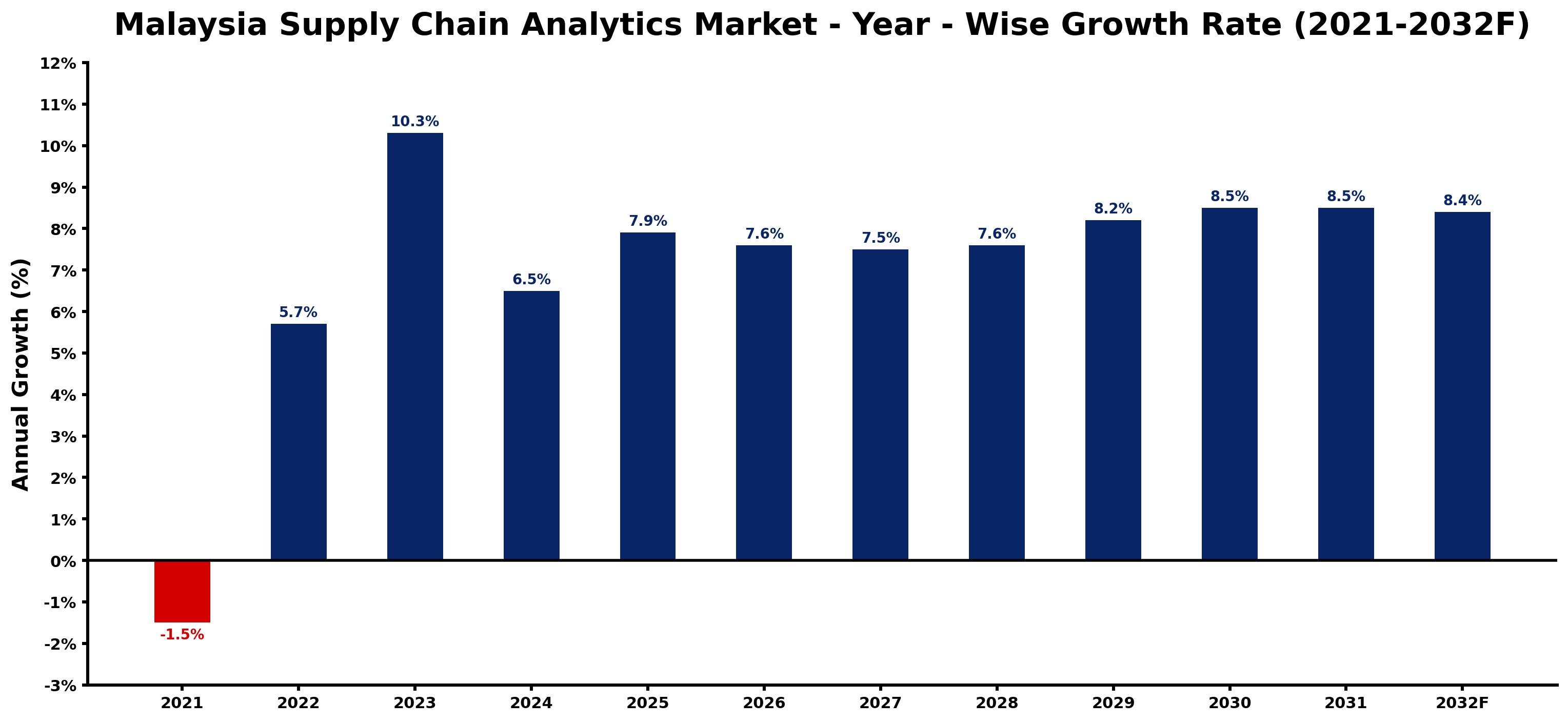
The table below presents the year‑wise growth rates along with the key drivers influencing the market
| Year | Growth Rate | Major Drivers |
| 2021 | -1.5% | Implementation delays due to MCO restrictions on businesses |
| 2022 | 5.7% | Government's MyDIGITAL initiative driving digital innovation. |
| 2023 | 10.3% | Increased demand for real-time data analytics solutions. |
| 2024 | 6.5% | Adoption of Industry 4.0 practices in manufacturing. |
| 2025 | 7.9% | Growing e-commerce sector requiring advanced logistics strategies. |
| 2026 | 7.6% | Investment in smart logistics technologies by major players. |
| 2027 | 7.5% | Rising consumer expectations for supply chain transparency. |
| 2028 | 7.6% | Implementation of stricter trade compliance regulations. |
| 2029 | 8.2% | Emergence of AI-driven optimization tools for logistics. |
| 2030 | 8.5% | Post-pandemic recovery boosting supply chain resilience solutions. |
| 2031 | 8.5% | Focus on sustainable practices in supply chain management. |
| 2032 | 8.4% | Continued growth in cross-border trade enhancing analytics needs. |
Note: Market size estimations and growth projections presented in this report are based on 6Wresearch's proprietary forecasting methodology, utilizing the latest available industry data, government publications, and primary research inputs.
Malaysia Supply Chain Analytics Market Key Takeaways
Below are some of the specific key takeaways from the market, including:
- Increased investment in advanced analytics tools is pivotal for enhancing operational efficiency.
- Real-time visibility into supply chain processes is a growing necessity for businesses.
- Integration of analytics solutions is being prioritized to mitigate supply chain disruptions.
- Organizations are focusing on data management and skill development to optimize analytics use.
- Government initiatives are actively promoting technology adoption within the supply chain sector.
Evaluation of Restraints in Malaysia Supply Chain Analytics Market
The Malaysia Supply Chain Analytics Market is grappling with several constraints that could limit its potential. One of the primary issues is the lack of end-to-end visibility, which hampers effective decision-making and leads to increased operational costs. Organizations often struggle with data quality, making it challenging to derive actionable insights from analytics tools. on top of that, regulatory compliance and concerns regarding data privacy act as barriers, as many firms hesitate to adopt analytics solutions without clear guidelines. Addressing these issues requires a focused approach on data management, technology integration, and building trust through compliance with evolving regulations.
Malaysia Supply Chain Analytics Market Trends
Several trends are influencing the Malaysia Supply Chain Analytics Market. Firstly, there’s a significant uptick in the utilization of predictive analytics to anticipate market fluctuations and customer demands. Companies are also adopting cloud-based analytics solutions for scalability and flexibility, enabling them to adapt quickly to changing circumstances. Additionally, the integration of artificial intelligence (AI) and machine learning (ML) into analytics tools is gaining traction, helping businesses optimize logistics and improve forecasting accuracy. This technological evolution is driving a competitive edge, allowing organizations to respond proactively to market dynamics.
Malaysia Supply Chain Analytics Market Opportunities
The potential for growth in the Malaysia Supply Chain Analytics Market is abundant. Organizations that prioritize investments in data analytics are likely to achieve substantial operational improvements. The increasing complexity of supply chains also presents opportunities for niche analytics providers to develop tailored solutions addressing specific industry needs. on top of that, collaboration between private and public sectors can enhance the adoption of analytics technologies, leading to improved infrastructure and technology access. Companies that position themselves strategically in this environment stand to gain a substantial competitive advantage.
Government Initiatives in the Malaysia Supply Chain Analytics Market
The Malaysian government is increasingly recognizing the significance of supply chain analytics in enhancing economic competitiveness. Public policies are being formulated to promote technology integration and support businesses in optimizing their supply chains. The focus on digital transformation is shaping the regulatory environment, ensuring companies are equipped with the necessary tools to thrive. This pro-active stance from the government is crucial for fostering an ecosystem conducive to growth in the analytics market.
- A recently completed initiative involved the launch of a national digital infrastructure program aimed at enhancing connectivity across supply chain networks.
- A current initiative focuses on developing a framework to encourage analytics adoption in SMEs through training and resources.
- Plans are underway for a public-private partnership designed to improve data sharing standards in the supply chain sector, expected to roll out by mid-2026.
- An upcoming regulatory body action will mandate improved data transparency for logistics providers, projected to be introduced in early 2027.
Future Insights of the Malaysia Supply Chain Analytics Market
Looking ahead, the Malaysia Supply Chain Analytics Market is set to expand significantly. By 2032, the adoption of advanced analytics will be integral to supply chain management across various sectors. Companies will increasingly rely on AI and ML to enhance data-driven decision-making, shifting from traditional methods to more automated solutions. As the market matures, organizations that embrace these changes and invest in capability building will be best positioned to succeed in an increasingly complex and competitive landscape.
Malaysia Supply Chain Analytics Market Latest Developments
In the past year, activity within the Malaysia Supply Chain Analytics Market has been marked by a surge in technological advancements and partnerships. Businesses are focusing on enhancing their analytics capabilities to cope with supply chain challenges. New products and initiatives are being introduced as companies strive for better efficiency and insight generation.
- A major technology vendor announced the launch of an advanced analytics platform tailored for the Malaysian market in Q3 2025, enhancing capabilities for local businesses.
- An ongoing initiative, started in early 2025, aims to integrate AI-driven analytics tools into existing supply chain systems across various industries.
- Plans for a strategic partnership are in discussion between key industry players to develop next-generation logistics solutions, expected to commence by late 2026.
- A service upgrade project initiated in mid-2025 has improved data integration processes for companies looking to enhance analytics accuracy.
Malaysia Supply Chain Analytics Market - Key Attractiveness of the Report
- 10 Years of Market Numbers
- Historical Data Starting from 2022 to 2025
- Base Year: 2025
- Forecast Data until 2032
- Key Performance Indicators Impacting the Market
- Major Upcoming Developments and Projects
Key Highlights of the Report:
- Malaysia Supply Chain Analytics Market Outlook
- Market Size of Malaysia Supply Chain Analytics Market, 2025
- Forecast of Malaysia Supply Chain Analytics Market, 2032
- Historical Data and Forecast of Malaysia Supply Chain Analytics Revenues & Volume for the Period 2022-2032F
- Malaysia Supply Chain Analytics Market Trend Evolution
- Malaysia Supply Chain Analytics Market Drivers and Challenges
- Malaysia Supply Chain Analytics Price Trends
- Malaysia Supply Chain Analytics Porter's Five Forces
- Malaysia Supply Chain Analytics Industry Life Cycle
- Historical Data and Forecast of Malaysia Supply Chain Analytics Market Revenues & Volume By Software for the Period 2022-2032F
- Historical Data and Forecast of Malaysia Supply Chain Analytics Market Revenues & Volume By Supplier Performance Analytics for the Period 2022-2032F
- Historical Data and Forecast of Malaysia Supply Chain Analytics Market Revenues & Volume By Dem for the Period 2022-2032F
- Historical Data and Forecast of Malaysia Supply Chain Analytics Market Revenues & Volume By Analysis & Forecasting for the Period 2022-2032F
- Historical Data and Forecast of Malaysia Supply Chain Analytics Market Revenues & Volume By Spend & Procurement Analytics for the Period 2022-2032F
- Historical Data and Forecast of Malaysia Supply Chain Analytics Market Revenues & Volume By Component for the Period 2022-2032F
- Historical Data and Forecast of Malaysia Supply Chain Analytics Market Revenues & Volume By Software for the Period 2022-2032F
- Historical Data and Forecast of Malaysia Supply Chain Analytics Market Revenues & Volume By Services for the Period 2022-2032F
- Historical Data and Forecast of Malaysia Supply Chain Analytics Market Revenues & Volume By Deployment Mode for the Period 2022-2032F
- Historical Data and Forecast of Malaysia Supply Chain Analytics Market Revenues & Volume By Cloud for the Period 2022-2032F
- Historical Data and Forecast of Malaysia Supply Chain Analytics Market Revenues & Volume By On-premises for the Period 2022-2032F
- Historical Data and Forecast of Malaysia Supply Chain Analytics Market Revenues & Volume By Organization Size for the Period 2022-2032F
- Historical Data and Forecast of Malaysia Supply Chain Analytics Market Revenues & Volume By Large Enterprises for the Period 2022-2032F
- Historical Data and Forecast of Malaysia Supply Chain Analytics Market Revenues & Volume By SMEs for the Period 2022-2032F
- Historical Data and Forecast of Malaysia Supply Chain Analytics Market Revenues & Volume By Service for the Period 2022-2032F
- Historical Data and Forecast of Malaysia Supply Chain Analytics Market Revenues & Volume By Professional Services for the Period 2022-2032F
- Historical Data and Forecast of Malaysia Supply Chain Analytics Market Revenues & Volume By Managed Services for the Period 2022-2032F
- Historical Data and Forecast of Malaysia Supply Chain Analytics Market Revenues & Volume By Vertical for the Period 2022-2032F
- Historical Data and Forecast of Malaysia Supply Chain Analytics Market Revenues & Volume By Automotive for the Period 2022-2032F
- Historical Data and Forecast of Malaysia Supply Chain Analytics Market Revenues & Volume By Retail & Consumer Goods for the Period 2022-2032F
- Historical Data and Forecast of Malaysia Supply Chain Analytics Market Revenues & Volume By F&B Manufacturing for the Period 2022-2032F
- Historical Data and Forecast of Malaysia Supply Chain Analytics Market Revenues & Volume By Machinery & Industrial Equipment Manufacturing for the Period 2022-2032F
- Historical Data and Forecast of Malaysia Supply Chain Analytics Market Revenues & Volume By Pharmaceutical for the Period 2022-2032F
- Historical Data and Forecast of Malaysia Supply Chain Analytics Market Revenues & Volume By Government for the Period 2022-2032F
- Historical Data and Forecast of Malaysia Supply Chain Analytics Market Revenues & Volume By Energy & Utilities for the Period 2022-2032F
- Malaysia Supply Chain Analytics Import Export Trade Statistics
- Market Opportunity Assessment By Software
- Market Opportunity Assessment By Component
- Market Opportunity Assessment By Deployment Mode
- Market Opportunity Assessment By Organization Size
- Market Opportunity Assessment By Service
- Market Opportunity Assessment By Vertical
- Malaysia Supply Chain Analytics Top Companies Market Share
- Malaysia Supply Chain Analytics Competitive Benchmarking By Technical and Operational Parameters
- Malaysia Supply Chain Analytics Company Profiles
- Malaysia Supply Chain Analytics Key Strategic Recommendations






































